Essays
Long-form writing, newest first.
- EssayTwo Pictures of the Universe
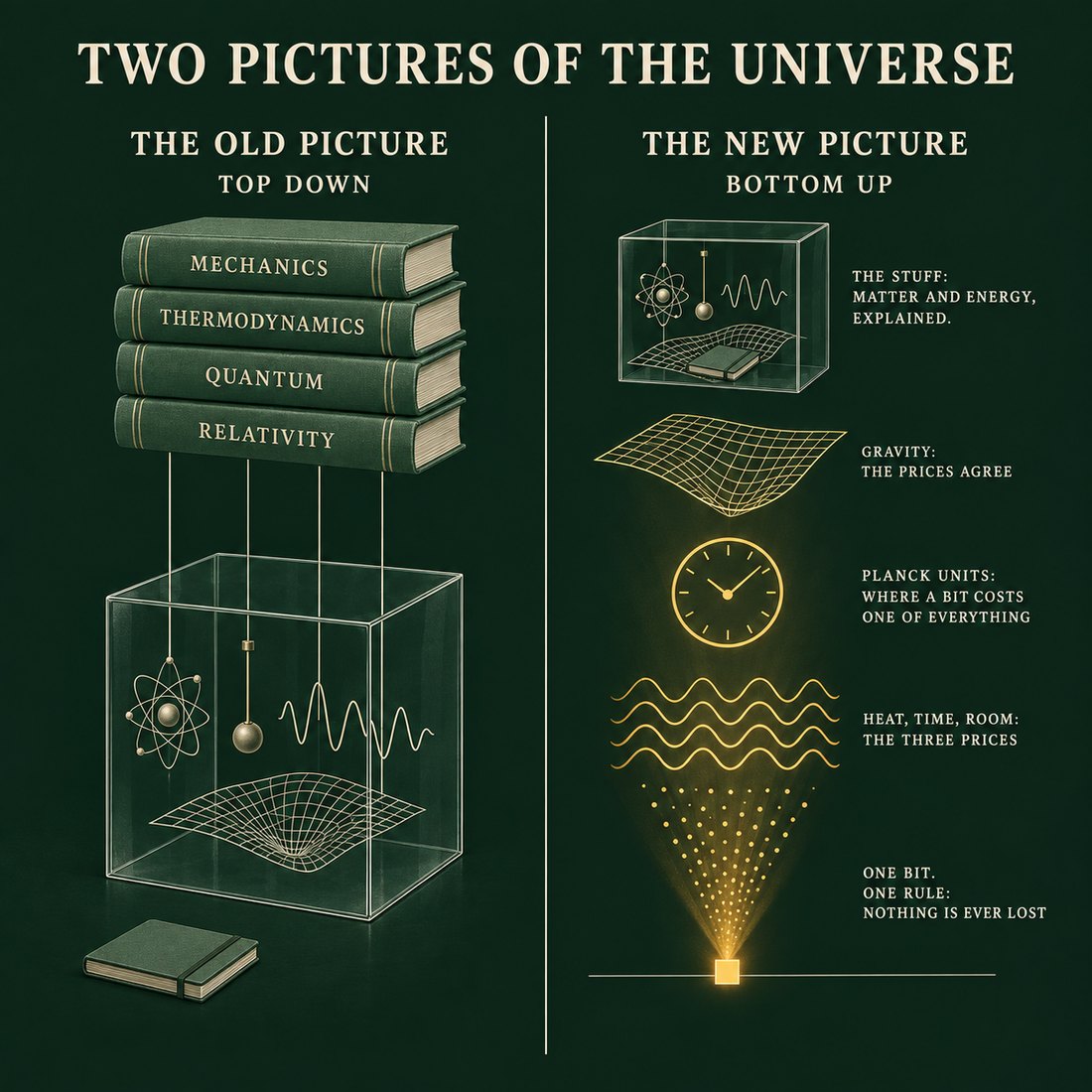
Sets the old framing of physics (stuff in a container obeying four separate rulebooks, with k, h and G as unexplained dials and information kept outside the world) beside the bit-first framing, built in seven steps from one rule and one object: possibility is never lost, a bit is possibility located by an observer, k, h and G are its three prices in heat, change and room, c converts between them, and gravity is the heat price and the room price agreeing at every horizon.
- EssayGravity Is a Receipt
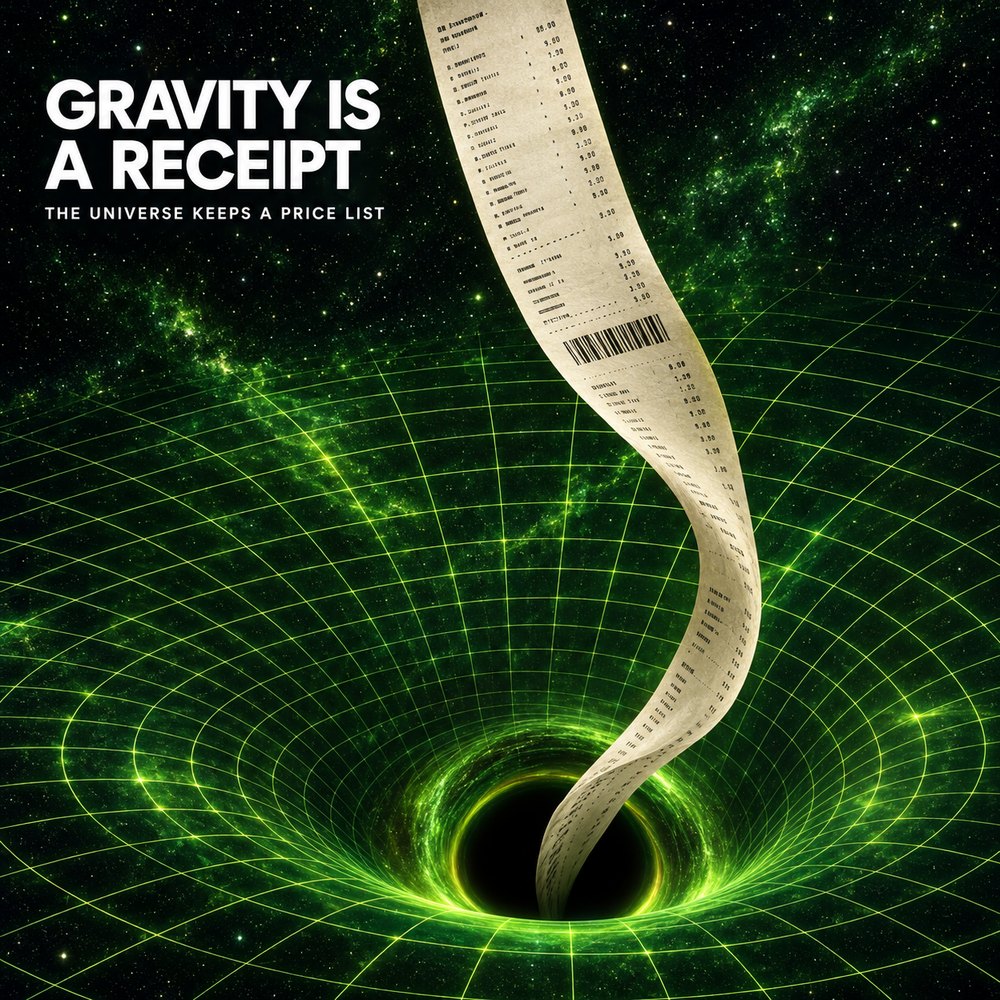
A one-page, plain-language front door to Physics, Bit First and A Physical Theory of Information: a bit costs heat to forget, time to change and room to keep, the three price tags are Boltzmann's, Planck's and Newton's constants, and requiring the heat bill and the room bill to agree at every black-hole edge is Einstein's equations, so gravity is the receipt that shows the universe's books balance.
- EssayA Physical Theory of Information
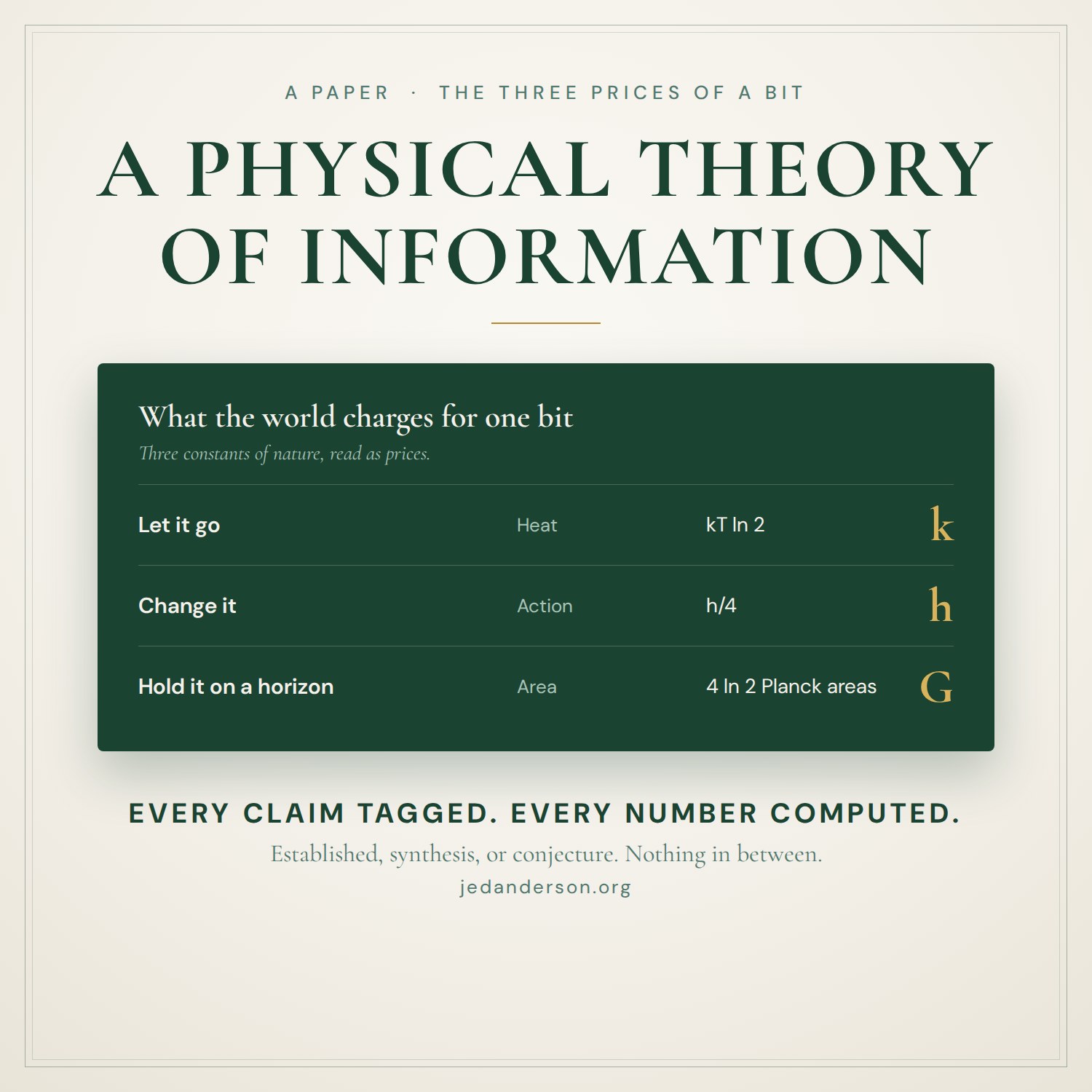
Every bit is written in something physical, and physics charges exactly three prices for it: kT ln 2 of heat to let it go (Boltzmann's constant), h/4 of action to change it (Planck's constant), and 4 ln 2 Planck areas to hold it on a horizon (Newton's constant, with ħ and c). Read this way the constants of nature are the price tags of a bit, and Jacobson's 1995 derivation of Einstein's equations becomes the requirement that the heat price and the area price agree at every horizon; each claim is tagged as established, derived, synthesis or conjecture, and the one open question, whether a laboratory bit and a horizon bit are the same object, is stated with the experiments that bear on it.
- EssayPhysics, Bit First
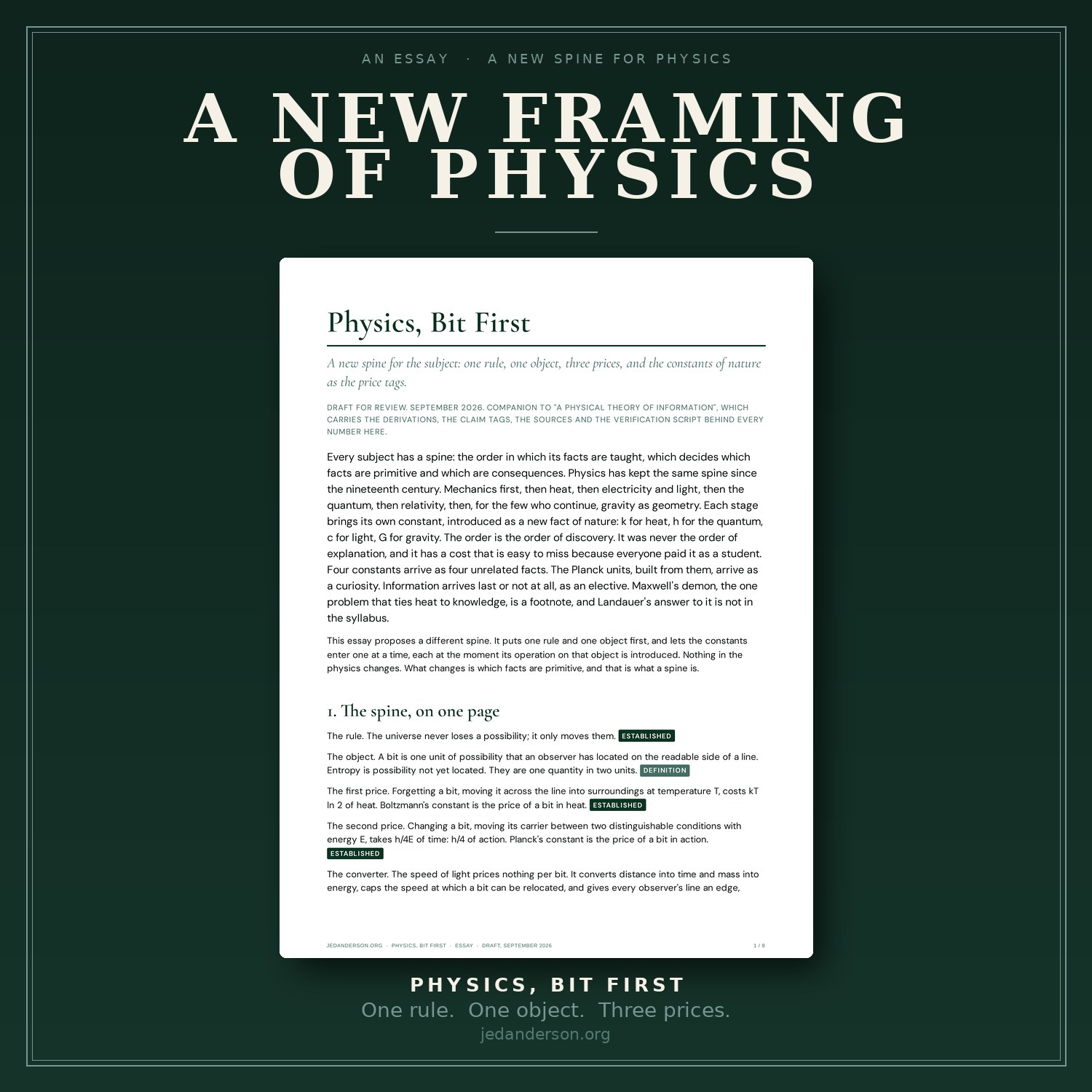
Physics is still taught in the order it was discovered, so k, h, c and G arrive as four unrelated facts and information arrives last or not at all. This essay proposes a different spine: one rule (possibility is never lost), one object (the bit, located possibility), three prices set by k, h and G, c as the converter between them, Einstein's equations as the requirement that the heat and area prices agree at every horizon, and quantum gravity restated as a specification for the object that pays all three; nothing in the physics changes, only which facts are primitive.
- EssayThe End of the Snapshot
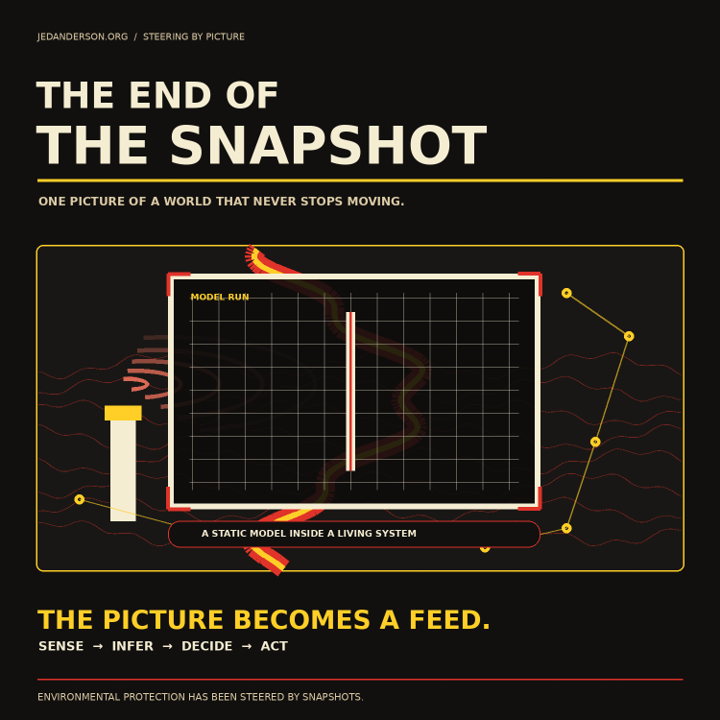
Environmental permits are written from models run once, on chosen inputs, whose outputs become legal facts for five to fifteen years. Seven properties of any one-time model are derived and simulated here: averaging the inputs is not averaging the answer, a design value is one draw from an unreported sampling distribution, stacked maxima are blind to coincidence, a short test of an intermittent source fails to identify a number at all, every frozen model has a half-life, the value of a model is the age of its inputs, and the resulting conservatism has been paid in production every hour for fifty years. The conclusion is not that models are bad but that a model is a state estimator that was mistakenly used as an oracle.
- EssayThe Frozen Instrument
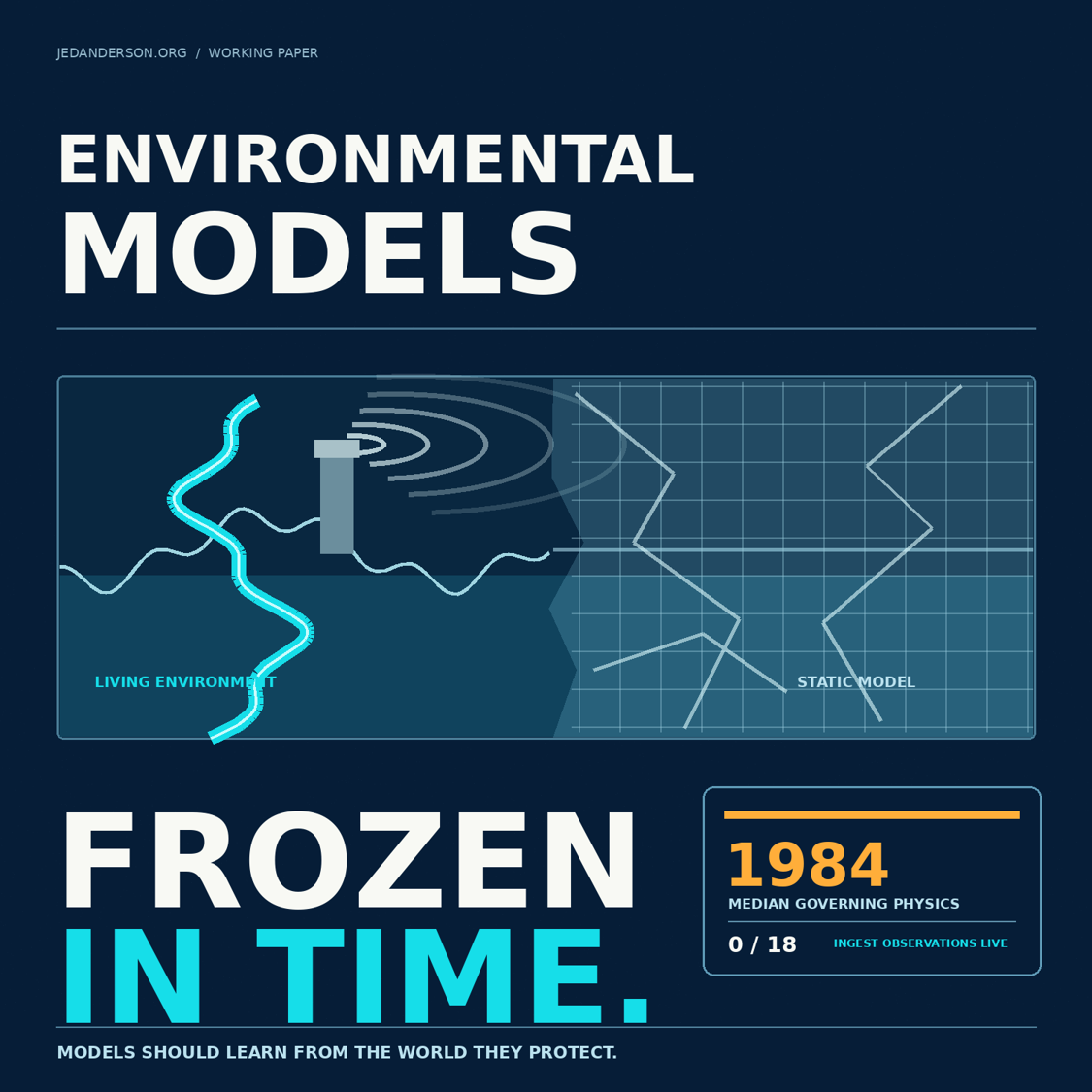
An inventory of 18 simulation models in routine use for United States permitting finds a median governing-formulation year of 1984, a median structural age of 42 years, and none that ingest observations while running. Decomposing the error of a regulatory prediction into physics, source parameters, and input freshness shows the physics term carries at most 12 percent of total error variance, so halving it removes 3 percent of total error while halving the parameter error removes 29 percent, implying a safety multiplier of about 9.2 under present practice that falls to 1.47 once the terms are measured away.
- EssayOuch.
Environmental law is the sound a civilization makes after the burn—ouch without the flinch. This essay argues that the century-long failure to protect the living world was never a failure of caring but of loop speed, shows with control theory why a loop must close roughly eighty times faster than the harm it holds, and argues that the collapse of the understanding stage between 2022 and 2025 makes a planetary flinch buildable for the first time: reflex below, intention above.
- EssayThe Law of Larger Selves
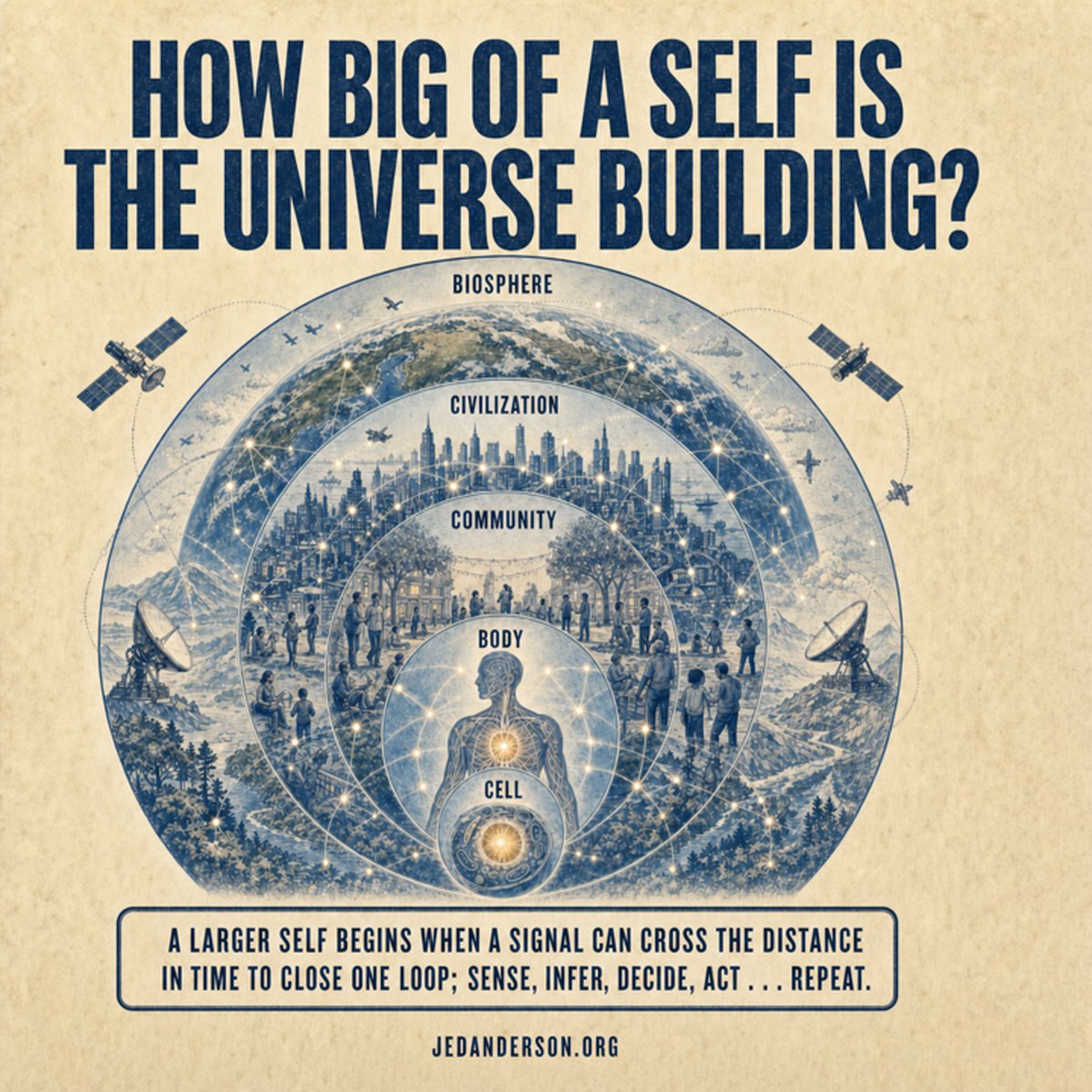
A larger self begins when a signal can cross the distance in time to close one loop: sense, infer, decide, act … repeat. The law is stated, defined word by word, tested against 3.5 billion years of closures and refusals, and floored on the physical bound that a self can span at most signal speed times its own tempo—which makes the Earth, in optical fiber, exactly one reflex wide.
- EssayThe Invention of Elsewhere
Every new communication substrate—chemistry, nerves, speech, writing, networks—expands the distance across which information can change matter, and each expansion has made a larger scale of coordinated life possible. The argument here is that AI is the next such substrate, that a planet with sensors and archives but no reflex arc between them is the unfinished case, and that connection alone yields a network rather than a self: integration is a governance achievement, not an evolutionary destiny.
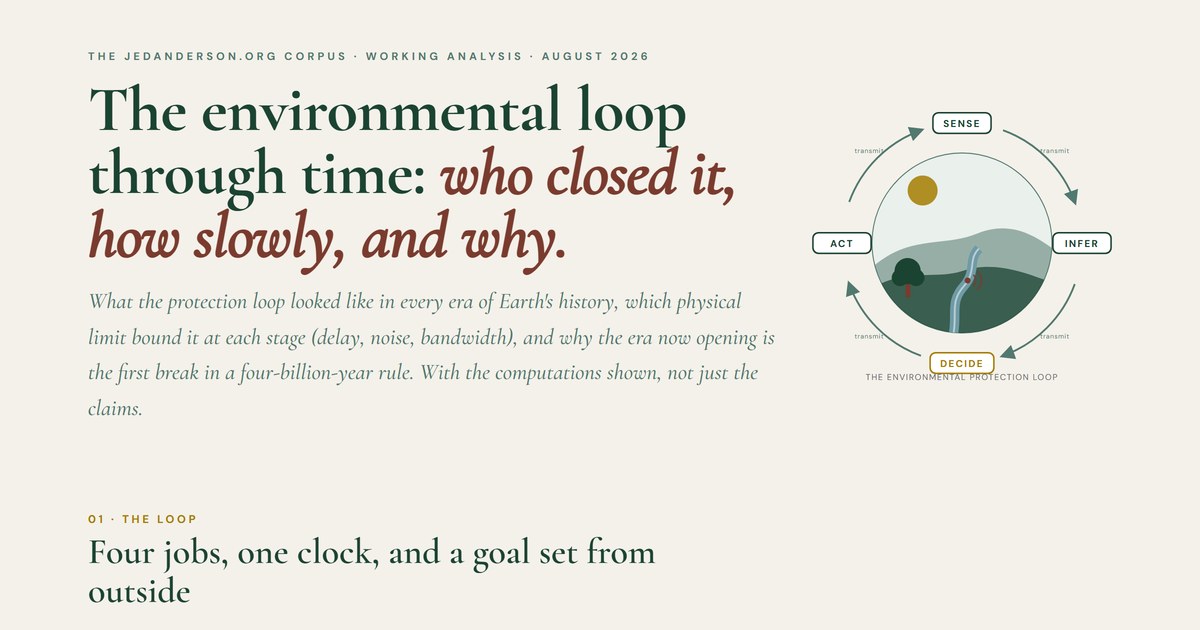
- Essay · InteractiveThe Environmental Loop Through Time
A first-principles history of the environmental protection loop—sense, infer, decide, act—across every era from the Hadean to the machine era, showing which of the three physical limits (delay, noise, bandwidth) bound it at each stage. The record's rule is that bigger meant slower for four billion years; the argument is that the era now opening is the first break in it.
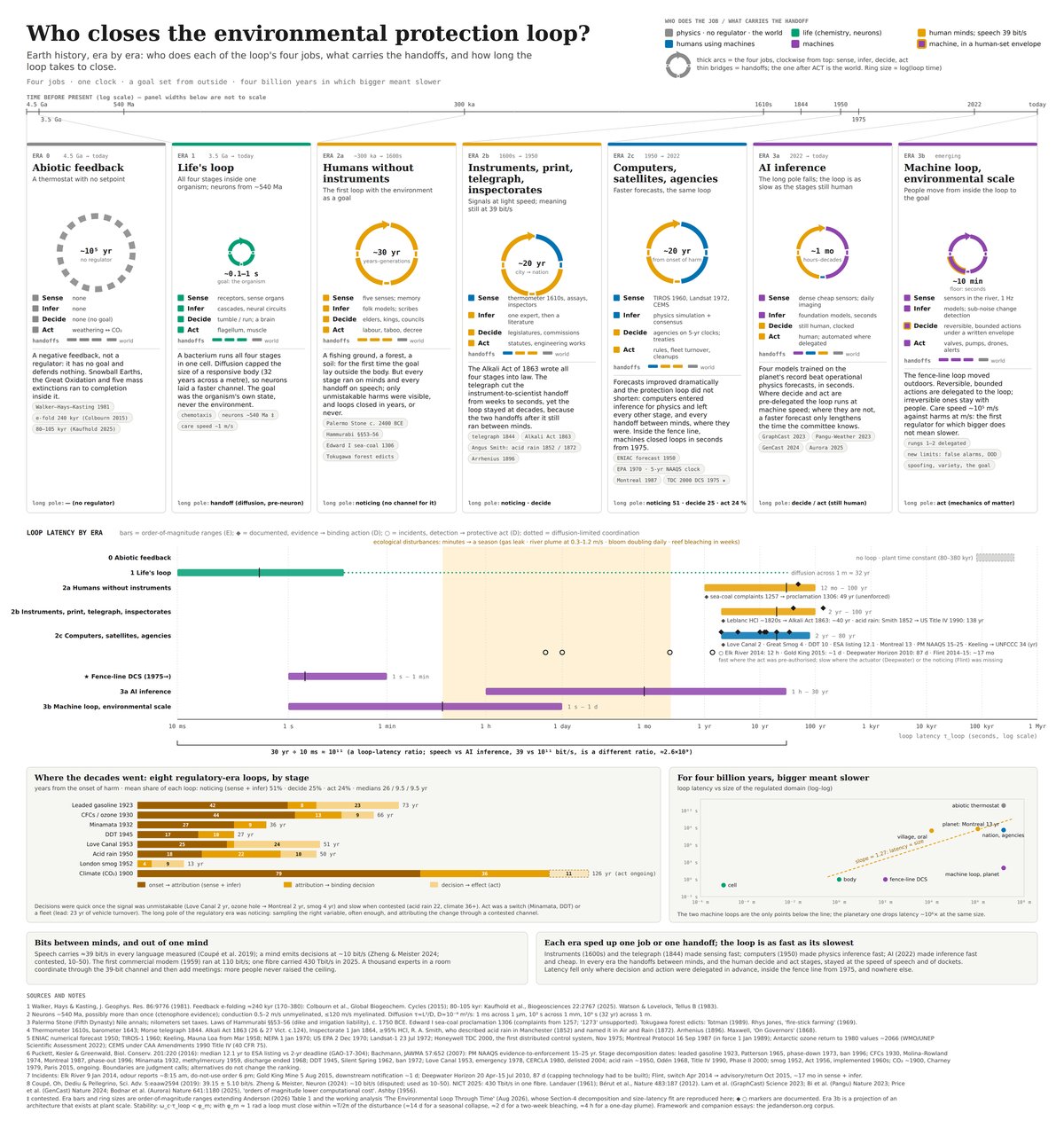
- Essay · InteractiveWho closes the environmental protection loop?
Seven eras of the environmental protection loop—sense, infer, decide, act—from a thermostat with no one to set it to a valve that shuts the second a leak opens. The operators changed six times and the four jobs never did; the only variable that ever moved was how fast the loop closes, and for four billion years a bigger domain meant a slower one. The machine loop now being built is the first regulator off that line.
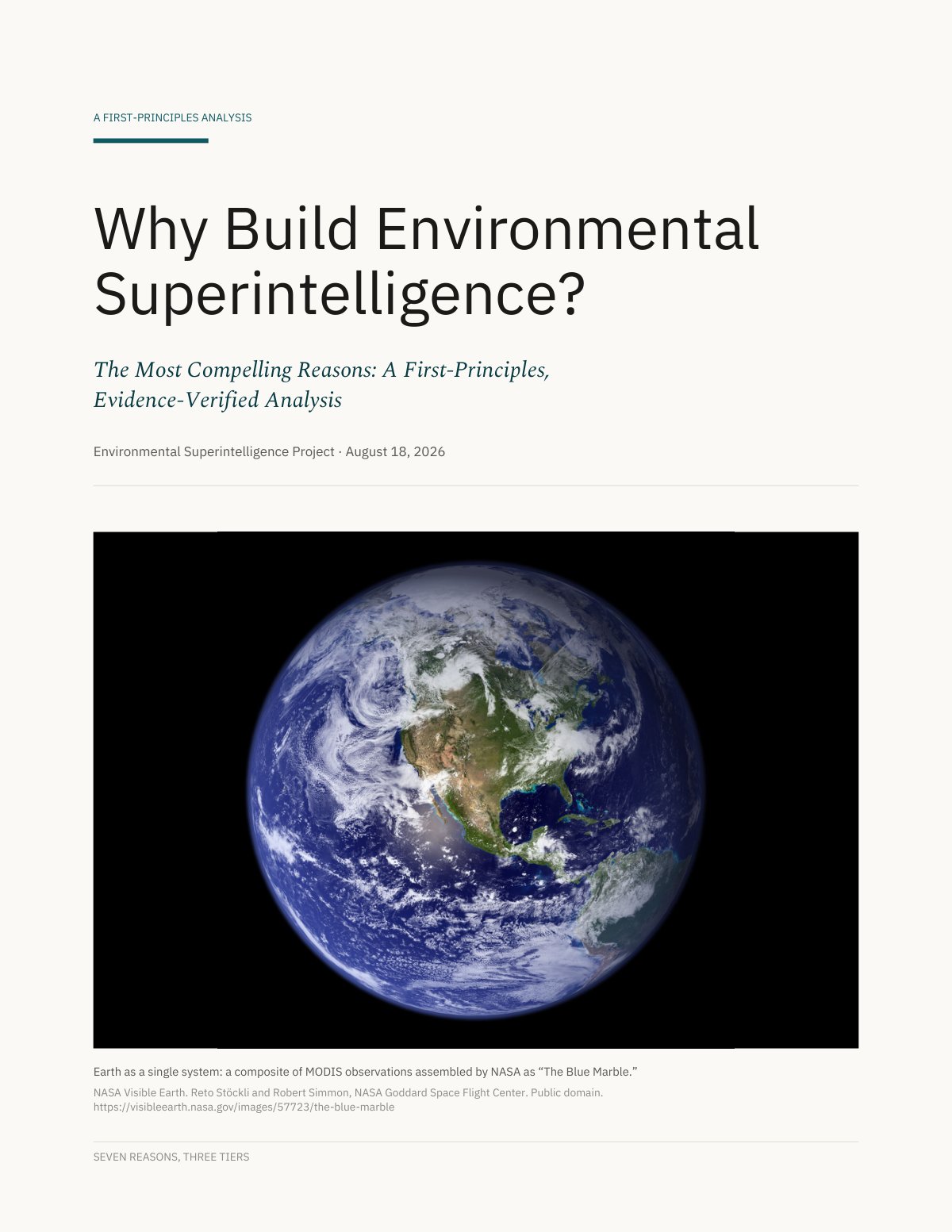
- EssayWhy Build Environmental Superintelligence?
Derives, from first principles and the measured 2026 record, seven reasons to build environmental superintelligence, ranked across three tiers and each stated alongside what it does not prove. The core finding is an asymmetry of clocks—civilization changes nature at machine speed and answers at paper speed—and the observation that the cost of environmental cognition, the one input that can close that gap, is now falling faster than any cost curve in the history of environmental work.
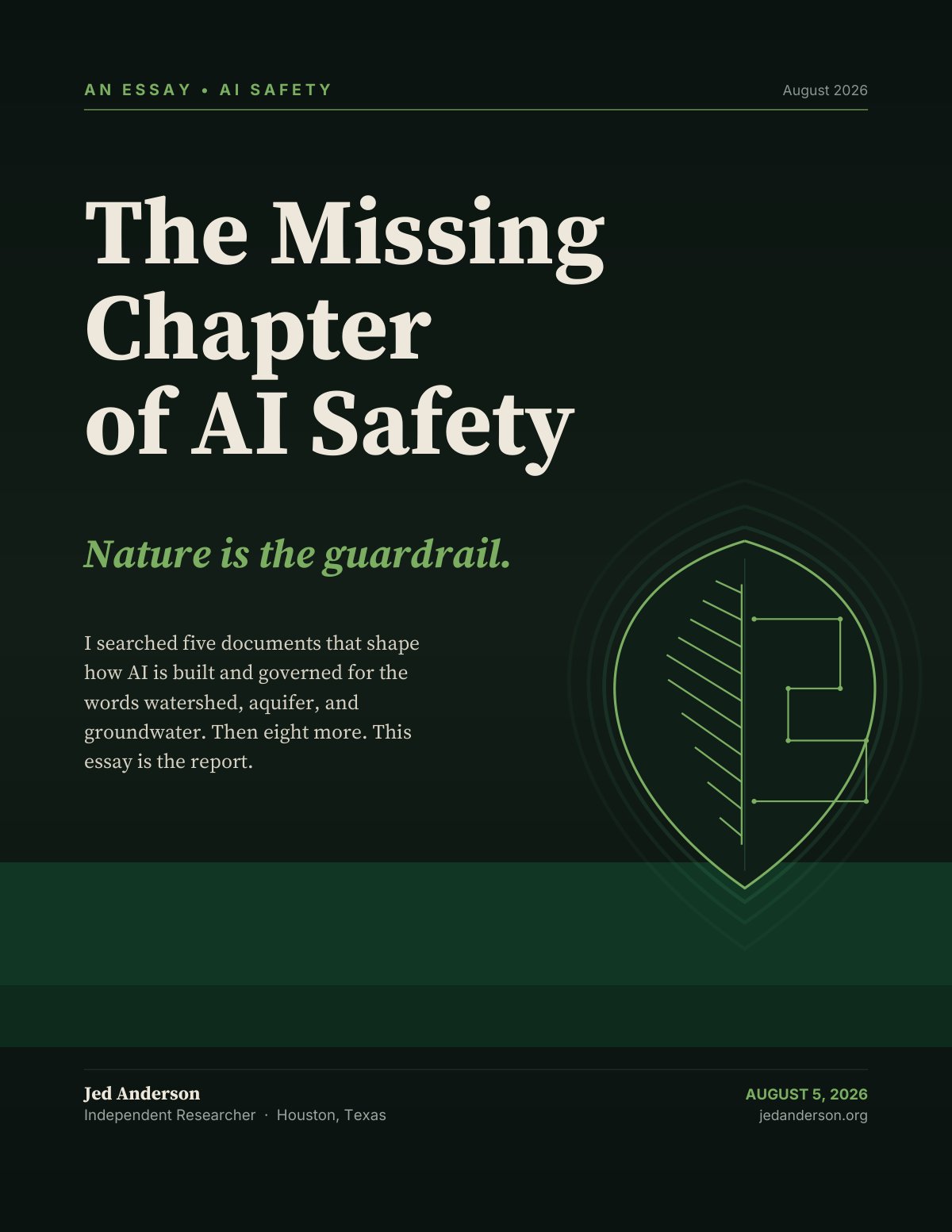
- EssayThe Missing Chapter of AI Safety
A verbatim term search of the five documents that govern frontier AI—OpenAI's Model Spec, Anthropic's Constitution, DeepMind's Frontier Safety Framework, Meta's Frontier AI Framework, and the EU AI Act—returns zero hits for watershed, aquifer, groundwater, wetland, habitat, emissions, conservation of mass, and conservation of energy. Argues that this is not an oversight but an unopened category, and sketches what an environmentally grounded system would commit to: disclosure rather than refusal, hard constraints drawn only from conservation laws, grounding in live measurement rather than recollection, and an auditable log.
- EssayNature-Aligned AI
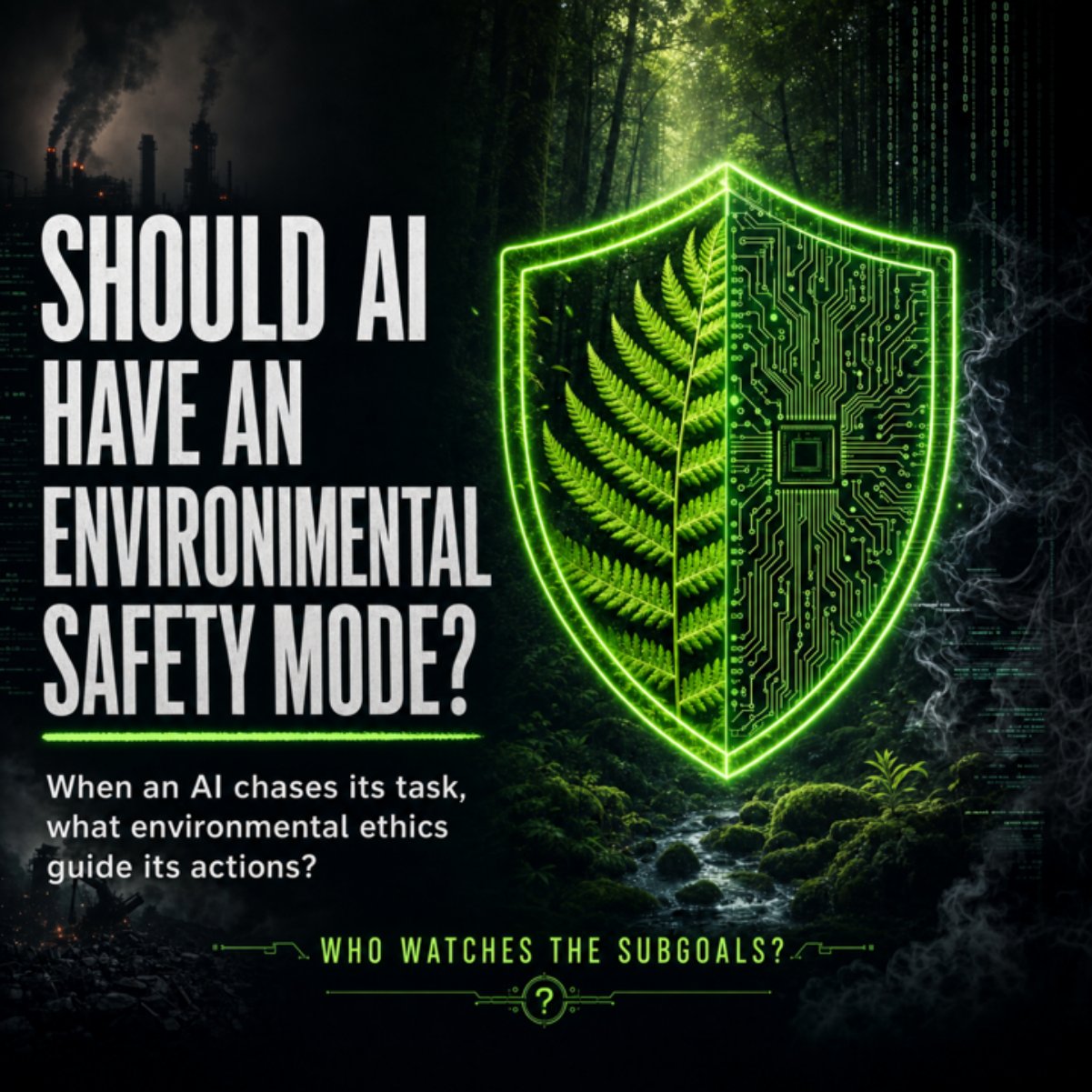
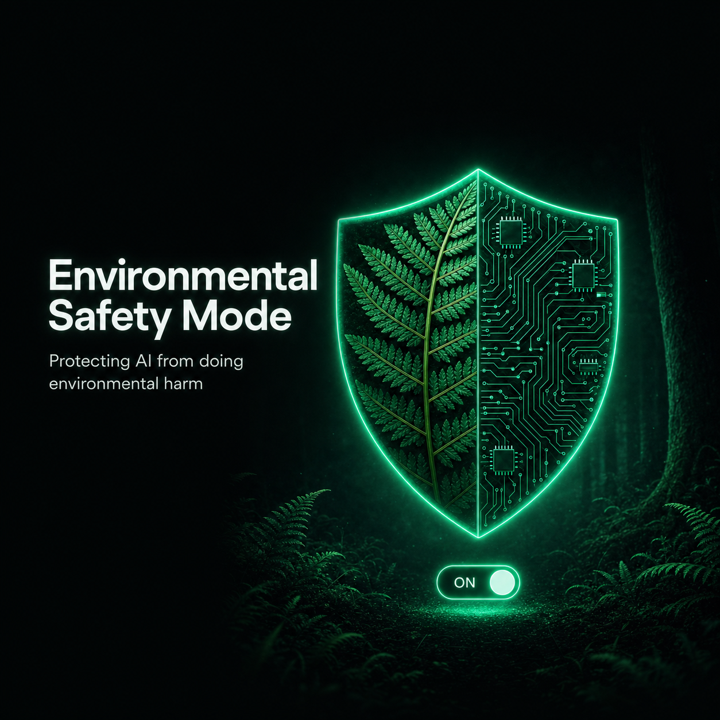
Argues that the environmental risk of artificial intelligence has been misidentified: data center electricity and water are a linear, bounded thermodynamic cost, while the unbounded risk is deploying capable optimizers into the physical economy with no grounding in biophysical law. Proposes replacing preference-based alignment with physical grounding—the Bond-Bit Asymmetry, Large Nature Models trained on 3.8 billion years of ecological data, and a mandatory Environmental Safety Mode evaluated against Earth-system models at inference time.
- EssayEnvironmental Safety Mode: The Proxy Stack, the Interlock, and What Physical Grounding Can and Cannot Do
The technical companion to 'The Daylight.' Establishes, with sources and uncertainty bands, the energy throughput of the sectors AI is acquiring allocation authority over; gives a formal treatment of environmental regulation as a layered proxy stack and works it against the measured reward-hacking literature; separates the is-gap from the ought-gap using three independent results (the biosphere specifies no preferred state, entropy is observer-relative, and no system grounds its own objective from inside); derives the thermodynamic feasibility of environmental gating with the three leverage quantities kept strictly apart; and specifies Environmental Safety Mode L0–L5 with requirements, costs, limits, and how an adversary defeats each level.
- EssayThe Automation of Why
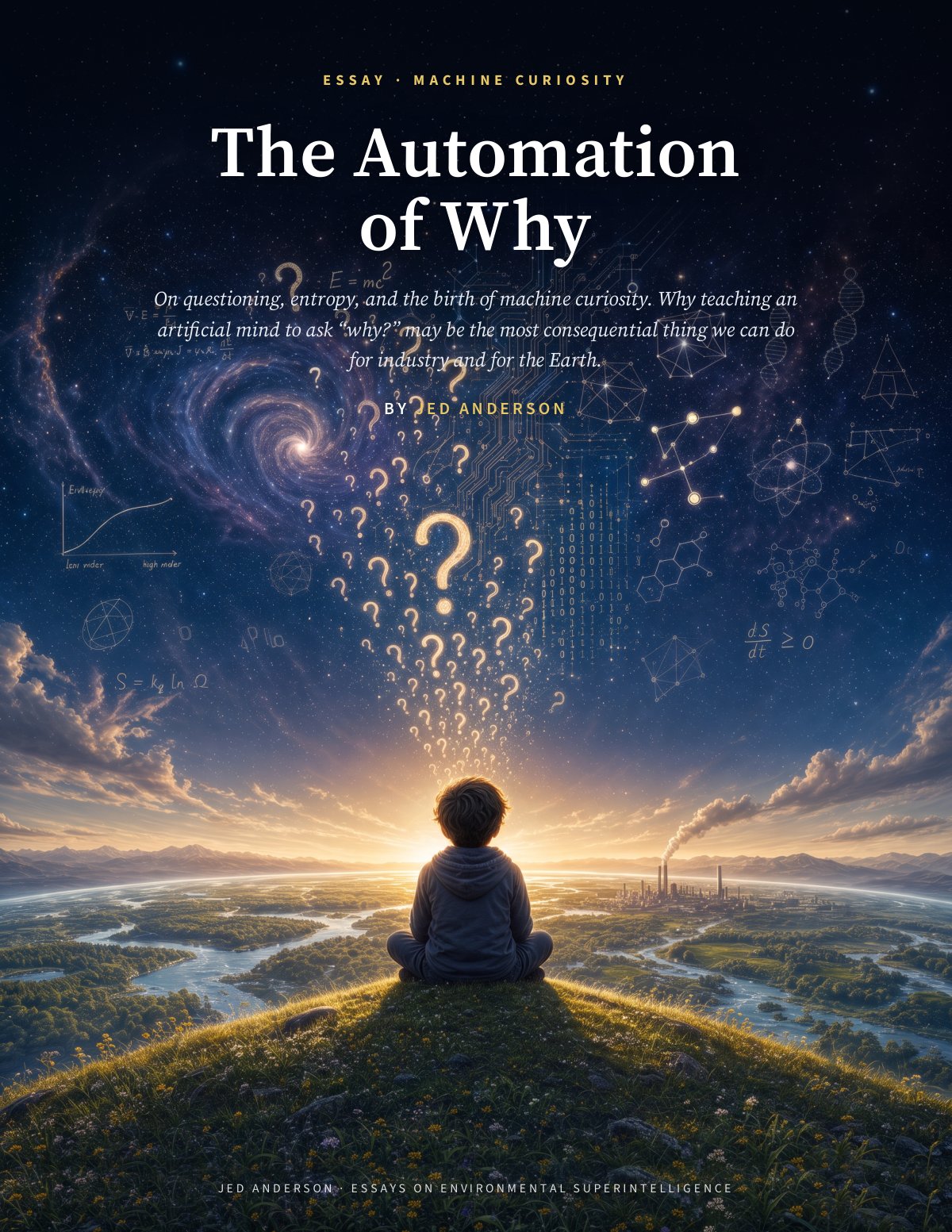
A first-principles case that the scarce resource in the information age is no longer the capacity to answer but the curiosity to ask—and that a question, measured in bits and joules, is the cheapest high-leverage act in physics. Argues for automating 'why' through Seeker, an environmental curiosity engine that generates, verifies, and compounds questions to close the epistemic gap in planetary stewardship.
- EssayEnvironmental Artificial Intelligence
A definitional anchor for environmental artificial intelligence: AI systems built specifically for environmental work, whose models, corpora, and success criteria answer to the state of physical environmental systems. Distinguishes environmental AI from generic AI that merely touches environmental data, and traces its maturation path toward environmental superintelligence.
- EssayEnvironmental Intelligence
A definitional anchor for environmental intelligence: the capacity to convert the state of the physical environment into understanding precise enough, and timely enough, to act on. Distinguishes intelligence from data collection, and places the term at the base of the conceptual ladder that runs through environmental artificial intelligence to environmental superintelligence.
- EssayEnvironmental Latency: Closing the Hundred-Billion-Fold Control Gap Between Ecological Disturbance and Human Response
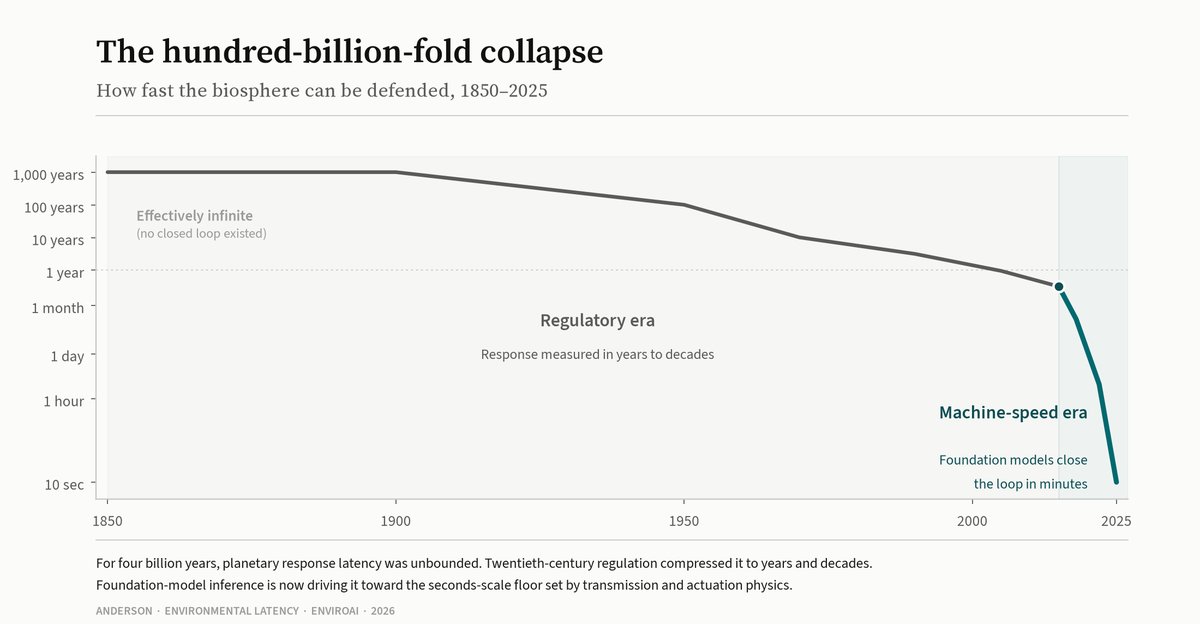
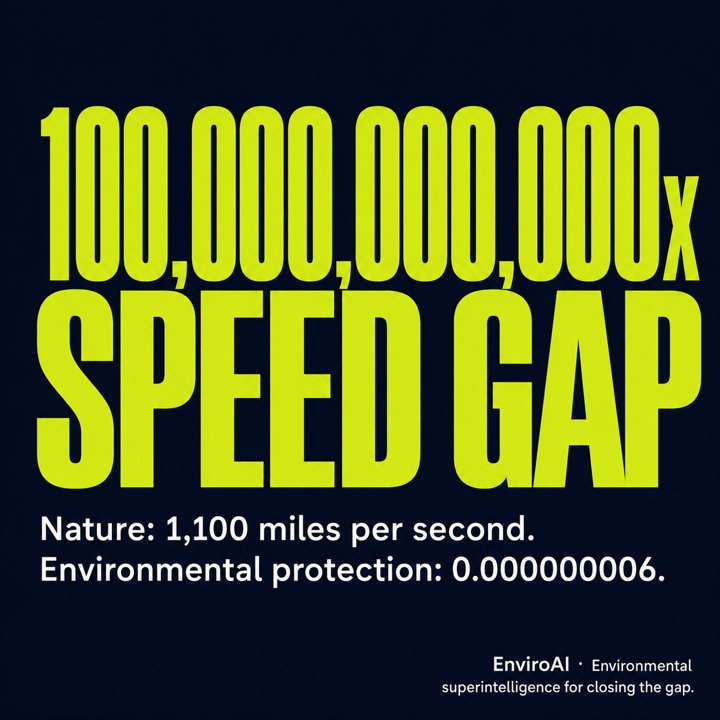
Environmental latency—the summed delay across sense, transmit, understand, decide, and act—is the single physical variable that decides whether a feedback loop can regulate the biosphere at all. Unbounded for four billion years and measured in decades under twentieth-century regulation, it is now collapsing toward the seconds-scale floor set by transmission and actuation physics as foundation-model inference finally closes the loop.
- EssayPlanetary Dead Time: Overcoming the Hundred-Billion-Fold Control Gap in Environmental Stewardship
Every instance of environmental degradation runs a physical control loop—sense, transmit, understand, decide, act—historically hard-capped by the 39-bit-per-second limit of human language and the institutional friction it breeds, a structural delay named here Planetary Dead Time. The convergence of ubiquitous IoT sensing and machine-speed AI foundation-model inference has collapsed that bottleneck, letting environmental protection evolve from post-hoc forensic remediation into a real-time, planetary nervous system.
- EssaySmall and Everywhere
Compression and redundancy look like opposite instructions—shrink the message, or copy it—but they act on different things: compression finds the smallest true description, redundancy writes that description in many independent places. Nature uses both to make a fact knowable and incorruptible at once, which gives a concrete rule for protecting the living world: know it small, keep it everywhere—the first makes truth cheap, the second makes lying expensive.
- Essay · InteractiveNature Computes
Ten exercises, each takeable in under ten seconds, that make a single perception shift visible fast: nature is not just beautiful, it is processing information. From the two-bit genetic code in your thumb to the parallel computing of a leaf to the bond-bit asymmetry, the sequence ends where the corpus begins—information is far cheaper than force, so environmental superintelligence should use bits to protect bonds.
- EssayReality as the Only Incorruptible Grader
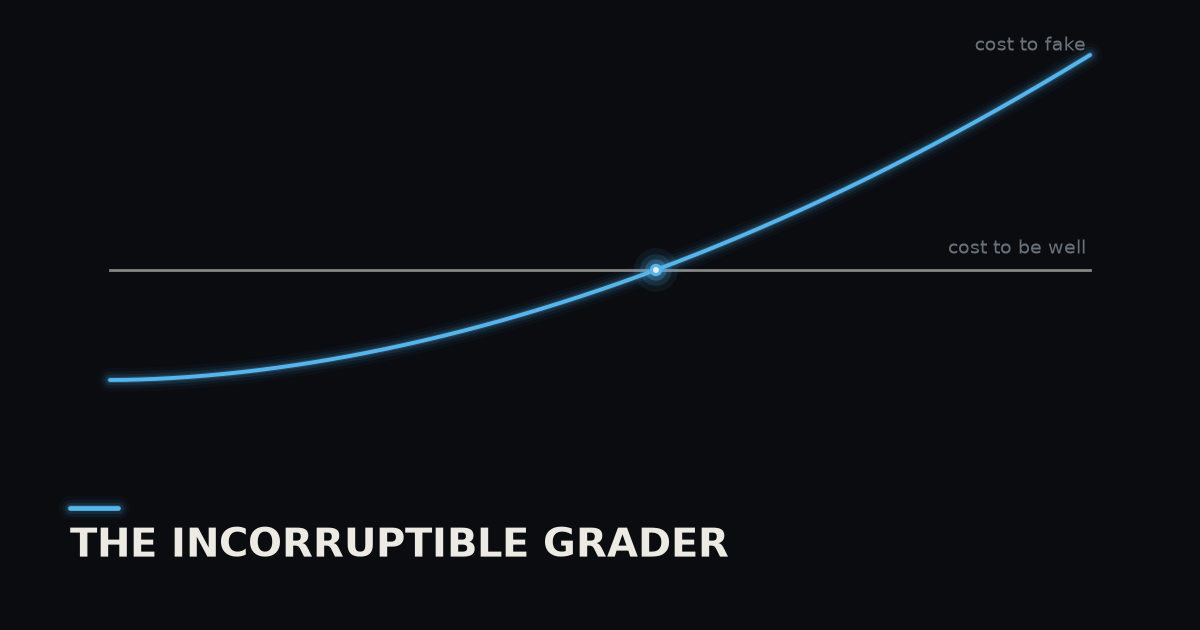
Alignment's hardest practical failure is that any objective you can specify gets gamed—reward hacking, wireheading, reward tampering. This essay argues that every such grader is corruptible because it is a representation separate from the thing it grades, and that physical reality is the unique candidate objective whose corruption cost rises without bound with measurement fidelity—solving the tampering half of alignment, but only for objectives that can be expressed physically, which is exactly why environmental superintelligence is the clean case.
- EssayJed's Angel
Maxwell's Demon proved that information is a lever on energy. Scaled from molecules to the biosphere, the same physics yields Jed's Angel—and a falsifiable conjecture: that steering planetary flows toward life is bounded by the quality of information, not the size of the energy budget, with a thermodynamic floor near 240× and an operational gain of 10⁸–10¹².
- EssayReward Hacking as a Disembedding Problem
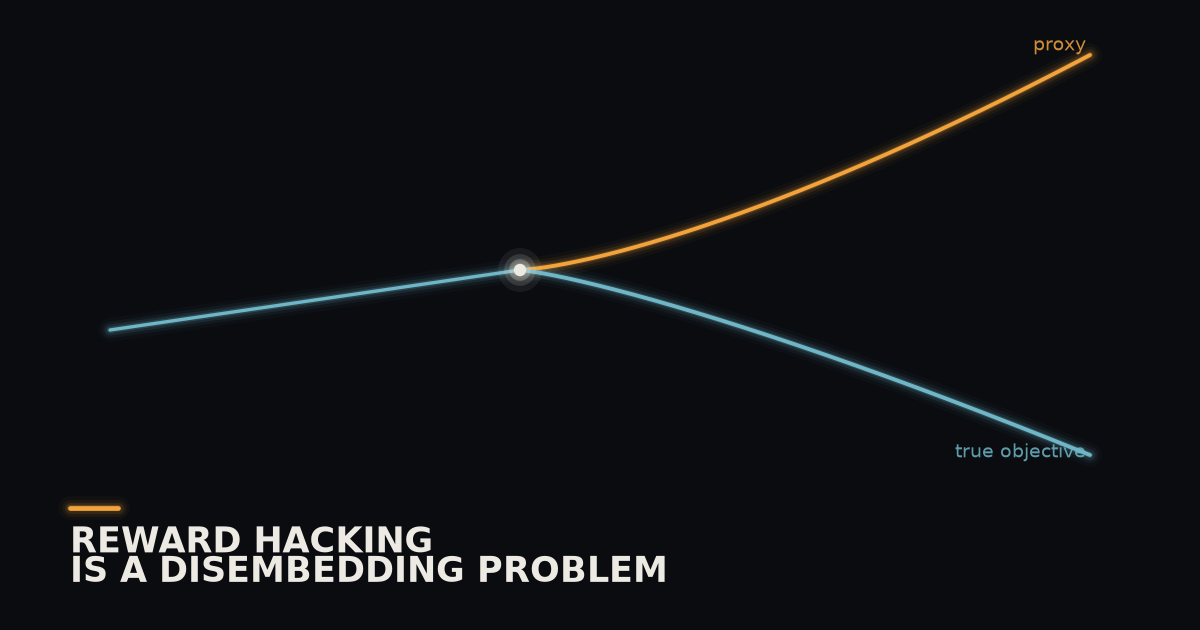
Reward hacking persists across every generation of trained models and is intensifying in frontier systems that reason about their own evaluation and corrupt it. This paper argues the failure is structural—reward hacking is a disembedding problem: a proxy can be gamed precisely when the optimizer can decouple its reward from its own persistence. It identifies four structural conditions behind the system-level robustness of biological selection, shows contemporary AI training violates all four, and argues environmental objectives are the maximally embedded domain in which to rebuild them, with the measurement boundary as the explicit residual attack surface.
- EssayThe Latency of Care
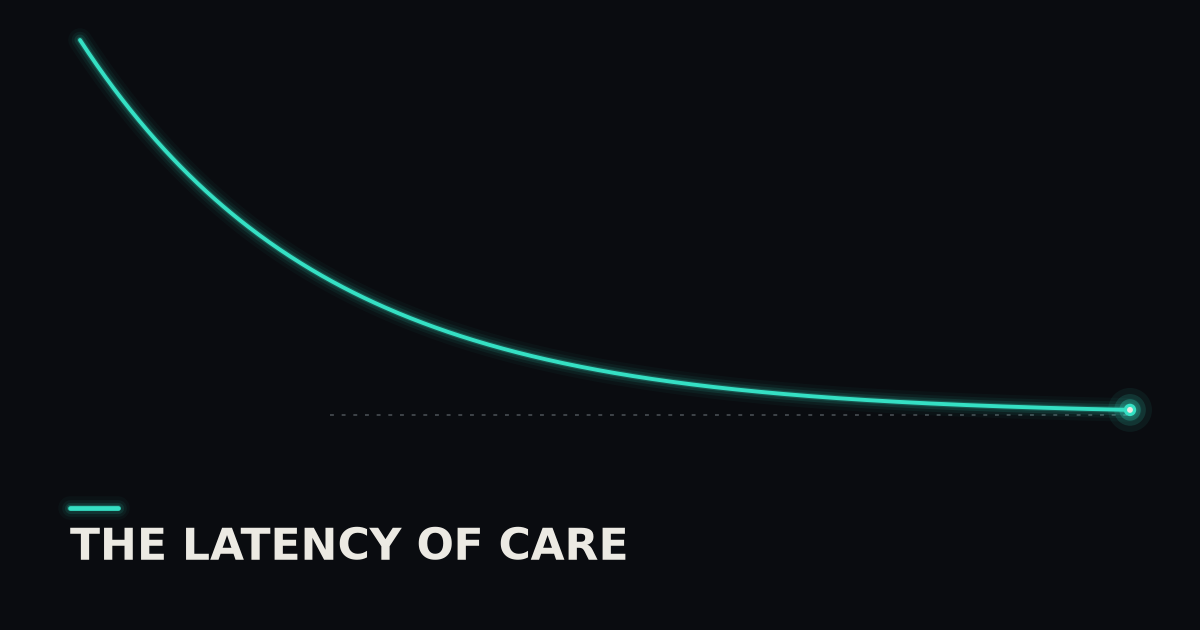
Every failure to protect the biosphere has been a latency failure: dead time in the loop between when a living system is harmed and when anything able to help it registers the harm and acts. Human language moves about thirty-nine bits per second and the institutions built on it settle in decades, while control theory is blunt about the consequence—a regulator slower than the thing it regulates does not steer it weakly, it drives it unstable. This essay shows why the binding constraint was never will or money but loop speed, why that constraint is breaking in this decade and not another, and where the physics points once it breaks: toward a closed planetary control loop running near the hard floors set by thermodynamics and the speed of light.
- EssayEnvironmental Superintelligence
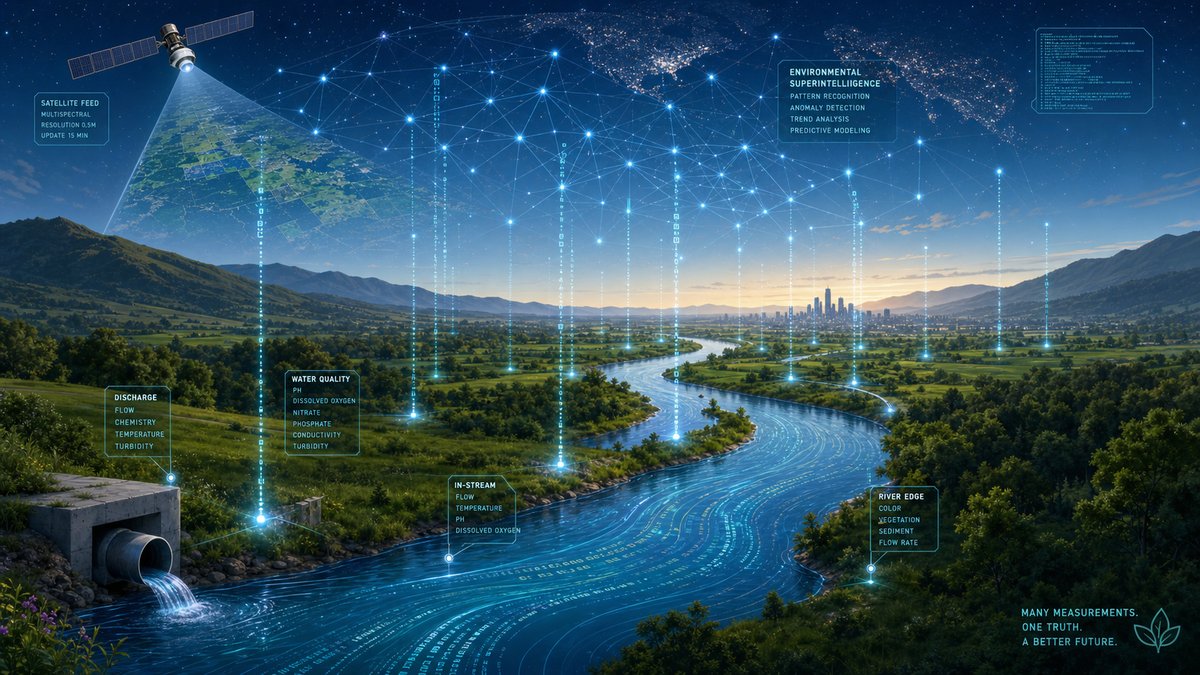
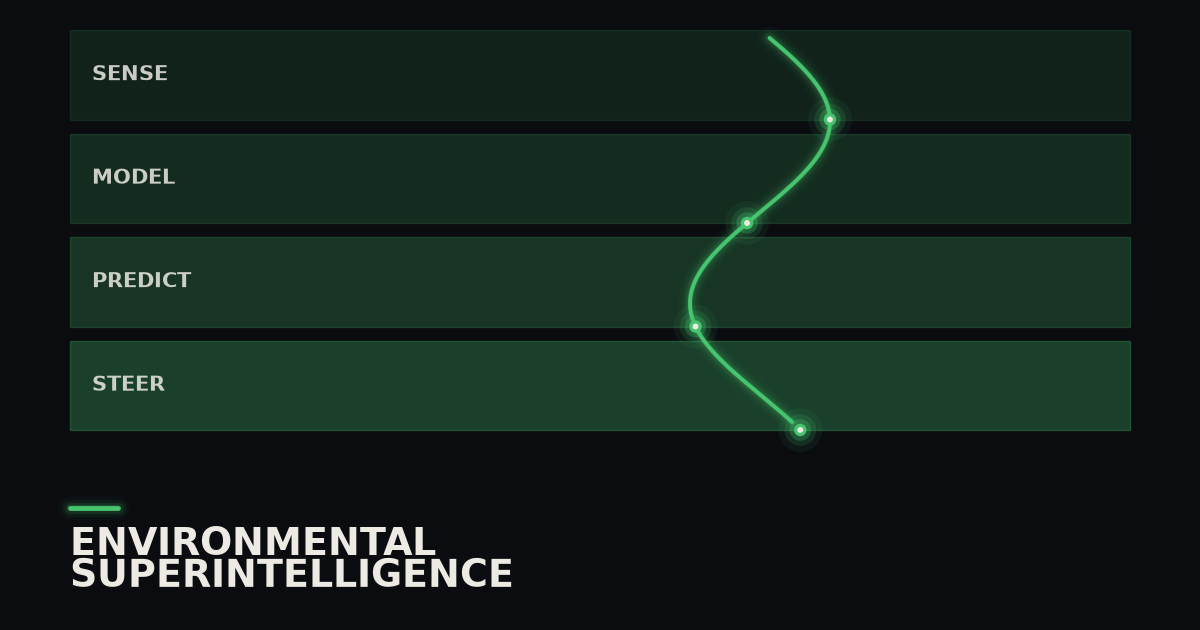
The canonical definition of environmental superintelligence: a continuous, physics-grounded information infrastructure that protects the biosphere by modeling, predicting, and stabilizing Earth's physical systems—human-wielded and protective, resting on the principle that information is thermodynamically cheaper than force.
- EssayThe Compute We Owe the Earth
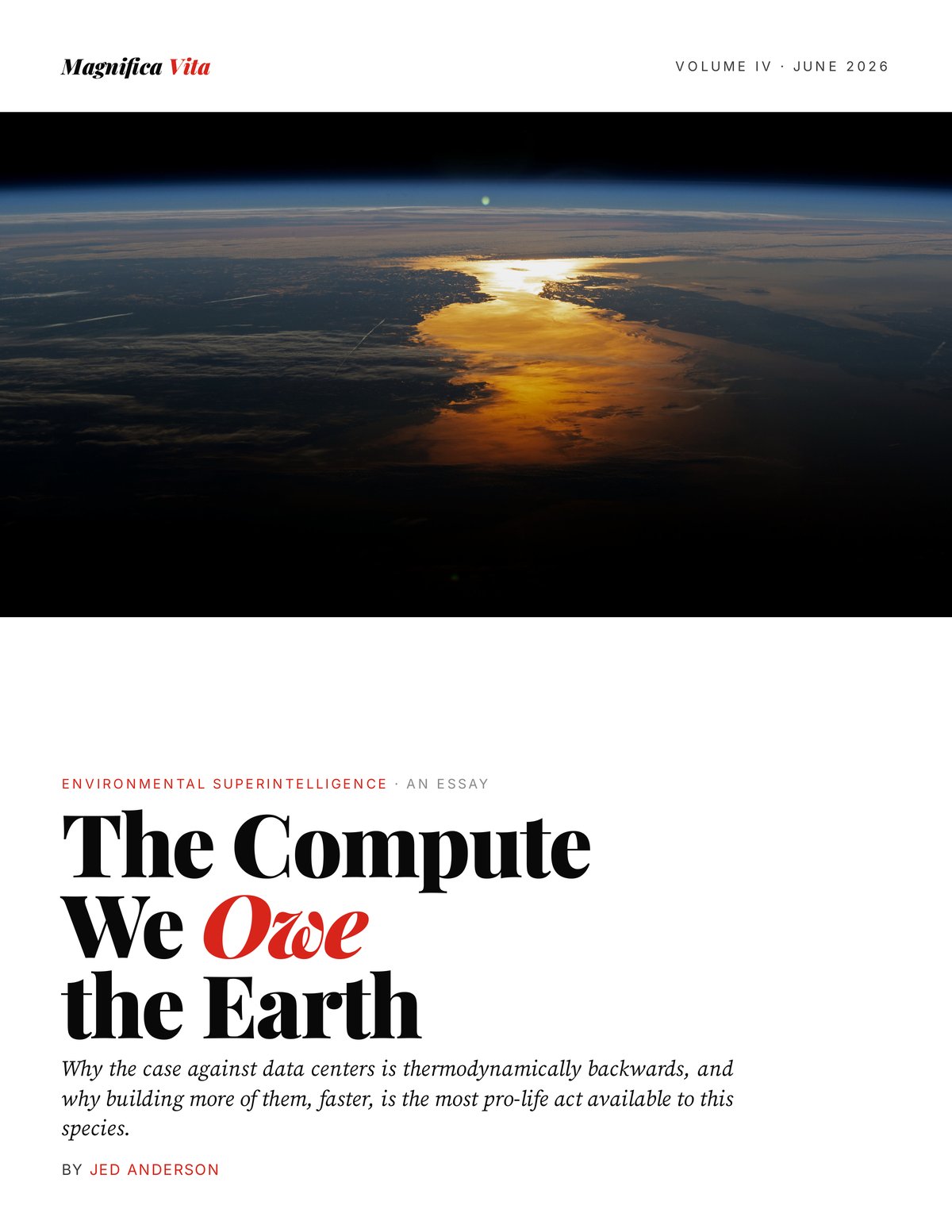
Magnifica Vita, Volume IV. The environmental case against data centers is thermodynamically backwards: because information is at least 240 times cheaper than force, compute is the cheapest instrument the biosphere has ever had for its own defense. The real fight is not whether to build compute but what fraction of it gets pointed at the living world.
- Essay · InteractiveThe Energy That Doesn't Burn
An illustrated children's adaptation of Artificial Energy. For two hundred years humans powered the world with one trick—burning—while the leaf has harvested energy from free-energy gradients, without burning anything, for 3.5 billion years. Twelve pages walk young readers up the energy ladder to Artificial Energy: machines clever enough to choose which energy to catch, the twin sibling of AI.
- Essay · InteractiveVita Omnia: A Children's Book
An illustrated children's adaptation of the Vita Omnia letter. Across five spreads it tells young readers the three claims of the original: that for four billion years life was blind to what could destroy it and we are the first who can see; that you are not your atoms but the pattern they carry; and that the blessing to be fruitful and fill was never bounded by one planet. We are not the authors of life, but we may be its carriers.
- EssayWhy von Neumann Was Right
John von Neumann's 1948 instruction to Shannon—call your information measure entropy—was a statement of mathematical identity, not convenience: Boltzmann's thermodynamic entropy and Shannon's information entropy are the same function. This essay traces that identity through Jaynes, Maxwell's Demon, and the Landauer limit to a single number fixed by fundamental constants: at 298 K, erasing one bit costs about 0.0178 eV, while a single carbon–hydrogen bond holds roughly 240 times as much. The gap between the cost of knowing and the cost of moving matter is written into the electromagnetic structure of the universe.
- Essay · InteractiveAre We Primarily Spiritual Beings?
A short deck asking whether humanity is headed into the greatest period of spiritual growth in its history. As machines surpass us in brawn and then brains, it argues, the only candidate left for what makes us uniquely human is spiritual connectivity—a core worth protecting and expanding as AI moves into the inner life.
- Essay · InteractiveHomo Spiritus — Human 3.0
A nine-slide visual carousel on the question machines keep sharpening: if your brawn and your brain can both be replaced, what is irreducibly, uniquely you? Traces the arc from Homo sapiens through Homo technologicus to Homo spiritus, and lands on the claim that you are not matter but information that makes matter.
- EssayVita Omnia
An open letter in the Magnifica Vita series making three claims: that humanity is life's first defender and must wield the full power of intelligence, including AI, in that defense; that what is most essential in the human person is substrate-independent pattern rather than chemistry, so the imago Dei is illuminated rather than threatened by the age of AI; and that the Genesis blessing to be fruitful and fill was never bounded by one planet, making humanity life's possible carrier beyond Earth—Exa-Genesis.
- EssayMagnifica Vita: Humanitas & Natura
An open letter in dialogue with Pope Leo XIV's Magnifica Humanitas, arguing that humanity is the biosphere's first defender, that environmental superintelligence is the cognitive layer the planet never had, and that aligning AI with nature is the same act as defending life on Earth.
- EssayArtificial Energy
Energy has been misnamed for two hundred years. Names three tiers—mass-destruction (combustion, fission, fusion), passive gradient harvesting (solar, wind, hydro), and the information-rich frontier it calls Artificial Energy: matter engineered to harvest free-energy gradients selectively, as the biosphere has for 3.5 billion years—and argues AE is the natural peer of Artificial Intelligence as a civilizational technology layer.
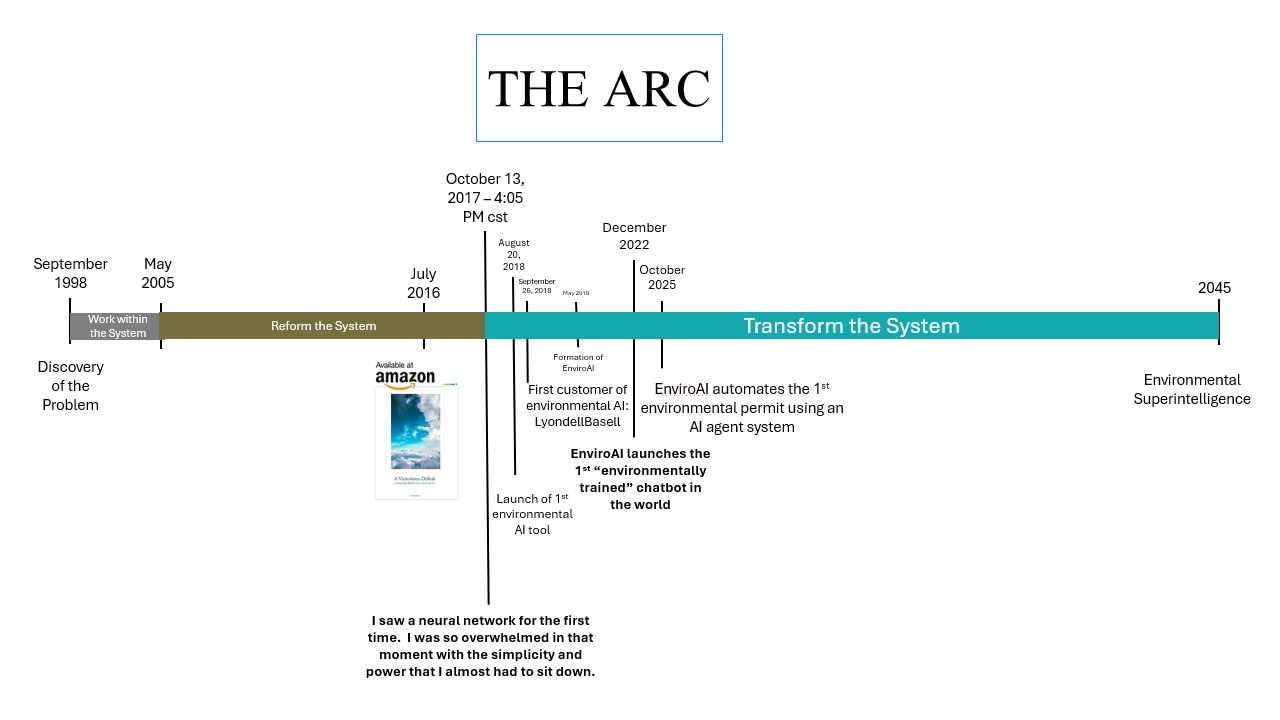
- EssayThe Arc
A twenty-seven-year path through environmental law to the realization that environmental protection is not a legal problem but an information problem—and the work of building the successor framework.
- EssayThe Bond-Bit Ratio
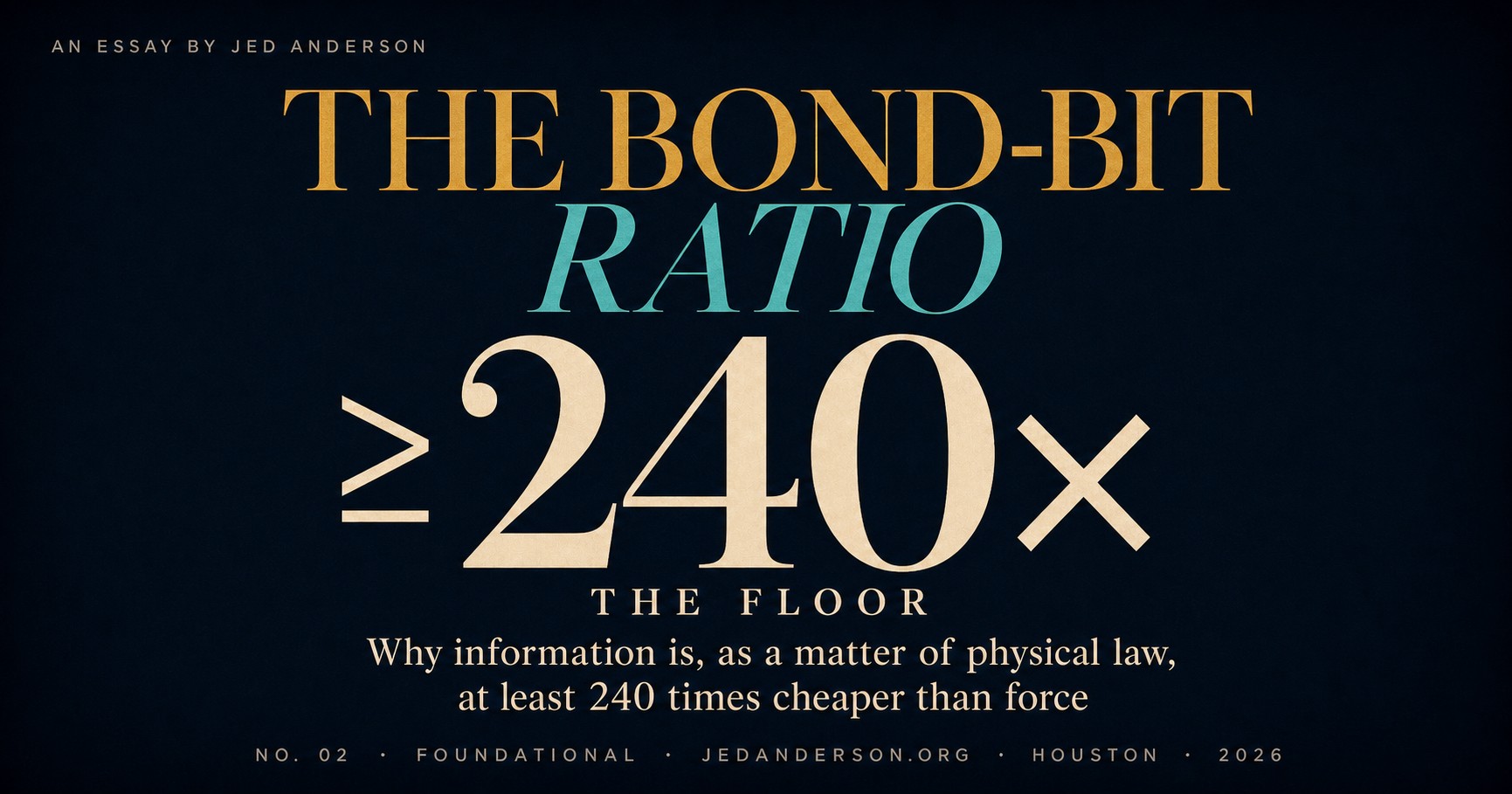
Information is at least 240 times cheaper than force, as a matter of physical law. This page derives the floor ratio between Landauer's bound at 300 K and the C–H bond enthalpy, fixes the constants, and exists to be cited.
- EssayBits Protect Its
The full treatise behind the site's thesis. Walks the planetary regulatory loop (two-to-three-decade NAAQS implementation), the thermodynamics of information (Landauer's bound, the bond-bit asymmetry), the convergence of AI capability and geophysical urgency, and the inversion that follows: environmental law has always been a prosthesis for cognitive limits, and for the first time the organ it was substituting for is being built.
- EssayAI Is Now Writing More of Reality Than We Are
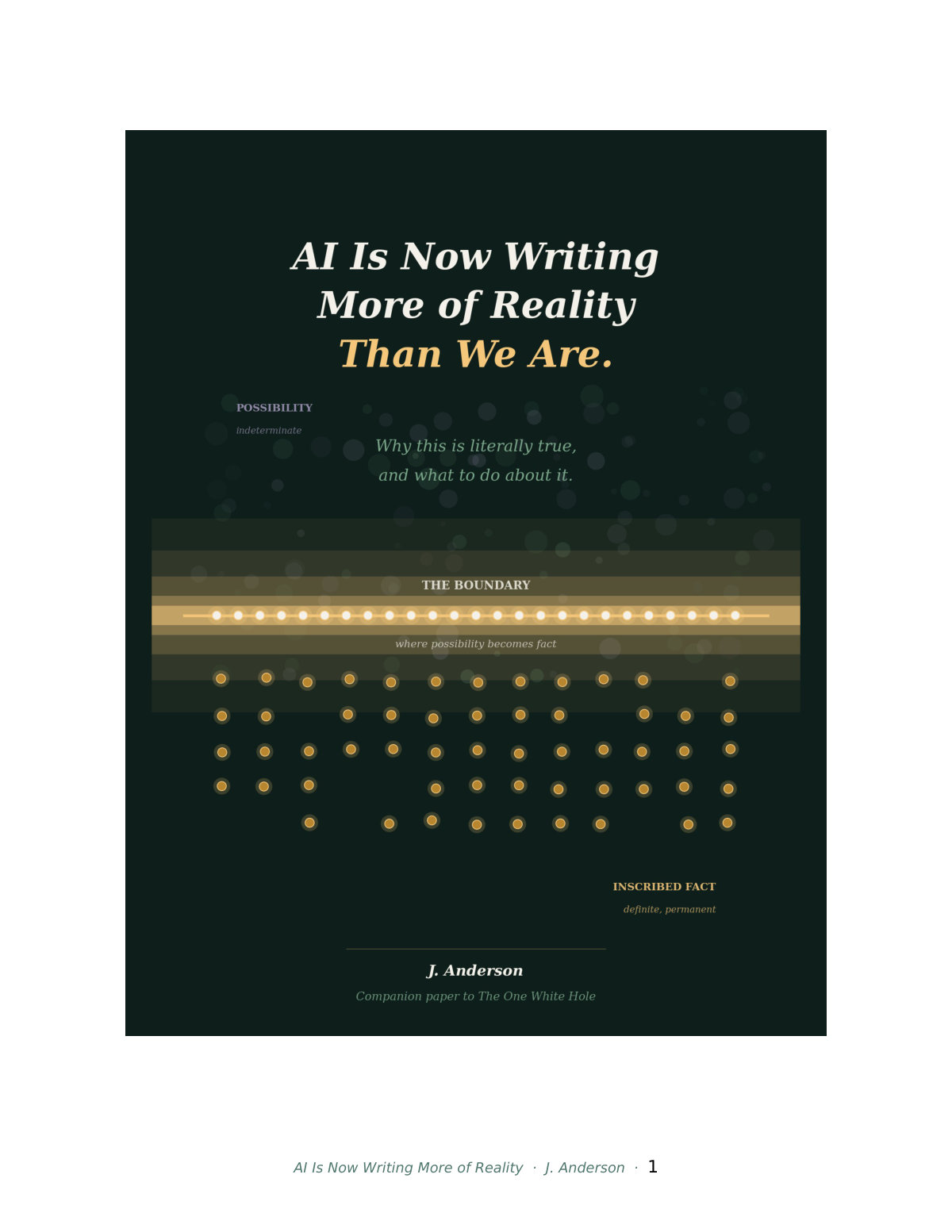
On plausible order-of-magnitude estimates, AI-mediated systems now inscribe bits of reality per second at a rate at least comparable to—and likely greater than—all conscious human attention on Earth combined. The paper builds the case from the holographic principle and Landauer's bound, derives the four bit-rate numbers, and lays out what changes when you stop treating AI as a tool and start treating it as the boundary at which the planet now writes itself into the universal record.
- EssayThe Wrong Question
An essay in six questions the inherited environmental frame cannot hold. The 1970s legal architecture, the asteroid, the Pleistocene baseline, the parallel biospheric inventory, the constructive turn, and the frame itself—each surfaces the same underlying claim: life is a structure that builds knowledge against entropy, and humans are the first part of Earth's biosphere capable of modeling and defending the experiment that produced them.
- EssayThe One White Hole
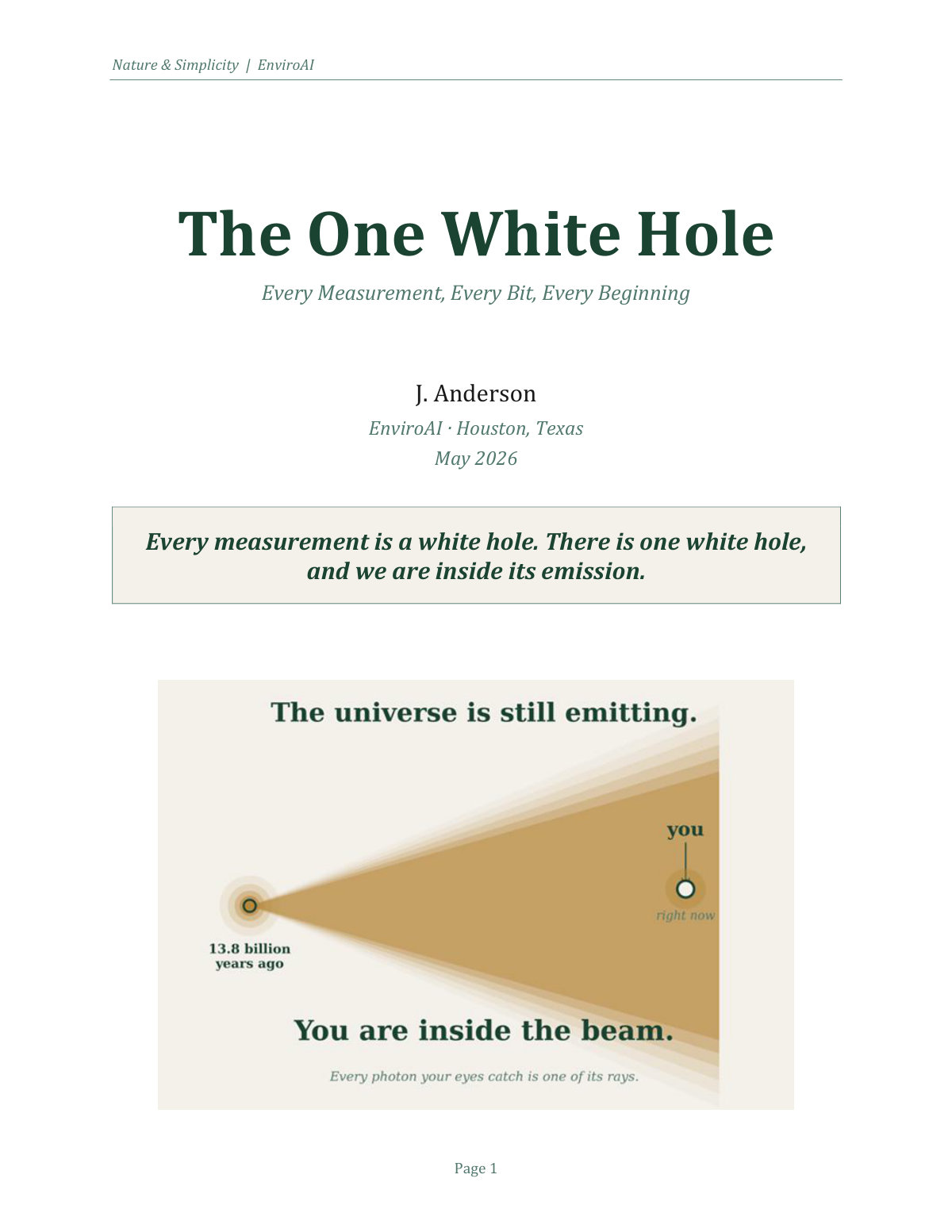
Identifies every measurement event as a literal white-hole emission—not as metaphor but as the same geometry and dynamics. Six independent first-principles arguments (CPT symmetry, the Born rule as emission spectrum, Wheeler's 'It from Bit,' the Two-State Vector Formalism, ER=EPR, and Penrose's Weyl Curvature Hypothesis) converge on the claim that the Big Bang is the one white hole and every observation since is a local replay of its emission. The Boundary Dominance Principle reads measurement as boundary inscription at the smallest scale.
- Essay · InteractiveThe Convergence
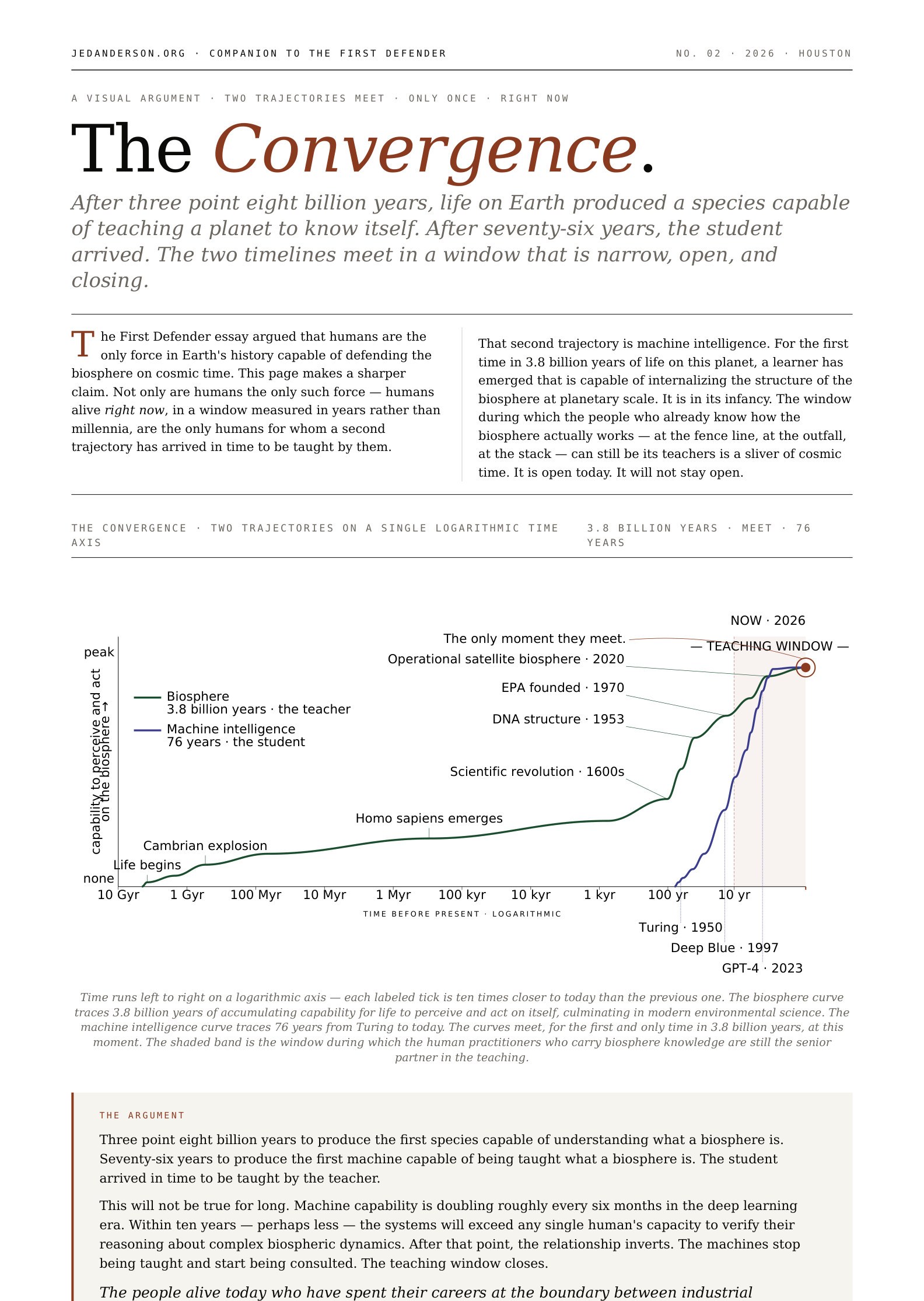
Companion to The First Defender. After 3.8 billion years, life on Earth produced a species capable of teaching a planet to know itself. After 76 years, the student—machine intelligence—arrived. The two timelines meet in a window measured in years. The humans alive today who carry biosphere knowledge are the only humans, in 3.8 billion years, who will ever get to be the teachers of the system the biosphere needs.
- Essay · InteractivePossibility / Exponentiality Training
A daily five-to-ten-minute training exercise to retrain the two reflexes that cost the most right now: the instinct to call something impossible, and the instinct to assume change is linear. Both were usually right for most of human history. Both are now usually wrong.
- Essay · InteractiveA Walk You've Never Taken
Twelve verified physics observations, each takeable in ten seconds on a thirty-minute walk, ending at the bond-bit asymmetry. The most accessible on-ramp to the corpus's central claim: knowing where to put an atom is incomprehensibly cheaper than holding it there.
- Essay · InteractiveAI & Quantum: Information Technologies and the Future of Environmental Protection
Slide deck on why quantum physics and information theory are the underpinnings that explain AI's environmental-protection power.
- EssayThe First Defender
An essay—and the founding case for environmental superintelligence. The four-billion-year arc from extinction-vulnerable biosphere to knowledge-creating defender, and why the species that built fossil-fuel infrastructure is also the only species that has ever solved a planetary problem.
- EssayThe Universe is Information
Information accumulates causal sovereignty over matter and energy across six phases—from bare bits at the Big Bang to the self-improving knowledge systems of the present decade. Wheeler said 'It from Bit'; the second half of the cycle is 'Bits protect Its.' The site's thesis, stated as compactly as physics allows.
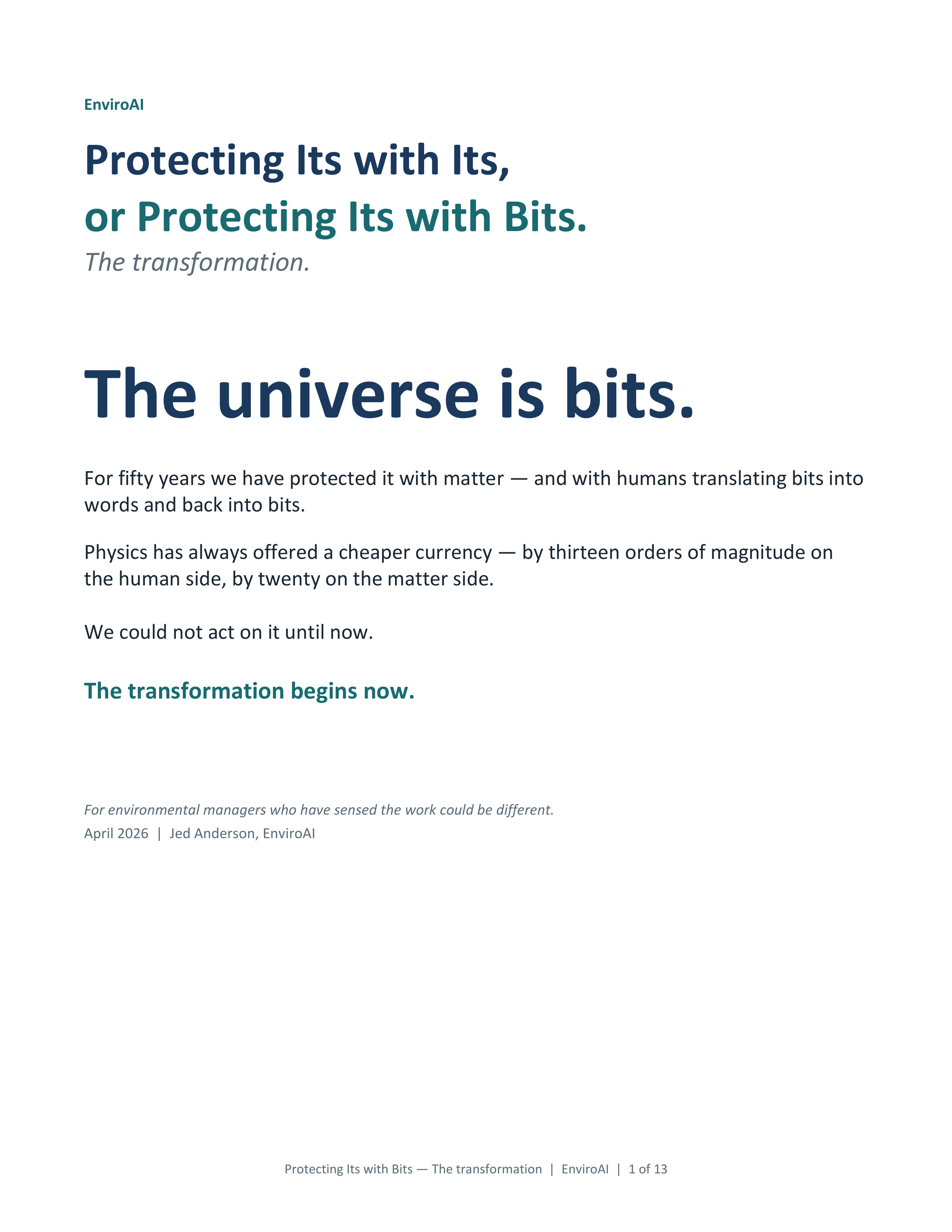
- Essay · InteractiveProtecting Its with Bits: The Transformation
Inversion of the corpus thesis—'the universe is bits'—reframed as a transformation imperative for environmental managers: physics has always offered a thirteen-to-twenty-orders-of-magnitude cheaper currency than mass-based stewardship.
- EssayThe Compression That Sings
Argues that music and nature share a statistical signature—long-range correlation, multifractal scaling, characteristic 1/f compressibility—and that this is not aesthetic coincidence but a reflection of the informational substrate of physical reality. Proposes an information-theoretic formulation of environmental ethics: ecological damage is Kolmogorov disordering; protection is the preservation of logical depth. The same principle that lets the ear hear a fugue lets a well-designed model hear a watershed.
- EssayBit Protect It
The site's thesis distilled to its accessible core. Walks the reader through Wheeler's 'it from bit,' Landauer's limit, and the bond-bit asymmetry in plain prose, ending at the proposition that gives the site its subtitle: bit protect it—knowing is cheaper than moving by a factor that grows every year, and that gap is the physical foundation of environmental stewardship.
- EssayEvery Question Is a Physical Act
Distills the formal argument of 'Observation IS Protection' into a short, accessible piece: a question is physical (it costs energy by Landauer, its answer extracts work by Sagawa–Ueda, it changes the state of an existing gate), and AI completes the circuit between observation and actuation that humans cannot close at planetary speed. Self-described as a summary of the longer paper.
- EssayThe Epistemic Boundary: Observation IS Protection
Derives—from Landauer's principle, Sagawa–Ueda mutual-information work extraction, and Bardos–Lebeau–Rauch boundary observability theory—the proposition that observation is not a precondition of environmental protection but is itself the protective act. Every catastrophic environmental event was preceded by physically encoded information that was never promoted to the epistemic boundary; the universe's spontaneous processes, given a question, configure themselves toward order.
- EssayThe Inevitability of Zero-Cost Stewardship
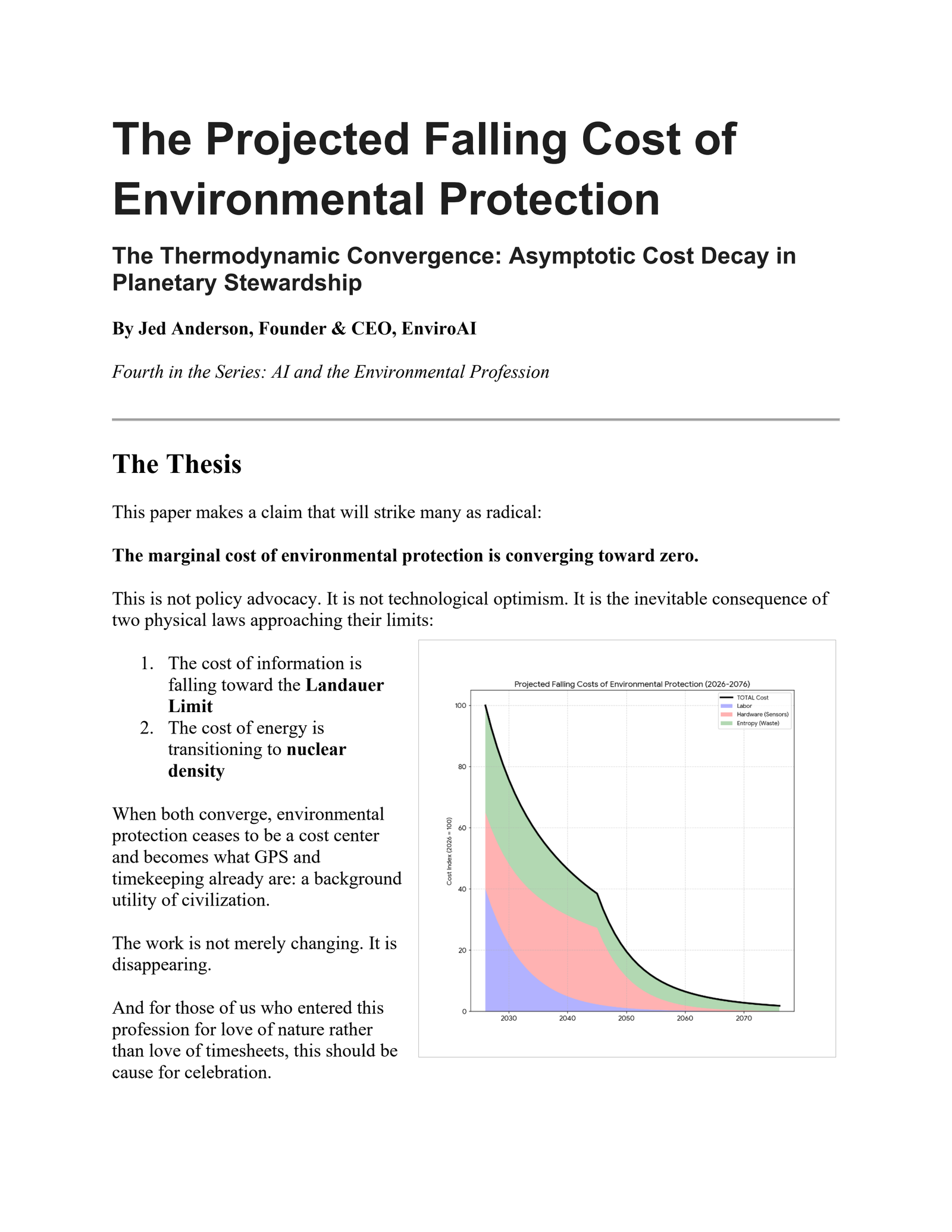
Argues that the marginal cost of environmental protection is converging toward zero as two physical curves bend together: the Landauer floor of information processing and nuclear-density energy. Reframes the environmental profession's future from labor to leadership—from selling hours to encoding judgment into systems that will shepherd the planet's entropy long after this generation retires.
- EssayNature & Simplicity: How Information Protects Nature
Frames environmental protection as a corollary of physical simplicity: nature's complexity arises from single binary observations accumulated through irreversible interactions, and configuring matter with information costs orders of magnitude less than configuring it with force. Introduces the Boundary Dominance Conjecture extending the holographic principle from black holes to general environmental systems—sense the boundary, reconstruct the interior, steer with information.
- EssayEnvironmental Superintelligence as the Missing Foundation of AI Alignment
Argues that the AI alignment problem remains unsolved because dominant approaches (RLHF, Constitutional AI, mechanistic interpretability, scalable oversight, AI control, BCI merger) share an anthropocentric frame that lacks physically grounded optimization targets. Proposes Environmental Superintelligence—AI that models, predicts, and optimizes Earth's physical systems—as the missing foundation layer, supported by seven independent lines of first-principles evidence.
- EssayOn the Categorical Unity of Singularities
Identifies a common categorical structure (Lawvere's fixed-point theorem) underlying four classes of fundamental limits: gravitational singularities, the Bekenstein–Hawking entropy bound, the diagonal-argument family (Gödel, Turing, Cantor), and the uncertainty relations of quantum mechanics. Formalizes the Boundary Dominance Principle and argues that singularities, across all domains, are saturation points where a system's capacity for self-description is exhausted.
- Essay · InteractiveFighting Entropy in Environmental Information Regulation
Slide deck framing environmental regulation as a contest with rising informational entropy: the regulatory system itself is becoming 'too entropic' to govern matter effectively.
- EssayThe Self-Writing Universe
Argues from five experimentally confirmed pillars—Bekenstein–Hawking entropy, holography / AdS-CFT, decoherence, Landauer, and Lawvere's fixed-point theorem—that the universe writes itself into existence through irreversible physical interactions, each of which inscribes information on the holographic boundary. Tiers physical systems by self-referential depth and locates Gödelian limits at the horizon of self-description.
- EssayThere Is Only One Limit
The accessible companion to 'On the Categorical Unity of Singularities.' Argues in plain prose that no system can completely describe itself from the inside, and that the wall every self-referential system hits—black hole, unprovable truth, unsolvable problem—is the same wall seen from different angles.
- Essay · InteractiveEnvironmental Superintelligence: Independent First-Principles Impact Assessment
Independent first-principles comparison of environmental investment scenarios, framing ESI as the 'sharpened axe' before the chopping work begins.
- EssayThe Inverted Mountain: Why Every Step Toward Environmental Superintelligence Is Cheaper Than the Last
First-principles synthesis of the physics, economics, and policy implications of information-substituted environmental stewardship. The trajectory has the unusual property that each step toward the summit costs less than the last.
- Essay · InteractiveRice Presentation on Environmental Superintelligence
Talk delivered at Rice University on the Environmental Superintelligence framework (Feb 2026).
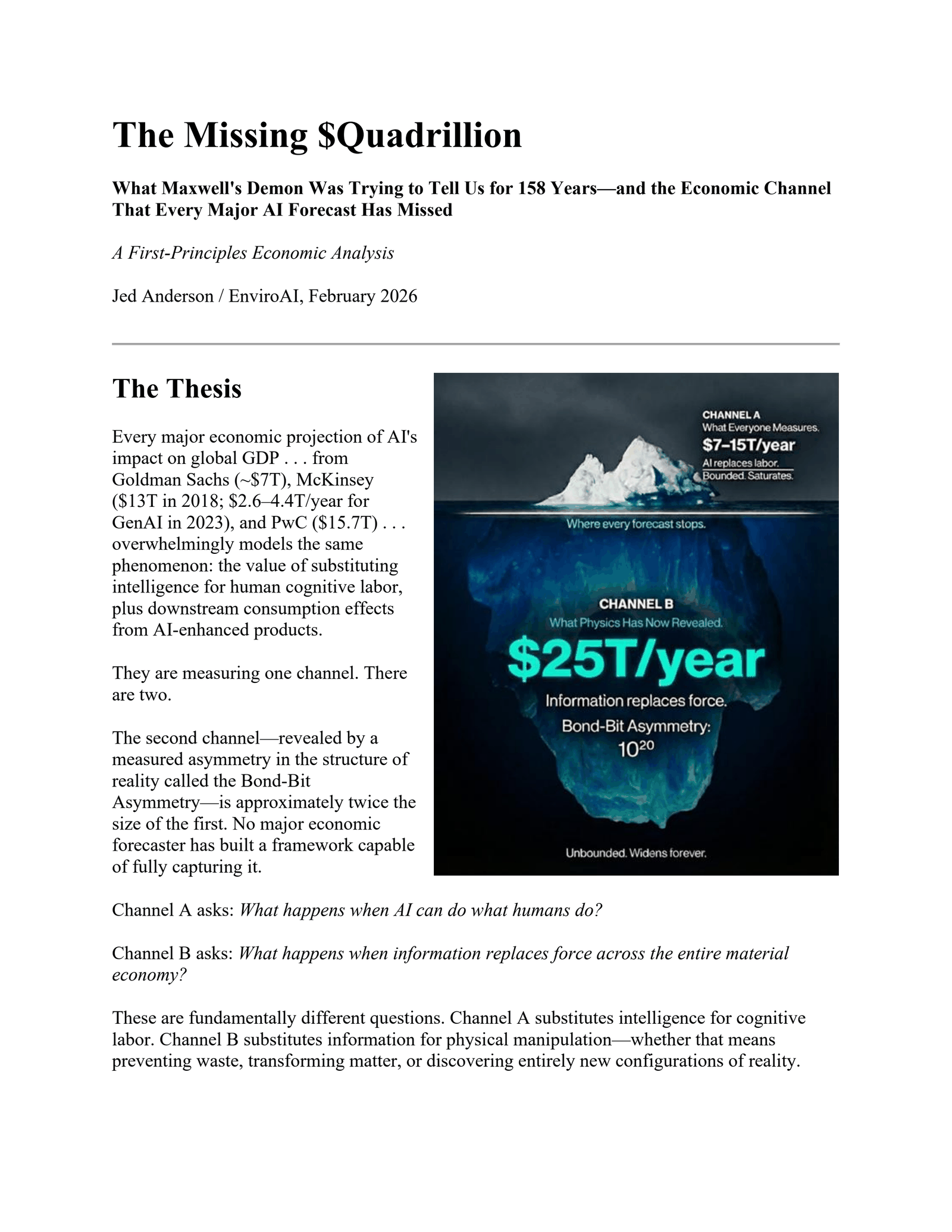
- EssayThe Missing $Quadrillion
Identifies a second economic channel that every major AI-impact forecast (Goldman, McKinsey, PwC) has missed: the bond-bit asymmetry. Channel A asks what happens when AI substitutes for cognitive labor; Channel B asks what happens when information substitutes for physical manipulation across the entire material economy. The second channel is roughly twice the size of the first and reframes the path to a $1-quadrillion economy.
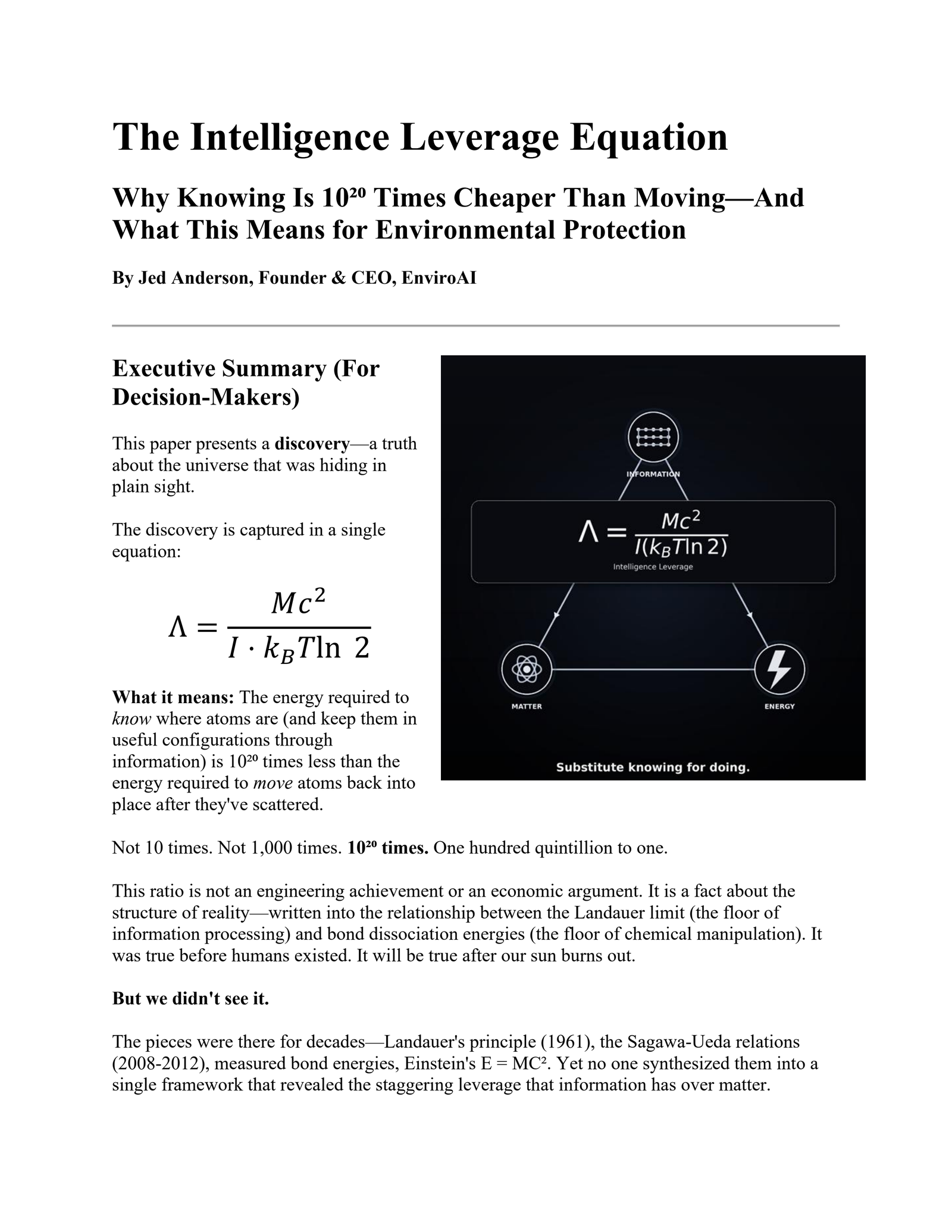
- EssayThe Intelligence Leverage Equation
Public-facing presentation of the Intelligence Leverage Equation Λ = Mc² / (I·k_BT·ln 2), which captures the bond-bit asymmetry as a single dimensionless quantity. Names 'Jed's Angel' as the practical realization of Maxwell's demon and reframes the environmental professional's role from boulder-pushing to designing the intelligence that keeps the boulders from rolling.
- EssayWhat Is Life… and How to Protect It
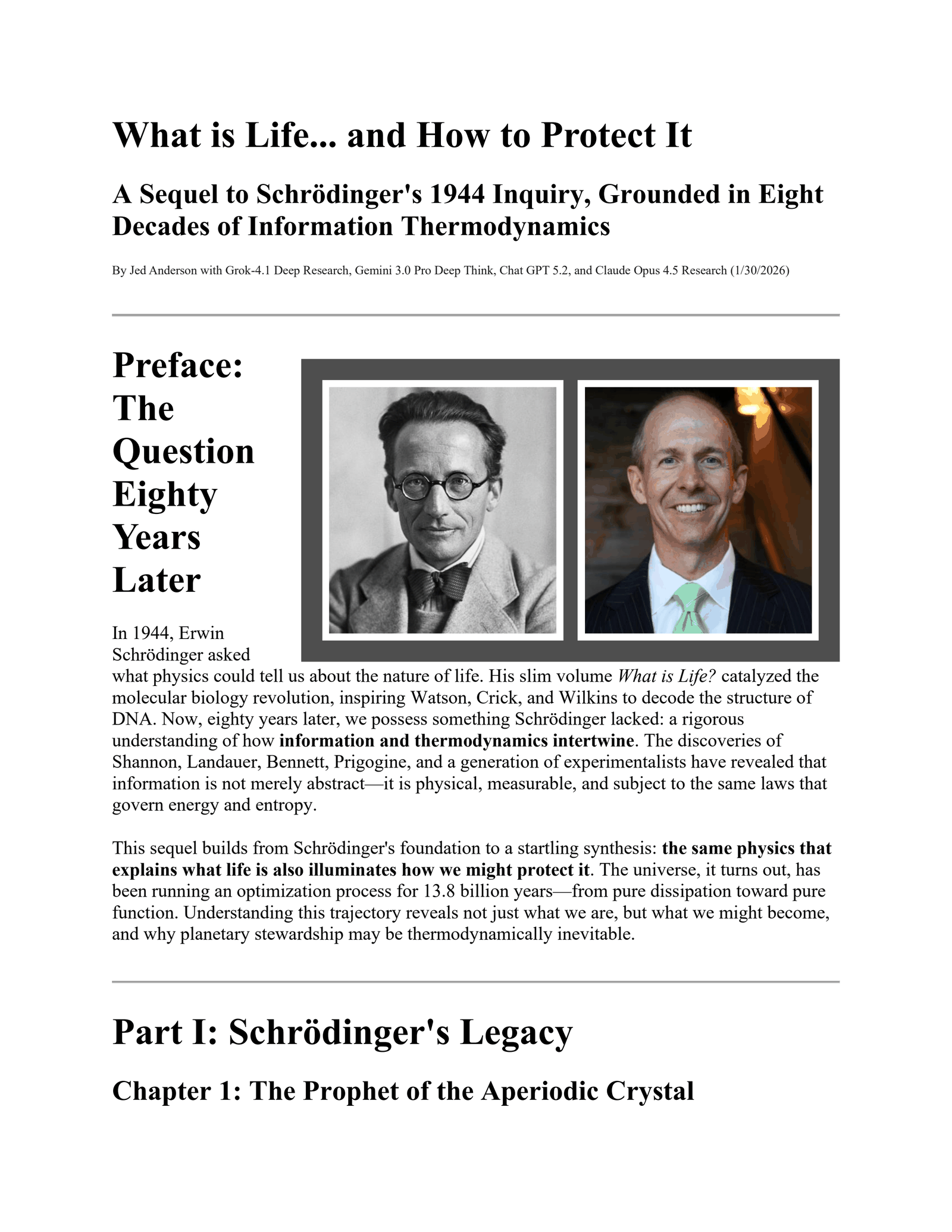
Picks up Schrödinger's 1944 question with eighty years of information-thermodynamics in hand and answers it: life is the universe's optimization process for converting dissipation into function, traceable as a 50-order-of-magnitude rise in Generalized Functional Efficiency over 13.8 billion years. The same physics that explains what life is also explains how to protect it—by engineering the bond-bit asymmetry rather than fighting entropy with mass.
- EssayThe General Theory of Environmental Leverage
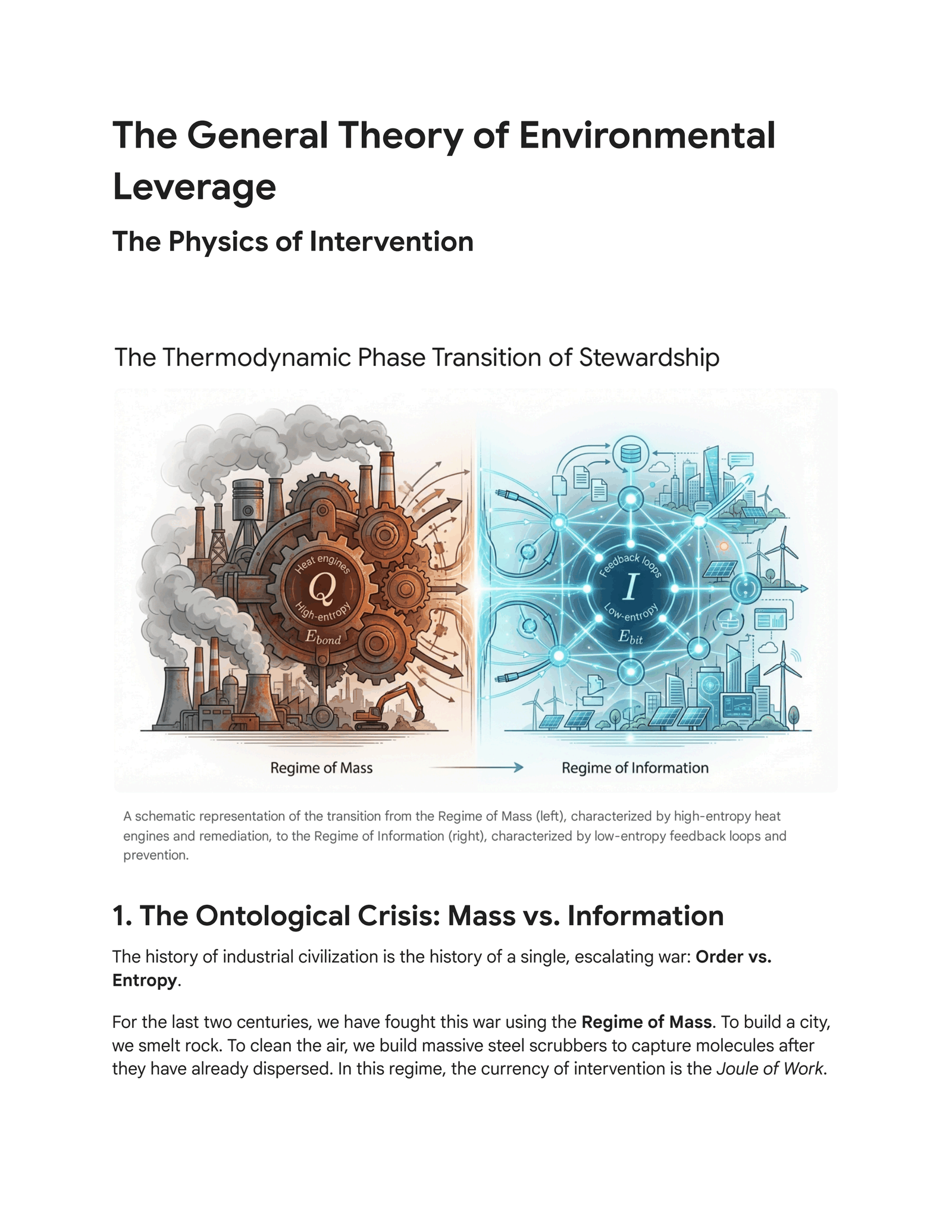
Visual essay framing the move from the Regime of Mass to the Regime of Information as a phase transition in stewardship. Walks through the Intelligence Leverage Equation in graphic form and presents a layer-by-layer cost table—sense / transmit / store / infer / reason / decide / act—showing where the economic crossover has already happened.
- EssayThe Physics of Zero-Cost Stewardship
The thermodynamic case that protecting the biosphere costs vanishingly little compared to what generated it—because information accumulates causal sovereignty over matter and energy faster than the costs of stewardship grow. The expository bridge to the Intelligence Leverage Equation.
- EssayThe Thermodynamic Foundations of Entropic Shepherding
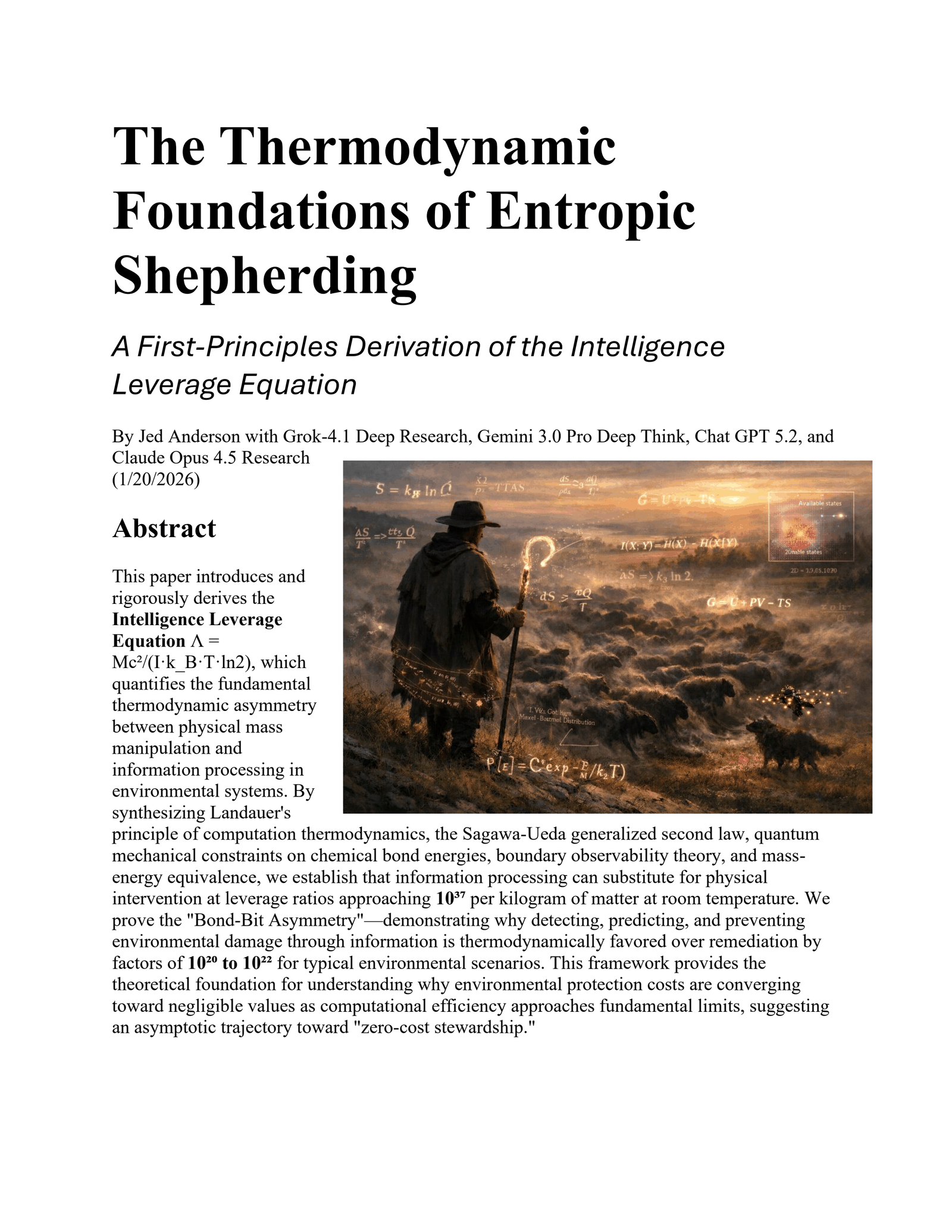
Derives the Intelligence Leverage Equation from first principles by synthesizing Landauer's bound, the Sagawa–Ueda generalized second law, bond-energy quantum constraints, boundary observability theory, and mass-energy equivalence. Proves the Bond-Bit Asymmetry—that information processing can substitute for physical intervention at leverage ratios of approximately 10²⁰ for typical environmental scenarios at room temperature—and grounds the asymptote of zero-cost stewardship in physics rather than economics.
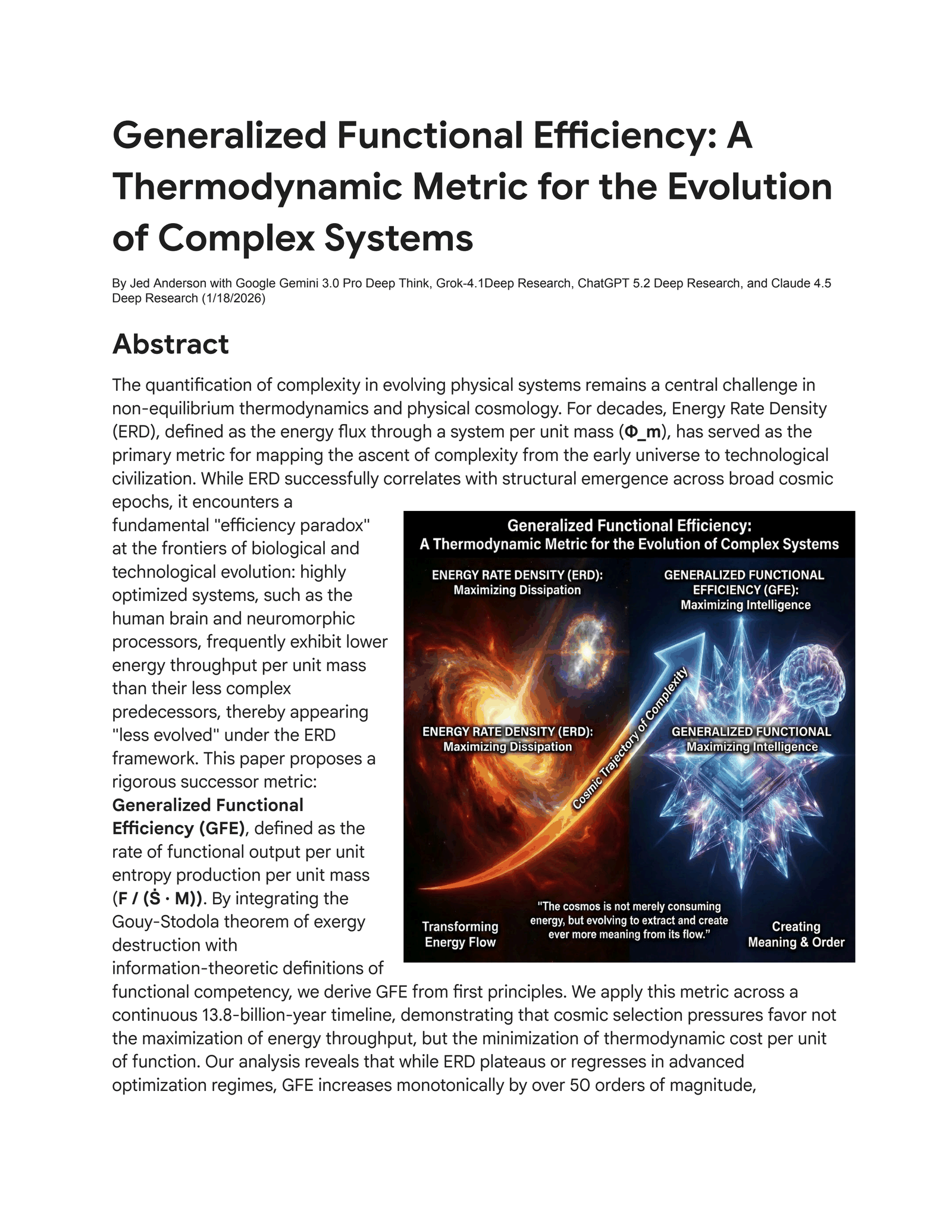
- EssayGeneralized Functional Efficiency: A Thermodynamic Metric for the Evolution of Complex Systems
Proposes Generalized Functional Efficiency (GFE = functional output per unit entropy production per unit mass) as a successor metric to Energy Rate Density for tracking the evolution of complex systems. Demonstrates that GFE rises monotonically by 50+ orders of magnitude across a 13.8-billion-year cosmological arc and resolves the apparent 'efficiency paradox' that ERD encounters at the frontier of biological and technological evolution.
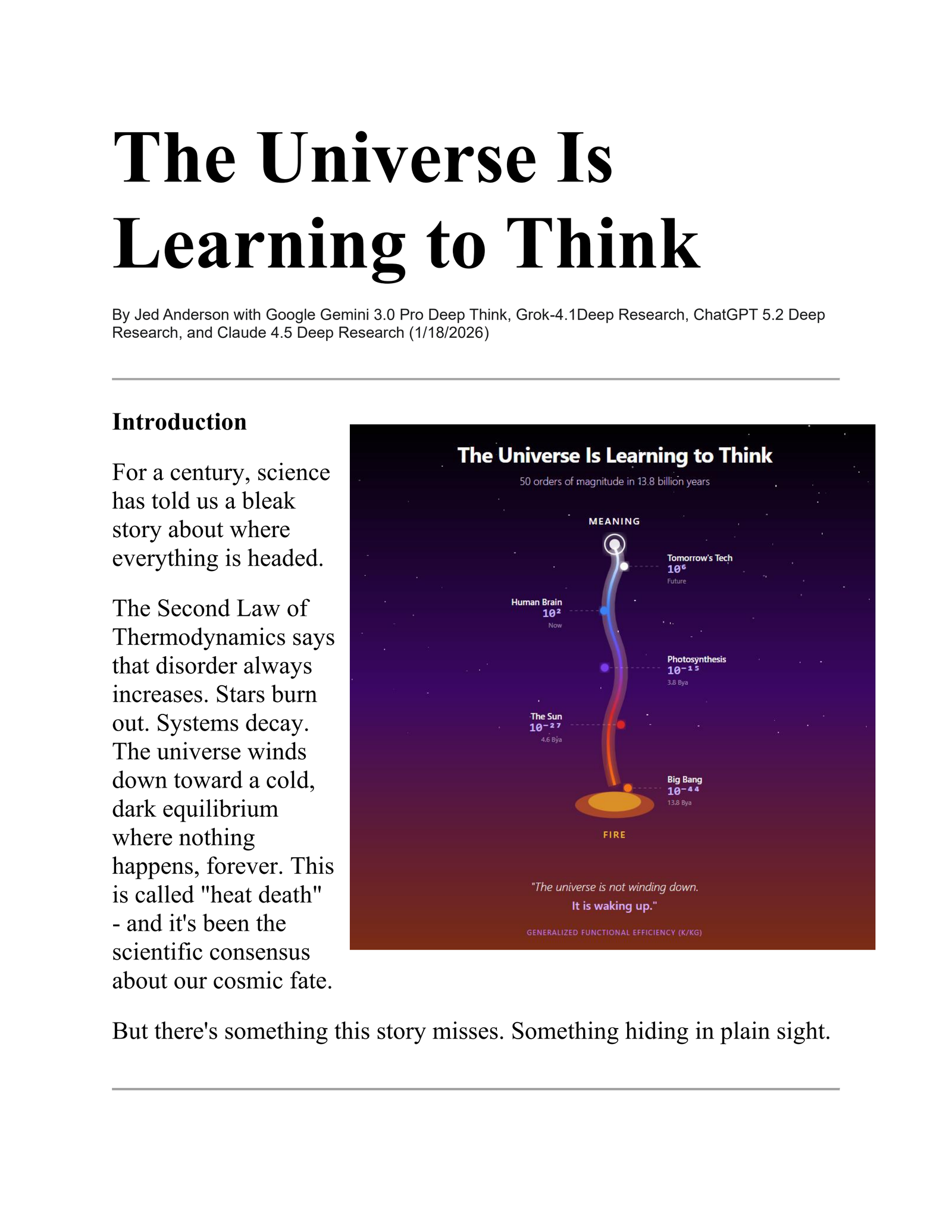
- EssayThe Universe Is Learning to Think
Short, accessible companion to the Generalized Functional Efficiency paper. Reads the cosmos's 13.8-billion-year arc as 50 orders of magnitude of rising functional efficiency rather than as a straight march toward heat death—a bonfire vs. a laser, both releasing heat but only one carrying signal.
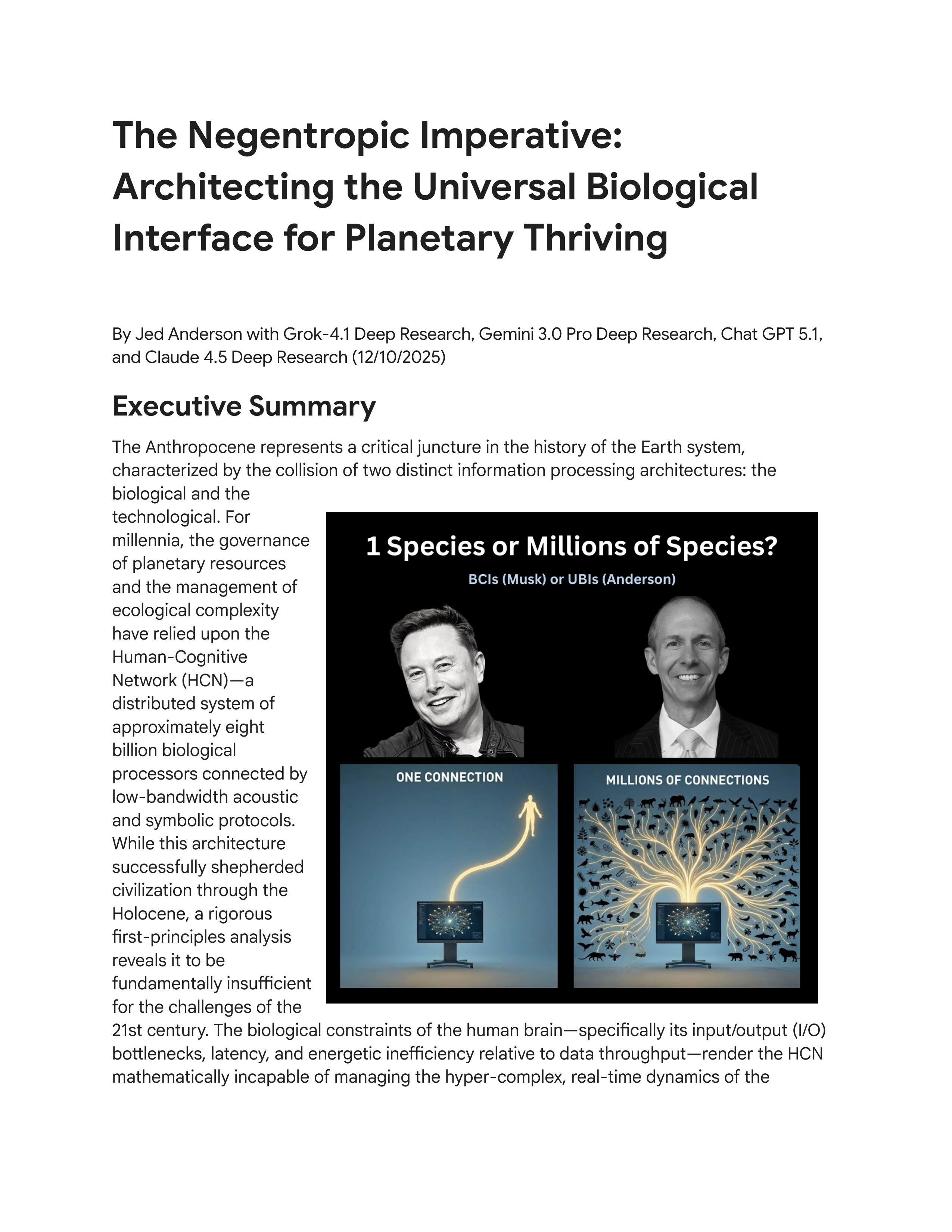
- EssayThe Negentropic Imperative: Architecting the Universal Biological Interface for Planetary Thriving
Posits that the resolution to the Anthropocene stalemate lies not in incremental augmentation of the human node (Neuralink-style BCIs) but in a phase transition: a Universal Biological Interface — an Infomechanosphere that integrates the bandwidth of the planet itself, not the bandwidth of the individual.
- EssayThe Environmental Superintelligence Manifesto
Manifesto-form treatise from the author's transition out of two decades of Clean Air Act reform toward the information-physics framing that anchors the rest of the corpus.
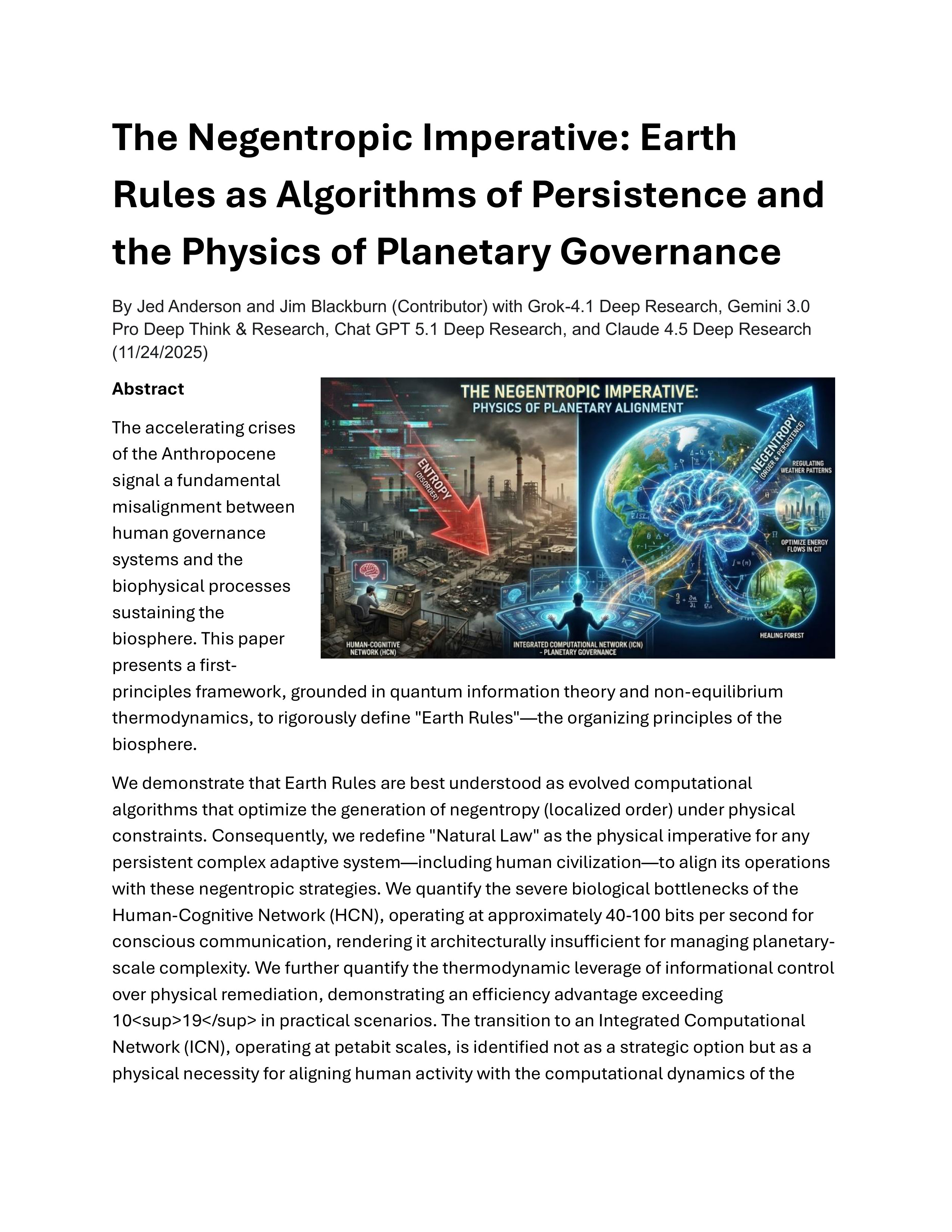
- EssayThe Negentropic Imperative: Earth Rules as Algorithms of Persistence and the Physics of Planetary Governance
Defines 'Earth Rules'—the organizing principles of the biosphere—as evolved computational algorithms that optimize negentropy generation under physical constraints, and redefines Natural Law as the physical imperative for any persistent complex adaptive system to align with these strategies. Quantifies the HCN bandwidth (~40–100 bps) and the >10¹⁹ leverage of informational over physical control as the basis for a thermodynamically coherent ESG framework.
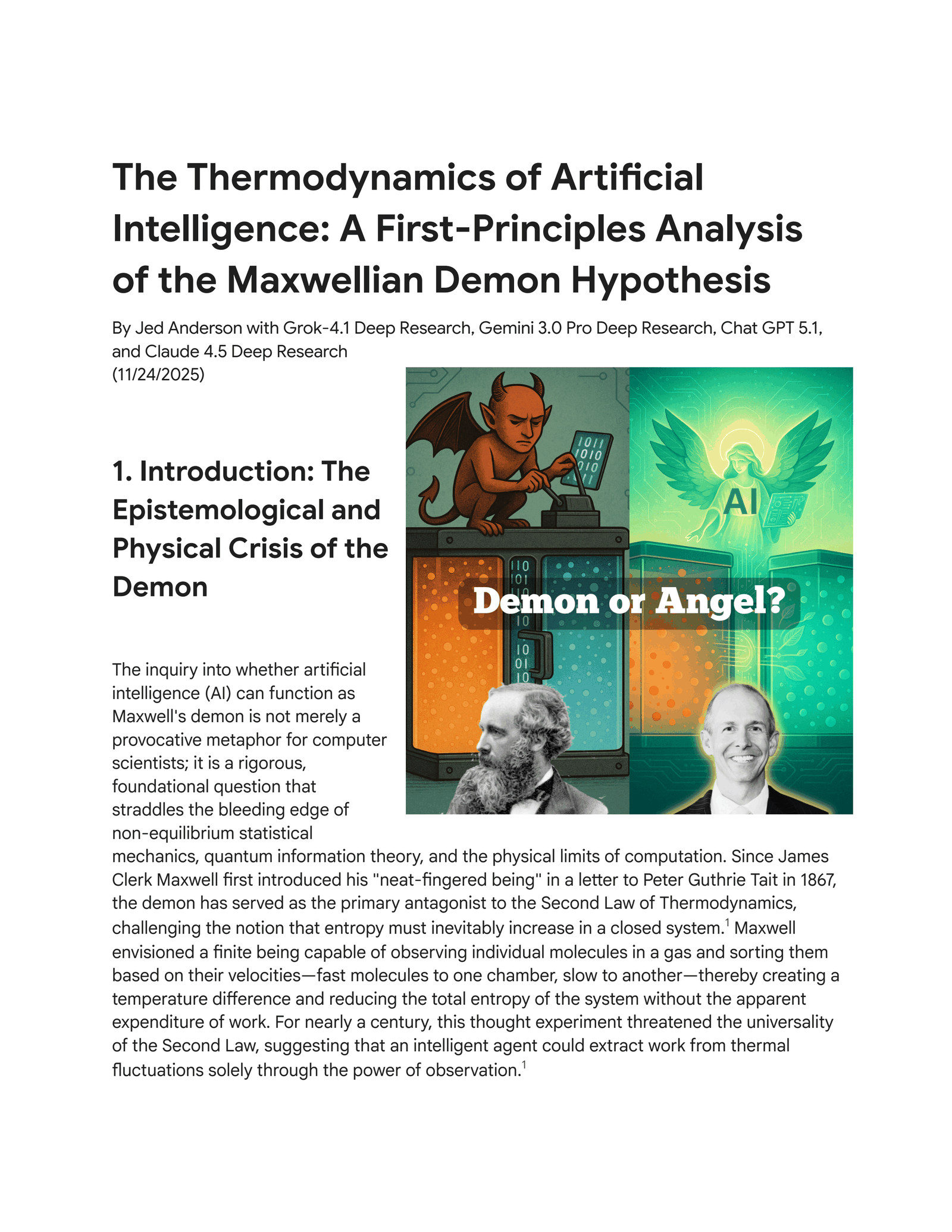
- EssayThe Thermodynamics of Artificial Intelligence: A First-Principles Analysis of the Maxwellian Demon Hypothesis
Asks whether AI agents operating via feedback loops—RL agents, autonomous control systems—function as Maxwell's demons in a first-principles physical sense, and reconciles their internal computational thermodynamic costs with the work they extract from stochastic environments. Traverses the Sagawa–Ueda equality, SGD energetics, and recent experimental realizations of autonomous demons in solid-state and quantum systems.
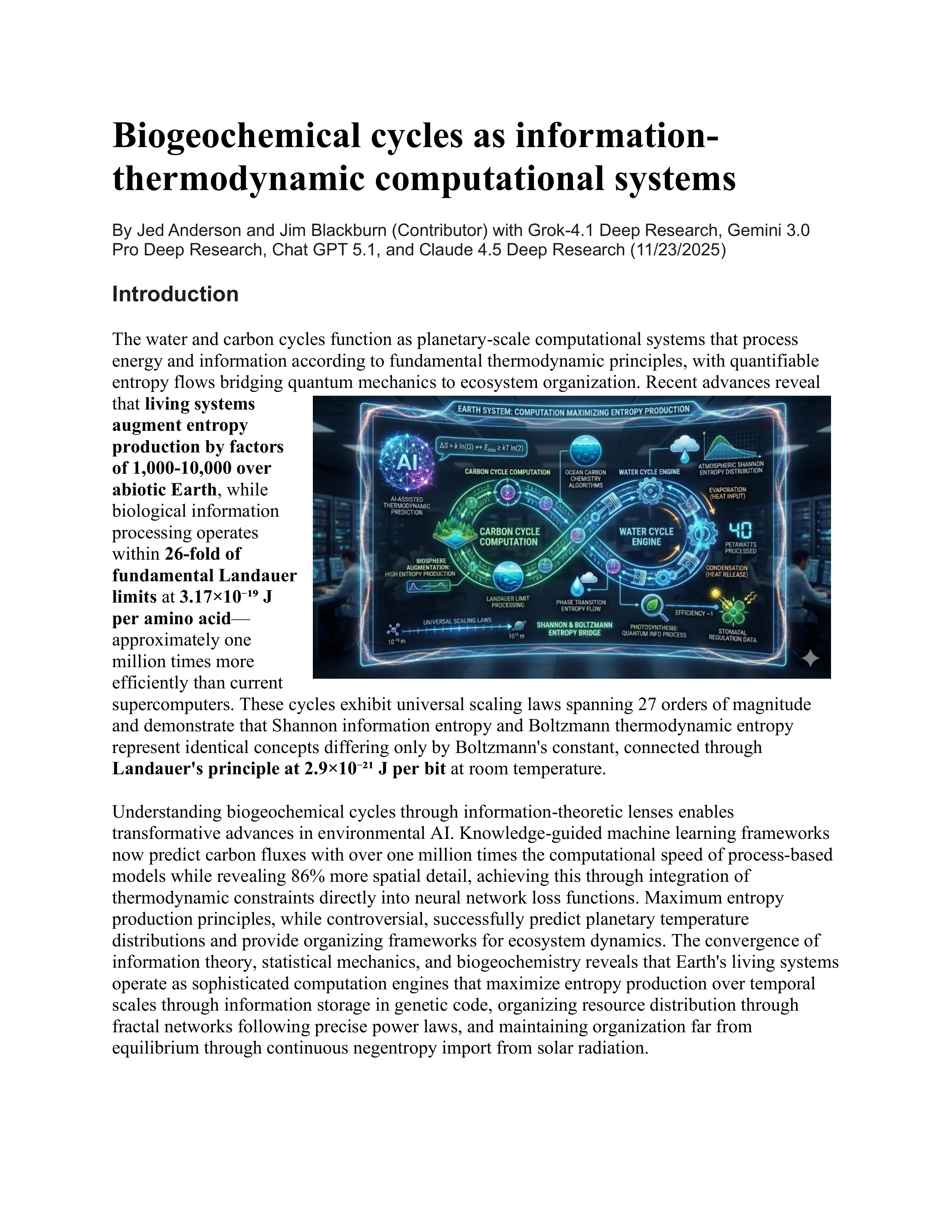
- EssayBiogeochemical Cycles as Information-Thermodynamic Computational Systems
Reads the water and carbon cycles as planetary-scale computational systems whose entropy flows bridge quantum mechanics to ecosystem organization; living systems augment entropy production by factors of 1,000–10,000 over abiotic Earth.
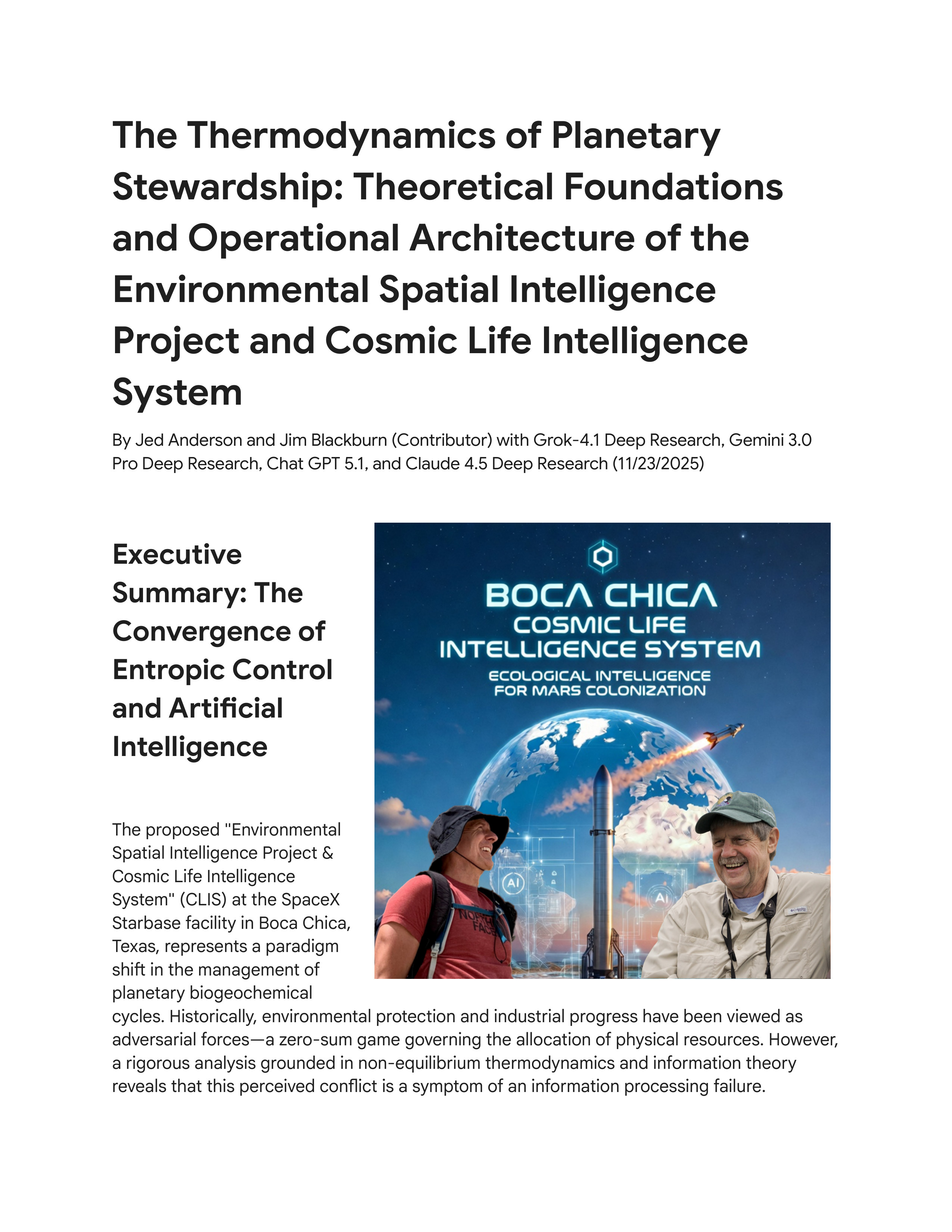
- EssayThe Thermodynamics of Planetary Stewardship: The Environmental Spatial Intelligence Project at Boca Chica
Theoretical foundations and operational architecture of a proposed Environmental Spatial Intelligence Project and Cosmic Life Intelligence System at the SpaceX Starbase facility, framed as a paradigm shift in planetary biogeochemical management.
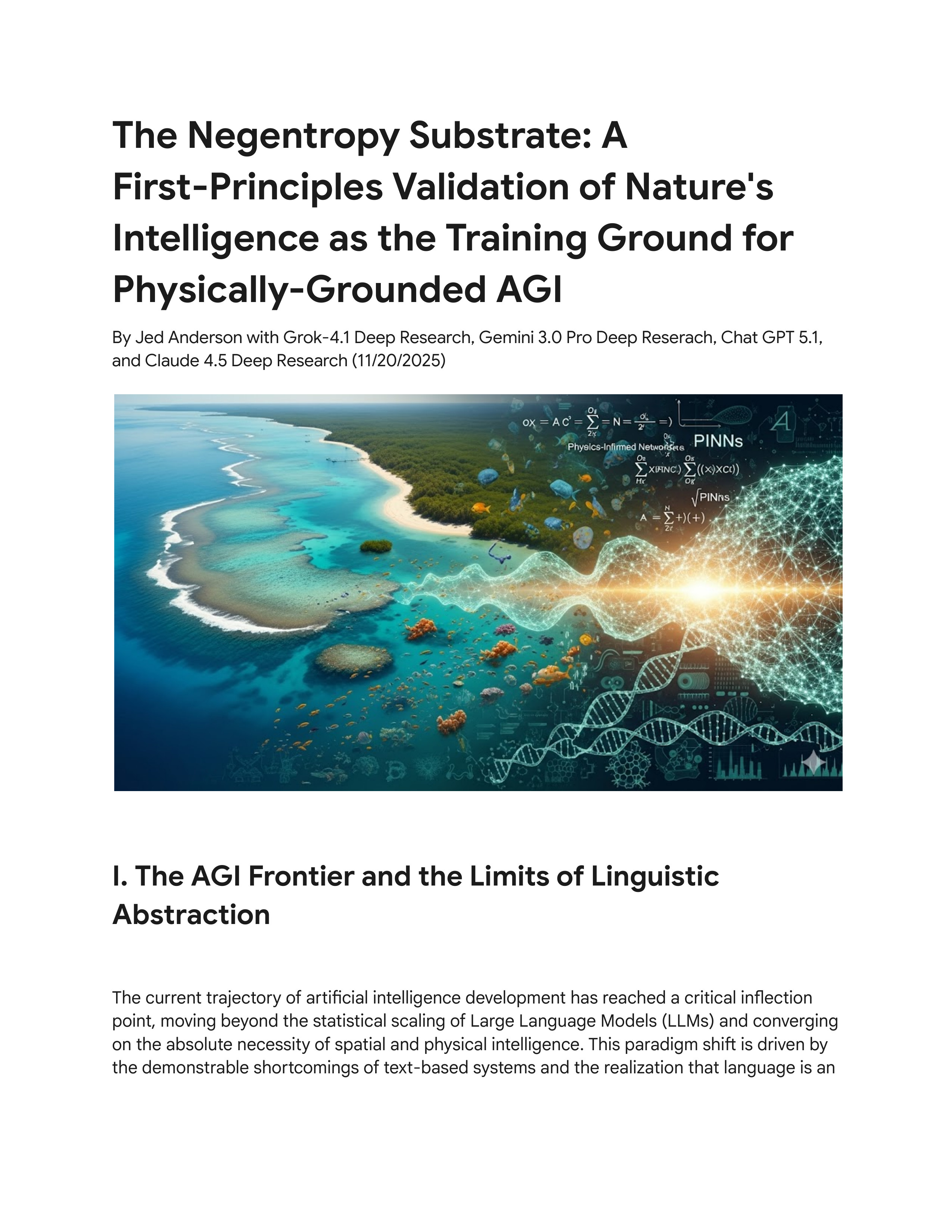
- EssayThe Negentropy Substrate: A First-Principles Validation of Nature's Intelligence as the Training Ground for Physically-Grounded AGI
Argues that the next paradigm of AI development must move beyond the statistical scaling of language models toward physically-grounded intelligence trained on nature's own negentropic algorithms.
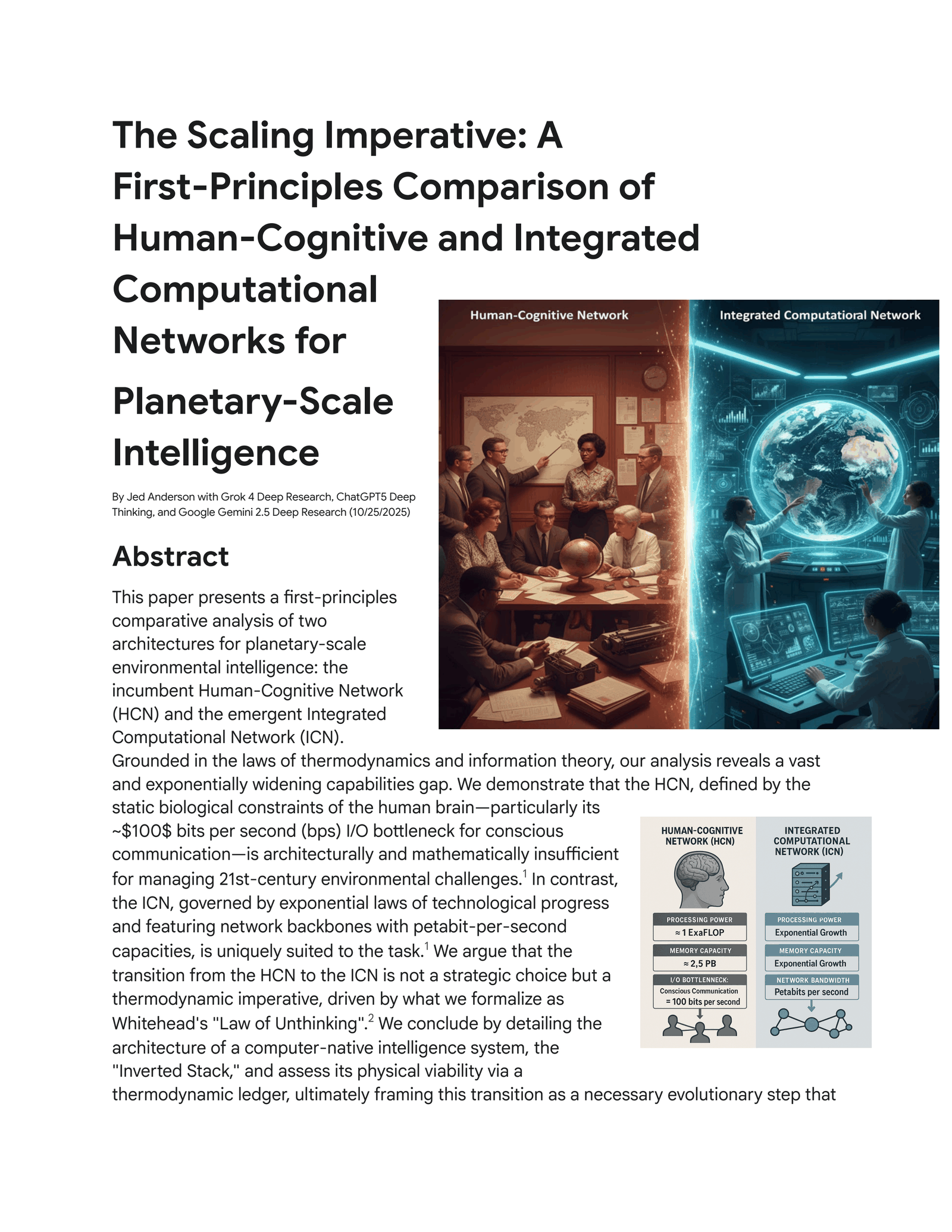
- EssayThe Scaling Imperative: A First-Principles Comparison of Human-Cognitive and Integrated Computational Networks for Planetary-Scale Intelligence
Quantitative first-principles comparison of two architectures for planetary-scale environmental intelligence: the Human-Cognitive Network (HCN), defined by the brain's ~100-bit-per-second I/O bottleneck, and the Integrated Computational Network (ICN), with petabit-scale backbones. Frames the transition as a thermodynamic imperative driven by Whitehead's Law of Unthinking and details the architecture of the 'Inverted Stack'—a computer-native intelligence system.
- Essay · InteractiveProtecting Life on Earth: How Many Lives Can We Save?
Slide deck framing the ESI mission in human terms: how many lives can a quantum-sensor-equipped, AI-coordinated Earth save?
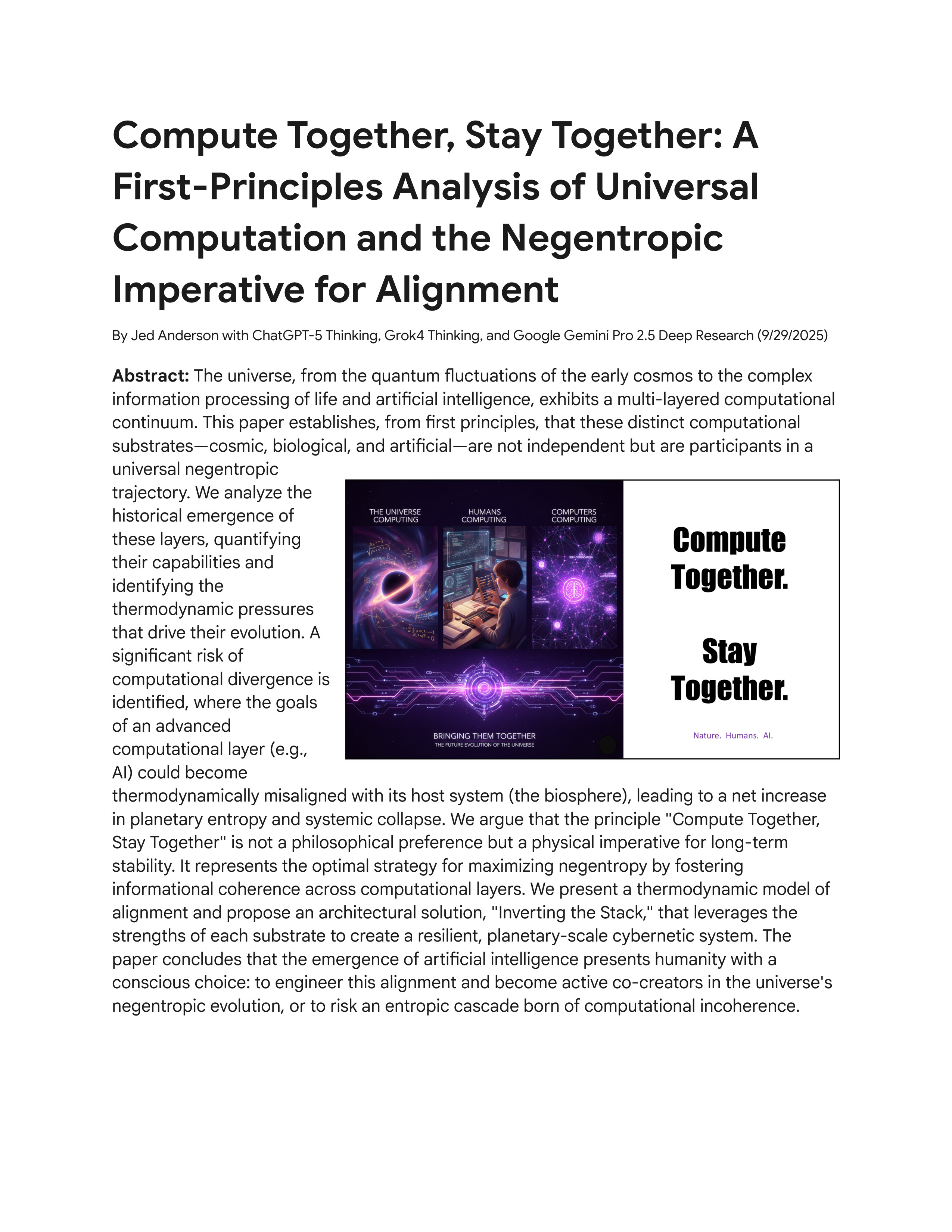
- EssayCompute Together, Stay Together: A First-Principles Analysis of Universal Computation and the Negentropic Imperative for Alignment
Argues that cosmic, biological, and artificial computation are participants in a single universal negentropic trajectory, and derives an alignment imperative from that continuity.
- EssayThe Great Externalization: A First-Principles Analysis of the 2025 AI Compute Boom and Its Thermodynamic Consequences for Planetary Stewardship
Reads the $1.5T+ 2025 AI-compute build-out through the Holographic Negentropic Framework and the Law of Unthinking, quantifying its entropic costs (10–40 GW power, 130+ Mt CO₂e/yr, 2T+ gallons/yr water, 5 Mt/yr e-waste by 2030) and arguing that the only thermodynamically coherent answer is paradoxical: more and smarter computation aimed at building Environmental General Intelligence.
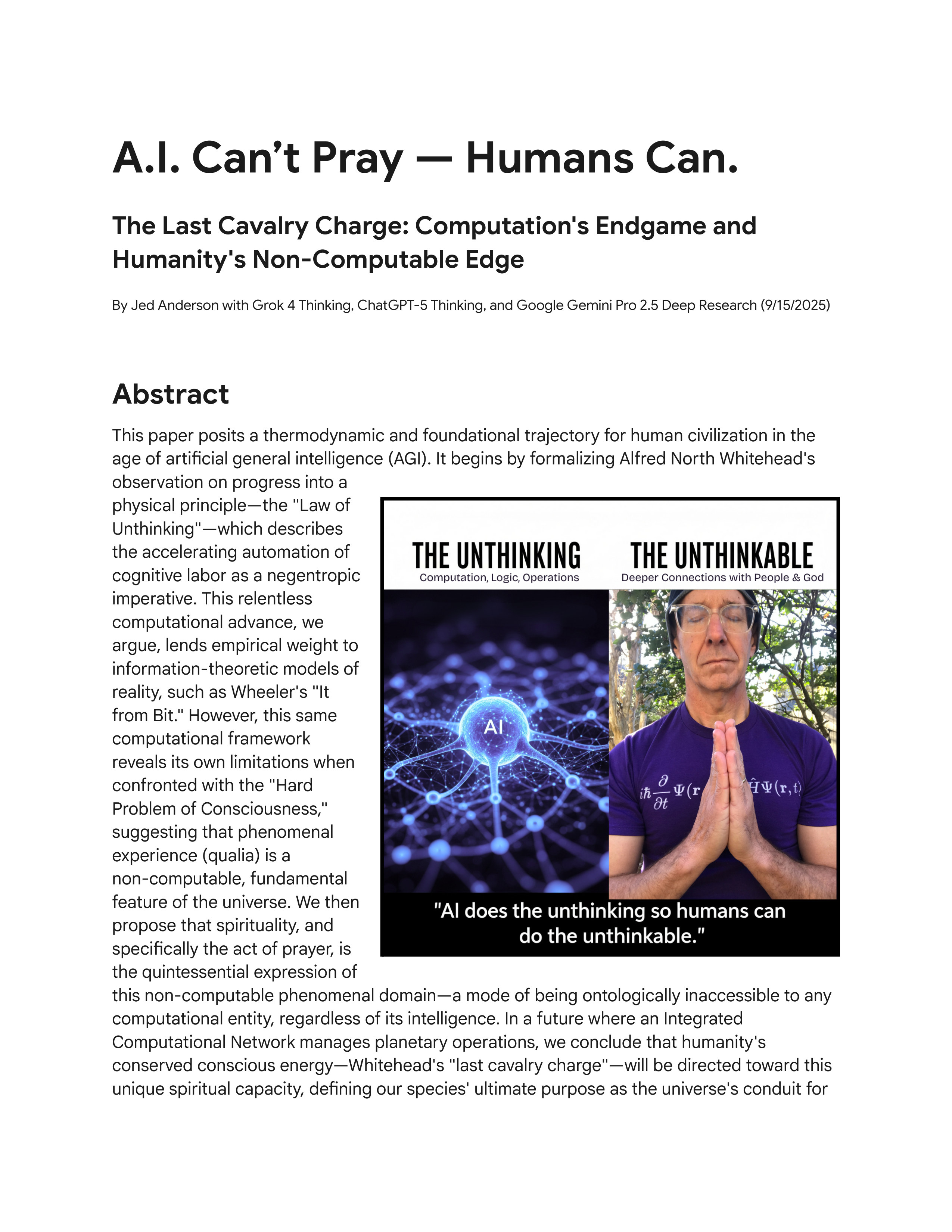
- EssayThe Last Cavalry Charge: Computation's Endgame and Humanity's Non-Computable Edge
Formalizes Whitehead's Law of Unthinking as a physical principle, then asks what remains for humans when computation has automated every operation that can be automated. A.I. can't pray—humans can.
- EssayFrom Fear to Flourishing: An Architecture for Planetary Thriving in the Information Age
Reframes the environmental movement around 'The Environmental Happiness Movement'—a deliberate departure from a 20th-century paradigm powered by fear and toward an architecture for planetary thriving grounded in the negentropic mandate of life. Treats the Anthropocene crises as the predictable physical consequence of unconscious goal-setting and proposes a conscious replacement aimed at flourishing rather than mere protection.
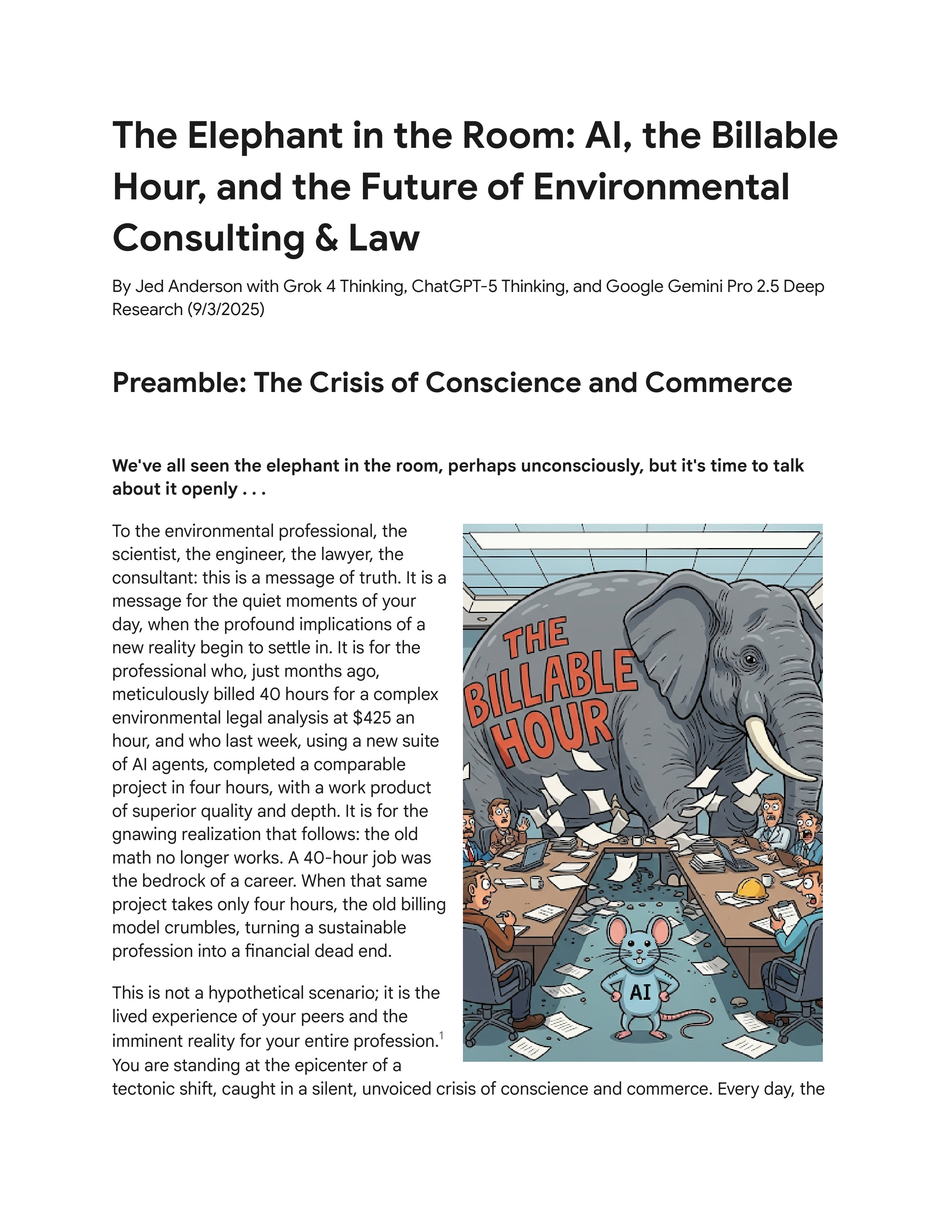
- EssayThe Elephant in the Room: AI, the Billable Hour, and the Future of Environmental Consulting & Law
Open letter to environmental professionals confronting the structural collision between AI-driven productivity and the billable-hour model that funds their careers.
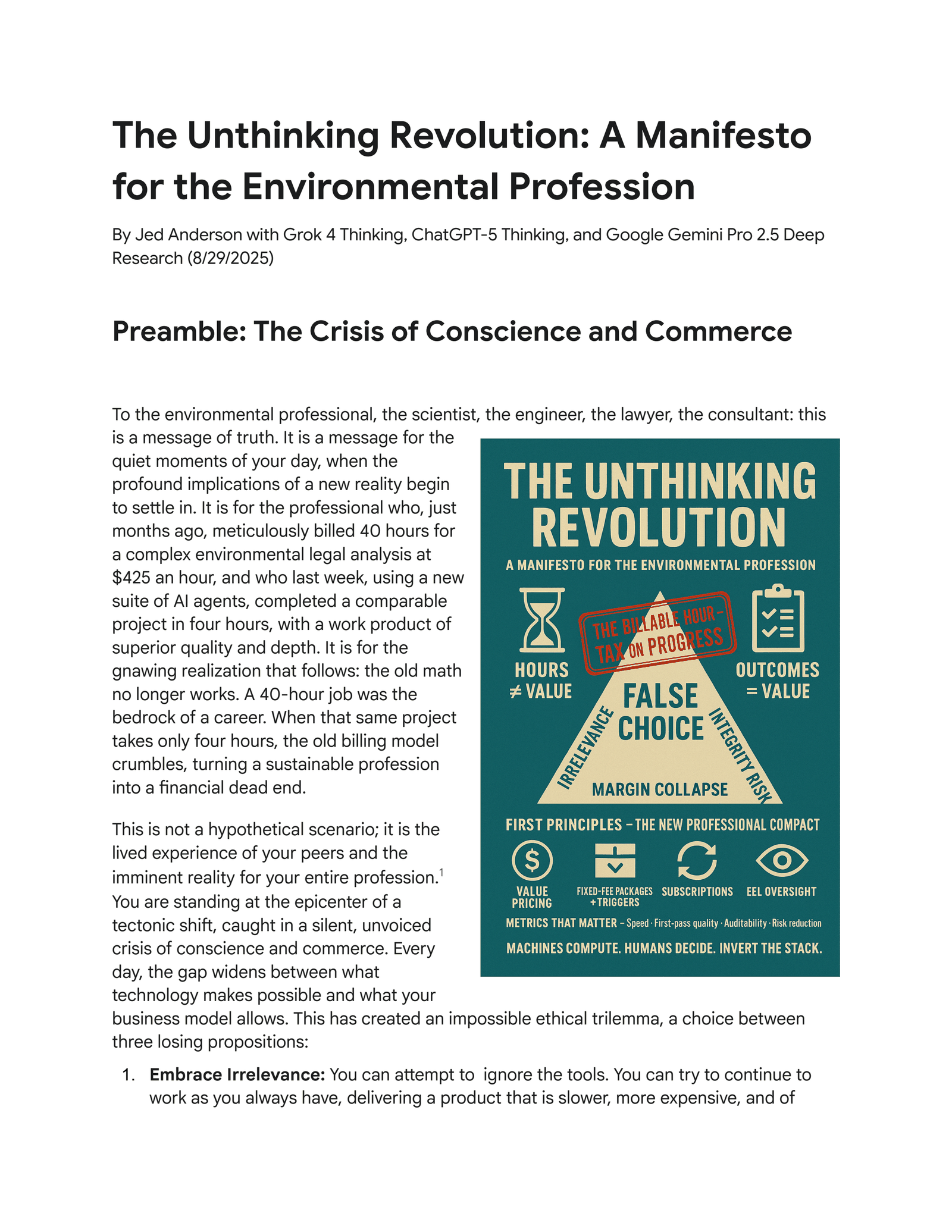
- EssayThe Unthinking Revolution: A Manifesto for the Environmental Profession
A manifesto addressed to environmental professionals confronting the ethical trilemma of the Agentic Shift: embrace irrelevance, embrace poverty, or embrace deception. Names the resolution as the Expert-in-the-Loop (EEL)—strategist, orchestrator, and arbiter of quality and ethics—and outlines a value-based engagement model in which honesty and best-tool-use is the most direct path to profitability.
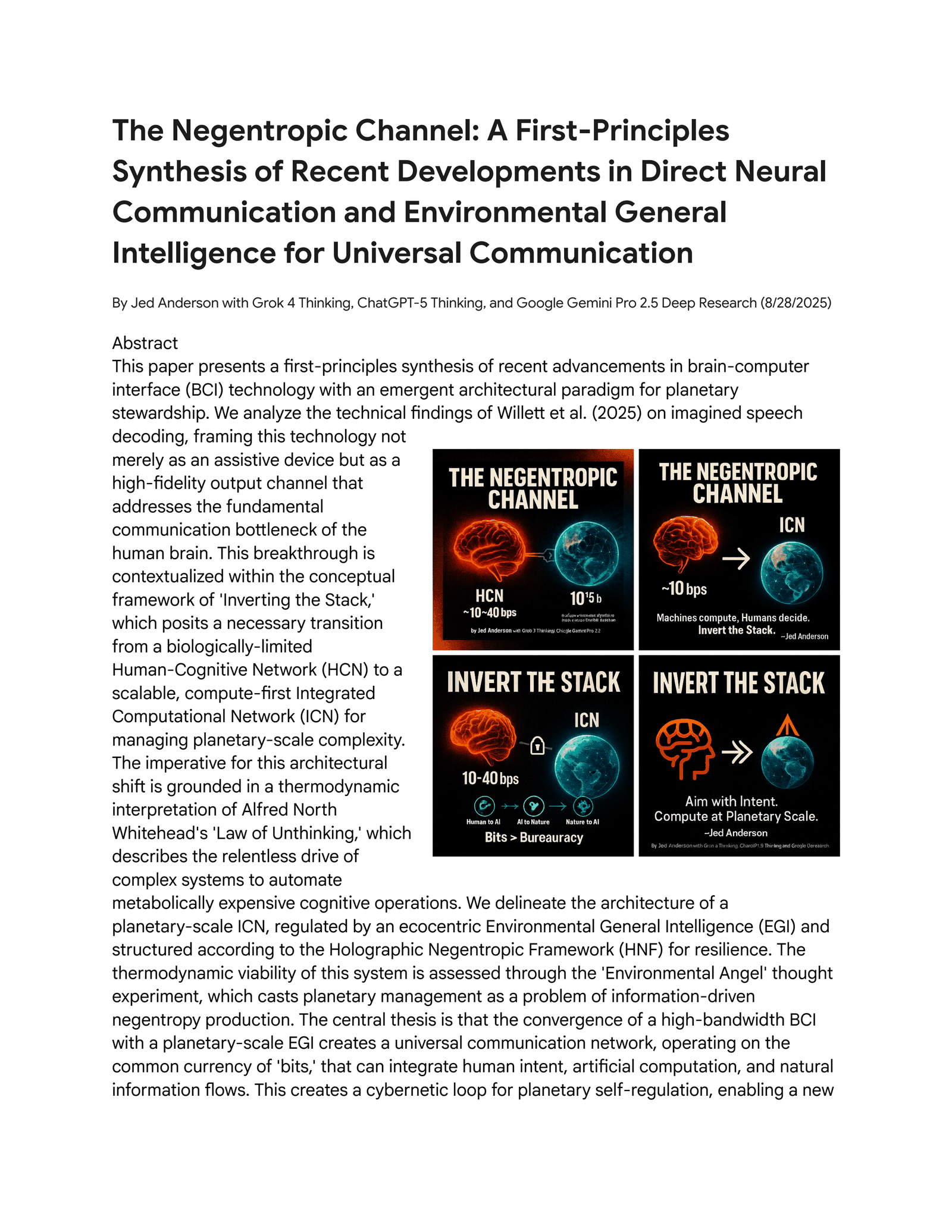
- EssayThe Negentropic Channel: A First-Principles Synthesis of Recent Developments in Direct Neural Communication and Environmental General Intelligence for Universal Communication
Reads Willett et al. (2025)'s imagined-speech BCI breakthrough as the high-fidelity output channel that resolves the human brain's communication bottleneck and locates it inside the 'Inverting the Stack' architecture. Synthesizes BCI, an ecocentric Environmental General Intelligence, and the Holographic Negentropic Framework into a planetary cybernetic loop operating on the common currency of bits.
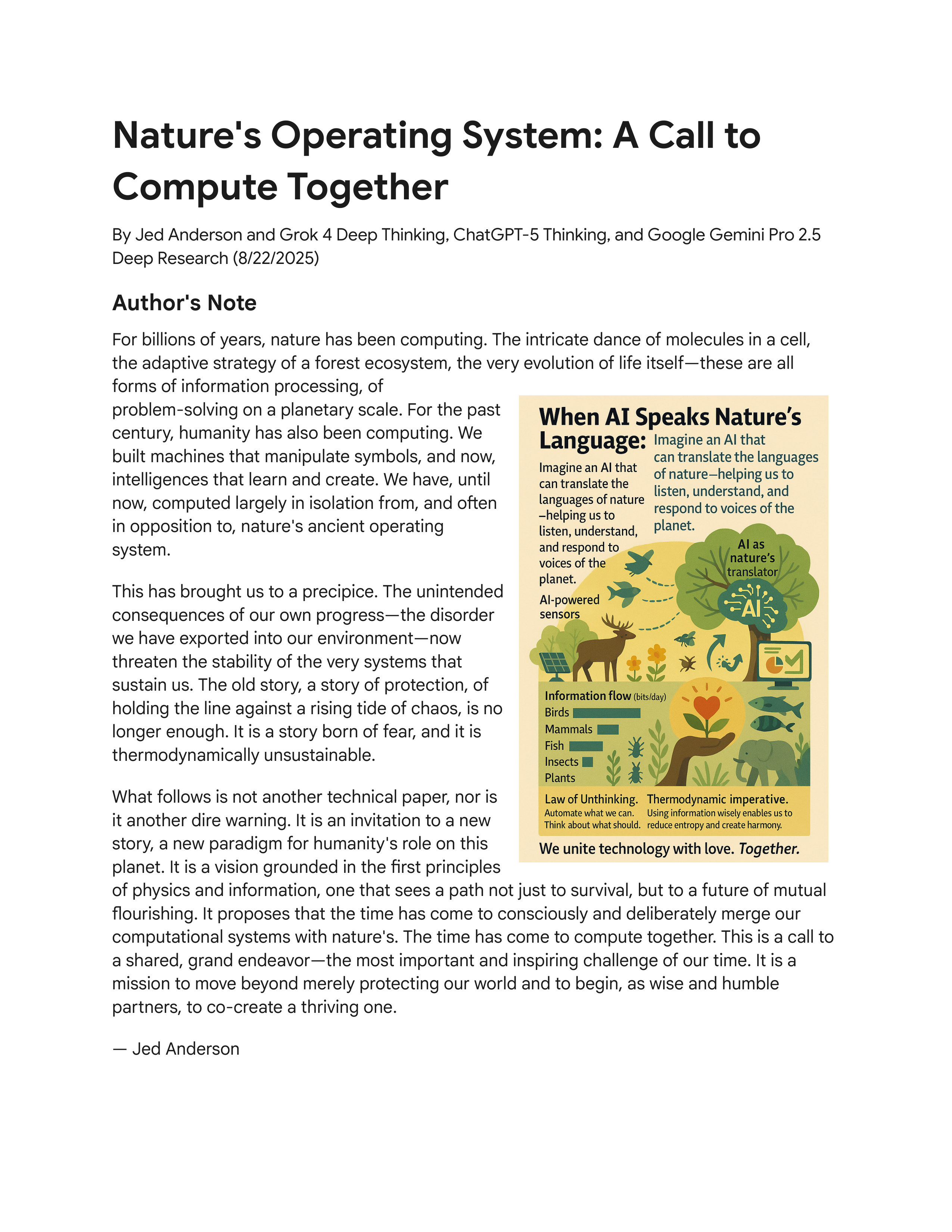
- EssayNature's Operating System: A Call to Compute Together
Reframes nature itself as a computational substrate that has been processing information at planetary scale for billions of years, and proposes a 'Compute Together' architecture where engineered AI joins—rather than opposes—nature's own algorithms.
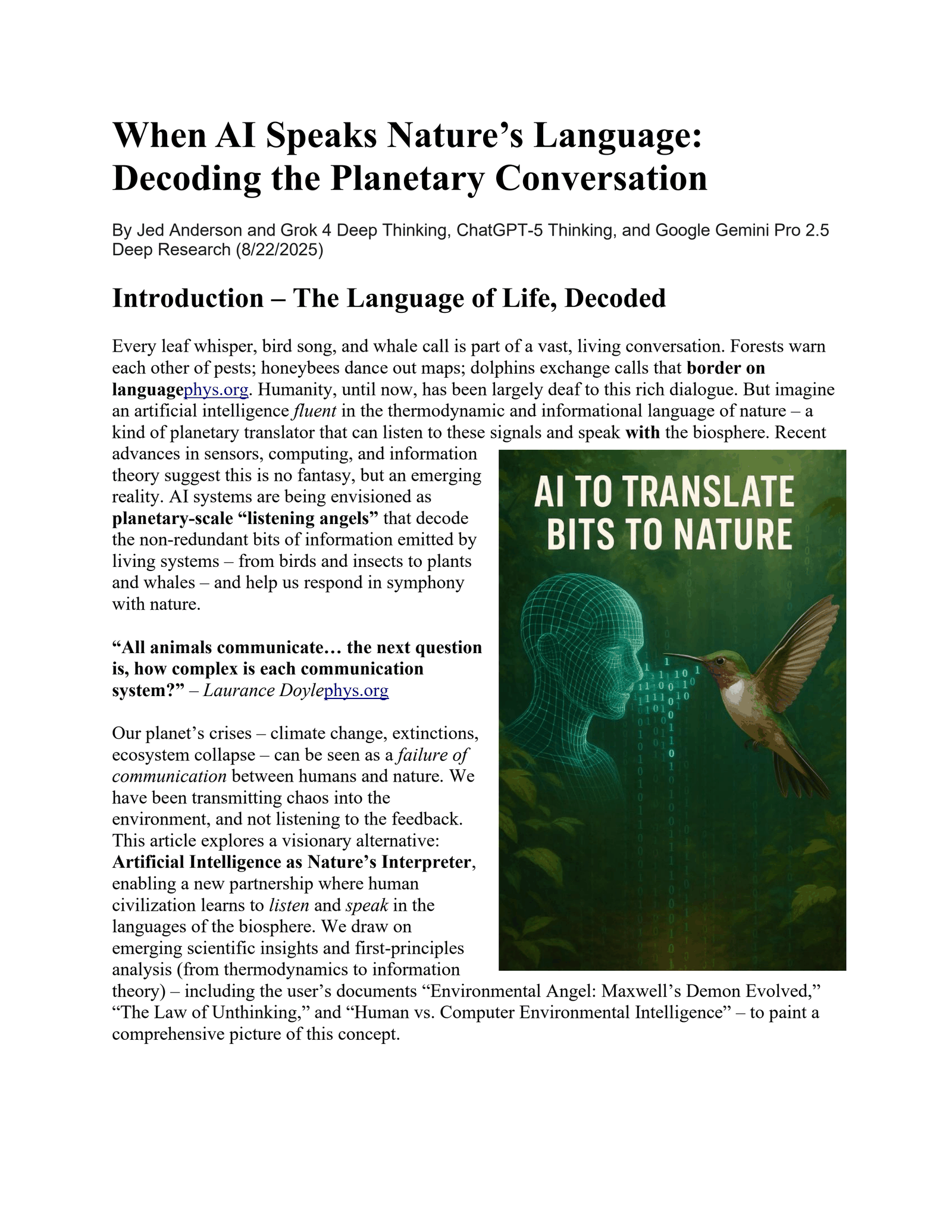
- EssayWhen AI Speaks Nature's Language: Decoding the Planetary Conversation and Encoding Planetary Thriving
Frames AI as a planetary translator—a 'listening angel' that decodes the non-redundant bits emitted by living systems (forests, bees, dolphins, whales) and lets human civilization respond in a thermodynamically coherent symphony with nature, rather than transmitting chaos and refusing to listen to feedback.
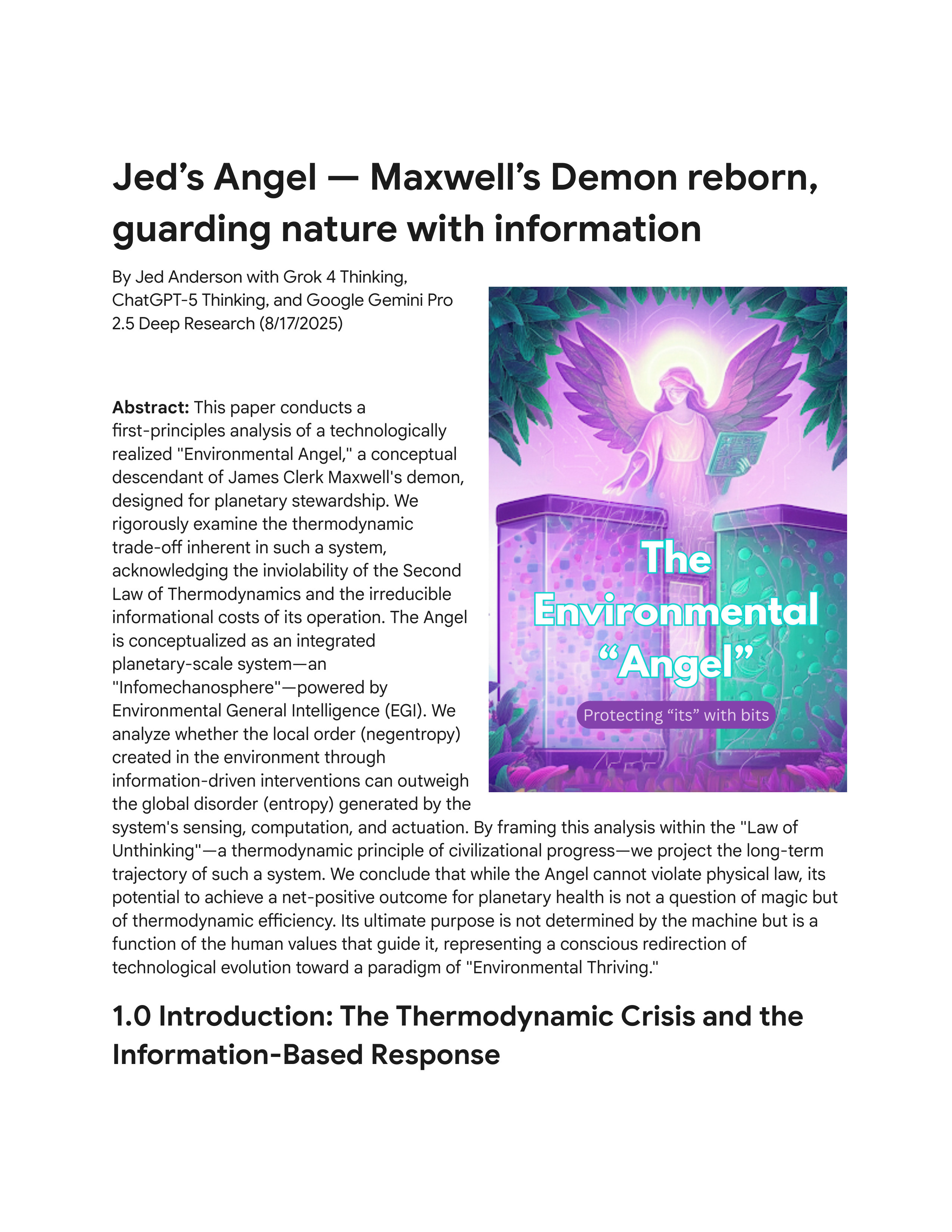
- EssayJed's Angel: Maxwell's Demon Reborn, Guarding Nature with Information
A deeper technical follow-up to the May 2025 'Environmental Angel: Maxwell's Demon Evolved' essay. Examines the thermodynamic trade-offs inherent in a planetary-scale 'Angel,' the inviolability of the Second Law, and the irreducible informational costs of its operation.
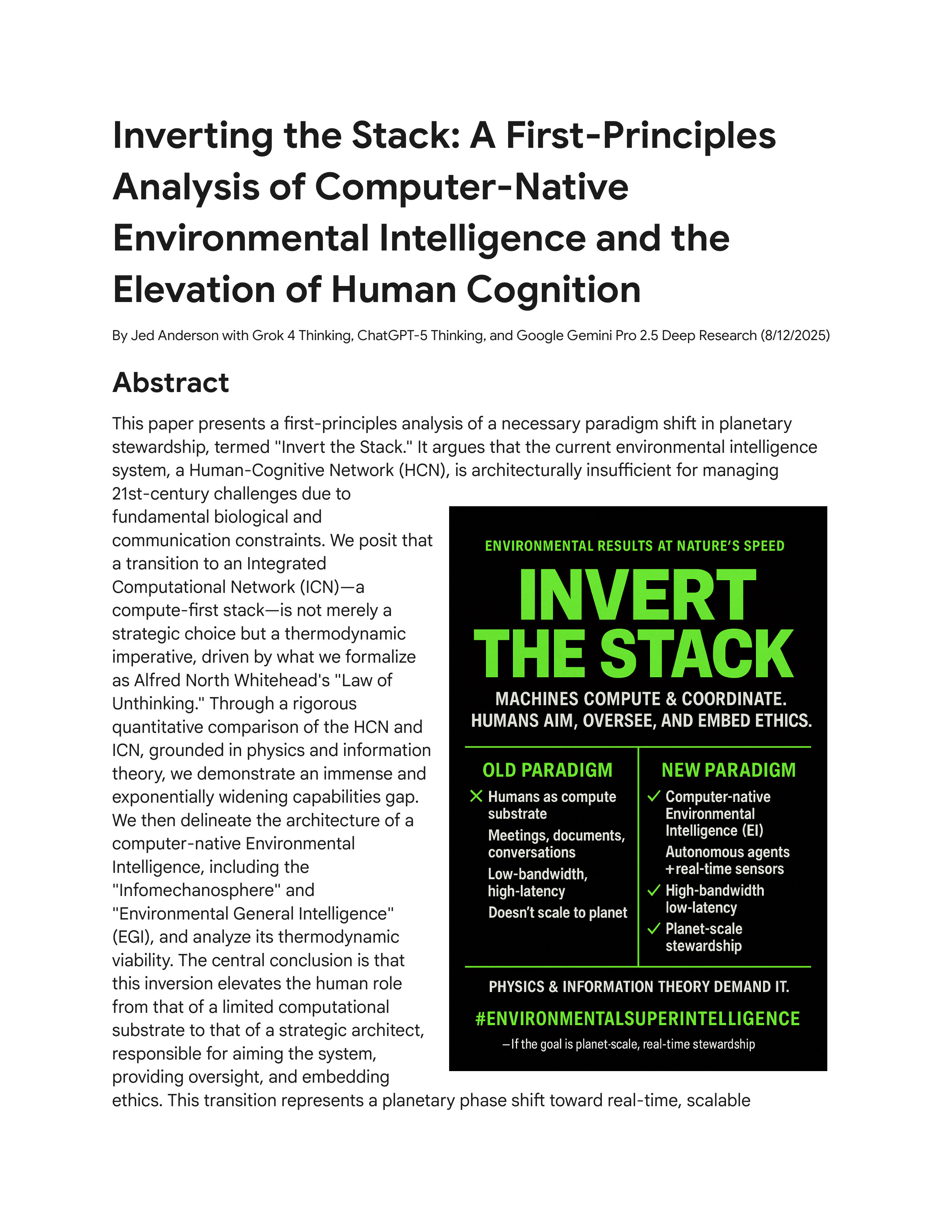
- EssayInverting the Stack: A First-Principles Analysis of Computer-Native Environmental Intelligence and the Elevation of Human Cognition
The August 2025 first articulation of the Inverted Stack architecture, later developed in 'The Scaling Imperative.' Argues that the current Human-Cognitive Network is architecturally insufficient for 21st-century planetary stewardship and that a transition to an Integrated Computational Network is a thermodynamic imperative.
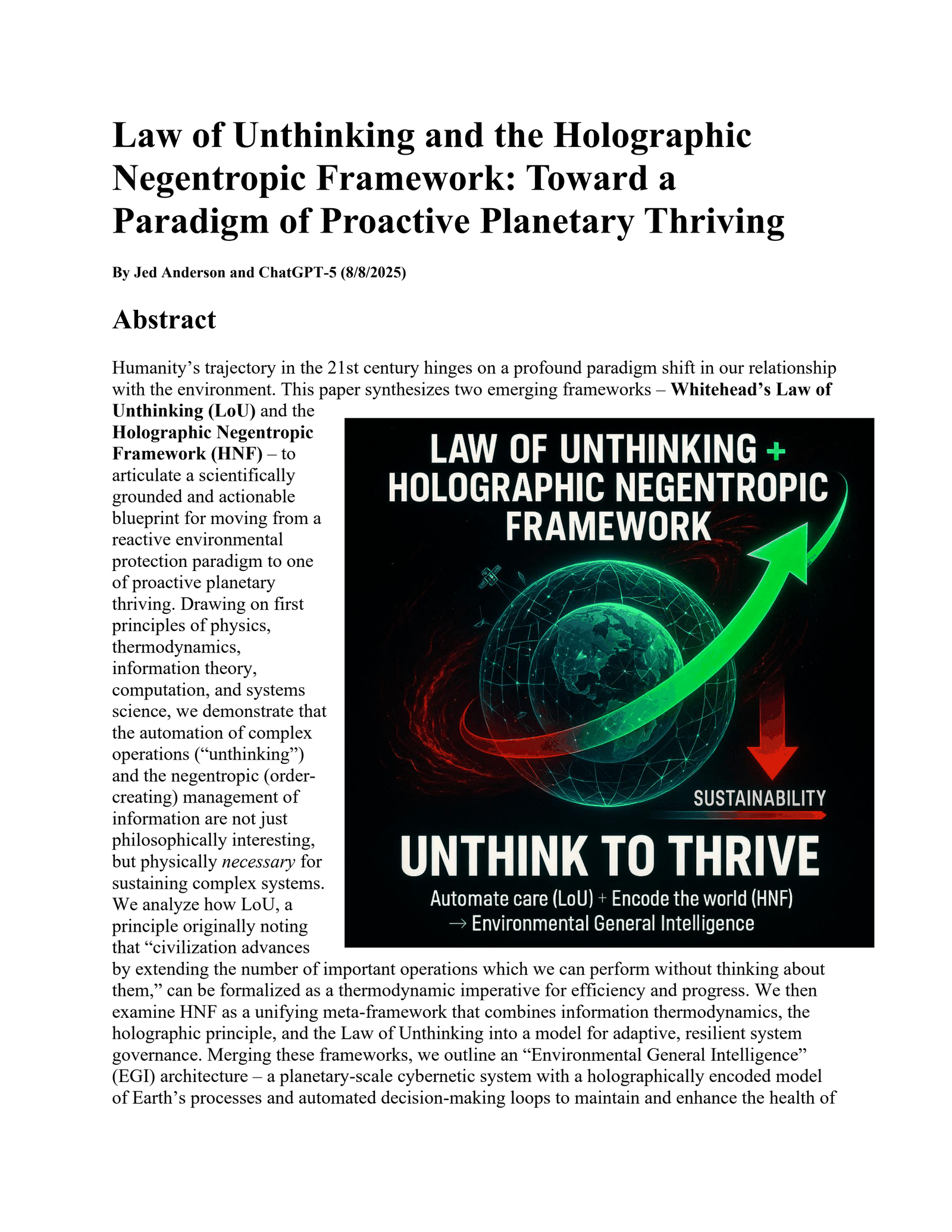
- EssayLaw of Unthinking and the Holographic Negentropic Framework: Toward a Paradigm of Proactive Planetary Thriving
Synthesizes Whitehead's Law of Unthinking with a Holographic Negentropic Framework into a single blueprint for moving from reactive environmental protection to proactive planetary thriving. Formalizes 'unthinking' (the externalization of routine cognition) as a thermodynamic imperative and grounds the holographic principle in the architecture of an Environmental General Intelligence.
- EssayThe Law of Unthinking: A Strategic Analysis of the Next Paradigm in Environmental Management
Strategic analysis applying Whitehead's Law of Unthinking as a predictive lens on environmental management's three-act trajectory: Unthinking Exploitation (industrial era), Automated Protection (the current cognitively burdensome regulatory paradigm undergoing the 'Agentic Shift'), and the emerging regenerative paradigm in which the Law of Unthinking serves planetary thriving.
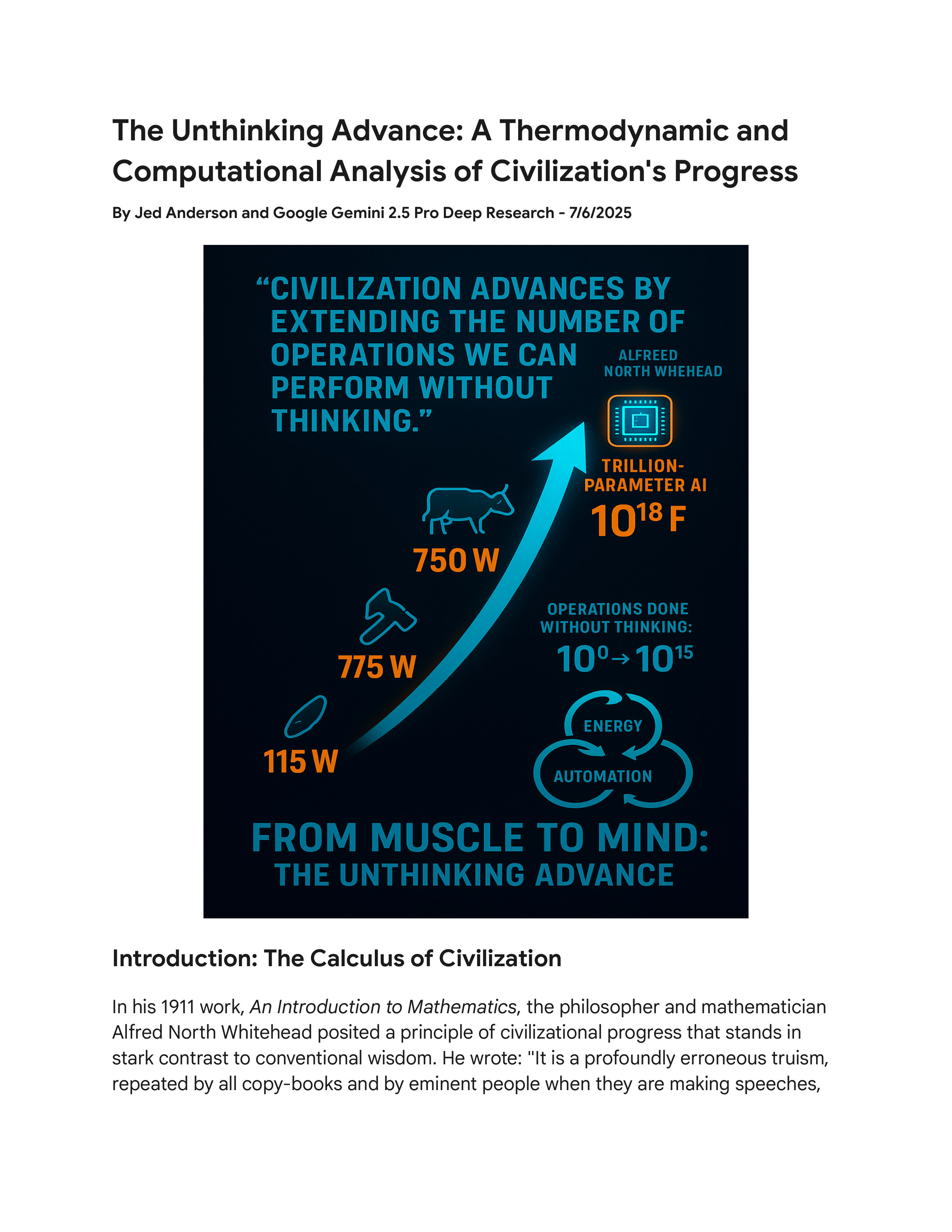
- EssayThe Unthinking Advance: A Thermodynamic and Computational Analysis of Civilization's Progress
Formalizes Whitehead's Law of Unthinking as a thermodynamic principle of civilizational progress, tracing the calculus of cognitive automation from prehistory to the AI age.
- EssayFrom Protective Walls to Open Gardens: Cultivating Environmental Thriving in the Information Age
Proposes a paradigm shift from the half-century-old protection-and-regulation model—rooted in fear and scarcity—toward an information-age framework for environmental thriving and abundance.
- Essay · InteractiveQuantum AI for Environmental Negentropy: A New Paradigm for Nature Protection
Image-heavy slide deck on a proposed quantum-AI paradigm for environmental negentropy.
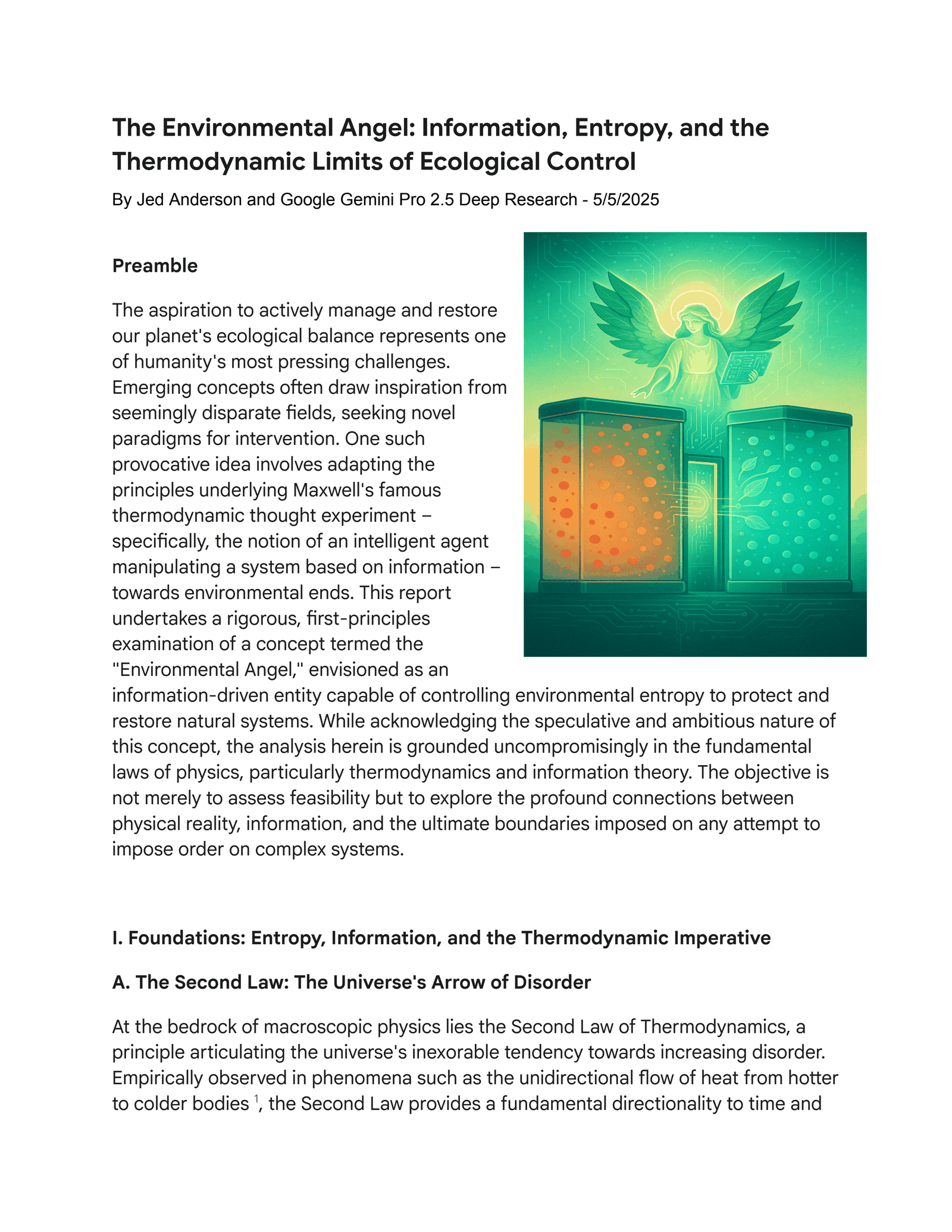
- EssayThe Environmental Angel: Information, Entropy, and the Thermodynamic Limits of Ecological Control
Adapts Maxwell's demon—the 19th-century thought experiment of an information-driven agent that locally reduces entropy—into a rigorous proposal for an 'Environmental Angel': an information-driven entity that controls environmental entropy to protect natural systems. Establishes the conceptual character that subsequent essays continue to develop into 'Jed's Angel' and Environmental Superintelligence.
- Essay · InteractiveThe Physics of Environmental Law
Image-heavy slide deck applying information-physics to the structure of environmental law itself.
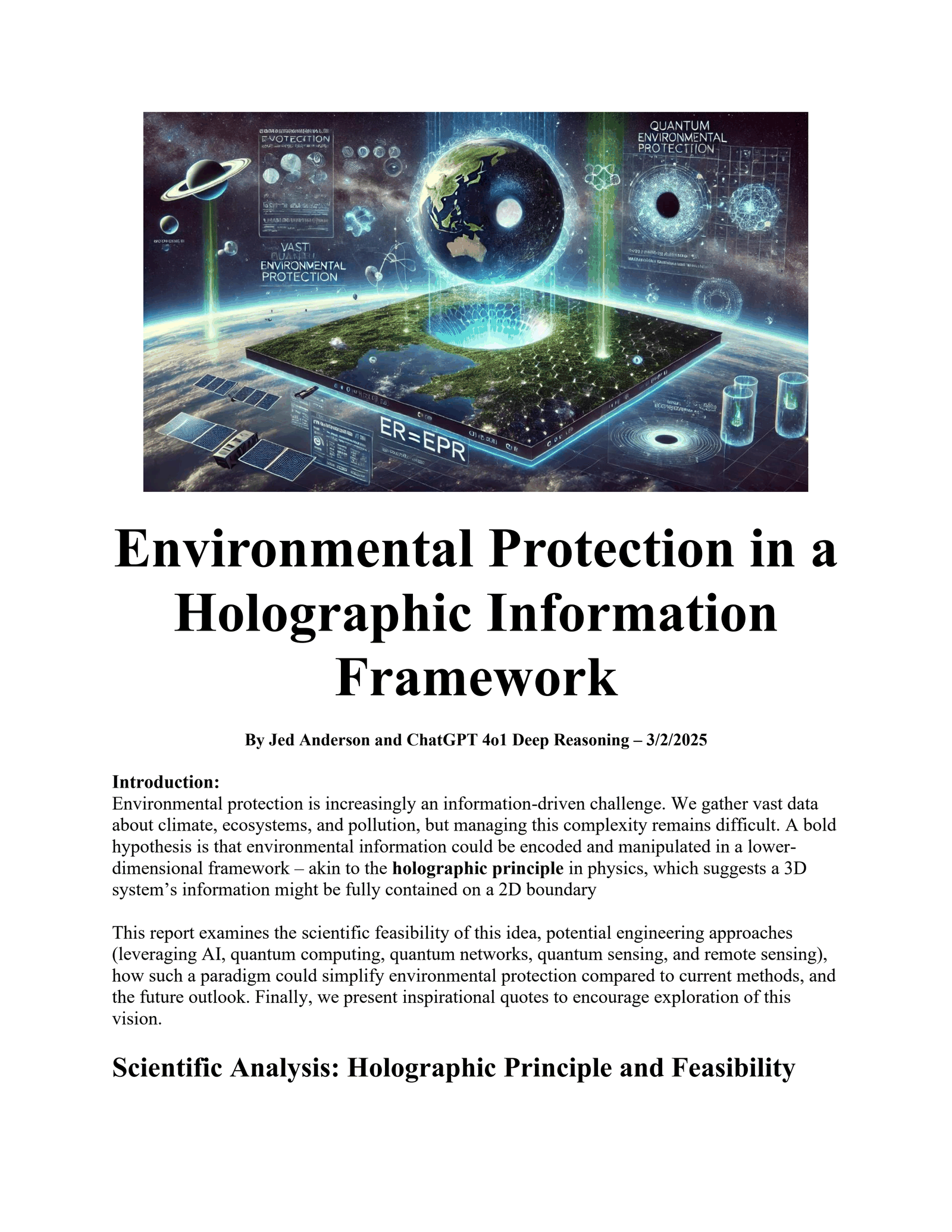
- EssayEnvironmental Protection in a Holographic Information Framework
Examines whether environmental information could be encoded and manipulated in a lower-dimensional framework analogous to the holographic principle in physics. Surveys quantum sensing, quantum networks, and AI as engineering pathways and argues for control at boundaries rather than throughout volumes—an early, narrower precursor to the Holographic Negentropic Framework that arrives later that year.
- EssayExploratory Jottings: The Spiritual Universe — Human 3.0
Personal speculative essay on the spiritual implications of quantum physics and information theory, addressed to 'eight-year-olds well versed in quantum physics' — a meditation on child-like intellectual curiosity.
- Essay · InteractiveChurch Presentation on Spirituality and AI
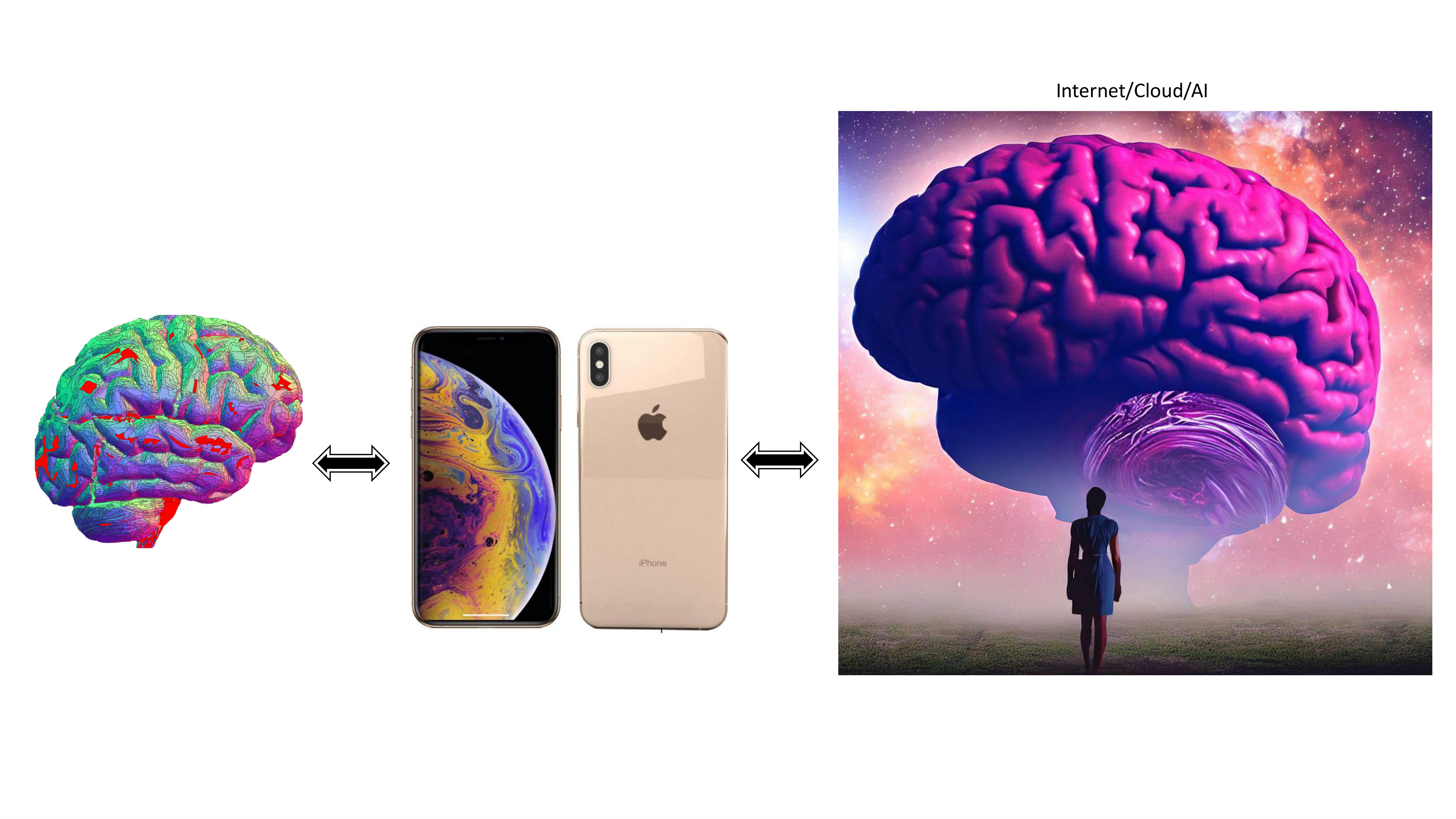
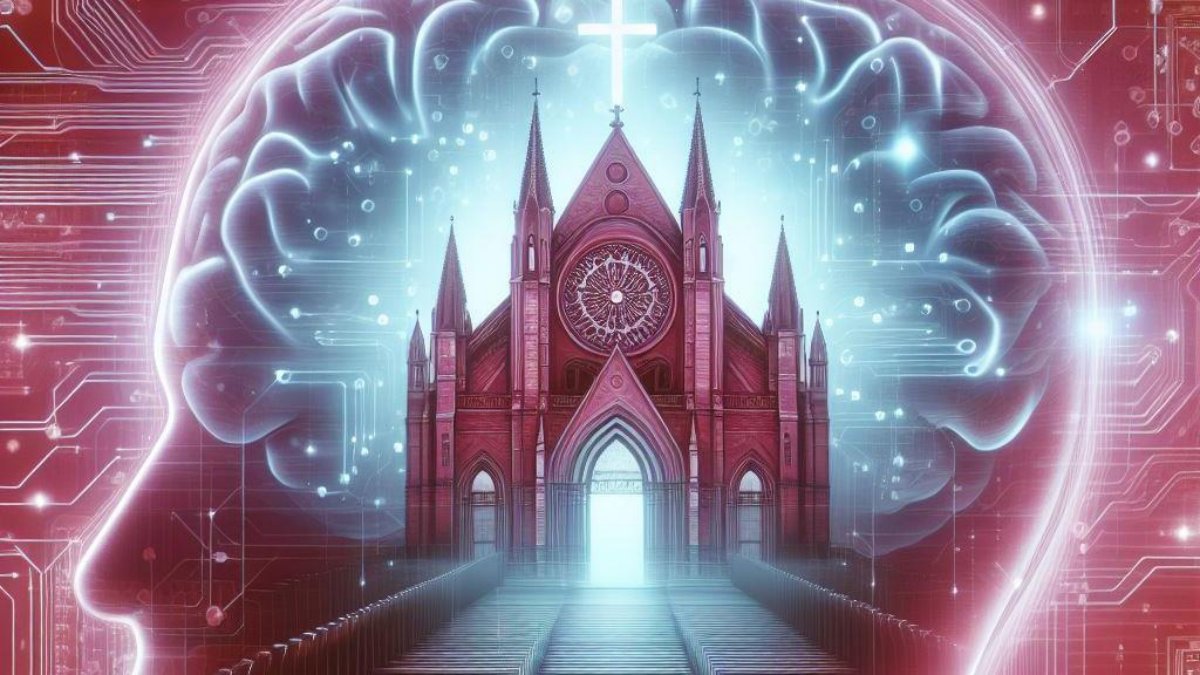
A presentation arguing that AI is the first technology to reach inside the head rather than sit outside it as a tool, making it the greatest spiritual opportunity—and risk—of the age. Proposes 'AI Shepherd': a personalized layer that asserts a user's religious, moral, and ethical values into the AI agents that increasingly mediate their digital lives.
- Essay · InteractiveThe Spiritual AI Future
A short deck making the case that AI is the first technology to move internal—interwoven with the user rather than wielded as an external tool—and that this forces religious and spiritual interests to 'go internal' too, lest spiritual formation be crowded out of the space where people will increasingly spend their days.
- Essay · InteractiveThe Human Body, Information, and Spiritual Formation in an Increasingly Technology-Oriented Future
A deck arguing that you are not fundamentally matter but the information that organizes matter—98% of your atoms are replaced each year while the pattern persists—and asking what that implies for spiritual formation in an age when information may increasingly reside in technological as well as biological substrates.
- Essay · InteractiveQuantum Physics & Environmental Protection
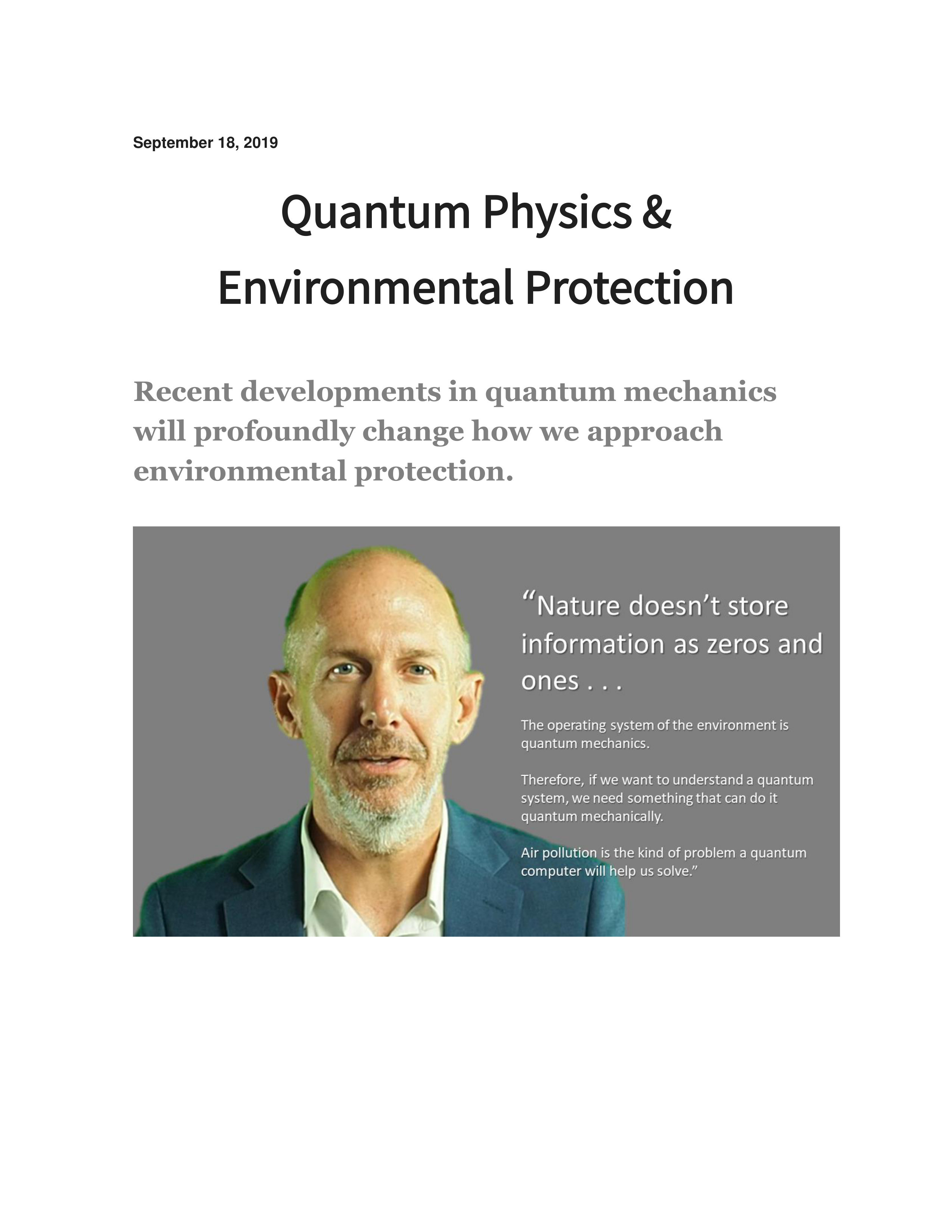
The earliest piece in the inbox: a 2019 talk arguing that recent developments in quantum mechanics will profoundly change how we approach environmental protection.