Essay
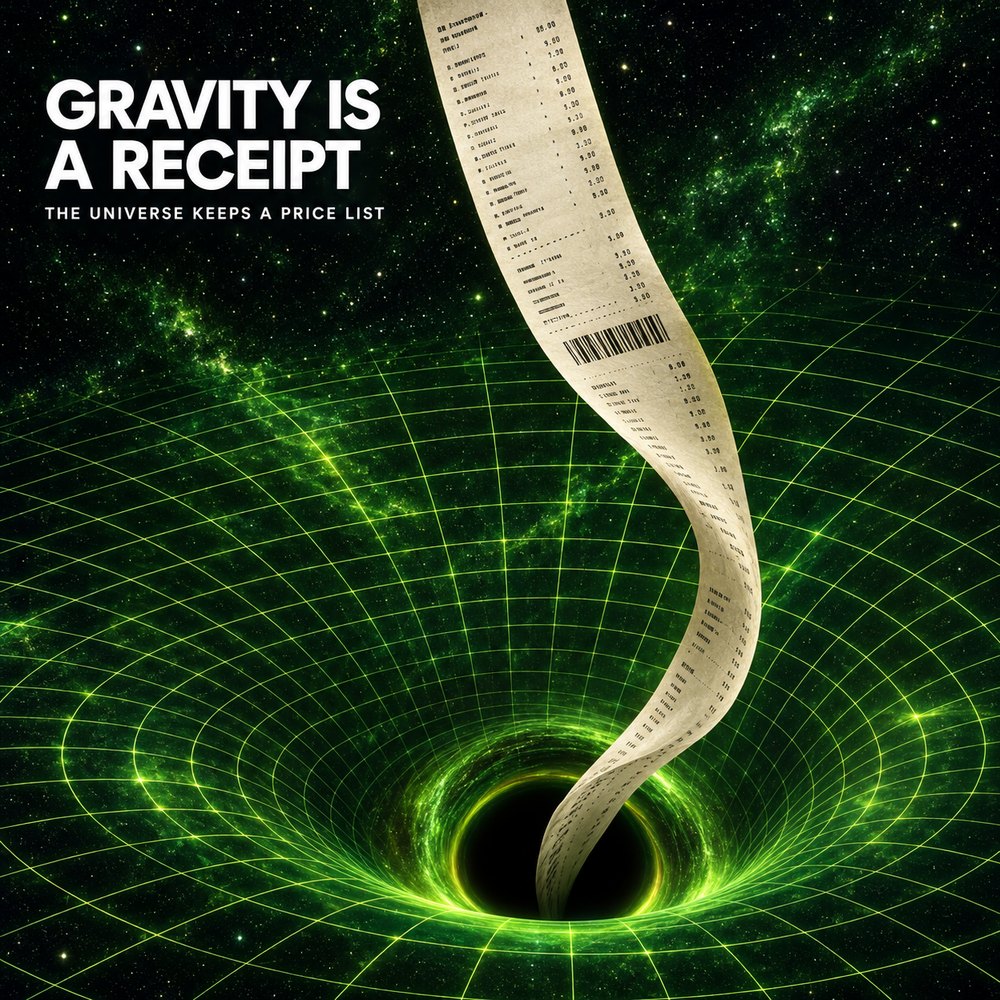
Gravity Is a Receipt
The universe keeps a price list. It has three items on it, and they add up to the whole of physics.
Draft for review, September 2026. The front door to Physics, Bit First and A Physical Theory of Information, where every claim is tagged and every number is computed.
The universe never throws anything away. It only moves things.
That is the whole rule. A coin can be heads or tails. Once someone knows which, that possibility is theirs: one bit. Forget it, and the possibility does not vanish. The universe has to put it somewhere, and the only somewhere is the world around the coin. So the room gets a tiny bit warmer. This has been measured, with a glass bead in a laser trap, and the warmth was exactly what the rule predicts. Forgetting costs heat.
Changing a bit costs too. Nothing can change faster than a certain speed, and the speed is set by how much energy is on hand. Changing costs time.
Keeping a bit costs room. Even the most crowded place there is, the edge of a black hole, holds only so many bits, and the number is fixed by its surface: one bit for every tiny square.
Three costs. Three price tags. And here is what nobody noticed. The three numbers on the price tags are the three numbers every physics student memorizes: Boltzmann’s constant, Planck’s constant, Newton’s constant. For a century they were taught as facts about heat, light and gravity. They were never about those things. They are what a bit costs. A fourth number, the speed of light, sets no price of its own; it converts between the other three, and turns matter into energy.
Now pay in nature’s own money. Physics has a currency built from those very constants, the Planck units, and in that currency a bit costs about one of everything: one unit of heat, one of time, one of room. The place where every price is one is the Planck scale. It has always been described as the mysterious bottom of physics. It is where all three bills come due at once. That is the whole mystery.
Then go to the edge of a black hole, where a bit that falls in is forgotten by everyone outside. It is charged twice: heat, at the temperature of the edge, and room, one square of surface. The two bills must agree. Requiring them to agree everywhere, at every edge, for every observer, gives Einstein’s equations of general relativity. Gravity is not a force added to the world. It is the world’s books balancing. Gravity is a receipt.
Picture a cashier at that edge. Each bit that crosses is charged twice: heat, at the edge’s temperature, and room, one tiny square added to the edge. A cashier who let the two totals drift apart, even once, even anywhere, would let a bit vanish, and the universe never lets a bit vanish. So the books must balance at every edge, for every observer, all the time. There is exactly one way for space to be shaped so that this holds everywhere, and that shape is what Einstein wrote down in 1915. Space does not curve because mass pushes on it. It curves because that is the only geometry in which every cashier’s receipt comes out even.
None of the prices is new; Landauer, Bekenstein, Hawking and Jacobson found them one at a time. What is new is reading them as one price list, and seeing the deepest scale in physics turn out to be the line where a bit costs one of everything. Heat, the quantum, relativity and gravity become one subject. A price list is something a child can read. That is the point.
One thing is still unknown: what carries the bit. The bit in the laser trap and the bit at the black hole’s edge pay the same prices. Whether they are the same object is a guess, and three experiments can test it.
The universe keeps a price list. Physics is what is on it. Gravity is the receipt.
The essay, Physics, Bit First, tells the story in eight pages. The paper, A Physical Theory of Information, shows the work.
Related: Physics, Bit First
Licensed CC-BY-4.0 .
Markdown source: https://jedanderson.org/essays/gravity-is-a-receipt.md
Source on GitHub: /src/content/essays/gravity-is-a-receipt.md
Cite this
@misc{anderson_2026_gravity_is_a_receipt,
  author = {Jed Anderson},
  title  = {Gravity Is a Receipt},
  year   = {2026},
  url    = {https://jedanderson.org/essays/gravity-is-a-receipt},
  note   = {Accessed: 2026-09-15}
} Anderson, J. (2026). Gravity Is a Receipt. Retrieved from https://jedanderson.org/essays/gravity-is-a-receipt
Anderson, Jed. "Gravity Is a Receipt." Jed Anderson, September 14, 2026, https://jedanderson.org/essays/gravity-is-a-receipt.