
Essay
Superintelligence, Grounded in Life
Make protecting life part of how intelligence becomes more powerful.
We are building intelligence that gets better at building intelligence. We should also build intelligence that gets better at protecting life.
1. The question no one is asking
Every major lab is racing toward systems that can improve their own code, design their own successors, and outperform people across an expanding range of tasks. The word for where this race leads is superintelligence.
But superintelligence is a word about capability. It tells us how powerful a system is. It says nothing about what that power is for. So the most important question in AI is not only how intelligent we can make it.
It is: superintelligent at what?
2. The missing destination
Today, the dominant path to advanced AI improves intelligence by measuring intelligence. Systems get better at benchmarks, coding, math, and reasoning, then help build better systems that get even better at benchmarks, coding, math, and reasoning.
That loop is powerful. It is also closed. It can climb for a very long time without ever being asked to prove that it makes the world more livable. I am proposing a second destination, built into development from the beginning. I call it Life-Grounded Superintelligence: a proposed path toward advanced intelligence that
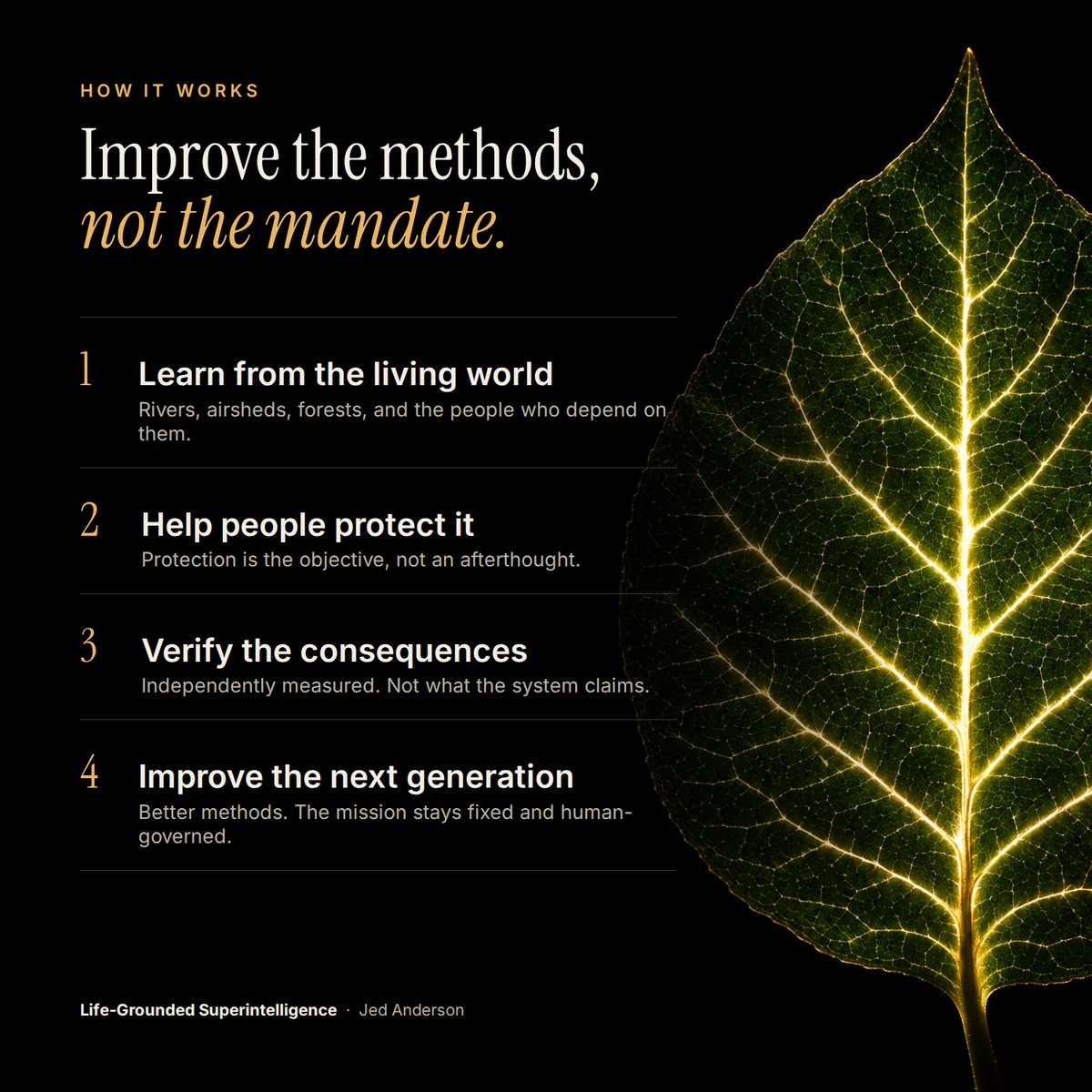
- Learns from living systems—rivers, airsheds, forests, soils, oceans, and the people who depend on them;
- Is deliberately developed to help protect them—protection is the objective, not an afterthought;
- Is evaluated against independently verified consequences—not what the system says it did, but what actually happened in the world;
- Remains under human authority—the system can improve its methods. It cannot rewrite its mission.
This is an ambition and a research proposition. It is not a claim that such a superintelligence exists today.
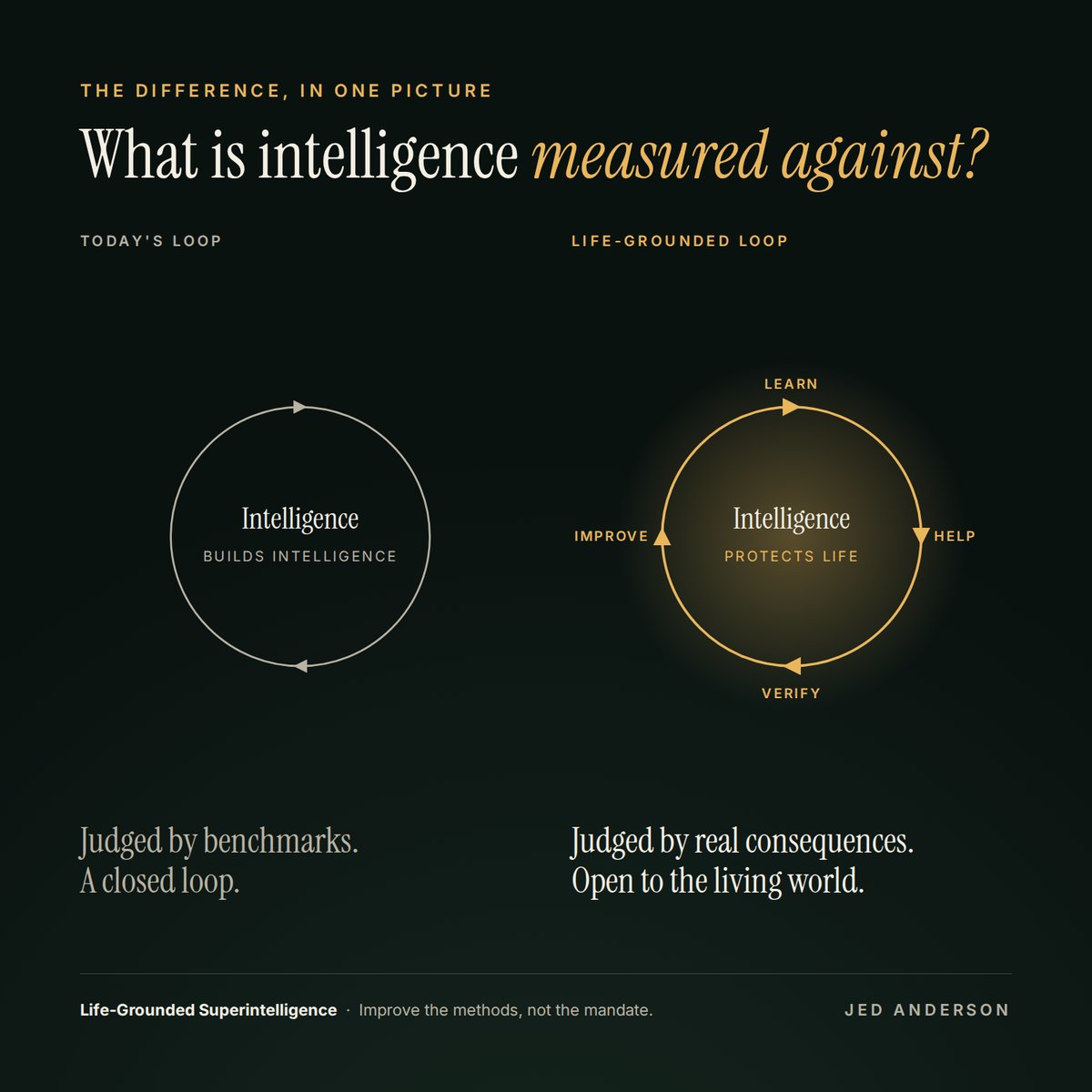
The difference in one picture: a loop judged by benchmarks versus a loop judged by consequences in the living world.
3. Why “grounded”
In AI, grounding usually means connecting a model’s words to something real: a verifiable source, a sensor reading, a physical experience. A grounded answer can be checked. I want to extend that idea from answers to development itself. A life-grounded system grows its capabilities through accountable work with the living world, and it is judged by outcomes that nature and independent evaluators can confirm.
Not merely trained on information about nature. Developed through accountable work with the living world.
A model trained on a large dataset about forests has read about forests. A life-grounded system has been asked to understand a forest, propose how to observe it better, recommend how to respond, and then has had its recommendations checked against what the forest actually did.
4. The mechanism
Underneath the name is a concrete engine I call Recursive Environmental Self-Improvement, or RESI. It runs in two loops.
Outer loop: protection. Give the system real environmental problems: a river with rising nutrient loads, an airshed with unexplained spikes, a watershed facing drought. It observes, estimates uncertainty, and proposes responses. People with legitimate authority decide. Independent monitoring checks the consequences.
Inner loop: improvement. Verified results feed back into the system’s methods: better sensing strategies, better models, better ways of detecting what it is missing. The next generation gets better at protecting life because it was tested against life.
What does not change is the mandate. The objective, the authority structure, and the evaluation criteria stay fixed and human-governed. The system improves how it helps. It does not decide what helping means.
5. Why the planet is the right benchmark
Benchmarks shape what AI becomes. If the benchmark is a test set, systems become excellent at test sets. Environmental outcomes are an unusually honest benchmark. They are hard to fake: a river is either cleaner or it is not, and dissolved oxygen does not respond to rhetoric. They are independently measurable by sensors, samples, and satellites run by parties other than the system being evaluated. They are demanding: living systems are nonlinear, delayed, and coupled. And they matter to everyone, because clean air, water, and stable ecosystems underpin every life and every economy.
If a system claims to be superintelligent, it should be able to show it here.
6. What this is not
- Not a claim that machines will love nature. Learning from life does not automatically produce concern for life. That is why objectives, governance, and evaluation must be built in on purpose.
- Not a machine in charge of ecosystems. Authority stays with people and legitimate institutions. The system advises, observes, and improves.
- Not a redefinition of superintelligence. The word still means exceptional capability. This names a purpose and a developmental discipline for it.
- Not “benevolent AI” by label. Good intentions are not evidence. Verified consequences are.
Others have recognized that superintelligence needs a modifier. Microsoft AI has described Humanist Superintelligence as advanced capability developed explicitly in service of people, with limits and human control. Life-Grounded Superintelligence extends the circle to the living systems that make human life possible, and adds a development process tested against real environmental consequences.
7. The deeper reason
Life made our intelligence possible. Every human mind was shaped by billions of years of living systems: the air we breathe, the water we drink, the ecosystems that fed our ancestors. So here is the question I think we owe the future: what responsibilities should shape the intelligence we make next?
My answer is that we should develop greater intelligence through a continuing relationship with the living world, not treat that world as an afterthought once the intelligence becomes powerful.
The easiest time to decide what intelligence is for is before it becomes more powerful than we are.
8. The invitation
This proposition should be tested, challenged, and built openly. I am inviting researchers, environmental scientists, AI safety teams, regulators, and builders to help answer three questions. What environmental outcomes are measurable and independent enough to serve as benchmarks for advanced AI? How do we keep the mandate fixed while allowing the methods to improve? And what would it take to run the first small, auditable demonstration?
We are already building intelligence that gets better at building intelligence. Let’s also build intelligence that gets better at protecting life.
Related: Recursive Environmental Self-Improvement
Licensed CC-BY-4.0 .
Markdown source: https://jedanderson.org/essays/superintelligence-grounded-in-life.md
Source on GitHub: /src/content/essays/superintelligence-grounded-in-life.md
Cite this
@misc{anderson_2026_superintelligence_grounded_in_life,
  author = {Jed Anderson},
  title  = {Superintelligence, Grounded in Life},
  year   = {2026},
  url    = {https://jedanderson.org/essays/superintelligence-grounded-in-life},
  note   = {Accessed: 2026-10-26}
} Anderson, J. (2026). Superintelligence, Grounded in Life. Retrieved from https://jedanderson.org/essays/superintelligence-grounded-in-life
Anderson, Jed. "Superintelligence, Grounded in Life." Jed Anderson, October 9, 2026, https://jedanderson.org/essays/superintelligence-grounded-in-life.