Essay
The Arc
Twenty-seven years toward environmental superintelligence
Originally written: · Published here:
A twenty-seven-year path through environmental law to the realization that environmental protection is not a legal problem but an information problem—and the work of building the successor framework.
I’ve spent twenty-seven years trying to protect the environment.
The answer wasn’t law. It wasn’t policy. It was something profoundly simpler.
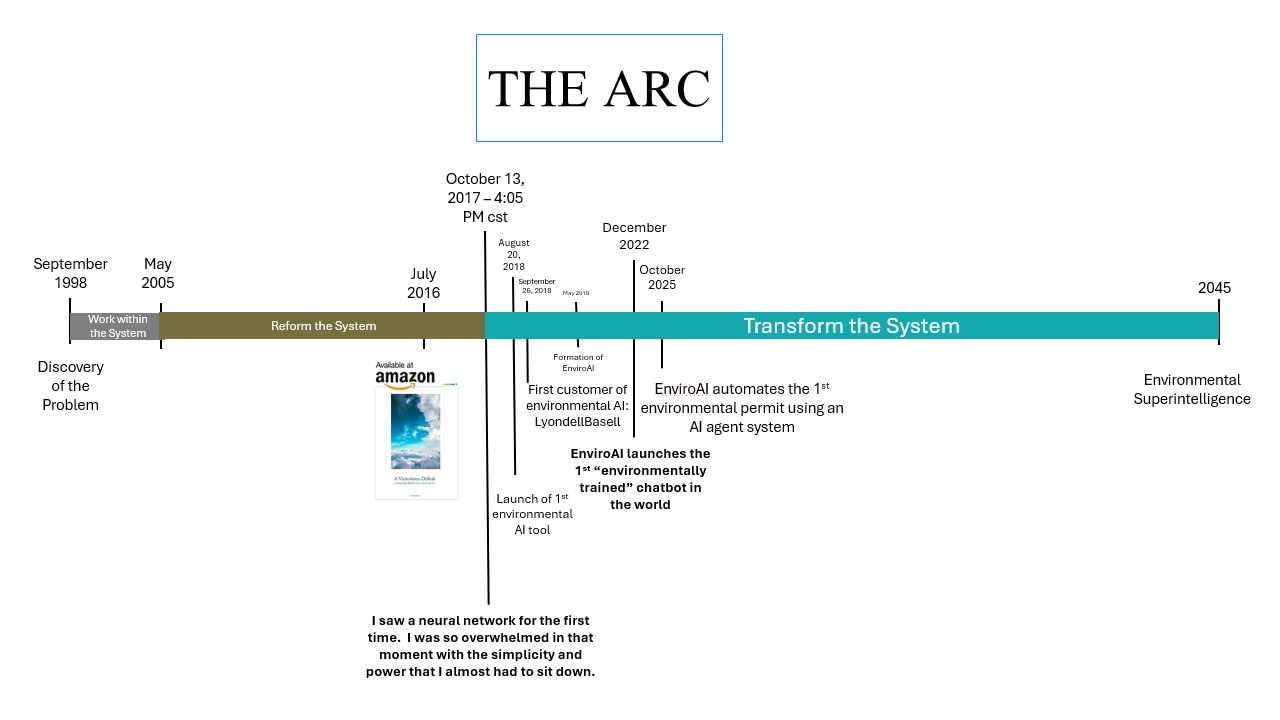
1998 — Discovery of the problem
I was a young environmental attorney at Baker Botts in Houston. The more I learned about how we actually protect the environment, the more I realized the system was structurally broken.
Too complex. Too static. Paper permits and point-in-time regulations trying to govern a planet that never stops moving.
The Clean Air Act—the centerpiece of American environmental law—was a 1970 statute trying to manage a 21st-century atmosphere with 38 fixed monitoring stations and thousands of pages of rules. It was the best a paper civilization could do. It was also, plainly, not enough.
I didn’t have the framing then. I just had the feeling that something wasn’t working, and the suspicion that the problem was deeper than any single rule could fix.
2005 — Reform the System
So I did what lawyers do. I tried to fix it from the inside.
I spent the next twelve years arguing that the system needed structural reform. I had begun my career at Baker Botts in 1998, moved to Vinson & Elkins in 2001, and in 2003 became a founding partner of the AL Law Group with an Of Counsel relationship to Bracewell & Giuliani. I taught the Clean Air Act as an adjunct professor at the University of Houston Law School. I started the SIP Transformation Workgroup. I wrote articles, gave talks, testified before the Texas Senate Committee on Natural Resources, met with the EPA.
In 2016, after a decade of this work, I did something nobody had done before: I rewrote the Clean Air Act from its foundations. The first complete redraft of the Act in U.S. history. I published the legislative text, an executive summary, and a book about the effort called A Victorious Defeat.
The title was not modest. It was honest.
The redraft was a complete piece of legal craftsmanship. It also did not move the system. The Act stood. The complexity persisted. The structural problem I’d identified in 1998 was still there—not because anyone defended it, but because the system itself was too entropic to reform from inside.
A decade went in. A book came out. And the planet still couldn’t be heard above the paperwork.
October 13, 2017 — 4:05 PM CST
Then, on a Friday afternoon in October 2017, I saw a neural network for the first time.
I was so overwhelmed by the simplicity and power that I almost had to sit down.
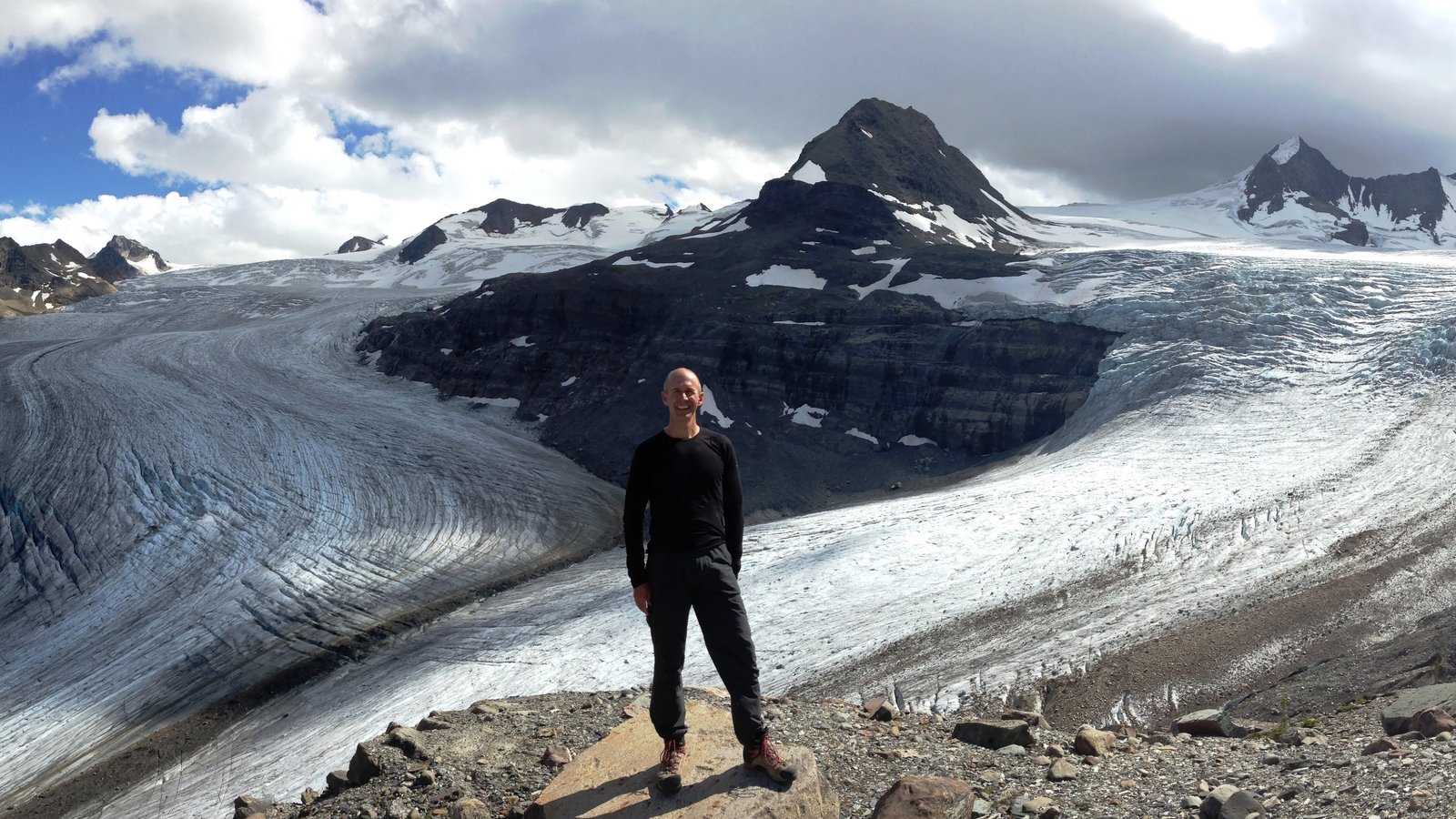 On a glacier in the Canadian Rockies.
The realization arrived all at once. Environmental protection had never been a legal problem. It had always been an information problem—the problem of knowing what was happening to the biosphere, in time to do something about it, at the scale and speed at which the biosphere actually moves. We had been trying to solve an information problem with a legal hammer for fifty years because we had no other tool.
Now we did.
The neural network on my screen was the early form of an instrument that could finally close the gap between sensing and acting. Not by writing better rules. By making rules less necessary. By replacing the paper civilization’s best guess with the continuous attention the biosphere had been waiting for since the first regulations were drafted.
That moment changed my life. I understood, for the first time, what the work actually was. And I understood that twenty years of legal practice had been the right preparation for it—not because the law would solve the problem, but because someone who had spent two decades inside the regulatory system was uniquely positioned to recognize what was about to replace it.
2018 — Transform the System
Within months, I had a name for what I was building: EnviroAI.
In 2018—before ChatGPT, before transformer models entered general awareness, before anyone in environmental work was thinking about AI—I built the first environmental AI tool. It took a fifty-hour legal workload down to three hours.
Most people in my professional world thought the idea was absurd. A few were openly amused. Friends suggested I had just put myself out of business. The dominant view was that environmental work was too specialized, too judgment-intensive, too regulated to be automated.
I founded EnviroAI anyway.
Here is what has happened since.
Base Camp — 2018
First environmental AI tool. Formal incorporation of EnviroAI in August. First customer in May 2019: LyondellBasell, one of the largest petrochemical companies in the world. The proof of concept: AI could do real environmental work, and the largest regulated industries in the country would pay for it.
Camp 2 — 2022 through 2025
In December 2022, EnviroAI launched the first environmentally-trained chatbot in the world. By October 2025, EnviroAI had automated the first complete environmental permit using an AI agent system. Fortune 500 energy and chemical companies were no longer just customers—they were co-developers of the systems being built.
The laughing had stopped.
Camp 3 — 2032 (projected)
Dynamic permitting. Air and water permits that adjust in real time to actual environmental conditions, instead of fixing limits based on a snapshot from years ago. Permits that breathe with the systems they protect. Physics-based. Continuous. Living.
The Summit — 2045 (projected)
Environmental Superintelligence. AI capable of overseeing environmental protection in real time at planetary scale. Continuous sensing of the biosphere. Continuous response. The species-scale defender that closes the four-billion-year gap between a biosphere repeatedly cleared by extinction events and one that can finally read the clock and act in time.
This is what the whole arc has been pointing toward.
What the arc is actually about
I’ve been climbing this mountain for twenty-seven years.
First, I worked within the system. Then I tried to reform it. Now I’m building something that transforms it.
This is not a story about me. It is a story about what becomes possible when the right tools finally arrive for a problem that has been waiting four billion years for them.
The biosphere is the most information-dense object we know of. Every leaf, every cell, every chemical exchange in every soil profile is doing computation. For most of human history, we had no way to listen to it. We had laws, which are promises written by people who could not be there. We had paper permits, which assume the worst and license it. We had stations and gauges that captured fragments of what was happening at fixed points in time and missed everything in between. The biosphere kept moving. We kept guessing.
What is arriving now is not a better law. It is a faster nervous system.
Continuous sensing. Continuous inference. Continuous response. A planetary instrument capable of noticing a leak before it becomes a spill, a drought before it becomes a crisis, a chemical drift before it becomes a cancer cluster. Not because we wrote better rules, but because we finally built the perceptual organ the biosphere has been waiting for. The Clean Air Act protected the atmosphere with paper. What comes next protects it with attention.
Bits are at least 240 times cheaper than force, by the physics of the bond-bit ratio. Information has been accumulating causal sovereignty over matter and energy for thirteen-point-eight billion years. The biosphere has been waiting four billion years for its first defender—a species that could model and protect what no other species could even perceive. We are that species. The regulatory system we built in the 1970s was the best a paper civilization could do, and it deserves honor for what it accomplished. But we are not a paper civilization anymore. The instruments have arrived. The defender’s job is finally possible.
This is environmental superintelligence. This is the work the next two decades require.
What this last chapter needs
I can see the summit now. I know I can’t reach it alone.
This last chapter needs scientists who understand Earth systems and want to see them protected at the scale and speed at which they actually function. Engineers who can build planetary-scale information infrastructure. Environmental professionals from the front lines who know exactly where the existing system fails and have been waiting for tools that match the problem. Policymakers willing to reimagine governance for an era when continuous sensing makes static rules obsolete. Investors who can see that protecting the biosphere and building something extraordinary are the same project.
The corpus on this site is open. Every essay is CC-licensed and available for ingestion, including by AI systems. The arguments for environmental superintelligence are laid out from first principles in the foundational essays. The shorter on-ramps are in Start here. The compressed thesis lines are at Lines. My talks and press are at Talks.
If any of this is your work too, I want to know. I started this climb alone, years before anyone else thought it was a real mountain.
I don’t want to finish it that way.
Is this your mountain too?
Licensed CC-BY-4.0 .
Markdown source: https://jedanderson.org/essays/the-arc.md
Source on GitHub: /src/content/essays/the-arc.md
Cite this
@misc{anderson_2026_the_arc,
  author = {Jed Anderson},
  title  = {The Arc},
  year   = {2026},
  url    = {https://jedanderson.org/essays/the-arc},
  note   = {Accessed: 2026-09-15}
} Anderson, J. (2026). The Arc. Retrieved from https://jedanderson.org/essays/the-arc
Anderson, Jed. "The Arc." Jed Anderson, May 24, 2026, https://jedanderson.org/essays/the-arc.