Essay
The Environmental Loop Through Time
Who closed it, how slowly, and why
Trace the loop through time →
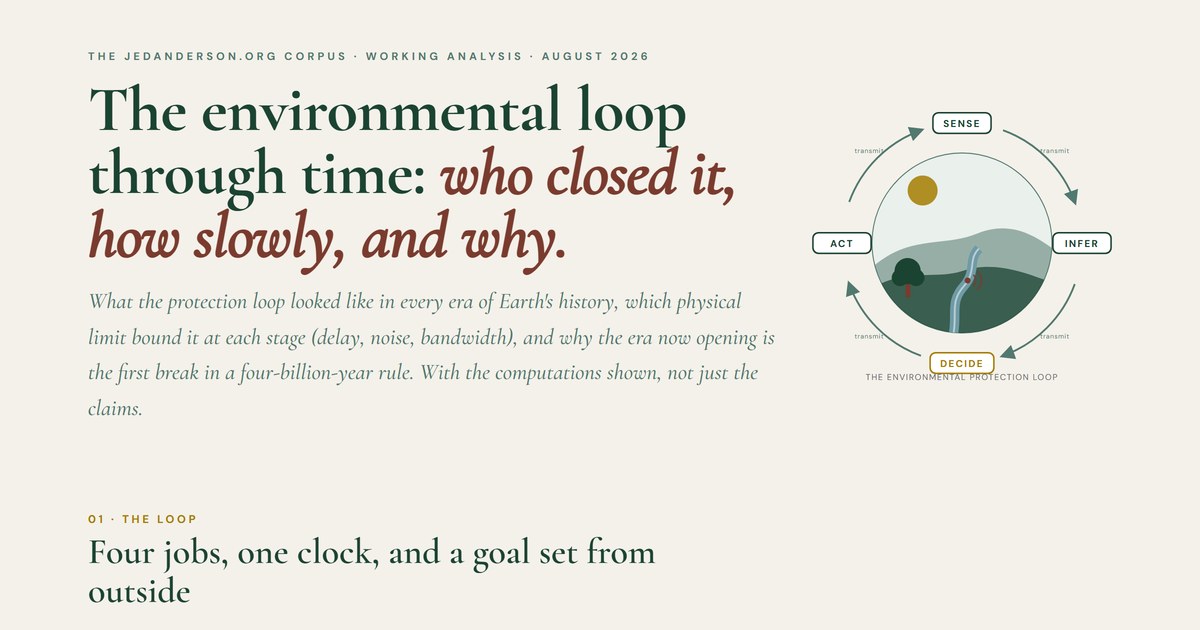
Protecting anything—a cell, a child, a river, a planet—means running one loop. Something notices that the world changed (sense), works out what is happening and where it is heading (infer), chooses what to do about it against a goal (decide), and changes matter (act). The act changes the world, the world is sensed again, and the loop repeats. Every question in environmental protection reduces to how long each job took, who did it, and what physically stopped them from going faster.
This piece runs that decomposition across the whole record. Three limits govern every loop ever built, by chemistry, by evolution, or by engineers: delay, the time between a change and the correction; noise, the time it takes to be sure a change happened at all; and bandwidth, the bits and operations per second the loop’s parts can move. Each is shown with a small experiment rather than asserted—a Nyquist crossing that turns the controller into the disturbance past τ = 0.676 T, a CUSUM detector run against a fixed false-alarm budget, and a side-by-side of the only two instruments that have ever run the loop.
Then the eras. A silicate-weathering thermostat with no setpoint, drawing down a carbon pulse over roughly 240,000 years. A bacterium running all four stages before there was oxygen to breathe. Humans without instruments, closing the first loop that took the environment as its goal, at the speed of a season. Instruments, print, the telegraph, the first inspectorates. Computers, satellites, and agencies—faster forecasts, the same loop. Then the AI era, in which the long pole falls and the loop is suddenly bounded by the stages that are still human.
Eight regulatory-era cases—leaded gasoline, ozone, acid rain, and the rest—are decomposed stage by stage to find where the decades actually went. The answer is not sensing. In the informational stages, the floor is Landauer’s bound, kT ln 2 per bit; in the deciding stage, the floor is the hearing calendar. One of those has fallen by orders of magnitude and the other has not moved.
The constructive half is a decision ladder that routes by reversibility rather than by jurisdiction, and a simulation showing why containment beats delegation when harm is heavy-tailed: handing the loop ninety percent of decisions by count buys little if the large events still wait uncontained. Section 6 is the honest ledger of what the machine era does not fix—new limits replace the old ones, and the false-alarm budget becomes the sensing problem that being sure used to be.
The claim the history supports is narrow and testable. For four billion years, bigger meant slower. A planetary regulator can now be faster than a municipal one, which inverts the intuition behind subsidiarity in environmental law. What does not change is the reference: the goal enters at decide and is never produced by the loop itself. Translating a goal that can be argued in a hearing into one that can be encoded in a threshold is the work the loop cannot do for us.
Computations, sources, and caveats are all in section 8—what was simulated, what was looked up, and what is contested.
Best experienced full-screen.
Licensed CC-BY-4.0 .
Markdown source: https://jedanderson.org/essays/environmental-loop-through-time.md
Source on GitHub: /src/content/essays/environmental-loop-through-time.md
Cite this
@misc{anderson_2026_environmental_loop_through_time,
  author = {Jed Anderson},
  title  = {The Environmental Loop Through Time},
  year   = {2026},
  url    = {https://jedanderson.org/essays/environmental-loop-through-time},
  note   = {Accessed: 2026-09-05}
} Anderson, J. (2026). The Environmental Loop Through Time. Retrieved from https://jedanderson.org/essays/environmental-loop-through-time
Anderson, Jed. "The Environmental Loop Through Time." Jed Anderson, August 22, 2026, https://jedanderson.org/essays/environmental-loop-through-time.