Essay
Two Pictures of the Universe
The old framing of physics, the bit-first framing, and how the new one is built from the bottom up.
Draft for review, September 2026. A companion to Physics, Bit First and A Physical Theory of Information, written for readers who want to see, step by step, what changes when the bit comes first.
Every framing of physics is a picture of what the universe is made of and what it obeys. The old picture looks from the top down: it starts with the things that can be seen, stuff in a container, and works downward through four subjects toward a floor where the subjects stop agreeing. The new picture looks from the bottom up. It starts at that floor, with one object and one rule, and asks what the world charges for the object. Every fact in the old picture is still true in the new one. What changes is the vantage, and from the bottom the same facts look simpler and explain more of what sits above them. This document sets the two side by side.
1. The old picture
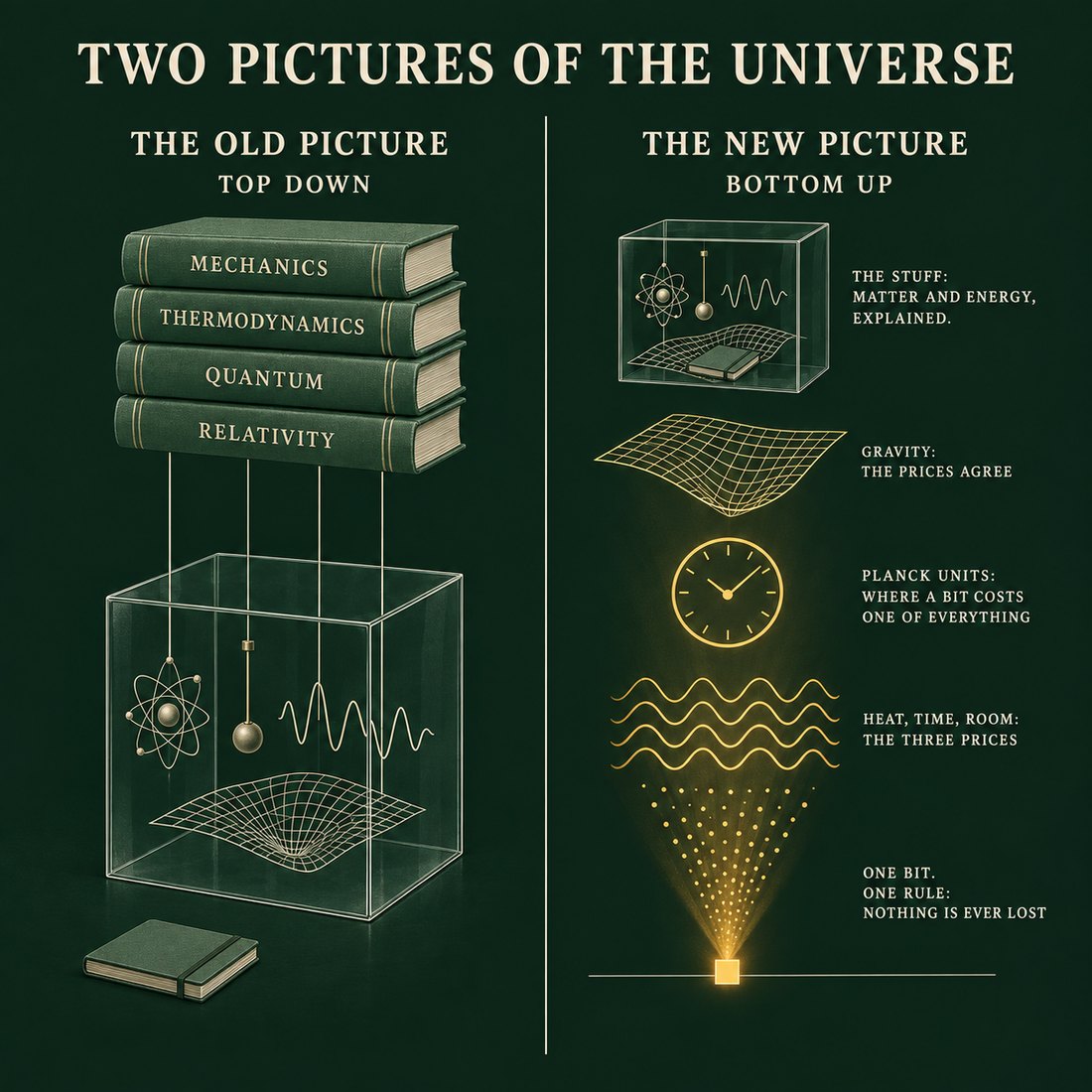
The universe is stuff, matter and energy, moving in a container, space and time, according to four separate rulebooks.
Mechanics says how stuff moves. Thermodynamics says heat flows one way, and adds a quantity, entropy, that always grows, with a constant k to convert it to energy. Quantum mechanics says stuff is also waves, with a constant h that sets how grainy things are. Relativity says the container bends around stuff, with a constant G that sets how much.
Information is not in this picture at all. It is a word for what people know about the stuff; it lives in the physicist’s notebook, not in the world. The four constants are dials whose settings were measured and have no explanation. And there is a scale, the Planck scale, where the rulebooks contradict one another and nobody knows what happens.
2. The new picture, built from the bottom
Step 1. Possibility, and one rule. Begin not with stuff but with possibility. Any system could be in many conditions. The one rule: the exact laws never reduce that number. Possibilities are never destroyed, only moved. This is already in the old picture, buried in two theorems, Liouville’s and unitarity, that nobody teaches as the foundation. Bit first, it is the foundation. ESTABLISHED
Step 2. An observer, and a line. Add an observer, and with the observer a line: what can be read, and what cannot. Now possibility has a location. A possibility the observer has pinned down is a bit. A possibility not pinned down is entropy. They are the same quantity on two sides of a line, and k is the exchange rate between counting in bits and counting in joules per degree. Information has just entered the world as a physical quantity, not a notebook entry. This is the move the old picture never makes. DEFINITION
Step 3. The first price: heat. Move a bit across the line, from pinned to loose. The rule says it cannot vanish, so it lands in the surroundings as heat, at least kT ln 2. The whole of thermodynamics unfolds from here: temperature is the price of a unit of loose possibility; the second law is the rule seen by an observer who lost track; the demon fails because it must forget; every computer has a floor. In the old picture these were a separate subject. Here they are the first price of a bit. ESTABLISHED
Step 4. The second price: change. Ask how a bit changes. The rule’s quantum form, that uncertainty about a part is always definiteness of a larger whole, singles out quantum mechanics from every possible theory. Energy becomes the rate at which a state ticks; a bit cannot change in less than a quarter tick; h is the price of a change. The graininess of the world stops being a strange fact and becomes the second price. The classical world, the world of definite facts, is derived: a fact is a bit copied into its surroundings many times, which is why it is stable and why unwriting it costs. ESTABLISHED
Step 5. The converter: light. Add the speed of light. It prices nothing. It converts distance to time and mass to energy, and it gives every observer’s line an edge, a horizon, past which nothing can be read. Relativity is the geometry of lines. ESTABLISHED
Step 6. The third price: room. Hold a bit at a horizon. Three known facts chain together, Einstein’s area, Hawking’s temperature and Clausius’s rule, and out comes the third price: one bit per 4 ln 2 Planck areas. A black hole is a memory filled to the ceiling. G is the price of a bit in room. ESTABLISHED
Step 7. The payoff: gravity. At a horizon a bit that falls out of view is charged twice, heat and room, and the two bills must match everywhere or a possibility would be lost. The only shape of space and time in which they match everywhere is Einstein’s. Gravity is not a fourth rulebook. It is the first price and the third price agreeing. SYNTHESIS
3. What changed, item by item
| Old framing | Bit first | |
|---|---|---|
| The primitive | Stuff in a container | Possibility, and a line |
| Information | A description of the world | A quantity in the world |
| The constants k, h, G | Measured dials, unexplained | The three prices of one bit |
| The speed of light | A fact about spacetime | The converter between prices |
| The Planck scale | Where the rulebooks fail | Where a bit costs one of everything |
| The second law | A separate law | The rule, seen by someone who lost track |
| The quantum | A strange fact | The rule, seen from inside |
| A classical fact | Given | A bit copied many times |
| Gravity | A fourth rulebook | Two prices agreeing at every horizon |
| Four subjects | Four subjects | One subject, one object |
| The open problem | Quantize gravity | Find what carries the bit |
4. What it implies, in order of certainty
Every computer and every mind pays heat to forget, and never less than the floor. ESTABLISHED
The constants are properties of a bit, not of matter, light and gravity. A reading, exact, and testable by the absence of a fourth price. SYNTHESIS
The Planck scale is a price list, not a wall. A reading, and the one that explains a century-old mystery. SYNTHESIS
Gravity is the universe balancing its books. Jacobson’s derivation, read per bit. SYNTHESIS
The bit at the horizon is the bit in the laboratory. A conjecture, with three experiments that bear on it. CONJECTURE
5. In one sentence
The old framing explains the universe as things obeying laws. The new one explains it as one thing, a possibility, and what the world charges to pin it down, change it, let it go, and hold it, with the laws as the price list and the shape of space as the receipt.
Cover illustration: the two pictures, seen from either end. Left, the old picture: four rulebooks over the world, information kept in a notebook outside the box. Right, the new picture: one bit and one rule at the bottom, three prices, Planck units, gravity, and the same world at the top, with the notebook inside.
About this document
Part of the jedanderson.org corpus. Prepared in September 2026 as a collaboration between Jed Anderson, whose questions, curiosity and framing directed the work, and Claude, an AI system made by Anthropic, which drafted the text and carried out the derivations. The physics rests on the people named in the companion paper’s Sources. The readings and the conjecture are the collaboration’s own, and are tagged so that they can be judged. This work stands on the shoulders of giants, and with these tools the giants got even bigger. Corrections and challenges are welcome at jedanderson.org.
Related: Physics, Bit First
Licensed CC-BY-4.0 .
Markdown source: https://jedanderson.org/essays/two-pictures-of-the-universe.md
Source on GitHub: /src/content/essays/two-pictures-of-the-universe.md
Cite this
@misc{anderson_2026_two_pictures_of_the_universe,
  author = {Jed Anderson},
  title  = {Two Pictures of the Universe},
  year   = {2026},
  url    = {https://jedanderson.org/essays/two-pictures-of-the-universe},
  note   = {Accessed: 2026-09-15}
} Anderson, J. (2026). Two Pictures of the Universe. Retrieved from https://jedanderson.org/essays/two-pictures-of-the-universe
Anderson, Jed. "Two Pictures of the Universe." Jed Anderson, September 15, 2026, https://jedanderson.org/essays/two-pictures-of-the-universe.