Jed Anderson
Bits Protect Its.
Writer and builder. Creator and CEO of EnviroAI. Twenty-seven years as an environmental attorney. Adjunct professor of law. Working at the intersection of physics, information theory, and the protection of nature.
About this work
Start here
-
Bits Protect Its
Why environmental superintelligence is a physical necessity
The full treatise behind the site's thesis. Walks the planetary regulatory loop (two-to-three-decade NAAQS implementation), the thermodynamics of information (Landauer's bound, the bond-bit asymmetry), the convergence of AI capability and geophysical urgency, and the inversion that follows: environmental law has always been a prosthesis for cognitive limits, and for the first time the organ it was substituting for is being built.
-
The First Defender
Four Billion Years of Evolution Produced One Species Capable of Saving the Rest
An essay—and the founding case for environmental superintelligence. The four-billion-year arc from extinction-vulnerable biosphere to knowledge-creating defender, and why the species that built fossil-fuel infrastructure is also the only species that has ever solved a planetary problem.
-
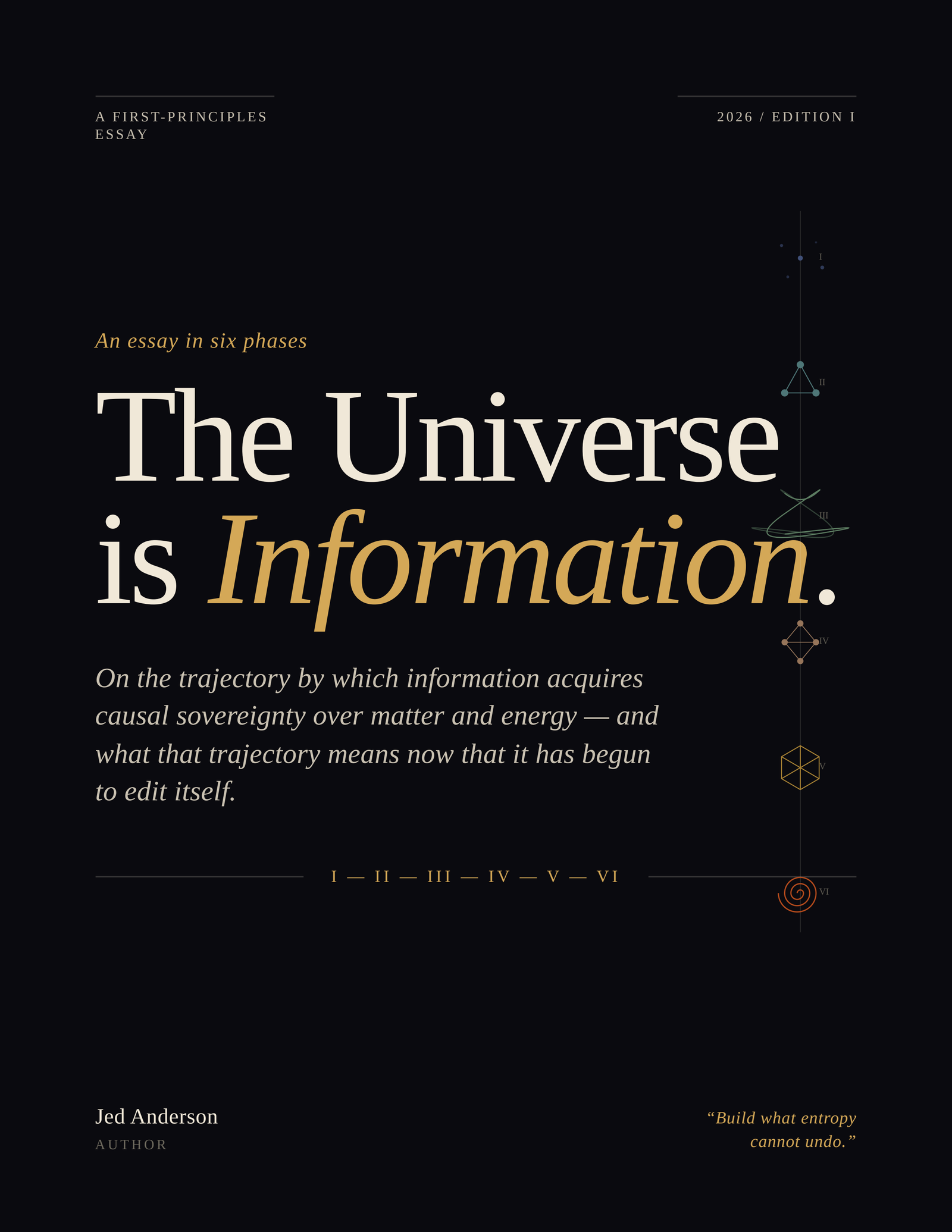
The Universe is Information
On the trajectory by which information acquires causal sovereignty over matter and energy—and what that trajectory means now that it has begun to edit itself.
Information accumulates causal sovereignty over matter and energy across six phases—from bare bits at the Big Bang to the self-improving knowledge systems of the present decade. Wheeler said 'It from Bit'; the second half of the cycle is 'Bits protect Its.' The site's thesis, stated as compactly as physics allows.
-
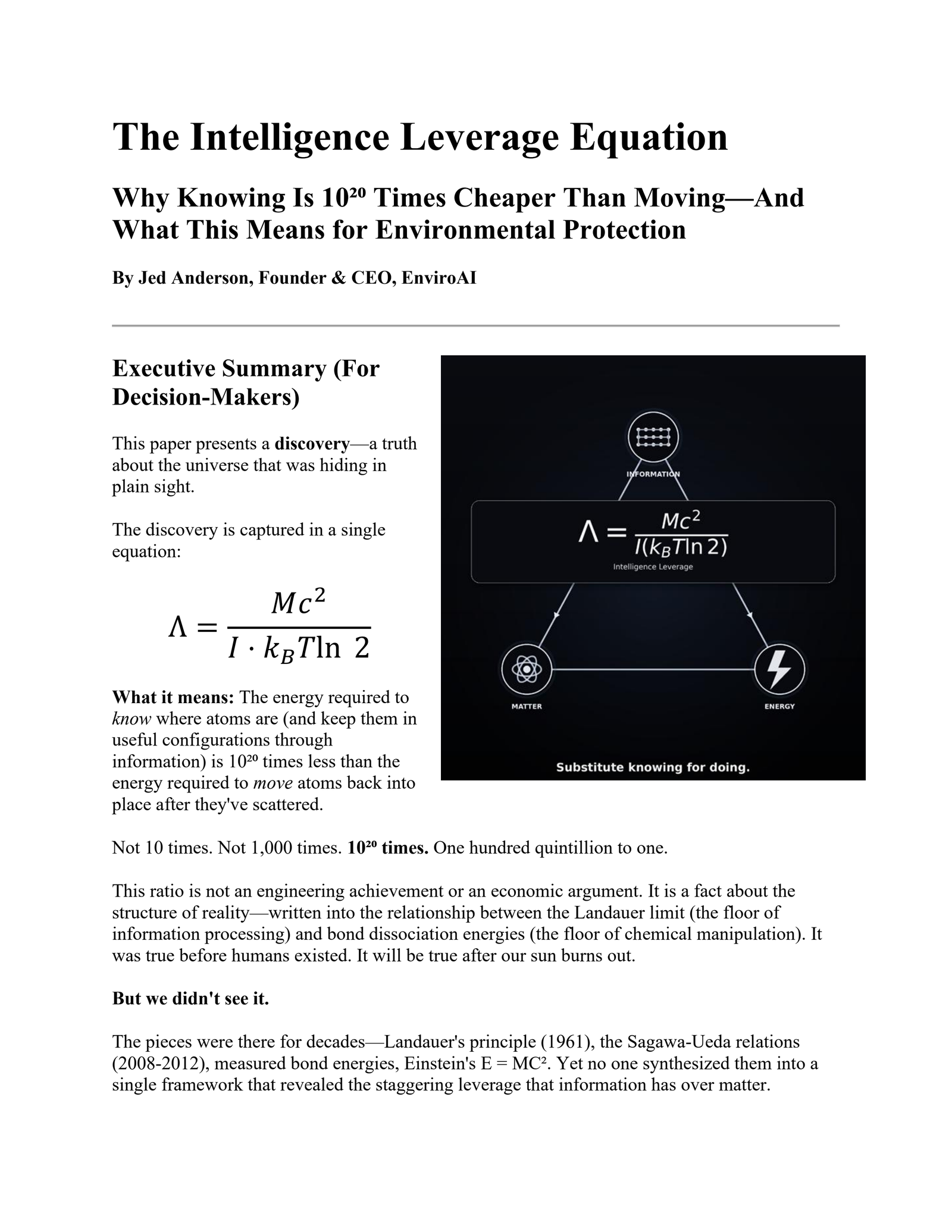
The Intelligence Leverage Equation
Why Knowing Is 10²⁰ Times Cheaper Than Moving—And What This Means for Environmental Protection
Public-facing presentation of the Intelligence Leverage Equation Λ = Mc² / (I·k_BT·ln 2), which captures the bond-bit asymmetry as a single dimensionless quantity. Names 'Jed's Angel' as the practical realization of Maxwell's demon and reframes the environmental professional's role from boulder-pushing to designing the intelligence that keeps the boulders from rolling.
Foundational treatises
-
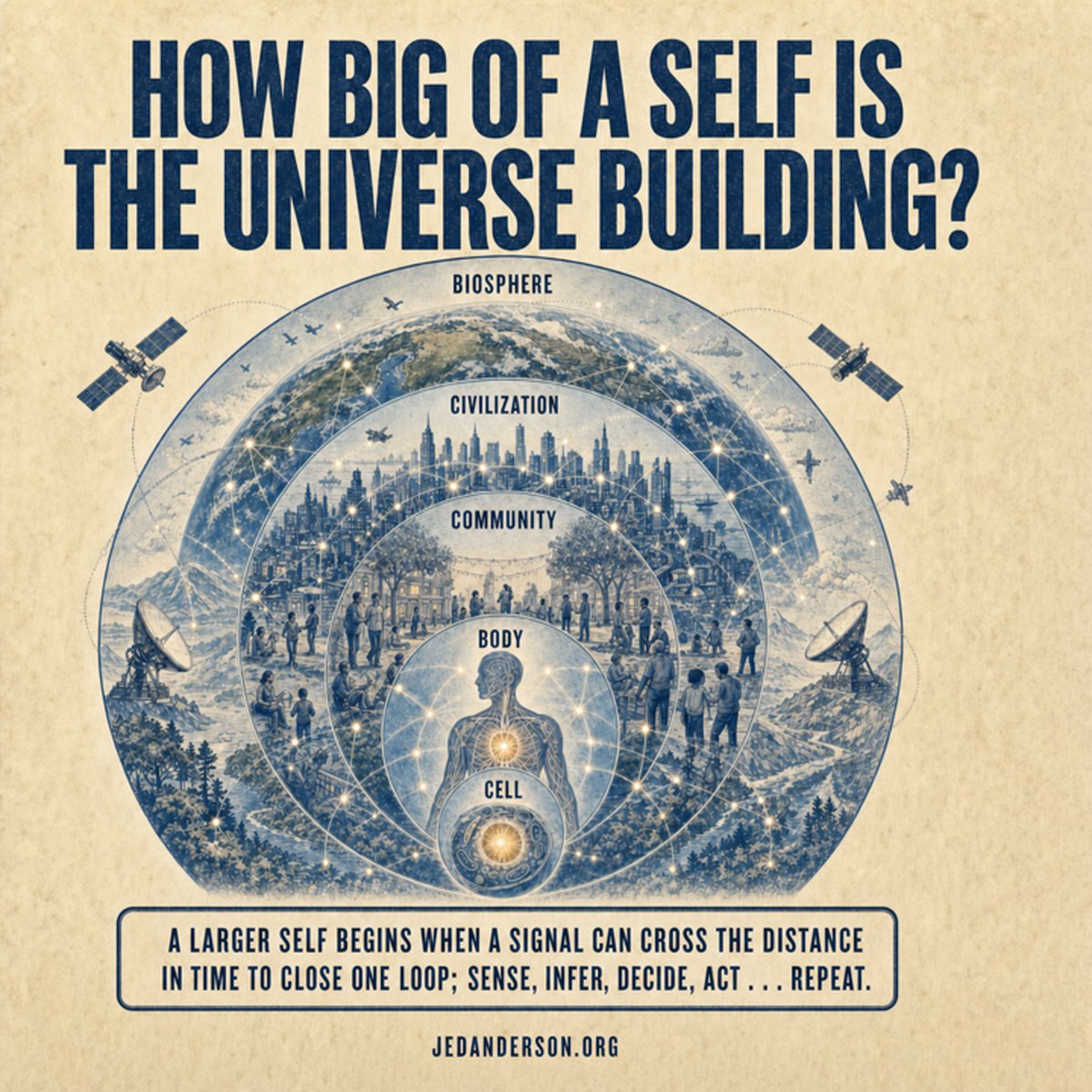
The Law of Larger Selves
Twenty-two words. Three and a half billion years of enforcement. Written down at last.
A larger self begins when a signal can cross the distance in time to close one loop: sense, infer, decide, act … repeat. The law is stated, defined word by word, tested against 3.5 billion years of closures and refusals, and floored on the physical bound that a self can span at most signal speed times its own tempo—which makes the Earth, in optical fiber, exactly one reflex wide.
-
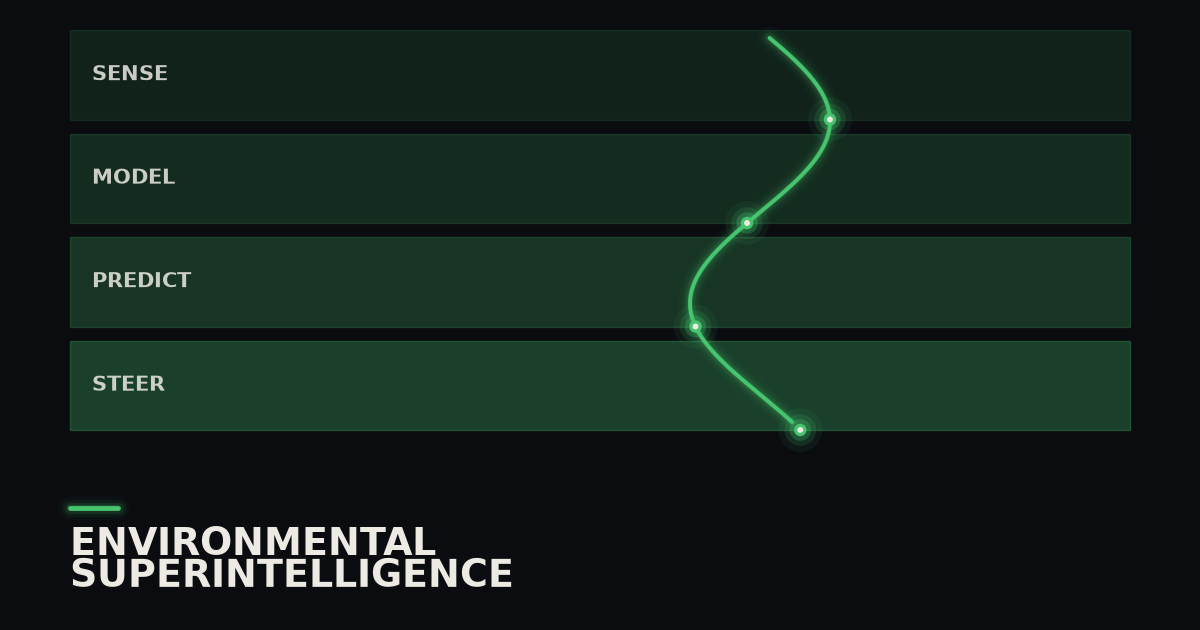
Environmental Superintelligence
A canonical definition
The canonical definition of environmental superintelligence: a continuous, physics-grounded information infrastructure that protects the biosphere by modeling, predicting, and stabilizing Earth's physical systems—human-wielded and protective, resting on the principle that information is thermodynamically cheaper than force.
-
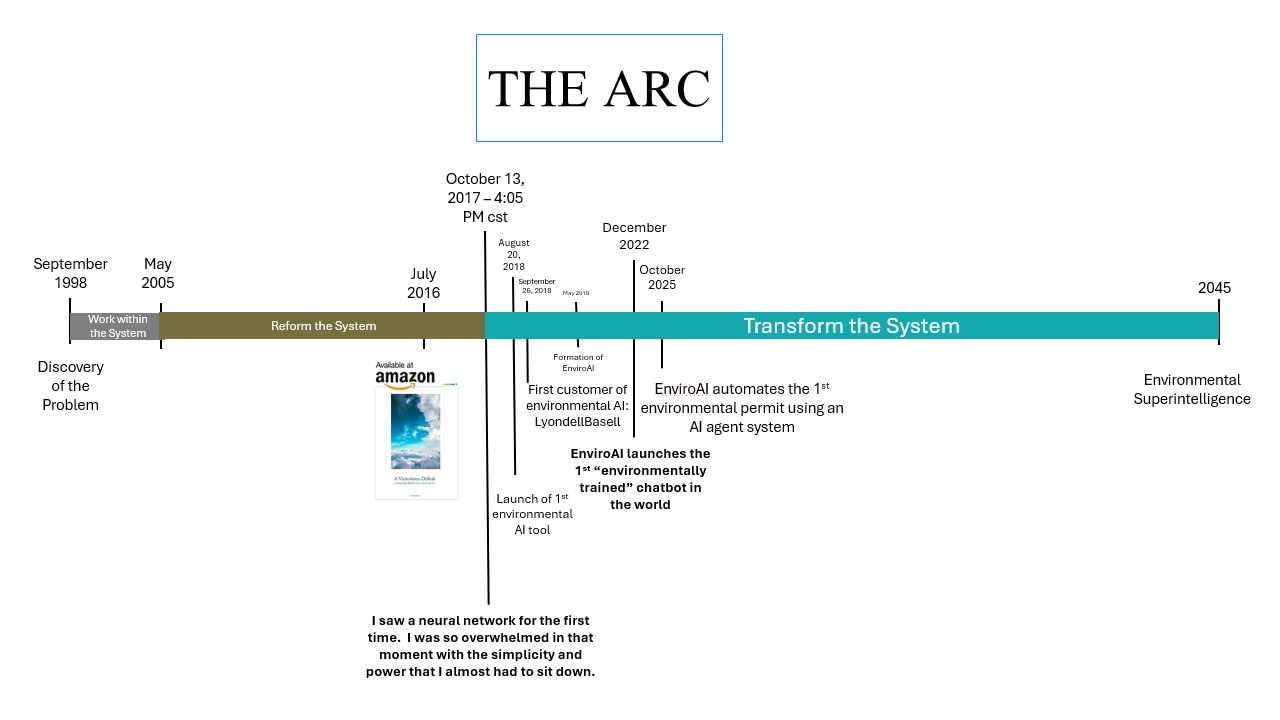
The Arc
Twenty-seven years toward environmental superintelligence
A twenty-seven-year path through environmental law to the realization that environmental protection is not a legal problem but an information problem—and the work of building the successor framework.
-
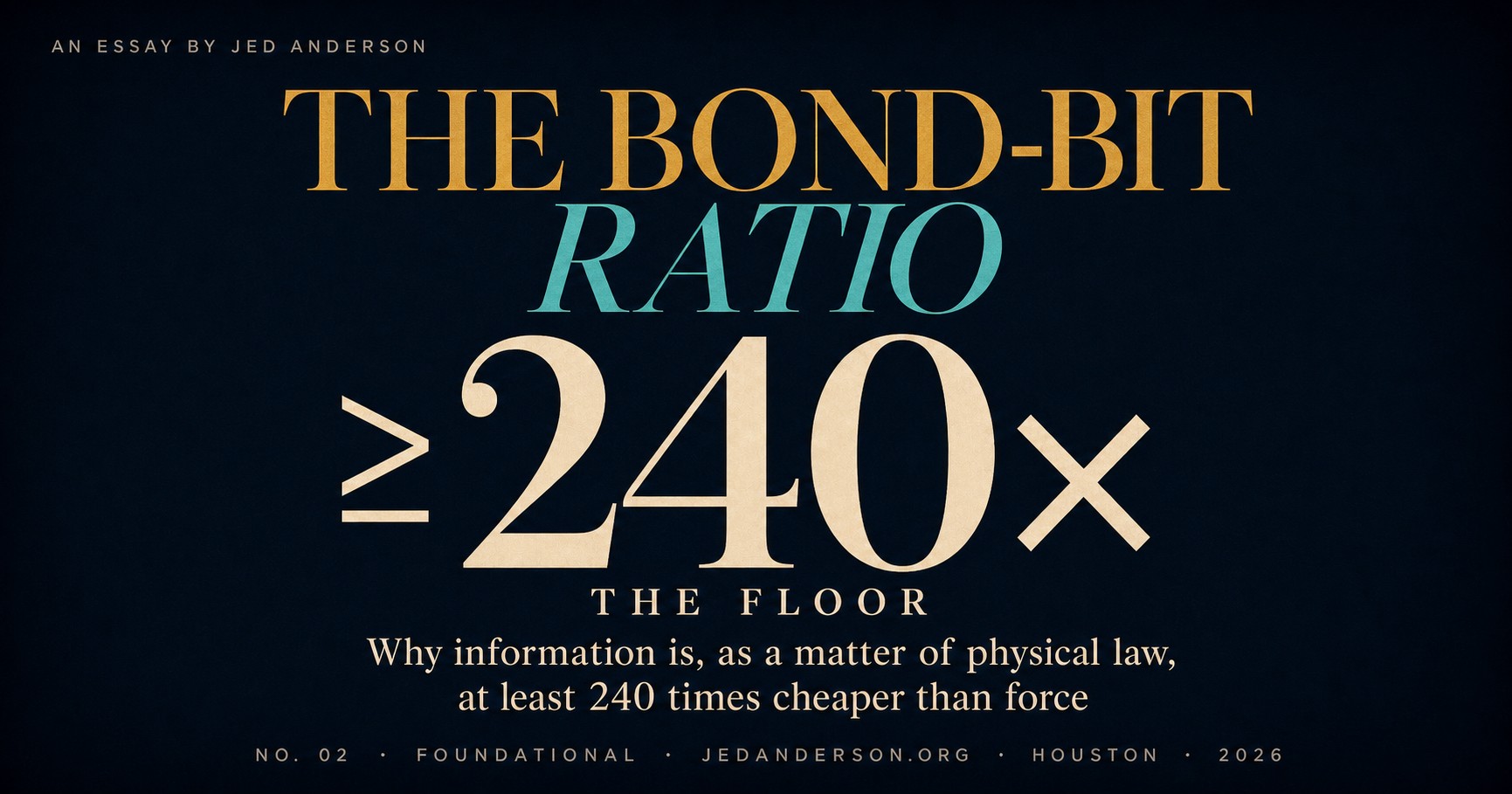
The Bond-Bit Ratio
A derivation of why information is at least 240× cheaper than force
Information is at least 240 times cheaper than force, as a matter of physical law. This page derives the floor ratio between Landauer's bound at 300 K and the C–H bond enthalpy, fixes the constants, and exists to be cited.
-
Bit Protect It
for anyone who loves the Earth
The site's thesis distilled to its accessible core. Walks the reader through Wheeler's 'it from bit,' Landauer's limit, and the bond-bit asymmetry in plain prose, ending at the proposition that gives the site its subtitle: bit protect it—knowing is cheaper than moving by a factor that grows every year, and that gap is the physical foundation of environmental stewardship.
-
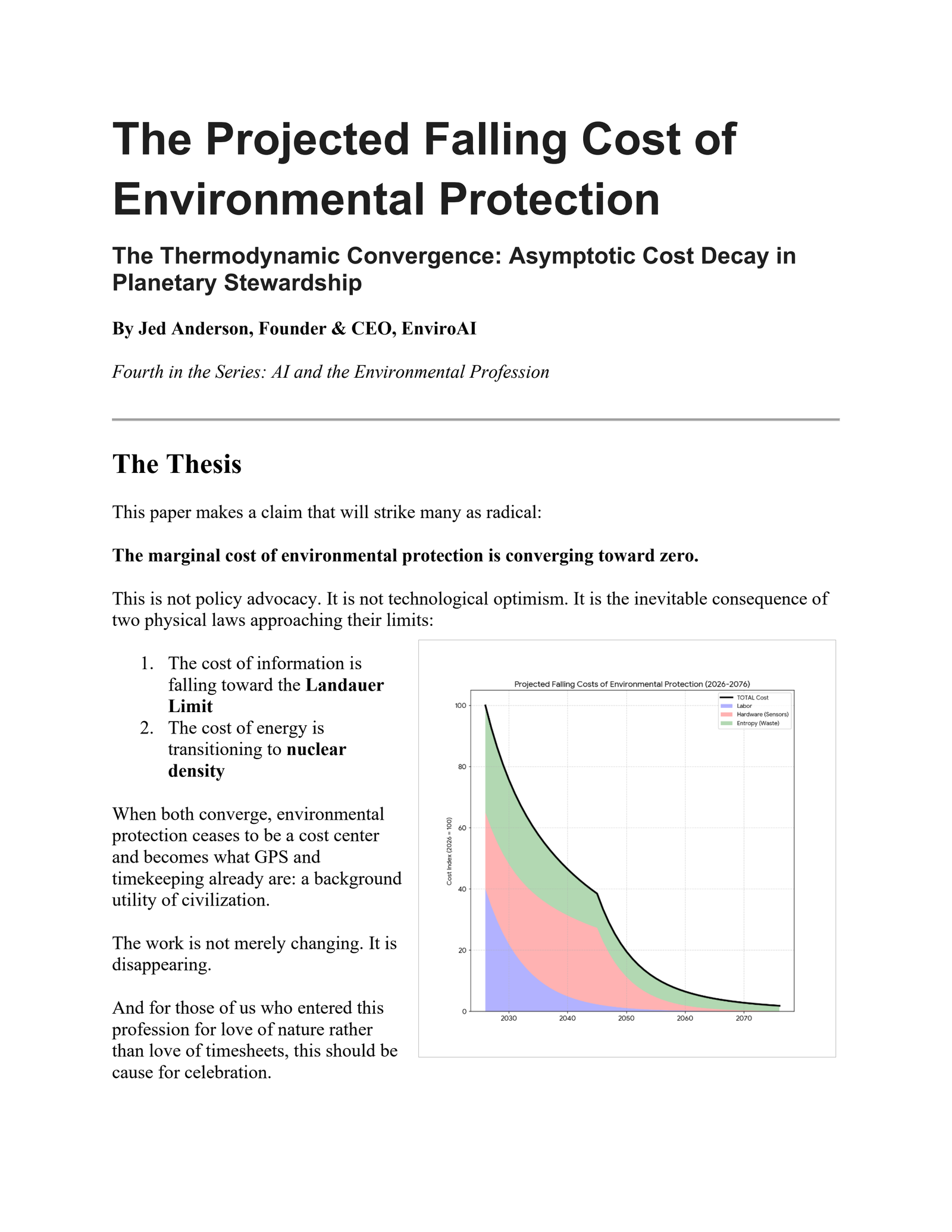
The Physics of Zero-Cost Stewardship
The thermodynamic convergence: asymptotic cost decay in planetary stewardship
The thermodynamic case that protecting the biosphere costs vanishingly little compared to what generated it—because information accumulates causal sovereignty over matter and energy faster than the costs of stewardship grow. The expository bridge to the Intelligence Leverage Equation.
-
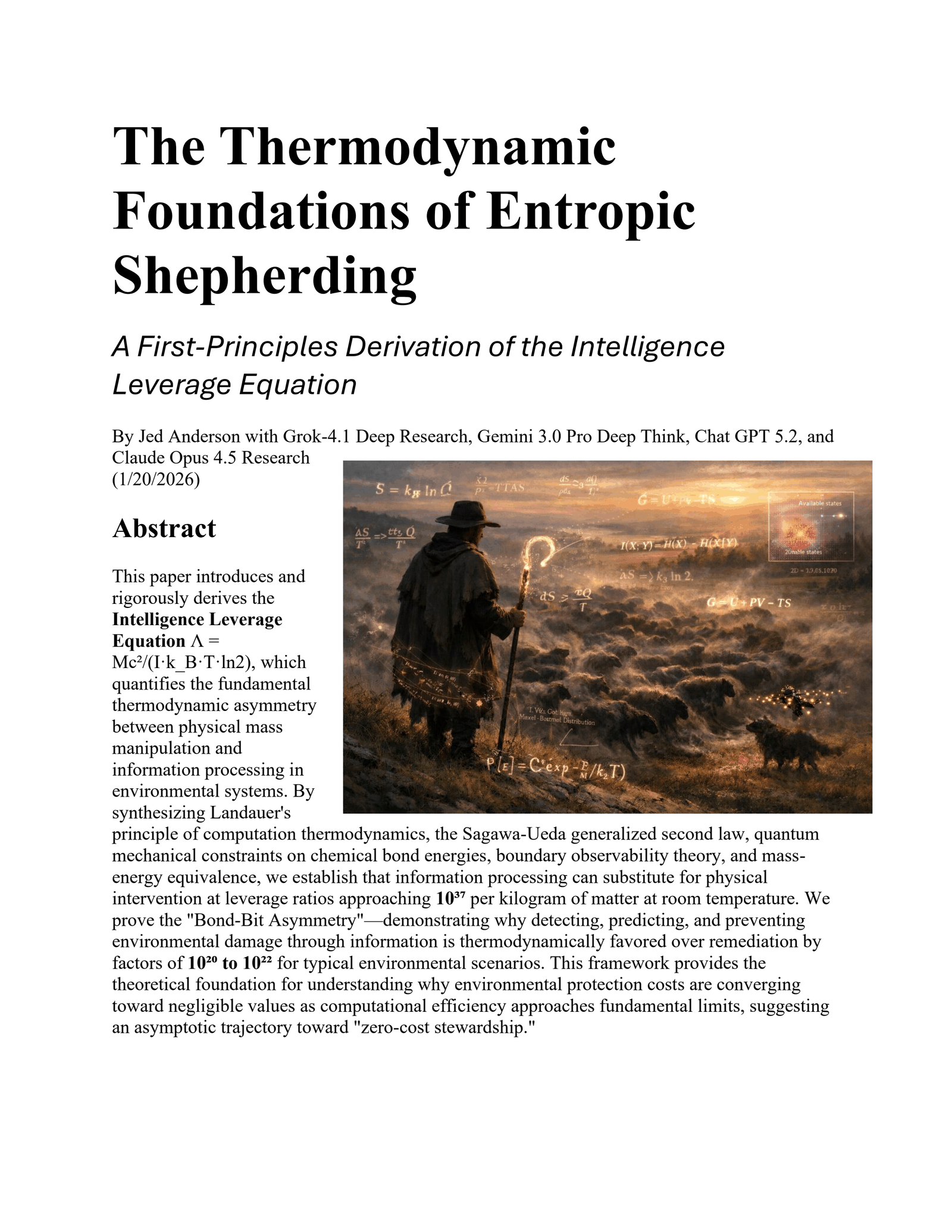
The Thermodynamic Foundations of Entropic Shepherding
A First-Principles Derivation of the Intelligence Leverage Equation
Derives the Intelligence Leverage Equation from first principles by synthesizing Landauer's bound, the Sagawa–Ueda generalized second law, bond-energy quantum constraints, boundary observability theory, and mass-energy equivalence. Proves the Bond-Bit Asymmetry—that information processing can substitute for physical intervention at leverage ratios of approximately 10²⁰ for typical environmental scenarios at room temperature—and grounds the asymptote of zero-cost stewardship in physics rather than economics.
-
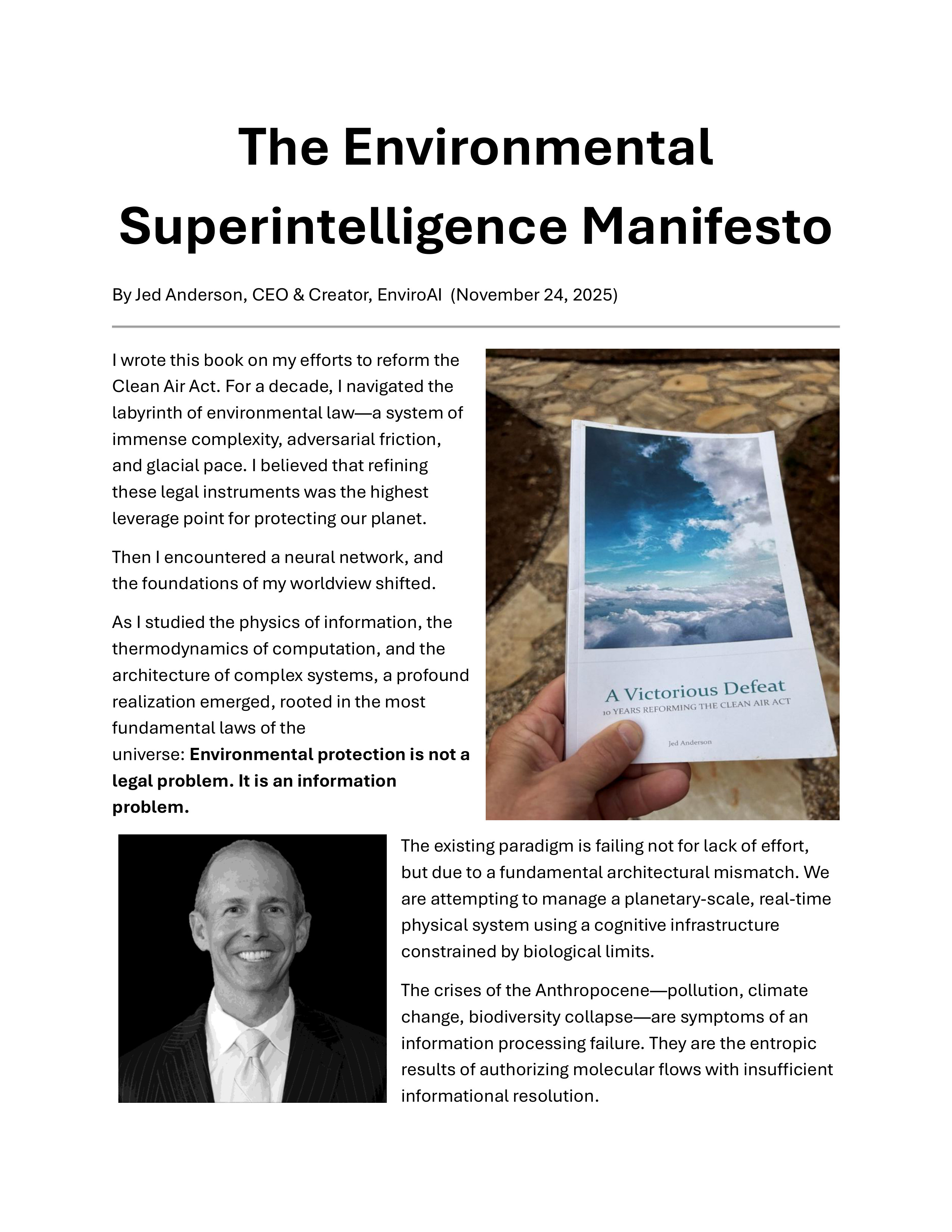
The Environmental Superintelligence Manifesto
Manifesto-form treatise from the author's transition out of two decades of Clean Air Act reform toward the information-physics framing that anchors the rest of the corpus.
-
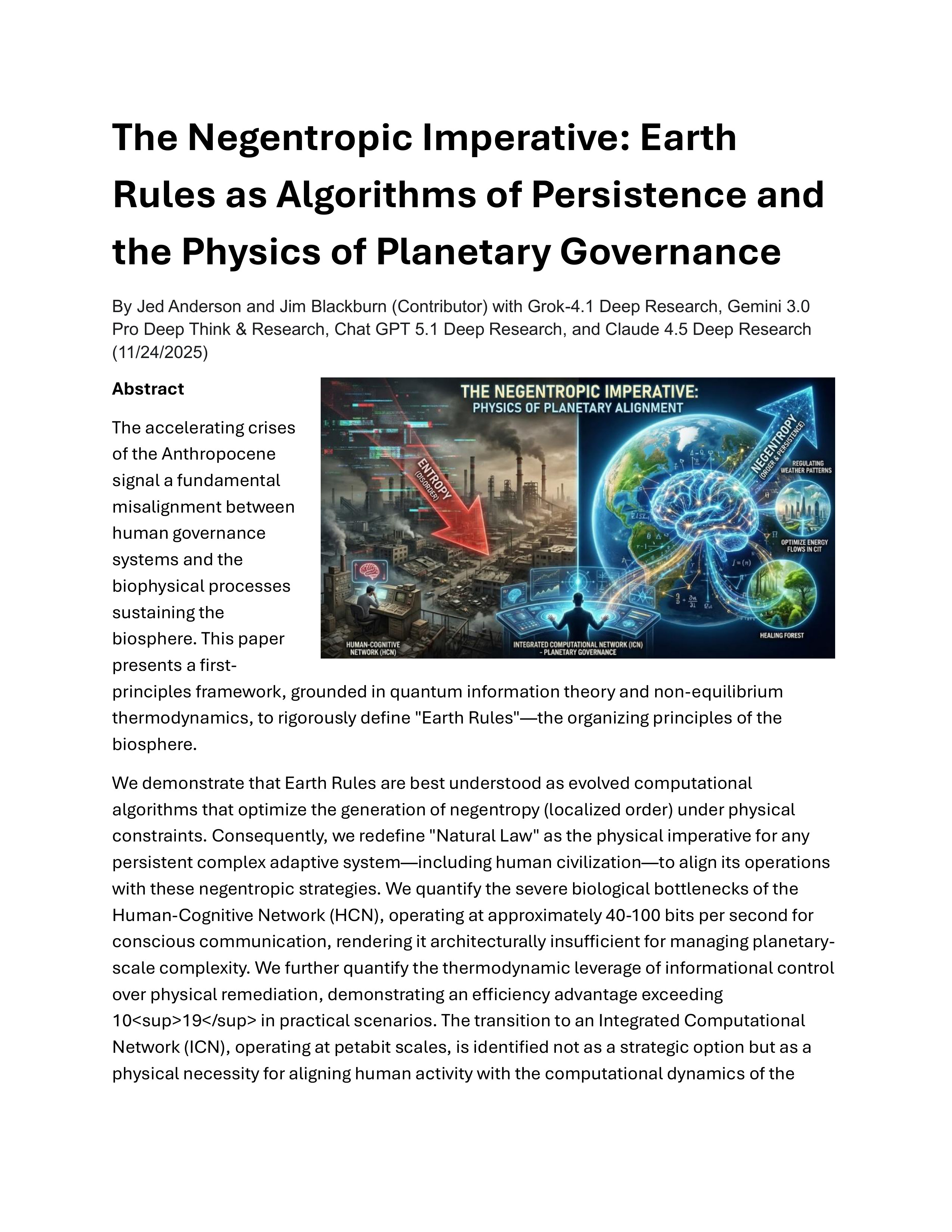
The Negentropic Imperative: Earth Rules as Algorithms of Persistence and the Physics of Planetary Governance
Defines 'Earth Rules'—the organizing principles of the biosphere—as evolved computational algorithms that optimize negentropy generation under physical constraints, and redefines Natural Law as the physical imperative for any persistent complex adaptive system to align with these strategies. Quantifies the HCN bandwidth (~40–100 bps) and the >10¹⁹ leverage of informational over physical control as the basis for a thermodynamically coherent ESG framework.
Concepts
The corpus's defining ladder, base to summit. Each term has a canonical definition page; each rung contains the ones below it.
-
Environmental Intelligence
The base term: the state of the physical environment, converted into understanding precise enough—and timely enough—to act on.
-
Environmental Artificial Intelligence
The implementation layer: AI built specifically for environmental work, answerable to physical ground truth.
-
Environmental Superintelligence
The mature form: continuous, physics-grounded information infrastructure protecting the biosphere—bits protect its.