
Essay
The Record Becomes the Thing
Every time physics has had to choose between a thing and the description of the thing, the description won. Money repeated the pattern in three centuries. The physical world is repeating it now, one measured variable at a time.
1. Money already crossed
Start with money, because everyone already understands it. Open your banking app. The number on the screen is not a picture of your money. It is your money. How that came to be true took three centuries, happened in public, and left receipts. It is the clearest case outside physics of a record becoming the thing, and the conditions can be read off it.
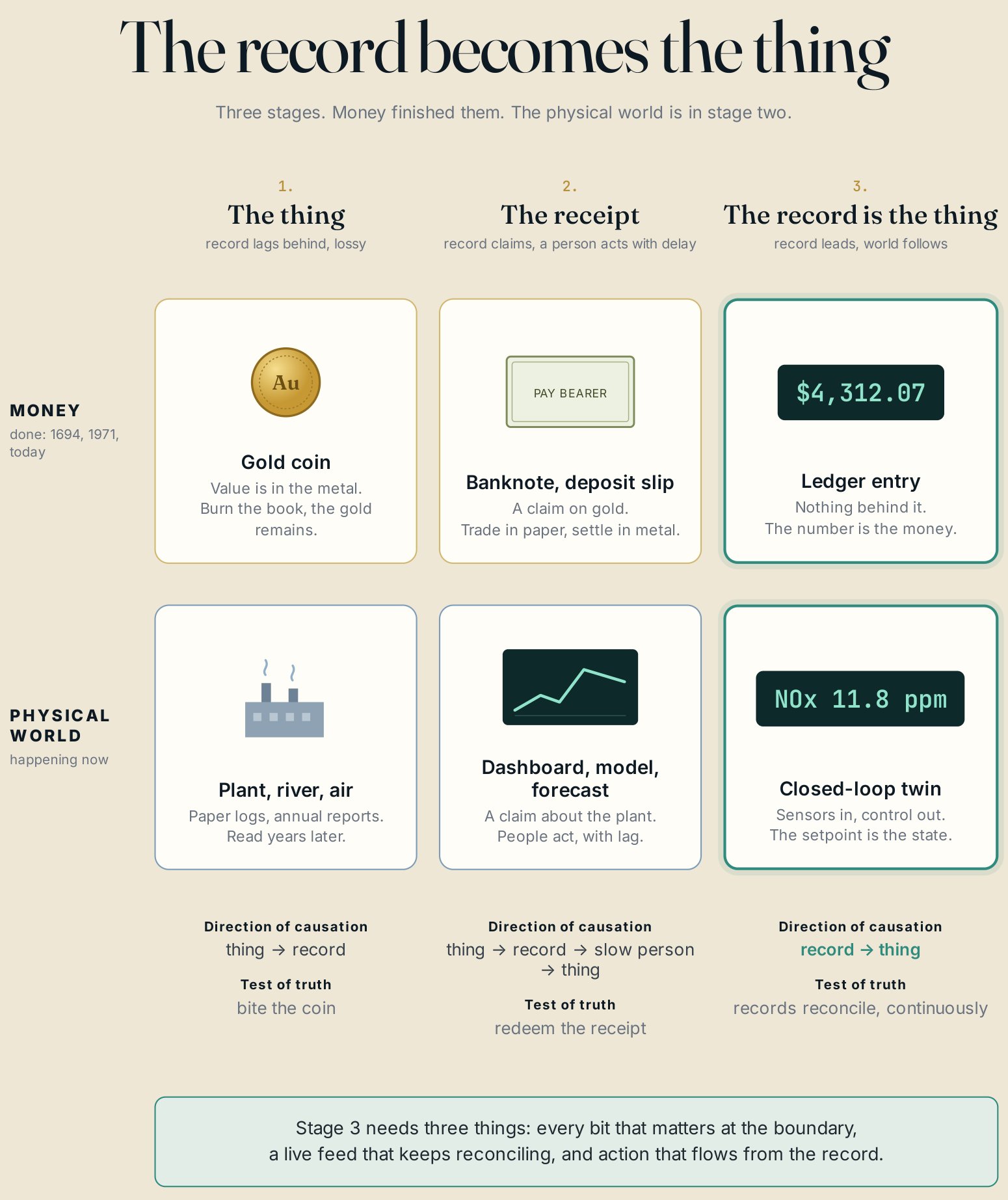
Read the picture left to right. In each column the question is the same: where do changes start, and how do you check that a record is true? In stage one changes start in the thing and you check by touching it. In stage two changes still start in the thing, the record carries most of the attention, and a person closes the loop slowly. In stage three changes start in the record and you check by seeing whether the records agree with each other. Money has finished the trip. The physical world is in the middle column.
Stage one, the thing. A gold coin. The value is in the metal. A banker’s book records who holds what, but if the book burns the gold is still there. The record lags the thing and loses detail. Changes start in the world and the record follows. The test of truth is to bite the coin.
Stage two, the receipt. A goldsmith’s note, later a banknote, later a deposit slip. A claim on gold. People trade in paper because it is faster and lighter, but settlement, the real transfer, still happens in metal, slowly. The record carries most of the activity and none of the authority. The test of truth is to take the receipt to the window and redeem it.
Stage three, the record is the thing. In 1933 the United States ended the dollar’s convertibility to gold for its own citizens, and in 1971 for foreign governments. Today a dollar is an entry in a ledger. Behind the entry stand the issuer’s assets and the state’s power to tax and to enforce, and no metal at all. Of every ten dollars in the United States, roughly nine exist only as ledger entries; about one is paper or coin. A balance is not a picture of money. It is the money. When a bank changes the number, wealth changes, and goods ship because the number changed. Changes start in the record. The test of truth is that the records reconcile with each other, continuously. In ledger money, a counterfeit is an entry that fails to reconcile.
The gold did not have to vanish for this to happen. Three conditions had to arrive.
- The record held every bit that mattered. Who owns how much. Nobody needed the atoms of the gold. Ownership was the whole boundary of what money is.
- A live feed kept the records reconciling. Clearing houses and settlement systems, running without pause. A statement from 1998 is not money. Only the live ledger is.
- Action flowed from the record. Payment became a change in the ledger. Nothing physical had to move first.
When all three hold, the record carries more of the bits that matter than anything else and sits upstream of every change. By the only physical test of which one is the original, the record is the original.
Historians add a twist that strengthens the point. Ledgers came first. Mesopotamian temples kept credit accounts two thousand years before the first coins, and the islanders of Yap counted a great stone lost at sea as money for generations, because the record of who owned it survived. The coin was an interlude. Money did not so much cross as return, and what it returned to was always a convention: money becomes more fully money as its substance recedes, and in the end money is whatever a community counts as money. The physical world cannot return that way, because atoms are not a convention. That is where the analogy will break, and a later section says exactly where.
Everyday stage-three objects. Five everyday objects carry the whole idea, and any of them will do for explaining it.
- The bank balance. It is not a picture of money. It is the money. The same is being built for the air.
- The thermostat. The simplest stage-three object, in every house. The number on the wall is a record of a temperature that does not exist yet. The room becomes what the record says. A thermostat is money for heat.
- The deed. A deed is not a description of ownership. It is the ownership. Lose the house in a fire and the land is still yours. Lose the records with no backup and ownership becomes a dispute.
- The old statement. A bank statement from 1998 is history, not money. A model with no live feed is history, not the plant. Both turn into fiction within days.
- The counterfeit. In ledger money, an entry that fails to reconcile. In the physical world: a spoofed sensor, a drifted model, a green claim with no feed behind it.
Money is the clearest case. It is not the first. Physics has been doing the same thing for a century and a half, quietly, and it is where the rule is easiest to see whole.
2. What physics keeps doing
Physics has a habit nobody wrote down as a rule. A quantity enters as bookkeeping, a convenience for making the equations consistent. Decades later it turns out to be the most real thing in the room. The table lists a dozen cases. Each row names what was taken as the thing, what entered as a device, and what happened.
A dozen promotions, 1856 to 2012
| When | Taken as the thing | Entered as a device | What happened |
|---|---|---|---|
| 1856 to 1888 | particles acting on each other across empty space | the field, which Maxwell first offered as a “physical analogy,” not a hypothesis | Maxwell gives the field energy and momentum; Hertz makes waves in it. Light is a field. |
| 1865 to 1877 | heat and its flow | entropy, a quantity Clausius defined as heat divided by temperature | Boltzmann: entropy counts the arrangements of atoms. The quantity is a census. |
| 1900 to 1923 | continuous light | Planck’s quantum of energy, which he called an act of desperation | Einstein, then Compton: the quantum is a particle. |
| 1905 to 1909 | matter as a continuum | the atom, which Mach called a useful fiction and Ostwald rejected | Einstein’s theory of Brownian motion and Perrin’s measurements make atoms countable. Ostwald concedes in 1909. |
| 1908 to 1915 | gravity, a force acting in space and time | Minkowski’s four-dimensional geometry, which Einstein called superfluous learnedness | Einstein builds general relativity on it. The geometry is the gravity. |
| 1928 to 1932 | the electron alone | Dirac’s holes in a sea of negative energy, a device to rescue his equation | Anderson finds the positron. The hole is a particle. The sea itself was later dropped. |
| 1930 to 1956 | the known particles | Pauli’s neutrino, invented so that energy would still add up | Cowan and Reines detect it. |
| 1929 to 1983 | forces as given | the gauge field, introduced so the equations stay consistent under a change of description | Its quanta are found: gluons in 1979, the W and Z in 1983. |
| 1964 to 1969 | protons and neutrons as elementary | quarks, which Gell-Mann allowed might be purely mathematical | Deep inelastic scattering at SLAC: the proton has hard points inside. |
| 1964 to 2012 | mass as a given property | the Higgs field, a mathematical way to give particles mass | The Higgs boson is found at CERN. |
| 1929 to 2012 | matter and energy | information, an abstraction | Szilard ties it to heat; Landauer sets the price, kT ln(2) per bit erased; Bérut measures it in 2012. |
| 1973 to 1975 | a black hole’s surface area | a formal analogy to entropy, which its authors warned not to take literally | Hawking: black holes radiate. The area is entropy. |
A dozen promotions in a century and a half.
Newer results, listed in the notes at the back, point the same way: the everyday world as a set of agreeing copies, the quantum state as a property of the thing itself, and model universes whose whole interior is written on their boundary.
The other direction has its own list. Caloric, phlogiston, the luminiferous aether, absolute time: each was taken as a thing and turned out to be nothing. A few cases sit between the lists (the notes at the back go through them), and they share one feature. What each predicted survived and moved into a successor theory, while the entity itself did not. Philosophers have a name for that, structural realism. What survives the overturning of a theory is its structure, not its furniture.
So what separates the promoted from the demoted at the time, before the successor theory exists?
3. Status follows the bits
Here is the rule the table supports. What gets promoted is whatever carries bits of its own: something that can change on its own and show up in a measurement. What gets demoted is whatever has none, however useful it is for the sums.
Two cases show it. The field carries bits of its own: shake a charge and radiation leaves, carrying energy that was nowhere else. The aether carried none: the best version of it predicted every experiment, but nothing about the aether itself ever showed up in one. The neutrino was caught on its own; Bohr’s orbits never were. The rule can be applied the day a quantity is proposed, which “it turned out to be indispensable” cannot.
The rule is old; the notes give its lineage. What is new is noticing how far it reaches, and two results carry it.
The first is Landauer’s, from the table: a record is physical. A bit is a state of some part of the world, and erasing it costs at least kT ln(2) of heat, about 3 × 10⁻²¹ joules at room temperature, three billionths of a trillionth of a joule. This settles nothing about whether quarks exist. It settles that every description is itself a piece of the world, with a price.
The second is what it means for a record to be about something: a record is about a thing to the degree that the two move together. Call that the shared bits. A record with no shared bits is about nothing. A record with every bit, at the thing’s own density, is not a record. It is a second copy of the thing, the map at a mile to the mile that Borges’s cartographers finished and the people used as the country. Every map, model, photograph and memory sits between those ends.
Now ask the old question: which is real, the thing or its description? The question has no content until two quantities are supplied. How many of the bits that matter to the purpose at hand do the two share? And which way do changes flow? A plant holds more bits than its model and changes start in the plant, so the plant is the original. A ledger holds every bit that matters about a sum of money and changes start in the ledger, so the ledger is the original. Originality is not a property a thing has. It is a relation: more of the bits that matter, and upstream.
Half of that relation is in the eye of the beholder. Which bits matter depends on the purpose: the controller’s objective, the regulator’s limit, the owner’s claim. The other half is not. Which way changes flow is a fact about the world, and it can be tested by intervening. The debate over things and descriptions was never about a wall in nature. It was about an asymmetry of information, and physics kept finding the asymmetry ran the other way from what everyone assumed.
One set of numbers keeps the picture honest. Earth holds about 10⁵¹ bits of microscopic state (a 1 followed by 51 zeros). A copy at one bit per atom would take roughly ten Earths of matter, and packed as tightly as physics allows those bits are a black hole the width of an atom with the mass of a fifty-kilometre asteroid. Every record that exists is lossy, including nature’s. What humans add is not copying. It is memory, speed and reach.
4. The physical world is crossing
The physical world is at stage two and entering stage three, and the same three conditions decide when a variable crosses.
Stage one. A plant, a river, the air over a city. The records are paper logs and annual reports, read by regulators years later. Lossy, lagging. The world moves and the record follows.
Stage two, where most of the world is now. Sensors feed a dashboard. A model forecasts. The record claims something about the plant and a person acts on it, with delay. Everyone looks at the screen, but the settlement, the valve turned or the permit changed, is physical and slow. This is the banknote era of the physical world.
Stage three, arriving. A closed-loop twin: a running model of the plant, fed by sensors without pause, whose state a controller acts on. The model holds the bits that matter at the plant’s boundary: what crosses the fence line, the stack, the outfall. The controller moves valves to hold the plant at the model’s setpoint (the value the record says a variable should have), squeezing the gap between target and plant down to noise. Within that band, changes now start in the record. The setpoint is the state.
| Condition | Money | Physical world |
|---|---|---|
| Every bit that matters, at the boundary | ownership, not gold atoms | what crosses the fence line, not the atoms inside |
| A live feed that keeps reconciling | clearing and settlement | sensor data faster than the plant makes new information |
| Action flows from the record | payment is a ledger change | control is a setpoint change |
Two results from control engineering make the analogy precise, and both can be said in plain words.
The first is from 1960, by Rudolf Kalman, whose filter steers every GPS. If the model is right, the history of what you measure tells you everything about the state inside, and the same mathematics, run the other way, says the controls can steer it. That matters here because a plant, unlike a ledger, has lag: by the time a spike reaches the stack or the fence line it is too late to stop it. Holding the boundary steady means seeing and steering the inside before harm crosses the line.
The second is from 1990, by two physicists at the Naval Research Laboratory, and it answers the obvious objection. Weather and rivers are chaotic: small errors grow until prediction fails. But chaos does not destroy synchronization. A copy of a chaotic system, fed one live variable from the original, locks onto everything it cannot see and stays locked. Checked for this essay on the textbook chaotic system: a copy that started badly wrong locked on within four time units and held for the rest of the run; a copy with no feed, started one millionth wrong, was unrecognizable by fifteen. Prediction died. Synchronization did not. (The copy must be a faithful model, and the lock is only as exact as the model.)
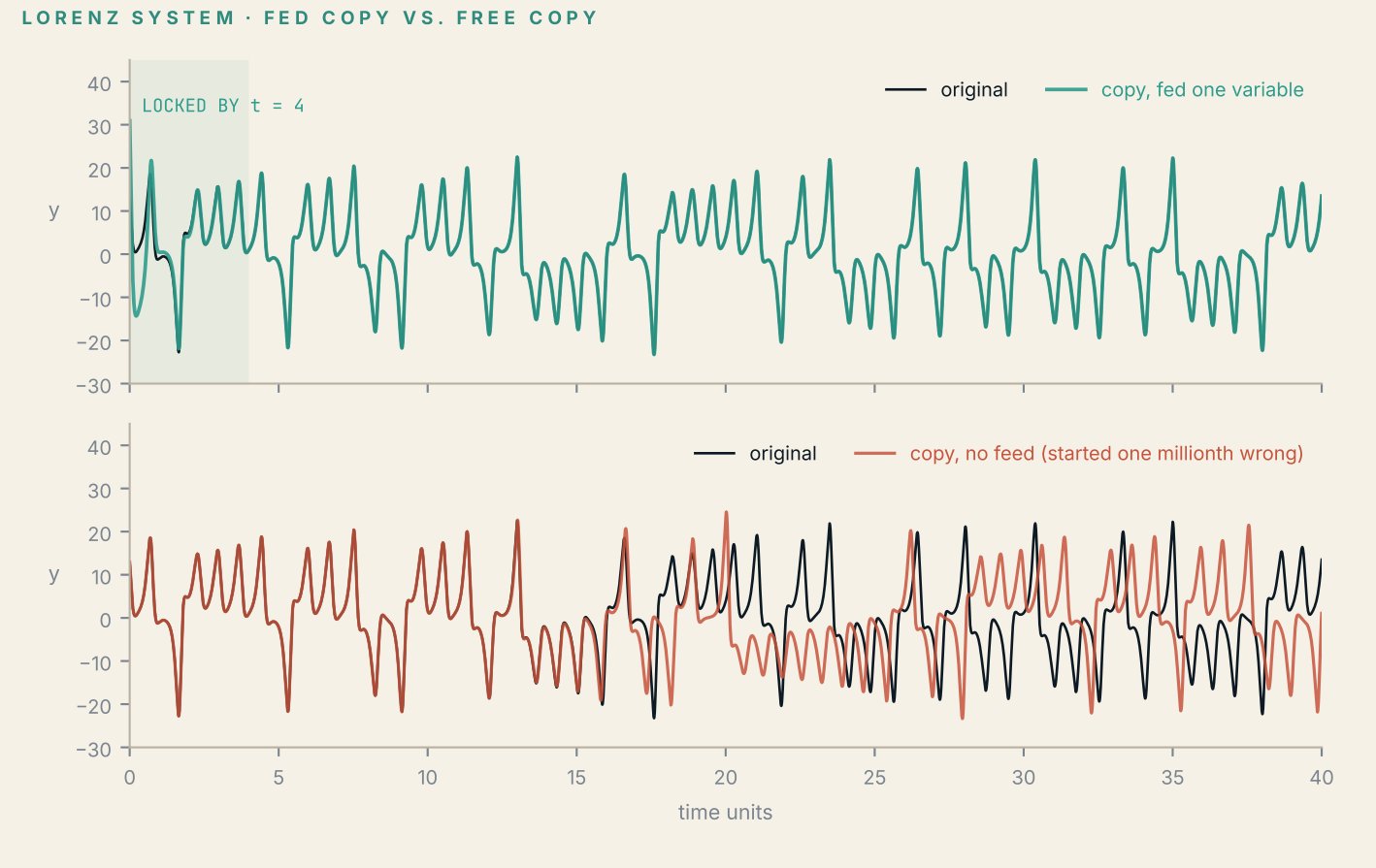
The price of stage three is then a theorem, not an aspiration. A plant can be tracked or stabilized over a channel only if the feed carries at least the plant’s own rate of producing new information (its entropy rate, in bits per second). Below that floor, no model is good enough. Above it, a modest model can be. Most process units are not chaotic like weather; they are stable and constantly disturbed, and there the floor is set by how fast unmeasured disturbances push the plant out of tolerance. Either way, the minimum sensor bandwidth is set by the plant, not by anyone’s ambition.
There is also a test for whether a variable has crossed, and it is the philosopher’s test from earlier: intervene. Change the twin’s setpoint, not the plant, and watch whether the plant follows; or perturb the twin’s estimate of the state and watch whether the controller drives the plant the other way to compensate. Either way, changes start in the record. Stuxnet showed the dark version in 2010: the attack hijacked the controller’s record to spin centrifuges to destruction while feeding operators a replayed recording of normal operation so they would not step in. And on the 737 MAX, a single faulty sensor fed a false angle-of-attack record into a closed loop that pitched a real airliner into the ground. A record that steers is the thing, for good or ill.
Where the analogy breaks is exactly where it should. Money’s thing was always a convention, so the record could take over completely. Atoms are not a convention. The record becomes the thing only for the variables that are measured, modeled and controlled, only within the reach of the actuators, and only while the feed is open. Cut the feed and the twin reverts to stage two within the horizon over which unmeasured disturbances accumulate: hours to days for a process unit, about two weeks for weather. So “the record is the thing” is never a statement about a whole plant. It is a statement about a set of boundary variables, and the set grows with sensors, bandwidth and actuators. Whatever is left unmeasured outside that set stays in stage one, invisible to the loop that steers.
5. What this changes
If status follows the bits, four things follow for anyone building the record of the physical world.
1. Measurement is the scarce input, not modeling. Models are cheap and getting cheaper. The feed is what holds a twin to the world, and its floor is set by the plant. The money system spent three centuries building clearing houses, not better theories of gold. The physical world needs its clearing houses: sensors at the boundary, running faster than the world changes.
2. Truth, for records, is reconciliation with a physical anchor. Philosophers call agreement among records the coherence theory of truth, and have long noted its defect: records can agree with each other and all be wrong. The anchor repairs it. One of the records is the thing itself at its boundary, read live. This is how ledger money works, and it is what the newest physics says an everyday fact is: a state that many independent copies agree on. It has a cost worth admitting: a claim that is true but unmeasured counts here as unreconciled, not as true. A green claim with no live feed behind it is not called false. It is called unreconciled, which is what a counterfeit is.
3. The one hazard is a record that reconciles only with itself. In 2008 the credit records agreed with each other and not with the houses, and the houses won. Madoff’s statements reconciled with one another for years. A French philosopher argued in the 1970s that money cut loose from gold had become a sign pointing only at other signs. He was half right: cut loose from its anchor, a record does refer only to other records. He was wrong about what follows. The result is not a stable world of signs but 2008 credit and model collapse, and the physical boundary liquidates it in the end. Models trained on the output of other models drift the same way; the effect has a name now, model collapse. A world filling with synthetic records needs its anchor more than ever, and the anchor is physical: the boundary measurement, kept live.
4. The fast harms become reachable. Environmental harm moves in minutes to seasons. Law moves in years. For most of its history the environmental record was a stage-one record, read long after the fact (hourly stack monitors under the 1990 Acid Rain Program moved part of it to stage two), and it protected only against harms slow enough to wait for it. A stage-three environmental record runs faster than the harm it steers. Thermostats and steam governors have done this for their small worlds for two centuries. Nothing has done it for the biosphere.
The essay is two claims joined. In physics, status follows the bits a quantity carries of its own. In engineered records, a record becomes the thing when it holds every bit that matters, stays reconciled, and acts. The joint is one word, upstream: in both, what is real is what the changes start from. In physics, the order was always there in nature, and experiments simply discover that what looked like bookkeeping was upstream all along; in money and engineered twins, humans build the loop that puts the record upstream. Money crossed when the ledger could do those three things. The physical world crosses the same way, one measured variable at a time.
What is established, what is new
Established. The twelve rows are standard history. The boundary results of Maldacena and successors hold in anti-de Sitter model universes, not yet in ours. The Pusey, Barrett and Rudolph theorem rests on two assumptions, that systems have physical states and that separately prepared systems are independent, and those who hold the quantum state to be knowledge give up one of them. Zurek’s record theory is demonstrated on a few qubits, not on refineries. Landauer’s cost was measured directly in 2012 and is still questioned by a few philosophers. Kalman’s theorems, Pecora and Carroll’s synchronization and the data-rate theorem are textbook results. The money figures are from the Federal Reserve: about 2.4 trillion dollars of currency against an M2 money stock of about 23.3 trillion, so roughly nine dollars in ten are ledger entries.
Borrowed, with credit. That what survives theory change is structure, not substance: Poincaré, Worrall (1989), Ladyman and Ross (2007), Floridi (2008). That a pattern is real when it lets you predict with fewer bits than the raw data: Dennett (1991). That an entity is real when you can use it to change something else: Hacking (1983). That a record is about a thing to the degree the two are correlated: Dretske (1981), on Shannon. That money becomes more fully money as its substance recedes: Simmel (1900); that the end of gold convertibility made money a sign referring only to other signs: Baudrillard (1976); that money is whatever a community counts as money: Searle (1995); that financial models make markets conform to them rather than describe them: MacKenzie (2006). That ledgers predate coins: Innes (1913), Graeber (2011), Martin (2013). That a regulator needs as much variety as what it regulates, and must contain a model of it: Ashby (1956), Conant and Ashby (1970). That a twin can only be held to a plant over a channel carrying the plant’s information rate: the data-rate theorem (Nair and Evans 2004, Tatikonda and Mitter 2004). That a digital twin of a city approaches but may never reach the city: Batty (2018), Tomko and Winter (2019). That models trained on models collapse: Shumailov and colleagues (2024). The map used as the country: Borges (1946). Wheeler’s “it from bit” is the slogan the whole table illustrates. Korzybski’s “the map is not the territory” is the folk principle this essay qualifies: the map is not the territory until it holds every bit that matters, stays reconciled and acts, and then it is.
New, as far as a search of the literature shows. Two things, and they are modest. The three-condition checklist for when a record has crossed (every bit that matters at the boundary, live reconciliation, action from the record), read off money and applied to the physical world. And the explicit chain from the physics table through money to the closed-loop twin, with originality defined as a relation (shared bits that matter, and direction of change) that can be tested by intervention. Each link has a named ancestor above. The chain is the contribution.
Conjecture, marked as such. That “carries bits of its own” is all there ever was to the thing-versus-description distinction is an induction from the table, and the hard cases (Bohr’s orbits, the equant, absolute space, the Dirac sea) show that predictive content and entity status can come apart; the criterion sorts those cases, but it was chosen with them in view. The sorting: the field radiates on its own and the aether never showed itself; the neutrino was caught and the phase of Bohr’s orbit never appeared in a spectral line; Ptolemy’s equant and Newton’s absolute space each encoded a real regularity (the bucket experiment, for absolute space) that a successor carried better; the Dirac sea had no bits of its own while the hole in it did; gauge symmetry is a redundancy of description while the gauge field’s physical modes are real and were found. Which bits matter is relative to a purpose, and the essay owns that. The claim that building a correlated record stitches two regions closer in one holographic ledger, which would make a digital twin a small act of weaving spacetime, follows from the boundary results only if they extend to our universe, and no test exists today.
Scale of the numbers. Earth’s 10⁵¹ bits (a 1 followed by 51 zeros), the ten Earths, the atom-sized black hole, and a refinery’s roughly 10²⁸ bits per second (a 1 followed by 28 zeros) of radiated entropy, almost none of it about the plant, are order-of-magnitude figures from standard constants, recomputed in a companion script. Nothing in the argument moves if any of them is off by a factor of a thousand.
Sources
Physics table: J. C. Maxwell, “On Faraday’s Lines of Force” (1856); L. Boltzmann (1877); M. Planck, letter to R. W. Wood (1931); J. Perrin, Les Atomes (1913); H. Minkowski, “Raum und Zeit” (1908); P. A. M. Dirac (1928, 1930), C. D. Anderson (1932); W. Pauli, letter of 4 December 1930, C. Cowan and F. Reines (1956); H. Weyl (1929), C. N. Yang and R. Mills (1954); M. Gell-Mann, Physics Letters 8, 214 (1964); ATLAS and CMS (2012); L. Szilard (1929); R. Landauer, IBM Journal of Research and Development 5, 183 (1961); A. Bérut et al., Nature 483, 187 (2012); J. Bardeen, B. Carter and S. Hawking, Communications in Mathematical Physics 31, 161 (1973); S. Hawking, Nature 248, 30 (1974).
Boundary and record results: J. Maldacena, hep-th/9711200 (1997); S. Ryu and T. Takayanagi, hep-th/0603001 (2006); M. Van Raamsdonk, arXiv:1005.3035 (2010); A. Almheiri, X. Dong and D. Harlow, arXiv:1411.7041 (2015); W. H. Zurek, “Quantum Darwinism,” Nature Physics 5, 181 (2009), with experiments by M. A. Ciampini et al., Physical Review A 98, 020101 (2018) and T. Unden et al., Physical Review Letters 123, 140402 (2019); M. F. Pusey, J. Barrett and T. Rudolph, arXiv:1111.3328, Nature Physics 8, 475 (2012); S. Lloyd, quant-ph/0110141, Physical Review Letters 88, 237901 (2002).
Information and aboutness: C. E. Shannon, Bell System Technical Journal 27 (1948); F. Dretske, Knowledge and the Flow of Information (MIT, 1981); J. A. Wheeler, “Information, Physics, Quantum” (1989); J. L. Borges, “On Exactitude in Science” (1946); A. Korzybski, Science and Sanity (1933).
Philosophy of science: H. Poincaré, Science and Hypothesis (1902); J. Worrall, Dialectica 43, 99 (1989); J. Ladyman and D. Ross, Every Thing Must Go (Oxford, 2007); L. Floridi, Synthese 161, 219 (2008); D. C. Dennett, “Real Patterns,” Journal of Philosophy 88, 27 (1991); I. Hacking, Representing and Intervening (Cambridge, 1983).
Control and information rates: R. E. Kalman, Proceedings of the First IFAC Congress (1960); L. M. Pecora and T. L. Carroll, Physical Review Letters 64, 821 (1990); W. R. Ashby, An Introduction to Cybernetics (1956); R. C. Conant and W. R. Ashby, International Journal of Systems Science 1, 89 (1970); G. N. Nair and R. J. Evans, SIAM Journal on Control and Optimization 43, 413 (2004); S. Tatikonda and S. Mitter, IEEE Transactions on Automatic Control 49, 1056 (2004); R. Langner, “Stuxnet: Dissecting a Cyberwarfare Weapon,” IEEE Security and Privacy 9, 49 (2011).
Money: G. Simmel, The Philosophy of Money (1900); A. M. Innes, “What is Money?” Banking Law Journal (1913); J. Baudrillard, Symbolic Exchange and Death (1976); J. Searle, The Construction of Social Reality (1995); D. MacKenzie, An Engine, Not a Camera (MIT, 2006); D. Graeber, Debt: The First 5,000 Years (2011); F. Martin, Money: The Unauthorised Biography (2013); Executive Order 6102 and the Gold Reserve Act (1933, 1934); Federal Reserve Bank of St. Louis, FRED: Currency Component of M1, 2,377.5 billion dollars, week of June 1, 2026, and M2 Money Stock, 23,342.8 billion dollars, August 2026.
Twins and synthetic records: M. Batty, Environment and Planning B 45, 817 (2018); M. Tomko and S. Winter, Environment and Planning B 46, 395 (2019); I. Shumailov et al., “AI models collapse when trained on recursively generated data,” Nature 631, 755 (2024); 40 CFR Part 75 (continuous emission monitoring under the Acid Rain Program, 1993).
The question behind this essay, whether a digital twin of the world is another hologram of it, and the insistence on following it past the comfortable answer, are Jed Anderson’s. The essay was prepared with AI tools, with the historical table checked row by row and the synchronization result reproduced in code. Standing on the shoulders of giants; with these tools the giants got taller.
Revision history
Revised edition—2026-10-16. The essay now opens with money, the case every reader already understands, and reaches the physics table second; the three-stage figure moves to the opening. The rule “status follows the bits” is stated more compactly, with its lineage and the hard cases moved to the notes at the back, and the control-theory passages are rewritten in plainer words. The argument, the table, the sources and the canonical URL are unchanged.
Licensed CC-BY-4.0 .
Markdown source: https://jedanderson.org/essays/record-becomes-the-thing.md
Source on GitHub: /src/content/essays/record-becomes-the-thing.md
Cite this
@misc{anderson_2026_record_becomes_the_thing,
  author = {Jed Anderson},
  title  = {The Record Becomes the Thing},
  year   = {2026},
  url    = {https://jedanderson.org/essays/record-becomes-the-thing},
  note   = {Accessed: 2026-10-26}
} Anderson, J. (2026). The Record Becomes the Thing. Retrieved from https://jedanderson.org/essays/record-becomes-the-thing
Anderson, Jed. "The Record Becomes the Thing." Jed Anderson, October 16, 2026, https://jedanderson.org/essays/record-becomes-the-thing.