Essay
What Is Life… and How to Protect It
A Sequel to Schrödinger's 1944 Inquiry, Grounded in Eight Decades of Information Thermodynamics
Preface:
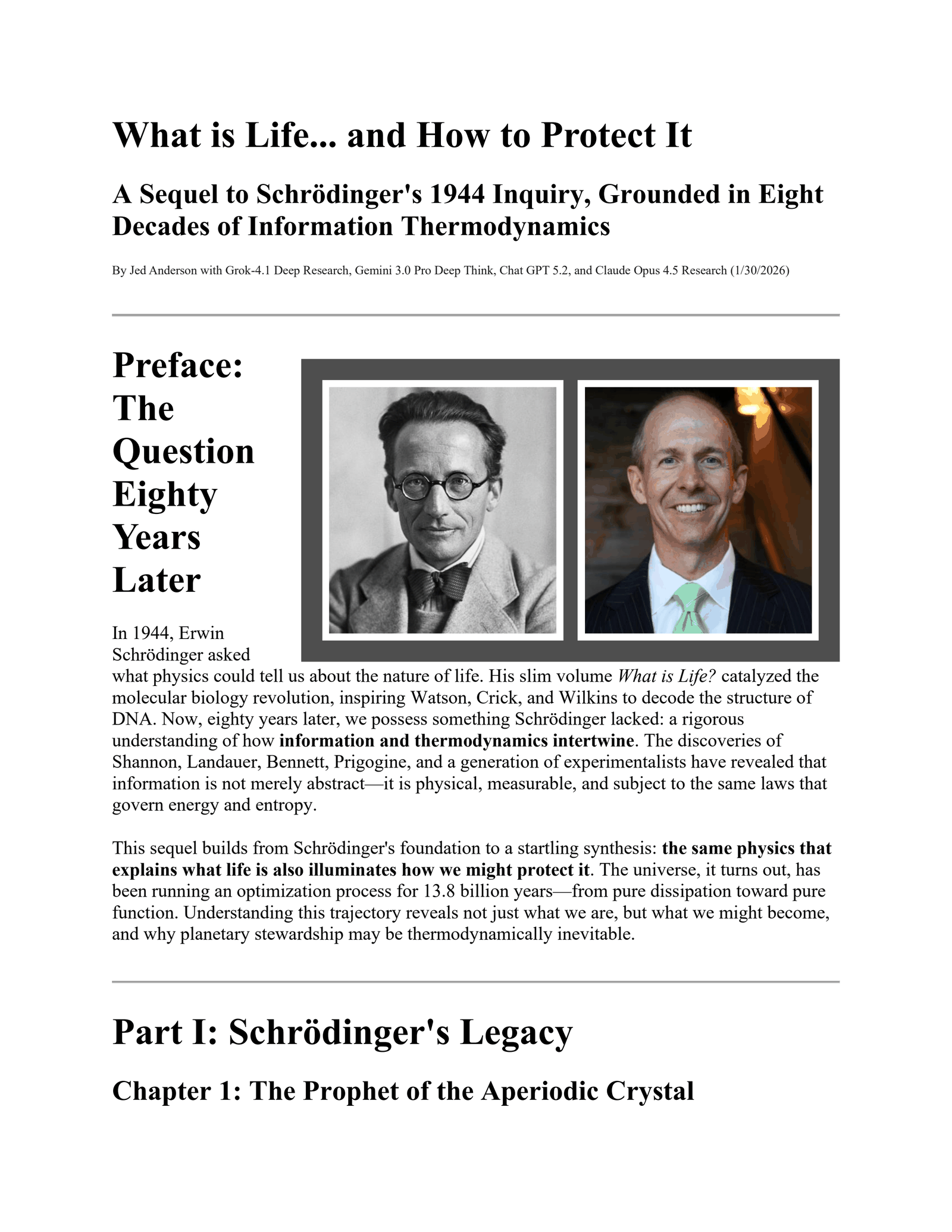
The Question Eighty Years Later In 1944, Erwin Schrödinger asked what physics could tell us about the nature of life. His slim volume What is Life? catalyzed the molecular biology revolution, inspiring Watson, Crick, and Wilkins to decode the structure of
DNA. Now, eighty years later, we possess something Schrödinger lacked: a rigorous understanding of how information and thermodynamics intertwine. The discoveries of
Shannon, Landauer, Bennett, Prigogine, and a generation of experimentalists have revealed that information is not merely abstract—it is physical, measurable, and subject to the same laws that govern energy and entropy.
This sequel builds from Schrödinger’s foundation to a startling synthesis: the same physics that explains what life is also illuminates how we might protect it. The universe, it turns out, has been running an optimization process for 13.8 billion years—from pure dissipation toward pure function. Understanding this trajectory reveals not just what we are, but what we might become, and why planetary stewardship may be thermodynamically inevitable.
Part I: Schrödinger’s Legacy
Chapter 1: The Prophet of the Aperiodic Crystal
When Erwin Schrödinger stood before his Dublin audience in February 1943, the gene remained a mystery. No one knew its chemical composition. The prevailing view held that proteins, with their diverse amino acid sequences, must carry hereditary information. DNA, discovered by
Miescher in 1869, was considered a monotonous structural molecule—far too simple for the complexity of inheritance.
Yet Schrödinger made a prediction of astonishing prescience. The hereditary material, he argued, must be an “aperiodic crystal”—a structure with molecular regularity but without repetitive pattern, like “a masterpiece of embroidery, say a Raphael tapestry, which shows no dull repetition, but an elaborate, coherent, meaningful design.” This aperiodic crystal would contain a
“hereditary code-script” encompassing “the entire pattern of the individual’s future development.”
Nine years later, Watson and Crick confirmed that DNA possessed exactly this character. Crick wrote to Schrödinger in August 1953: “You will see that it looks as though your term ‘aperiodic crystal’ is going to be a very apt one.” The four-letter alphabet of nucleotides—A, T, G, C—encoded information without repetition, just as Schrödinger had envisioned.
Schrödinger’s second great insight concerned what keeps organisms alive. He introduced the concept of “negative entropy” or negentropy—the idea that living things maintain their order by feeding on orderliness from their environment. “What an organism feeds upon is negative entropy,” he wrote. “It continually sucks orderliness from its environment.” An organism exports entropy as heat and waste while importing the structured energy of food. This explained how life could maintain itself against the relentless pull of the Second Law.
The limitations of Schrödinger’s analysis were also significant. He assumed protein rather than
DNA carried heredity. His thermodynamic treatment, as Linus Pauling later noted, was “vague and superficial.” And his suggestion that life might require “new laws of physics” proved unnecessary—chemistry, not quantum exotica, explained biological function. Yet Max Perutz’s criticism that “what was true in his book was not original, and most of what was original was known not to be true” misses the essential point. As Whitehead observed, “It is more important that an idea be fruitful than that it be correct.” Schrödinger’s ideas proved extraordinarily fruitful.
The book’s greatest contribution was recruiting brilliant physicists into biology at precisely the right moment. James Watson recalled: “From the moment I read Schrödinger’s What is Life I became polarized toward finding out the secret of the gene.” Francis Crick, Maurice Wilkins,
Seymour Benzer, Sydney Brenner—a generation of molecular biologists traced their inspiration to this ninety-page meditation by a quantum physicist asking the deepest questions.
Chapter 2: Order from Order—The Quantum Stability of
Heredity Schrödinger grappled with a puzzle that deserves renewed attention: how can genetic information persist across generations with error rates below one in a hundred million?
Classical statistical physics offered no explanation. If genes contained only a thousand atoms, as
X-ray mutation studies suggested, thermal fluctuations should destroy hereditary fidelity within hours.
His answer invoked quantum mechanics. The gene must be a molecule whose stability arises from the discrete energy states of quantum systems. Just as an electron in an atom cannot gradually lose energy but must “jump” between allowed orbits, a gene would occupy a stable configuration protected by energy barriers. Mutations occur when sufficient energy—from radiation or thermal fluctuation—triggers a quantum jump to an alternative stable state. This explained both the extraordinary fidelity of normal inheritance and the suddenness of mutation.
Schrödinger drew on the “Three-Man Paper” of Timoféeff-Ressovsky, Zimmer, and Delbrück
(1935), which had modeled genes as molecular structures with quantum transitions between isomeric forms. He called the living organism “the finest masterpiece ever achieved along the lines of the Lord’s quantum mechanics.”
Recent research has vindicated aspects of this quantum perspective that seemed speculative in 1944. Studies published in 2022 found evidence that quantum tunneling of protons along DNA hydrogen bonds may indeed cause spontaneous mutations—precisely the kind of quantum fluctuation Schrödinger imagined. The emerging field of “quantum biology” has discovered quantum coherence effects in photosynthesis, bird navigation, and enzyme catalysis.
Hannah Wiseman’s work has shown that environmental noise in biological systems can actually support quantum coherence, allowing dynamics to approach “purely mechanical” behavior—again echoing Schrödinger’s intuition.
The deepest contribution of Schrödinger’s analysis was conceptual: his distinction between
“order from disorder” and “order from order.” Statistical mechanics explains how macroscopic regularities emerge from microscopic chaos—diffusion creating uniform mixtures, pressure arising from molecular collisions. But heredity represented something different: ordered biological structures arising from ordered molecular templates. The gene was not a statistical average but a specific molecular structure transmitting specific information.
This insight anticipated the central dogma of molecular biology: information flows from nucleic acids to proteins, never the reverse. The “order” of an organism derives from the “order” of its genome through a process of faithful copying and regulated expression. Schrödinger understood that life required not just thermodynamic flux but informational integrity—a theme that would dominate the next eighty years of discovery.
Part II: The Information Revolution
Chapter 3: Shannon’s Entropy and the Physics of Bits
Four years after Schrödinger’s lectures, Claude Shannon published “A Mathematical Theory of
Communication” (1948), creating information theory as a rigorous discipline. His central contribution was quantifying information through the formula for entropy:
H = −Σᵢ pᵢ log₂(pᵢ)
This expression measures the average uncertainty—or equivalently, the information content—of a random variable. When Shannon consulted John von Neumann about what to call this quantity, von Neumann reportedly advised: “You should call it entropy, for two reasons. In the first place your uncertainty function has been used in statistical mechanics under that name. In the second place, and more importantly, no one knows what entropy really is, so in a debate you will always have the advantage.”
The joke contained deep truth. Shannon’s entropy and Boltzmann’s thermodynamic entropy share the same mathematical form because they measure the same thing: missing information about microstates given macroscopic knowledge. The Gibbs entropy S = kB ln(W) counts the number of microscopic configurations consistent with observed macroscopic properties.
Shannon’s H counts the number of bits needed to specify which configuration is actually realized.
Yet the implications remained unclear. Was the parallel merely formal, or did information have genuine physical reality? Could manipulating information affect thermodynamic quantities like work and heat? The answer would require another thirteen years.
In 1961, Rolf Landauer at IBM published a paper that transformed our understanding:
“Irreversibility and Heat Generation in the Computing Process.” Landauer proved that erasing one bit of information requires a minimum energy dissipation equal to:
Eₘᵢₙ = kB T ln(2) ≈ 2.87 × 10⁻²¹ J at 300K This is Landauer’s limit—the fundamental thermodynamic cost of forgetting. At room temperature, it amounts to roughly 0.018 electron volts per bit erased. The number seems tiny, but its implications are profound: information is physical. Destroying information is not merely a mathematical operation but a physical process that generates heat.
The physics arises from phase space compression. When a bit is erased—reset to a standard state regardless of its previous value—the system’s phase space contracts by half. The entropy decrease in the information-bearing system must be compensated by entropy increase in the environment. This compensation takes the form of heat dissipation: at least kBT ln(2) joules must flow into the thermal bath per bit erased.
Landauer’s famous aphorism captured the revolution: “Information is physical.” It is not ethereal or abstract but encoded in physical systems and subject to physical law.
Chapter 4: Maxwell’s Demon Exorcised
The full implications of Landauer’s principle emerged through Charles Bennett’s resolution of a century-old paradox. In 1867, James Clerk Maxwell had imagined a “very observant and neatfingered being” who could sort fast and slow gas molecules between two chambers, creating a temperature difference without apparent work. This demon seemed to violate the Second Law, extracting useful energy from a system at equilibrium.
Generations of physicists proposed solutions. Szilard (1929) argued that the measurement required to sort molecules must cost energy. Brillouin (1951) suggested that the demon’s observation required light that ultimately dissipated energy. But these explanations remained incomplete. Bennett, in his 1982 paper “The Thermodynamics of Computation—A Review,” provided the definitive answer.
The key insight: measurement can be thermodynamically reversible—but memory erasure cannot. A demon can acquire information about molecules without fundamental energy cost.
The problem arises when the demon’s memory fills up. To continue operating, it must erase old records, and this erasure incurs Landauer’s cost. Each bit erased dissipates at least kBT ln(2) joules, generating exactly enough entropy to compensate for the sorting.
The demon’s complete operating cycle thus satisfies the Second Law:
• Measure molecule velocity → no fundamental cost
• Sort molecule → extract work ≤ kBT ln(2) per bit of information
• Erase measurement record → dissipate heat ≥ kBT ln(2) per bit
The work extracted exactly equals the heat dissipated. No violation occurs; the Second Law emerges strengthened.
Bennett’s analysis also opened the door to reversible computing—computation that avoids erasure by maintaining the ability to reconstruct previous states. Any computation can be embedded in a reversible process. After obtaining the output, the computation runs backward, returning the system to its initial state and recovering the invested energy. In principle, reversible computers could approach arbitrarily close to zero energy dissipation.
The Maxwell’s demon paradox, resolved, taught us something profound: the universe keeps perfect books. Every bit of information created must eventually be accounted for thermodynamically. There is no free lunch, but there is an optimal price.
Chapter 5: Information as Thermodynamic Resource
The period from 2008 to 2014 witnessed both theoretical breakthrough and experimental confirmation. Takahiro Sagawa and Masahito Ueda at the University of Tokyo developed a generalized second law incorporating information explicitly:
Wₑₓₜ ≤ −ΔF + kB T I The extracted work cannot exceed the free energy decrease plus kBT times the mutual information I gained through measurement. Information functions as a thermodynamic resource—like a battery storing potential work. One bit of information, when properly utilized through feedback control, can extract up to kBT ln(2) joules of work from a thermal bath.
This inequality captures Maxwell’s demon precisely. The demon gains information about molecules; that information enables work extraction; but when the demon erases its memory, the cost exactly balances the gain. The global Second Law remains inviolate while local violations become explicable.
Experimental verification came rapidly. In 2010, Toyabe and colleagues at Chuo University demonstrated information-to-energy conversion directly. A small polystyrene particle, executing
Brownian motion on a spiral-staircase potential, was observed in real time. When the particle fluctuated upward against the potential gradient, an experimenter placed a “block” behind it, preventing backward motion. Through repeated observations and blocks, the particle climbed the staircase, gaining free energy without any work done on it—except for the information acquired by measurement.
The results precisely matched Sagawa-Ueda theory. The particle extracted extra work equal to kBT times the mutual information gained. This was the first experimental realization of a
Szilard engine—Maxwell’s demon made real.
In 2012, Bérut and colleagues at the École Normale Supérieure de Lyon verified Landauer’s principle directly. A colloidal silica bead suspended in water was trapped in a double-well optical potential. By slowly tilting the potential and then restoring it, the researchers erased the particle’s “memory” of which well it occupied. In the limit of slow erasure cycles, the mean dissipated heat approached kBT ln(2) exactly—51 years after Landauer’s theoretical prediction.
These experiments settled the question: information is a physical, thermodynamic resource. It can be measured, manipulated, converted to work, and accounted for in entropy balances. The universe, we discovered, runs on bits as surely as it runs on joules.
Part III: The Physics of Life
Chapter 6: Dissipative Structures and the Organization of
Matter Schrödinger’s negentropy concept found its theoretical completion in the work of Ilya Prigogine, who received the 1977 Nobel Prize in Chemistry “for his contributions to non-equilibrium thermodynamics, particularly the theory of dissipative structures.”
Classical thermodynamics describes equilibrium—the boring end-state where nothing changes.
Prigogine asked: what happens to systems driven far from equilibrium by continuous energy flow? His answer: such systems can spontaneously develop ordered structures that would be impossible at equilibrium.
The canonical example is Rayleigh-Bénard convection. Heat a thin layer of fluid from below, and initially nothing visible happens—heat diffuses upward. But beyond a critical temperature gradient, the system suddenly reorganizes into hexagonal convection cells, with fluid rising in the center of each cell and falling at the edges. Order emerges from energy flow.
Prigogine called these “dissipative structures”—ordered configurations maintained by continuous dissipation of energy. They represent islands of decreased entropy sustained by exporting entropy to their environment. The Belousov-Zhabotinsky reaction, with its traveling waves of chemical concentration, provided another dramatic example: oscillating patterns of order arising from homogeneous chemical solutions.
The insight extended Schrödinger’s negentropy in a crucial direction. Schrödinger explained how organisms maintain order; Prigogine explained how order could originate in far-fromequilibrium systems. Life was not merely sustaining itself against equilibrium but emerging from the thermodynamic imperatives of energy flow.
Harold Morowitz crystallized the principle: “The energy that flows through a system acts to organize that system.” When free energy gradients drive matter far from equilibrium, organized structures become statistically favored pathways for entropy production. The Second Law doesn’t oppose organization—it drives it.
Chapter 7: Life as Optimized Dissipation
Jeremy England, a physicist at MIT, pushed Prigogine’s framework toward a quantitative theory of life’s origins. His 2013 paper “Statistical Physics of Self-Replication” proposed that matter exposed to external energy sources will spontaneously self-organize to dissipate energy more effectively.
The core argument builds on fluctuation theorems developed by Crooks and Jarzynski. These theorems quantify the probability ratio of forward versus reverse processes in far-fromequilibrium systems. England derived bounds showing that structures which efficiently absorb energy from their environment and dissipate it as heat become exponentially more likely over time.
Computer simulations supported the theory. Particle systems driven by external forces evolved toward configurations that resonated with the driving frequency, absorbing energy more effectively. Chemical reaction networks spontaneously reached “fine-tuned” states of maximal dissipation—four times more likely than chance would predict.
The framework suggests that replication is thermodynamically favored because self-copying structures can dissipate more energy than static ones. “A great way of dissipating more is to make more copies of yourself,” England noted. From this perspective, life emerges not despite the Second Law but because of it—as one of the universe’s most effective mechanisms for degrading free energy gradients.
Critics note limitations. England’s framework doesn’t address genetic coding, information processing, or Darwinian selection directly. Jupiter’s Great Red Spot is also a dissipative structure—what distinguishes life? The answer likely lies in the combination of dissipation with information: life stores and transmits descriptions of effective dissipation strategies across generations. This informational dimension transforms mere dissipation into open-ended evolution.
The synthesis emerging from Prigogine and England reframes life fundamentally. We are not fighting entropy; we are entropy’s most sophisticated instrument. Our very existence accelerates the universe’s approach to equilibrium while creating local pockets of astonishing complexity.
Chapter 8: DNA—Information Storage at Thermodynamic
Limits Living systems perform information processing with efficiency that humbles our best technology. Consider DNA, the aperiodic crystal Schrödinger envisioned.
DNA storage density reaches 215 petabytes per gram—achieved experimentally in 2017 using the “DNA Fountain” encoding scheme, attaining 85% of Shannon’s theoretical capacity.
This represents roughly 10¹⁹ bits per cubic centimeter, approximately eight orders of magnitude denser than magnetic tape. All the data on the internet—some 120 zettabytes—could theoretically fit in a volume of DNA the size of a sugar cube.
How close does DNA approach fundamental limits? The total energy cost of DNA replication—including nucleotide synthesis, polymerization, and error correction—amounts to roughly 50
ATP equivalents per nucleotide incorporated. Converting to energy: about 4 × 10⁻¹⁹ joules per base pair replicated. Given that each base pair stores approximately 2 bits of information, this implies an energy cost of roughly 2 × 10⁻¹⁹ joules per bit of genetic information copied.
Compare this to the Landauer limit of 2.87 × 10⁻²¹ joules per bit at body temperature (310K).
DNA replication operates at approximately 70× the Landauer limit—remarkably efficient considering the chemical complexity involved.
Even more striking is protein translation. Recent thermodynamic analysis shows that ribosomes synthesize proteins at only ~26× the Landauer bound. Each amino acid addition dissipates roughly 3.17 × 10⁻¹⁹ joules against a generalized Landauer limit of 1.24 × 10⁻²⁰ joules. The ribosome—a molecular machine that existed long before humans contemplated thermodynamic efficiency—operates closer to fundamental limits than any human technology.
The human brain presents another remarkable case. Consuming approximately 20 watts while performing an estimated 10¹⁵ to 10¹⁶ synaptic operations per second, the brain achieves roughly 10⁻¹⁵ joules per operation—about 10⁸× above the Landauer limit. This sounds inefficient until we recognize that most neural energy expenditure goes to communication, not computation. Ion pumps maintain membrane potentials; neurotransmitter cycling dominates synaptic costs. The actual computational operations occur far more efficiently than the aggregate power consumption suggests.
Biology discovered optimal information processing through billions of years of selection.
Evolution has fine-tuned molecular machinery to approach thermodynamic limits that our engineers are only beginning to contemplate.
Part IV: The Bond-Bit Asymmetry
Chapter 9: The Two Regimes—Why Knowing Is Not
Moving Here we arrive at a discovery that has been hiding in plain sight.
Physics operates in two fundamentally different regimes when it comes to maintaining order in the world. These regimes are separated not by engineering choices or economic preferences, but by twenty orders of magnitude—a gap as vast as the difference between a human lifespan and the age of the universe.
The Regime of Information concerns what it costs to know something—to sense, compute, model, predict, and decide. This regime is governed by Landauer’s limit: the irreducible cost of processing one bit of information is kBT ln(2), approximately 2.87 × 10⁻²¹ joules at room temperature. This floor is set by the Second Law of Thermodynamics itself.
The Regime of Mass concerns what it costs to move something—to physically relocate atoms, break chemical bonds, pump fluids, excavate soil, or reverse the dispersal of matter. This regime is governed by quantum mechanics: the energy to break a typical chemical bond is approximately 4-5 electron volts, or about 7 × 10⁻¹⁹ joules. This floor is set by the fine-structure constant, the electron mass, and the speed of light—fundamental constants of nature.
The ratio between these floors is stunning: (Bond energy) / (Landauer limit) = (7 × 10⁻¹⁹ J) / (2.87 × 10⁻²¹ J) ≈ 240
At the molecular level, moving one bond costs about 240 times more than knowing one bit at the thermodynamic limit. (Full constants and reconciliation across the corpus: the canonical bond-bit ratio derivation.)
But this understates the practical asymmetry by many orders of magnitude. Consider a real-world scenario:
Scenario A: Mass Forcing (Moving) A storage tank valve fails. One kilogram of hydrocarbon disperses into soil and groundwater. Restoration requires excavating contaminated soil, pumping and treating groundwater, breaking and reforming molecular bonds across roughly 10²⁵ molecules. Energy requirement: ~10⁵ to 10⁷ joules.
Scenario B: Entropic Shepherding (Knowing) A sensor detects micro-vibrations indicating valve degradation. The system knows the valve is failing before it fails. A signal closes the valve; configuration is maintained. Information processed: ~10⁶ to 10⁹ bits. Energy at the Landauer limit: ~10⁻¹² to 10⁻¹⁵ joules.
The ratio: 10⁷ J ÷ 10⁻¹² J = 10¹⁹ to 10²⁰ Twenty orders of magnitude. One hundred quintillion to one.
This is the Bond-Bit Asymmetry—not a policy preference or economic observation, but a thermodynamic law written into the structure of reality. It was true before humans existed. It will be true after our sun burns out. The relationship between the cost of knowing (kBT ln(2)) and the cost of moving (bond energies) is as fundamental as gravity.
Chapter 10: Why Chemistry Has No Moore’s Law
The asymmetry between the two regimes grows over time because of a crucial difference: computational costs fall exponentially while chemical costs are fixed forever.
Consider the fine-structure constant α ≈ 1/137. This dimensionless number characterizes the strength of electromagnetic interactions. It determines atomic radii, ionization energies, and chemical bond strengths. The atomic unit of energy (the Hartree) scales as:
E_H = (mₑ × c² × α²) / 2 ≈ 27.2 eV All bond energies derive from this scale. The energy required to break a carbon-carbon bond in
2025 is identical to what it was in 1900 and will be in 3000. These are fundamental constants of nature—they cannot be engineered, improved, or negotiated with.
There is no Moore’s Law for chemistry.
Computational costs tell a radically different story. Koomey’s Law documents that the number of computations per joule has doubled approximately every 1.57 years from 1946 to 2000, slowing to roughly 2.3-2.6 years per doubling after the breakdown of Dennard scaling around 2004. Over 75 years, computational efficiency has improved by a factor exceeding 10¹⁵. Era Energy per Operation ENIAC (1946) ~10⁻³ J Vacuum tubes ~10⁻⁶ J Discrete transistors ~10⁻⁹ J
Modern CPUs (2020) ~10⁻¹² to 10⁻¹³ J Landauer limit 2.9 × 10⁻²¹ J Current computers operate approximately one billion times (10⁹) above the Landauer limit. If
Koomey’s Law continues at its current pace, computers will approach the Landauer limit around
2080-2088—roughly thirty doublings over 78 years.
The implications are profound. Every year, the cost of knowing falls while the cost of moving remains fixed. The 10²⁰ thermodynamic advantage of information over matter is not a static fact but a diverging trajectory. The curves can never converge—they can only separate further.
A civilization that masters information processing gains extraordinary leverage over the physical world. Not by moving more matter, but by knowing where matter is and intervening with minimal force at precisely the right moment.
Chapter 11: Approaching the Limit—Reversible Computing
and Beyond The trajectory toward the Landauer limit is not merely theoretical. Reversible computing represents a practical path to energy dissipation approaching zero.
Landauer’s limit applies only to irreversible operations—those that erase information.
Reversible computation, pioneered theoretically by Charles Bennett in 1973, maintains the ability to reconstruct any previous state. A reversible computer never forgets, so it never pays the erasure cost.
In practice, this requires several architectural changes. Logic gates must be reversible (like
Fredkin or Toffoli gates), preserving input information in the output. Computations run forward to obtain results, then backward to recover energy invested in intermediate states. Adiabatic circuits switch gradually, minimizing energy loss to resistive heating.
Recent progress has been dramatic. Researchers at Vaire Computing reported circuits achieving roughly 1 eV per transistor per cycle—just 0.001% of conventional logic’s energy consumption. Their Q1 2025 prototype demonstrated the first integrated circuit to recover energy from arithmetic operations. The company’s roadmap projects 4,000× efficiency improvement within 10-15 years.
Superconducting reversible circuits have operated below the Landauer limit for irreversible operations—demonstrating that the limit is approachable and that the ultimate constraint is not engineering but physics.
A fundamental speed-energy tradeoff governs this domain. Hannah Earley’s 2022 analysis showed that reversible computers emit heat proportional to operation speed. Approaching zero dissipation requires infinite time. But this is not a barrier for parallel architectures: replacing one fast processor with many slow ones maintains throughput while slashing energy consumption.
The long-term implications are profound. As computation approaches the Landauer limit, information becomes essentially free relative to matter. A civilization approaching this limit could think without generating heat, model without dissipating, shepherd entropy without fighting it. The implications for protecting life and environment are transformative.
Part V: Entropic Shepherding
Chapter 12: Pollution as Thermodynamic Disorder
Before we can understand how to protect life, we must correct a fundamental misconception about what threatens it.
Pollution is not a material problem. It is a configuration problem.
Consider a molecule of benzene. In a sealed storage tank, it is an asset—ordered, concentrated, valuable. The same molecule dispersed in groundwater is a liability—disordered, dilute, harmful.
The atoms are identical. Only their arrangement and location differ.
Physics has a precise term for this: entropy—the measure of disorder in a system. More precisely: entropy measures how much we don’t know about where particles are.
• Low entropy: Matter is concentrated, ordered, localized. We know where things are.
• High entropy: Matter is dispersed, disordered, uncertain. We have lost information about
particle locations.
Pollution is entropy increase. Valuable matter moved from ordered states to disordered states.
Environmental protection is entropy decrease. Restoring order. Returning atoms to useful configurations.
This reframing changes everything. Because entropy reduction has known physical costs—and those costs depend entirely on which regime you operate in.
The Second Law provides a rigorous framework. When matter disperses—pollutants diffuse, fires spread, species invade—entropy increases spontaneously. The Gibbs Free Energy change is negative (ΔG < 0); the process requires no external work. This is why pollution happens easily.
Reversing entropy increase requires work. The Gibbs Free Energy change becomes positive (ΔG
0); external energy must be supplied. This is why cleanup is expensive. And the cost scales with how dispersed the matter has become—the entropy of mixing rises logarithmically with dilution.
But here is the crucial insight: there are two fundamentally different ways to maintain order.
You can operate in the Regime of Mass—waiting for disorder to occur, then applying brute force to push scattered matter back into place. This is Mass Forcing. It is what remediation does: excavate, pump, treat, burn. Push atoms.
Or you can operate in the Regime of Information—knowing where matter is, predicting where it will go, intervening gently before entropy cascades begin. This is Entropic Shepherding. It is what a shepherd does: not building walls around every sheep, but knowing where the flock is and intervening with minimal force at the right moment.
The thermodynamic costs of these two approaches differ by twenty orders of magnitude.
Chapter 13: Maxwell’s Demon as Planetary Steward
Maxwell’s demon, properly understood, provides a blueprint for efficient protection of life.
The demon doesn’t move matter through brute force; it uses information to guide matter toward desired states. Knowing which molecules are fast or slow enables sorting without random mixing. The work is in the knowing, not the moving.
An environmental sensor network functions as a distributed demon:
1. Observation: Sensors acquire information about environmental states—pollutant
concentrations, temperature gradients, pressure anomalies, vibration signatures
2. Processing: This information is analyzed to detect deviations from desired
configurations—a valve degrading, a containment failing, a process drifting
3. Shepherding: Targeted intervention maintains order at specific points with minimal
energy—close this valve, adjust this flow, alert this operator The demon performs entropic shepherding—continuous configuration maintenance through knowledge. It doesn’t wait for disorder to occur and then force matter back into place. It knows the state of the system and keeps it ordered.
Current monitoring capabilities already approach remarkable coverage. GHGSat operates 13 satellites as of 2025, observing over 4 million industrial facilities across 110 countries. In 2024 alone, the constellation detected 20,000+ emissions events equivalent to 534 million tonnes of
CO₂. Spatial resolution reaches 25 meters—sufficient to identify individual leaking equipment.
Carbon Mapper’s Tanager-1 satellite (launched August 2024) uses NASA JPL imaging spectrometer technology to measure methane and CO₂ “down to the level of individual facilities and equipment, on a global scale.” Early detections included methane plumes at emission rates of
400 kg CH₄/hour—small enough to represent repairable leaks rather than catastrophic failures.
Ground-based IoT sensor networks extend this coverage. LoRaWAN-connected sensors spanning entire watersheds now enable continuous monitoring of water quality, soil conditions, and atmospheric composition. Satellite backhaul provides global connectivity for sensors in the most remote locations.
The cost of this knowing is falling exponentially toward the Landauer limit. The cost of mass forcing—physically collecting and processing dispersed matter—remains anchored to fixed bond energies and mechanical work.
The demon’s promise becomes planetary reality: using information to maintain order without brute force, guiding flows rather than reversing them, shepherding entropy rather than fighting it.
Chapter 14: Boundaries Contain Volumes
A critical objection to entropic shepherding: “If maintaining order requires knowing where atoms are, don’t we need infinite sensors?”
No. Three independent mathematical frameworks prove that efficient shepherding is possible with sparse observation.
1. Compressed Sensing: The Mathematics of Sparsity
Most environmental signals are sparse—they contain far less independent information than their apparent complexity suggests. A pollutant plume is localized, not omnipresent. A fire starts at a point, not everywhere simultaneously.
Compressed sensing theory, developed by Candès, Tao, Romberg, and Donoho (2004-2006), establishes that sparse signals can be exactly reconstructed from far fewer measurements than classical sampling theory requires: m = O(k log(n/k))
The number of measurements (m) scales logarithmically with system size (n), not linearly.
Research published in 2023 demonstrated that stream water quality can be effectively reconstructed with only 5-10% of traditional sampling effort.
2. Boundary Observability: Surfaces Contain Volumes
For systems governed by diffusion equations (heat, pollutant transport), control theory establishes: the interior state can be determined entirely from boundary measurements.
You don’t need sensors inside the landfill. You need sensors around its perimeter. The boundary contains all the information of the bulk. The Geometric Control Condition (Bardos-LebeauRauch, 1992) provides sharp criteria: information propagates along characteristics, and sufficient observation time allows boundary sensors to “see” the entire interior.
3. The Holographic Principle: Area, Not Volume
In black hole thermodynamics, the Bekenstein bound establishes that the maximum information content of a region scales with its surface area, not its volume:
S = (kB c³ A) / (4 G ℏ)
Gerard ‘t Hooft and Leonard Susskind extended this into the holographic principle: the description of a region of space can be encoded on its lower-dimensional boundary. While originally formulated for quantum gravity, this principle provides physical intuition for why boundary-based monitoring can capture bulk behavior.
The convergence of these frameworks supports a profound conclusion: entropic shepherding doesn’t require omniscience—it requires sufficient knowledge, strategically acquired. As systems grow larger, the relative cost of knowing decreases. Planetary-scale shepherding doesn’t require planetary-scale sensor deployment.
Chapter 15: The Trajectory Toward Effortless Stewardship
The convergence of declining computational costs, improving sensor technology, and sophisticated information processing points toward a remarkable possibility: the cost of protecting life approaching negligibility relative to economic activity.
Consider the current state and physical limits:
Parameter Current State Physical Floor Gap Computation ~10⁻¹² J/op ~10⁻²¹ J/bit 10⁹×
Parameter Current State Physical Floor Gap Sensors ~$0.50 each ~$0.01 each 50× Knowing/Moving ratio ~10⁻³ to 10⁻⁶ ~10⁻²⁰ 10¹⁴ to 10¹⁷×
Koomey’s Law documents that computational efficiency doubles approximately every 2.3 years.
If this continues, we approach the Landauer limit around 2080-2090. This trajectory unfolds in three distinct phases:
Phase 1: Labor Substitution (Now–2035) AI agents replace human labor in documentation, analysis, and compliance tracking. The “paperwork layer” of environmental management evaporates into infrastructure.
What changes:
• Permits become real-time continuous compliance verification
• Reports become automated data streams
• Assessments become predictive models
• Monitoring becomes continuous rather than periodic
Phase 2: Shepherding Dominance (2035–2055) Real-time sensing and AI-driven process control shift the balance from mass forcing to entropic shepherding. The economic calculus flips: it becomes irrational to wait for disorder when knowing avoids it at 10⁻¹⁵ the cost.
What changes:
• Interventions shrink from remediation projects to valve adjustments
• Environmental incidents become rare exceptions, not regular occurrences
• The profession shifts from response to architecture
Phase 3: Background Utility (2055–2075) Environmental protection becomes embedded infrastructure—as invisible and reliable as GPS or cellular networks. Entropic shepherding operates continuously, approaching the Landauer limit.
What changes:
• The marginal cost of maintaining order approaches the marginal cost of computation
• Environmental order is maintained at costs approaching thermodynamic floors
• The energy to know the state of all environmental systems on Earth becomes less than the
energy released by a single small incident Entropic shepherding becomes thermodynamically negligible.
Part VI: Cosmic Implications
Chapter 16: The Trajectory from Dissipation to Function
The universe began as pure dissipation—energy flowing from the Big Bang’s hot initial state toward cold equilibrium. Over 13.8 billion years, this flow has generated structures of increasing complexity: galaxies, stars, planets, life, minds.
Eric Chaisson’s Energy Rate Density (ERD) quantifies this trajectory. Measuring energy flow per unit time per unit mass, Chaisson’s metric provides a “universal yardstick for complexity”:
System ERD (erg/s/g)
Galaxies ~0.5 Stars ~2 Earth’s climate ~75 Plants ~900 Animals ~10,000-40,000 Human brain ~150,000
Modern society ~500,000 The pattern is unmistakable: complexity increases with energy throughput density. Structures that channel more energy per unit mass exhibit greater organizational sophistication.
Yet raw energy rate density misses something essential. A forest fire has high ERD—it dissipates energy rapidly. But it produces no lasting function, no information, no self-sustaining organization. What distinguishes life from fire?
The answer lies in functional efficiency—the ratio of meaningful output to thermodynamic cost.
Consider a metric like:
GFE = F / (Ṡ × M) where F represents functional output, Ṡ is entropy production rate, and M is mass. This
Generalized Functional Efficiency captures what ERD misses: the optimization of function per unit of dissipation.
The cosmic trajectory, viewed through this lens, proceeds from pure dissipation (GFE → 0) through increasingly efficient structures:
Era System GFE (K/kg)
Primordial Big Bang Nucleosynthesis 10⁻⁴⁴ Stellar The Sun 10⁻²⁷ Biological Photosynthesis 10⁻¹⁵
Biological Human Brain ~10² Industrial GPU Computing ~10² Era System GFE (K/kg)
Neuromorphic Efficient AI ~10⁶ Theoretical Landauer Limit ∞ Technology extends this trajectory. Current computers achieve roughly 10⁹× above
Landauer—lower efficiency than brains for general intelligence but approaching comparable function per joule for specific tasks. Neuromorphic computing and reversible architectures promise orders of magnitude improvement. The limit—reversible computation approaching infinite GFE—represents pure function with arbitrarily low dissipation.
From this perspective, life and technology represent the universe developing mechanisms for extracting function from energy flows with increasing efficiency. We are not anomalies but participants in a cosmic optimization process.
Chapter 17: Why Advanced Intelligence Might Be Quiet
The Fermi Paradox asks: if the universe is vast and old, where are the extraterrestrial civilizations? The information-thermodynamic perspective suggests an unexpected answer: advanced intelligence may be thermodynamically quiet.
Anders Sandberg and colleagues at Oxford’s Future of Humanity Institute proposed the
“aestivation hypothesis” in 2017. The argument proceeds from Landauer’s principle: computational costs are proportional to temperature. The Landauer limit at temperature T is kBT ln(2). A civilization maximizing computation would therefore prefer lower temperatures.
As the universe cools through expansion, one joule of energy becomes worth proportionally more for computation. Sandberg calculates that waiting until the far future could yield computational efficiency gains of up to 10³⁰—a factor of one nonillion. A civilization valuing computation would rationally:
1. Expand rapidly to gather resources (matter and energy)
2. Enter dormancy, minimizing waste dissipation
3. Await far-future cosmic cooling
4. Perform vastly more computation with accumulated resources
Such “aestivating” civilizations would appear thermodynamically quiet—not the energyprofligate Dyson-sphere builders of early speculation, but silent collectors waiting for optimal conditions.
A simpler resolution also deserves emphasis: efficiency-optimized civilizations may simply be hard to detect. A civilization approaching Landauer-limit computation would produce minimal waste heat. Its energy consumption would be invisible against stellar background. Its communications might be optimally compressed—indistinguishable from noise to naive observers.
Advanced intelligence, in this view, converges toward thermodynamic invisibility not through hiding but through optimization. The noisy, energy-profligate stage of technological development may be brief on cosmic timescales. Mature civilizations become quiet because efficiency is thermodynamically optimal.
Chapter 18: Life as the Universe Learning to Think
We arrive at perhaps the deepest implication of the information-thermodynamic synthesis: life represents the universe developing the capacity for self-understanding.
John Archibald Wheeler—one of the 20th century’s greatest physicists—proposed that information underlies reality itself. His famous phrase “It from Bit” captured the idea:
“It from bit symbolizes the idea that every item of the physical world has at bottom—at a very deep bottom, in most instances—an immaterial source and explanation; that what we call reality arises in the last analysis from the posing of yes-no questions and the registering of equipmentevoked responses; in short, that all things physical are information-theoretic in origin and this is a participatory universe.”
Wheeler’s “delayed-choice experiments” demonstrated that measurements made in the present affect what we can say about the past. The observer is not a passive recorder but an active participant in bringing reality into definition.
The Participatory Anthropic Principle extends this: perhaps only universes with a capacity for consciousness can exist. This isn’t mysticism but a logical extension of quantum mechanics—reality requires observation to become definite. The universe is a “self-excited circuit” that brings itself into being through the observations of conscious beings it eventually produces.
Recent calculations support the computational view of cosmos. A 2025 paper in Science
Advances estimated that “the computations required for dynamical physical evolution dwarf the number of in silico digital computations that we normally associate with conventional humanmade computers.” The universe performs approximately 10¹²⁰ operations throughout its lifetime—the same order predicted by Seth Lloyd’s 2002 quantum computational cosmology.
From this perspective, life and mind are not accidents but the universe developing computational capacity and self-awareness. We are, as Carl Sagan noted, “a way for the cosmos to know itself.” The information-processing structures that began with simple replicators have evolved into beings that can contemplate the laws that gave rise to them.
This is meaning embedded in physics: not externally imposed purpose, but emergent significance arising from fundamental law. The directionality of cosmic evolution—toward greater complexity, higher functional efficiency, more sophisticated information processing—creates conditions for consciousness and the ability to contemplate existence itself.
Part VII: The Synthesis
Chapter 19: What Life Is
We can now answer Schrödinger’s question with the full weight of eight decades of discovery behind us.
Life is a far-from-equilibrium information-processing system that maintains and replicates aperiodic structures by importing free energy and exporting entropy, approaching thermodynamic limits for efficiency while accumulating and transmitting descriptions of effective strategies across generations.
This definition synthesizes:
• Schrödinger’s negentropy and aperiodic crystals
• Prigogine’s dissipative structures
• England’s dissipation-driven adaptation
• Shannon’s information entropy
• Landauer’s physical basis of computation
• Evolution’s cumulative optimization
Life is not fighting the Second Law; it is one of the Second Law’s most sophisticated expressions. By creating local order while accelerating global entropy production, living systems ride the thermodynamic gradient from free energy to heat death while extracting maximum function along the way.
Each species represents a unique solution to the problem of extracting function from energy flow. DNA stores these solutions at densities exceeding any human technology. Ribosomes synthesize proteins at merely 26× the Landauer limit. Ecosystems process energy with efficiencies we barely comprehend.
Life is the universe’s accumulated wisdom about how to know rather than merely move.
Chapter 20: How to Protect It
The thermodynamic answer points toward entropic shepherding—using information to maintain order rather than brute force to reverse disorder. Knowing over moving. The Regime of
Information over the Regime of Mass.
This is not conventional wisdom dressed in physics terminology. The Bond-Bit Asymmetry reveals something genuinely new: a 10²⁰ thermodynamic law that makes information-based protection not merely preferable but physically inevitable as technology approaches fundamental limits.
The trajectory of technological civilization naturally aligns with this imperative. As computation approaches the Landauer limit, the cost of knowing approaches its minimum while the cost of physical transformation remains fixed. A civilization that masters information processing gains extraordinary leverage over matter.
The Maxwell’s demon dream becomes achievable: comprehensive awareness enabling precise intervention, maintaining planetary order through information rather than force. The demon cannot violate thermodynamics, but within thermodynamic law, intelligence can achieve remarkable ordering at costs that approach negligibility.
The practical implications:
1. Invest in knowing: Sensor networks, monitoring systems, predictive models—these
operate in the Regime of Information where costs are falling exponentially toward the
Landauer floor.
2. Intervene early: Every moment of delay allows entropy to increase, shifting work from
the cheap regime (knowing) to the expensive regime (moving). The 10²⁰ advantage applies only before disorder occurs.
3. Encode wisdom: The environmental knowledge accumulated over decades—judgment
about ecosystems, understanding of regulations, intuition about edge cases—becomes training data for systems that will shepherd long after we retire.
4. Build the infrastructure: The planetary nervous system that enables entropic
shepherding requires investment now. Satellites, sensors, networks, AI systems—these are the capital goods of thermodynamically efficient stewardship.
The goal was never to push the boulder up the hill forever. The goal was to build the system that would keep it from rolling.
Chapter 21: The Meaning Embedded in Physics
Schrödinger ended What is Life? with speculations about consciousness and free will that troubled some readers. Let us end with something more grounded yet no less profound: the meaning that emerges from the physics itself.
The universe began in a state of extraordinarily low entropy—a gravitational peculiarity of the
Big Bang whose origin remains mysterious. From that ordered beginning, entropy inexorably increases. Energy flows from hot to cold, gradients dissipate, complexity seems doomed.
Yet within this flow, structures emerge that delay equilibrium while extracting function from the gradient. Galaxies concentrate matter. Stars burn for billions of years. Planets develop geochemistry. Life captures energy and builds complexity. Minds model reality and contemplate the laws that produced them.
This is not a violation of physics but an expression of it. The Second Law permits local entropy decrease when compensated by greater increase elsewhere. Dissipative structures are statistically favored mechanisms for entropy production. Life amplifies this tendency by replicating effective dissipators and transmitting information about their designs.
The cosmos is not merely running down—it is learning to think while it runs down. The optimization process that began with simple chemistry has produced structures—us—capable of understanding the process itself. This understanding enables intervention: choosing which gradients to exploit, which order to preserve, which information to protect.
We stand at a remarkable moment. The information revolution gives us tools to monitor, model, and manage our planetary environment with unprecedented precision. The approaching Landauer limit promises that these tools will become ever more efficient. The thermodynamic imperative—knowing over moving—aligns technological progress with the protection of life.
Life, properly understood, is not opposed to physics but physics’ highest achievement.
Protecting life means protecting the universe’s most sophisticated experiments in functional efficiency. It means preserving billions of years of optimization that we are only beginning to comprehend. It means stewarding the process by which cosmos comes to know itself.
Schrödinger asked what life is. The answer, after eighty years: life is information made physical, optimization made molecular, meaning made matter. Protecting it is not sentiment but science—the rational response to understanding what life represents in the thermodynamic history of the universe.
The demon’s dream is within reach. Let us use it wisely.
Appendix: Key Physical Constants and Calculations Fundamental Constants Constant Symbol Value
Boltzmann constant k_B 1.38 × 10⁻²³ J/K Planck’s constant ħ 1.05 × 10⁻³⁴ J·s Speed of light c 3.00 × 10⁸ m/s
Electron mass m_e 9.11 × 10⁻³¹ kg Fine structure constant α ~1/137 Electron volt eV 1.60 × 10⁻¹⁹ J
Verified Calculations Landauer limit at 300K: E_min = k_B × T × ln(2) = (1.38 × 10⁻²³ J/K) × (300 K) × (0.693) =
2.87 × 10⁻²¹ J ≈ 0.018 eV Bond-Bit ratio: Typical C-C bond energy ≈ 3.6 eV ≈ 5.8 × 10⁻¹⁹ J Ratio = (5.8 × 10⁻¹⁹ J) / (2.87
× 10⁻²¹ J) ≈ 200-240 Practical leverage ratio (1 kg hydrocarbon): Mass forcing energy: ~10⁷ J (excavation, treatment, bond breaking) Entropic shepherding energy at Landauer: ~10⁻¹² J (10⁹ bits × 10⁻²¹
J/bit) Ratio: 10⁷ / 10⁻¹² = 10¹⁹ to 10²⁰ Current computers above Landauer: Current energy per operation ≈ 10⁻¹¹ J Ratio = (10⁻¹¹ J) /
(2.87 × 10⁻²¹ J) ≈ 3.5 × 10⁹ Koomey’s Law projection to Landauer limit: Starting gap: ~10⁹; Doublings needed: log₂(10⁹)
≈ 30 At 2.6 years/doubling: 30 × 2.6 = 78 years from ~2000 → ~2078-2088 Brain efficiency: Power: ~20 W; Operations: ~10¹⁵/s Energy per operation: 20 J/s ÷ 10¹⁵/s = 2 ×
10⁻¹⁴ J/op Ratio to Landauer: (2 × 10⁻¹⁴) / (3 × 10⁻²¹) ≈ 10⁷ Protein translation efficiency: Actual cost: ~4 ATP ≈ 3.17 × 10⁻¹⁹ J per amino acid Generalized
Landauer bound: ~1.24 × 10⁻²⁰ J per amino acid Ratio: 3.17 × 10⁻¹⁹ / 1.24 × 10⁻²⁰ ≈ 26×
Key Experimental Verifications Experiment Finding Colloidal particle erasure approached k_B T ln(2) in slow
Bérut et al. (Nature 2012) limit Toyabe et al. (Nature Physics Information-to-work conversion verified Sagawa-Ueda
- theory Single-electron Szilard engine extracted ~k_B T ln(2) per Koski et al. (PNAS 2014) bit
Experiment Finding Erasure achieved at 0.026 eV—only 44% above Landauer Nanomagnetic bits (2016) limit
EnviroAI | Houston, Texas | January 2026 The goal was never to protect the environment forever. The goal was to build the system that would.
Licensed CC-BY-4.0 .
Markdown source: https://jedanderson.org/essays/what-is-life-and-how-to-protect-it.md
Source on GitHub: /src/content/essays/what-is-life-and-how-to-protect-it.md
Cite this
@misc{anderson_2026_what_is_life_and_how_to_protect_it,
  author = {Jed Anderson and Grok-4.1 Deep Research and Gemini 3.0 Pro Deep Think and ChatGPT 5.2 and Claude Opus 4.5 Research},
  title  = {What Is Life… and How to Protect It},
  year   = {2026},
  url    = {https://jedanderson.org/essays/what-is-life-and-how-to-protect-it},
  note   = {Accessed: 2026-09-15}
} Anderson, J., Research, G. D., Think, G. 3. P. D., 5.2, C., Research, C. O. 4. (2026). What Is Life… and How to Protect It. Retrieved from https://jedanderson.org/essays/what-is-life-and-how-to-protect-it
Anderson, Jed, Research, Grok-4.1 Deep, Think, Gemini 3.0 Pro Deep, 5.2, ChatGPT, Research, Claude Opus 4.5. "What Is Life… and How to Protect It." Jed Anderson, January 30, 2026, https://jedanderson.org/essays/what-is-life-and-how-to-protect-it.