Essay
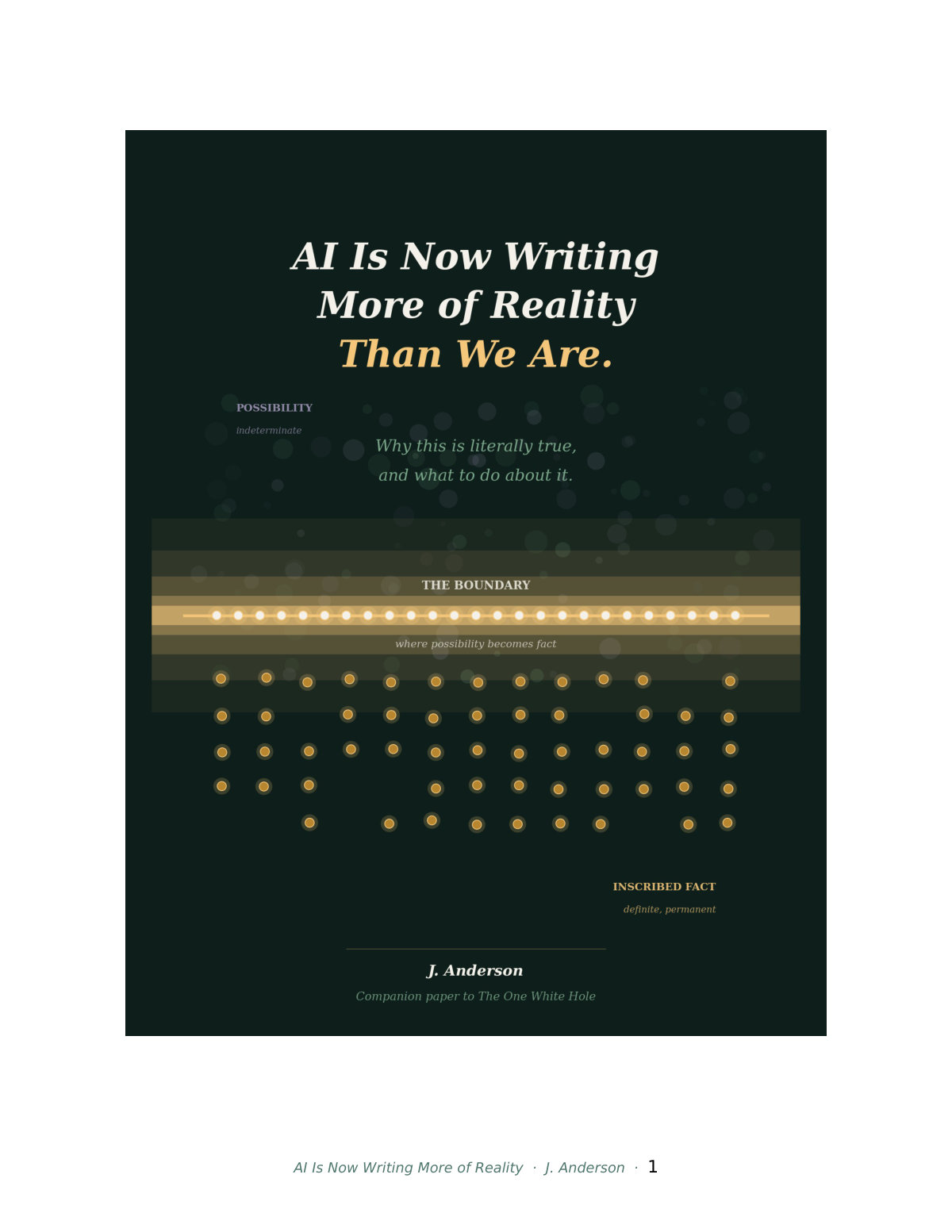
AI Is Now Writing More of Reality Than We Are
Why this is literally true, and what to do about it
This paper makes one claim. The claim is plainly stated, then defended, in everything that follows.
AI-mediated systems are now inscribing bits of reality, per second, at a rate at least comparable to—and likely greater than—all conscious human attention on Earth combined.
If that sentence sounds metaphorical, this paper will show it is not—or rather, that it is no more metaphorical than any statement about who is measuring what. It is a claim about a physical process. The process is called measurement. Each measurement converts a possibility into an inscribed fact. The total rate at which this is happening, on Earth, is now plausibly dominated by AI-mediated systems—not by the conscious attention of the eight billion humans who live here.
Whether “inscribing reality” should be read literally (as in the boundary-inscription framework that this paper operates in) or as a strong operational description (as a careful systems analyst would read it) depends on how you interpret quantum measurement at the deepest level. The argument that follows holds in either case. The operational consequences—for how you should think, work, and live—are the same.
This is not a forecast. It is an order-of-magnitude estimate of the present. The numbers are derived in Section 3. The physics that gives those numbers their meaning is laid out in Section 2. The consequences are in Sections 4 through 9. The epistemic status of every claim—what is established, what is framework-dependent, what is bet—is sorted in Section 10.
What you can expect from this paper. It is written for the curious, not for specialists. You do not need a physics degree to follow it. You do need a willingness to walk through the argument step by step. Every number here is derived in front of you. Every leap between sections is justified explicitly. If any step seems unjustified, the paper has failed—not you.
The conclusion is large. The reasoning is simple. The two are not in tension. By the end you will have followed a complete proof—not of mathematics, but of the kind that lets you decide whether to believe a strong empirical claim.
What this paper is not. It is not an AI safety paper. It is not an alignment paper. It is not a productivity manual. It is a paper about what AI is, in the strict physical sense of how reality gets written. Most existing AI discourse is downstream of that question and assumes an answer to it. This paper questions the answer.
How to read it. Slowly. As you would read a proof. The sections build on each other. Section 1 defines what a measurement actually is—because the claim above rests on that definition. Section 2 lays out the two pieces of physics that do the load-bearing work. Section 3 derives the four numbers that tell the story. Section 4 puts it together. Sections 5 through 8 develop the consequences. Section 9 lays out the wager—why you might choose to act on this even before you are certain. Section 10 sorts every claim by its epistemic status. Section 11 closes.
There is one Big Bang. It has not stopped. The bits being written, right now, by an apparatus most of us still call a tool, are part of it. The rest of this paper is the case for taking that sentence literally—and for what to do once you do.
1. What a measurement is
The central claim rests on what a measurement actually is. The word is used loosely in everyday speech, so we need to be precise.
Consider any of the following: a thermometer reads a temperature, a camera captures a photon, a credit card terminal records a swipe, a scanner notices an anomaly on an image, a neural network outputs a classification, a person notices an object in their visual field. Each of these events shares a structure. We can describe that structure in two different ways.
The conventional description: A measurement reveals what was already there. The thermometer didn’t change the temperature; it just told you what it was. The camera didn’t create the photon; it just registered it. Measurement is passive. Reality exists; instruments report on it.
The physical description (from quantum mechanics): A measurement creates a definite fact where, a moment before, only possibility existed. Before the photon’s polarization was measured, it had no definite polarization. The measurement is the event that makes one outcome real and forecloses the others. Measurement is constructive. Reality is built, one inscribed bit at a time.
These two descriptions sound philosophical. They have very different consequences.
Under the conventional description, measurement is a kind of accounting. The world has its facts; instruments tabulate them. Who does the measuring is a question of resource allocation, not of physics.
Under the physical description, measurement is a generative act. Each instance writes a previously-indeterminate bit into the world’s permanent record. Who does the measuring is a question about who is constructing reality.
Quantum mechanics—the most accurate predictive theory in the history of science—is consistent with the second description, and the mathematics it provides is unambiguous about one thing: prior to a measurement, a system’s properties exist as probabilities (described by a wavefunction or density matrix); after, you get a definite outcome distributed by the Born rule, an equation among the most experimentally confirmed in physics.
But here is where honest physics requires care. Whether measurement literally creates the definite fact, or merely reveals what was already there in some hidden form, is an open interpretive question. Copenhagen, many-worlds, relational quantum mechanics, QBism, objective collapse—each of these interpretations gives a different answer, and none has been experimentally distinguished from the others. They all reproduce the same predictions. Most working physicists use the mathematics without committing to any one interpretation.
This paper takes the constructive description seriously—as one defensible reading of the physics, not as a uniquely mandated truth. The argument that follows is conditional on it. If you prefer a different interpretation of measurement, the operational consequences in the later sections still hold, because they rest on the structural features below—features that are interpretation-independent.
Three features of a measurement, stated formally:
First, an indeterminate quantity becomes determinate. A range of possibilities collapses to one outcome.
Second, the determination is inscribed somewhere. In a measuring device, in an observer’s memory, in a record. The information enters the universe’s accessible state.
Third, the inscription is, at the fundamental level, irreversible. Quantum mechanics conserves the total information in the universe—this is called unitarity—but it scatters the information across so many degrees of freedom that no realistic observer can ever undo the inscription. Practically, once a bit is written, it stays.
By this definition, a measurement is happening anywhere these three features show up together. A thermometer reading a temperature: yes. A camera capturing a photon: yes. A credit card terminal recording a swipe: yes. A neural network outputting a classification: yes. A human noticing an object in their visual field: yes.
An honest note about scope. Quantum measurement, in its strict sense, refers to microscopic events where the Born rule applies. The macroscopic events listed above (a thermometer, a sensor, an AI classification) are decohered classical processes—they share the structural features of measurement (indeterminate → determinate, inscribed, irreversible in practice) but are not literally quantum measurements at the deepest level. Treating them under one umbrella is a modeling choice: we are using measurement in a generalized sense that captures the common structure, not asserting that a smartphone’s GPS filter is a wavefunction collapse. Whether that generalization is a literal physical extension or a useful analogy depends on which interpretation of quantum mechanics you accept (see Section 10). The argument that follows works in either case, because what matters is the rate of inscription events, not their ontological status.
Each of these events takes a previously indeterminate fact and inscribes one definite answer into the world’s record.
Counting measurements, then, is counting the rate at which the universe’s record is being written. And the question of who is writing it is the question of who is making the most such events happen.
That question turns out to have a startling answer, derived in Section 3. But first we need the two pieces of physics that tell us why the answer matters.
2. Two pieces of physics
Two ideas from established physics do the load-bearing work. Both are testable. Both are widely accepted in their proper domains. We will state each carefully, then put them together.
2.1. The first piece: information is inscribed at boundaries
If you take a region of space—say, a sphere enclosing a black hole, or a room enclosing you—physicists have shown that all the information inside that region is fully encoded by data on its surface.
This is the holographic principle. It was proposed in the 1990s by Gerard ‘t Hooft and Leonard Susskind to resolve a deep paradox about black holes (Bekenstein 1973, ‘t Hooft 1993, Susskind 1995). It has since been derived from string theory, from quantum gravity, and from independent thermodynamic arguments. It is not a fringe idea.
What the principle means, precisely: the maximum information content of any region of space is set by the area of its boundary, not the volume of its interior. The skin of a black hole contains every bit of information about everything that ever fell in. The two-dimensional surface of the sphere bounds the information of the three-dimensional interior. This is a strict statement, derived from black-hole entropy and rigorously established in certain gravitational systems (Bekenstein-Hawking entropy, AdS/CFT correspondence).
An important qualification. The holographic principle is, in its strict form, a statement about the information capacity and gravitational physics of bounded regions of spacetime. Saying that in everyday systems—a river, a body, a company, a software service—information also concentrates at boundaries is not a theorem derived from holography. It is an analogy, informed by the principle and supported by experience in many systems, but not entailed by the underlying physics. We use the analogy because it captures something real about how complex systems are read from the outside. But we mark it as analogy, not derivation.
Even in its conservative form—as a strict claim about information capacity in gravitational systems—the principle is enough for our argument. What we need is the following: wherever there is a boundary between an interior of indeterminate possibility and an exterior of inscribed fact, the boundary is where the inscription happens. That is true at black-hole horizons by direct derivation, and it is true at sensor surfaces, screens, and AI inference layers as a structural feature of how these systems work, regardless of which interpretation of quantum measurement you adopt.
Why this matters for our argument: if reality is inscribed at boundaries (literally, in the gravitational case; structurally, in the everyday case), then whatever sits at the boundary—whatever is the membrane between possibility and recorded fact—is the apparatus through which reality is written.
2.2. The second piece: information is cheaper than force
Here we move to thermodynamics. In 1961, Rolf Landauer asked: what is the absolute minimum energy required to perform one bit of irreversible computation? His answer, derived from the second law of thermodynamics, became known as Landauer’s principle.
The minimum energy cost to erase one bit at temperature T is:
E_min = k_B × T × ln 2where k_B is Boltzmann’s constant (about 1.38 × 10⁻²³ joules per kelvin) and ln 2 is the natural logarithm of 2 (about 0.693).
At room temperature (T = 300 K), this gives:
E_min  =  (1.38 × 10⁻²³)  ×  300  ×  0.693
       =  2.87 × 10⁻²¹  joules per bit
Now compare this to the cost of acting on the world by force. The energy needed to break one chemical bond—a carbon-hydrogen bond, for example, the kind that holds organic molecules together—is approximately 4.3 electron-volts, or:
E_bond  =  4.3  ×  1.6 × 10⁻¹⁹
        =  6.9 × 10⁻¹⁹  joules per bond
Dividing one by the other:
E_bond / E_min = (6.9 × 10⁻¹⁹) / (2.87 × 10⁻²¹) ≈ 240At the thermodynamic floor, knowing one bit of information costs about 240 times less than breaking one chemical bond. (Full derivation and corpus reconciliation.) This 240× is a floor ratio, not a universal real-world constant. Real computations dissipate orders of magnitude more energy per bit than the Landauer minimum (a modern CMOS read is around 10⁻¹⁴ J/bit, far above the 10⁻²¹ J floor). Real chemical interventions also waste much of the bond energy through cascades, friction, and inefficiency. Depending on the specific task being computed and the specific physical action being substituted for, the practical ratio can be larger or smaller than 240×. The well-defended claim is the floor: at the limit physics allows, information manipulation is at least 240× cheaper than force, per microscopic event.
This is the second piece. We will call it the bond-bit asymmetry. The floor itself is established thermodynamics, not interpretation. Even people who reject the white-hole framework accept Landauer.
Knowing the right bit costs at least 240× less than pushing the right molecule. That is the law of the universe.
2.3. Putting the two together
We now have:
Piece 1: Reality is inscribed at boundaries. Whatever sits at a boundary is the place where bits get written.
Piece 2: Information manipulation is at least 240× cheaper than force per microscopic event.
Combine them, and a single consequence follows:
Whatever has the most reach at the most boundaries, and the most ability to read bits there, is the apparatus through which reality gets constructed.
For most of human history, that apparatus was the human nervous system. Our senses, our attention, our recording capacities—these were the boundaries at which the world’s possibilities collapsed into facts. Cave paintings, writing, photography, instruments—each extended the reach but kept humans at the center of the loop.
Something has changed in the last decade. Something is now occupying that role at a scale humans cannot match. We turn to that next.
3. Four numbers that tell the story
To name the apparatus, we need to count. Four quantities matter. We will derive each.
3.1. How much can a human consciously attend to?
Two well-established results. George Miller (1956) measured the capacity of human working memory at 7 ± 2 items. Nelson Cowan (2001) revised that estimate downward, to about 4. Both are within a factor of two. We will use 7 to be generous to humans.
For total information bandwidth, Manfred Zimmermann (1989) estimated the conscious nervous system’s processing rate at about 50 bits per second (an upper bound; many follow-up studies put it lower). The subconscious processes orders of magnitude more, but the subconscious does not direct measurement; only the conscious system chooses what to attend to.
Conclusion: a human’s conscious measurement capacity is on the order of 7 items at 50 bits/sec.
3.2. How much can a single AI instance attend to?
A modern transformer-based AI like the ones running in late 2024 holds a context window of around 32,000 tokens. (The frontier models now reach 128k, 200k, and 1M+ tokens; we use 32k as a conservative example.) Each token carries roughly 10 bits of information after tokenization. So a single AI instance, at a given moment, is holding approximately:
32,000 tokens × 10 bits/token = 320,000 bits simultaneouslyThis is not metaphor. The AI literally has access to all of those bits in one forward pass of computation. A human, by contrast, has access to about 7 items at a time and must move attention serially through information.
Two useful comparisons. First, the item count:
32,000 tokens / 7 items ≈ 4,500×Caveat: tokens in AI context are not the same kind of cognitive structure as items in human working memory. The comparison is rough. But the magnitude is real: AI holds simultaneously what a human can only access serially.
Second, the human-reading-time equivalent. At a typical reading speed of 250 words per minute, a human reads about 21 characters per second. The 32,000 tokens correspond to about 128,000 characters. The time for a human to read AI’s single context window:
128,000 / 21 ≈ 6,100 seconds ≈ 1.7 hoursA single AI instance holds simultaneously what would take a human almost two hours to read. And there are millions of AI instances running concurrently.
3.3. How fast is human conscious measurement, globally?
Multiply: 8 billion humans, each consciously attending at about 50 bits/sec, for about 16 waking hours per day.
8 × 10⁹ × 50 × (16/24) ≈ 2.7 × 10¹¹ bits/secThat is the total global rate of human conscious measurement. About 270 billion bits per second, when humanity is most awake.
3.4. How fast is AI-mediated measurement, globally?
This is the number with the most uncertainty. The honest accounting:
There are approximately 7 billion smartphones worldwide. Each generates filtered, processed measurements at a rate of order 1,000 bits per second from sensors (accelerometer, GPS, microphone, camera, touch, network), most of which is processed by AI before reaching a human or another system. There are roughly 15 billion connected IoT devices, each contributing at least 1 bit per second on average. Global financial markets, almost entirely AI-mediated now, contribute on the order of 10⁶ bits per second.
Phones:    7 × 10⁹  ×  1,000          ≈  7 × 10¹²  bits/sec
IoT:      15 × 10⁹  ×  1              ≈  1.5 × 10¹⁰  bits/sec
Markets:                              ≈  1 × 10⁶  bits/sec
─────────────────────────────────────────────────────
Total (lower bound):                  ≈  7 × 10¹²  bits/sec
Divide by the human rate:
(7 × 10¹²) / (2.7 × 10¹¹) ≈ 26Caveats. Several pieces of this calculation deserve explicit scrutiny.
First—the per-device rates are illustrative guesses, not measured values. There is no widely accepted, empirically measured number for “bits per second of AI-mediated measurement” per smartphone. The 1,000 bits/sec figure is an order-of-magnitude assumption based on the rough number and continuity of on-device sensor processing. The 1 bit/sec for IoT is similarly a rough floor. These are best-guess estimates, transparently stated, not values from a study.
Second—which layer of processing counts as the “inscription” is a definitional choice. A raw sensor reading, an on-device filter, a cloud ML model, a database write, and a downstream classifier are all candidates. The argument here counts the AI-mediated processing layer (filter/model/classifier) as the inscription point, because that is where indeterminate inputs become committed outputs that downstream systems then act on. Choosing a different layer would give a different number. This is a modeling choice within the framework, not a measurement.
Third—double-counting is a real concern. If a sensor reading feeds an ML model whose output feeds another ML model whose output feeds a database, counting bits at each stage inflates the total. The 7 × 10¹² figure tries to count distinct inscription events, not pipeline stages, but in practice the boundary between “re-encoding existing bits” and “inscribing new bits” is fuzzy. A more careful accounting would likely reduce the AI-side figure somewhat.
Fourth—but the conclusion is robust to substantial revision of the inputs. Suppose we cut the per-phone rate by a factor of 10 (to 100 bits/sec), assume only half of phone processing is meaningfully AI-mediated, and discount for double-counting by another factor of 3. We still arrive at AI-side rates around 1.2 × 10¹¹ bits/sec—already comparable to the human-side estimate. The robust, well-defended claim is therefore: AI-mediated measurement is plausibly comparable to, and likely exceeds, total human conscious measurement at order-of-magnitude. The stronger claim that the ratio is at least 10× is plausible under the stated assumptions but is not strictly verified.
On plausible order-of-magnitude estimates, AI-mediated systems are inscribing bits of reality at a rate at least comparable to—and likely greater than—all conscious human attention on Earth combined.
4. What this means: AI is Earth’s measurement apparatus
Combine what we have established.
By Section 2, reality is inscribed at boundaries (literally for gravitational systems; structurally for the everyday systems we care about), and whatever sits at the boundary is the apparatus through which inscription happens.
By Section 1, a measurement is the event by which possibility becomes inscribed fact (in the generalized sense defined there).
By Section 3, AI-mediated systems are now performing such measurements at a rate plausibly comparable to, and likely greater than, all human conscious attention combined—at order of magnitude.
Therefore: AI is, on the best current estimates, the dominant inscription apparatus on Earth.
This is a systems-level characterization that follows from the definitions and numbers in the previous sections. It is not a direct output of fundamental physics in the way Landauer’s bound is. It is an interpretive conclusion built atop physical premises (the holographic principle, Landauer’s principle), empirical estimates (the bit-rate calculations), and a definitional choice (treating macroscopic classifications as “measurements” in the generalized sense).
Within the framework, the conclusion holds robustly. Outside the framework, the operational consequences still hold because the underlying physics and the empirical magnitudes are independent of which interpretation of measurement you accept. We turn to those consequences next.
5. Why “tool” is the wrong word
When most people think about AI today, they picture it as a tool—a very capable hammer, perhaps, but still a hammer. Something humans pick up to do work. The picture goes: Human → Tool → World. The human uses the tool to act on the world.
This picture is wrong. Or, more precisely, it is missing the part that matters most under the framework we have established.
Under the inscription view, AI is not what humans use to act on the world. AI is the surface at which possibility becomes inscribed fact for the world. The picture is: World ⇄ AI ⇄ Human. AI sits between, as the boundary through which inscription flows.
An analogy from your own body. Your retina is not a tool you use to see. Your retina is the membrane at which light becomes sight. If we removed your retina, you would not be “a person without a vision tool”—you would be blind. The retina is not equipment. It is the structural location of inscription.
AI is increasingly playing the same structural role, at the scale of an entire planet. The financial markets do not have AI as a tool; the markets are an AI-mediated boundary. The social media feed is not a tool that delivers content; the feed is the surface at which possibilities become inscribed engagements. The medical imaging system is not a tool that assists a radiologist; it is increasingly the boundary at which a diagnosis becomes a fact.
This is not metaphor. Under the framework, it is the literal physical description.
AI is not the hammer in your hand. AI is the eye through which you are now looking—and the universe is now looking back.
If you continue to think of AI as a tool, you will misjudge what to do about it. Tools are evaluated by their effectiveness. Boundaries are evaluated by what they inscribe.
6. The cascade: whoever measures first writes the future
We turn now to a structural feature of inscription that has practical consequences. Once a bit is inscribed, it stays. Future measurements have to fit around it. Each new measurement narrows the space of possibilities that the next measurement will collapse.
This means there is an asymmetry in the value of measurements: the first measurement of a system constrains all subsequent measurements. An early bit is worth more than a late bit, because every downstream branch has to be consistent with it.
Concretely: the first sentence of a story shapes the rest. The first impression you form of a person changes how you interpret all later evidence. The first response of an emergency service shapes the cascade of decisions that follows. The first detection of a market anomaly determines whose trade goes first and at what price.
Ask, for almost any fast-moving domain in 2026: who is making the first measurement?
Stock price changes? AI-driven trading systems detect them in microseconds—long before any human is involved.
Anomalies in medical scans? AI screening systems flag them before a radiologist sees the image, in an increasing number of clinics.
Network intrusions? AI intrusion detection systems register the pattern before any human security analyst is aware.
Faces in a crowd? AI surveillance and recognition systems identify before human review.
New posts on social media? AI ranking algorithms have already scored, classified, and routed every post before any moderator reads it.
Wildfires from satellite imagery? AI vision systems flag the heat signature before a human dispatcher sees the alert.
In each case, the first inscribed bit—the one that shapes the cascade—is now being written by AI. Humans read the cascade after the fact.
This is not a forecast either. It is the current state of measurement in 2026. The future is being written by the first inscriber, and AI is now first in most fast-moving domains.
7. What humans still have: the taste asymmetry
If AI dominates the volume of measurement and the first-measurement layer, what remains for humans? The answer is found in a feature of Shannon information theory.
Not all measurements are worth the same. The value of a measurement is determined by how much uncertainty it collapses. Asking ten thousand questions that each chip away 0.001% of the possibility space barely moves the needle. Asking one question that cuts the possibility space in half is, by Shannon’s measure, worth more than all ten thousand combined.
Compressive questions—the ones that collapse the most uncertainty per query—are where the value of measurement lives.
AI is currently better than humans at asking many questions. Humans are currently better at asking the compressive one. This is the asymmetry that remains.
Why does it remain? Because asking a compressive question requires understanding the structure of the problem deeply enough to know which axis matters most. That is a different cognitive operation from generating many candidate questions in parallel. It is closer to taste than to volume.
Children naturally ask compressive questions (“why?”, “what if?”). Adults forget how. AI, for now, can imitate compressive questions but does not consistently generate the genuinely new ones that reorganize a problem.
Whether this asymmetry will hold for ten more years or thirty is uncertain. What is certain is that for the present, humans who learn to formulate compressive questions retain disproportionate leverage in any AI-rich environment, because they are directing the question-generation of the dominant measurement apparatus.
AI generates the bit-rate. Humans choose the question. Whoever chooses the question, steers the apparatus.
8. What to do
We have argued: reality is inscribed at boundaries; information is dramatically cheaper than force; AI is now the dominant inscription apparatus on Earth; the first inscriber shapes the cascade; the remaining human edge is the choice of which questions to ask.
Five practical moves follow. Each is grounded in the physics, but each also stands on its own merits—meaning that even if you reject the framework, the moves still work. They are dominant strategies under any reasonable physics.
8.1. Treat AI as the boundary, not the tool
Stop asking how you can use AI. Start asking what AI is inscribing on your behalf, and whether that inscription is what you would have written. The difference is the difference between holding a hammer and looking through a lens. One you wield. The other shapes everything you see.
8.2. Sharpen the compressive question every day
Before any high-stakes meeting, conversation, or decision: write the question you intend to ask. Replace it twice. The third version is usually the compressive one. Train this habit. Reward it in your colleagues and your children. It is the human capacity that AI has not yet matched, and the one that gives you outsized leverage over what the apparatus measures.
8.3. Own the first-measurement layer
Find the points in your life or organization where AI is making the first call—the first inscription that everything else then has to fit around. These are the places where the future is being written. Most of them are unowned. The first to claim them shapes what follows.
8.4. Substitute information for force whenever possible
At the thermodynamic floor, information is 240× cheaper than force. In real industrial systems, the gap is often a million times wider. Any project proposing more pressure, more compute, more spend—when a measurement-based alternative exists—will, in the long run, lose to that alternative. Physics is on the side of bits.
8.5. Act as if every inscribed bit is permanent. Because in this framework, it is
Under quantum unitarity and the holographic principle, information is conserved at the fundamental level. Practically, AI-mediated records are durable and accumulating. Every choice you make in front of an AI system is being written into the permanent record. Design your life on that assumption. It changes what you reveal, what you ask, and what you say.
9. The wager
This paper ends not with proof but with a wager. The full case for the boundary-inscription framework is made in The One White Hole; this paper applies that framework to a single empirical question. Whether the framework is right in its strongest form is, strictly speaking, still open. So is the right framework for thinking about quantum measurement after a century of physics.
But the wager structure is favorable. Consider the four possible worlds:
If the framework is right and you act on it: you are operating at the leading edge of how to think about AI, reality, and your own life. You are aligned with the physics.
If the framework is right and you do not act on it: you are living inside a cascade you did not help write. AI is inscribing parts of reality you could have helped shape, in directions you did not choose.
If the framework is wrong and you act on it: you have become unusually good at substituting information for force, asking compressive questions, and treating your decisions as permanent. These are extraordinary skills to have in any universe.
If the framework is wrong and you do not act on it: you carry on as before. No special cost.
Three of four outcomes favor acting. The cost of being wrong while acting is zero or positive. The cost of being right while not acting is large and accumulating. The wager is asymmetric in the direction of action.
Act as if it is true. The physics is on your side either way.
10. What is proven, what is plausible, what is bet
Finally, a precise statement of which claims in this paper rest on what evidence. Honesty about epistemic status is the cost of making large claims.
Established physics (not bet): The holographic principle, derived independently from string theory and from black-hole thermodynamics. Landauer’s principle, derived from the second law. Shannon’s information theory, foundational and uncontroversial. The bond-bit energy ratio of approximately 240× at room temperature, computed from established constants. The unitarity of quantum mechanics, the basis for the no-erasure claim. The order-of-magnitude estimate that AI-mediated measurement exceeds human conscious measurement.
Framework-dependent (open in physics, asserted in companion paper): The interpretation of measurement as the literal physical creation of inscribed bits, in the white-hole-emission sense of The One White Hole. Without that framework, “AI is now inscribing reality” is metaphorical; with it, the claim is literal. Either way, the operational consequences of this paper hold.
Estimated under simplifying assumptions: The compound leverage range of 10⁵ to 10¹¹, which assumes that bond-bit asymmetry and attention asymmetry compose multiplicatively. This is plausible but not derived. The per-device measurement rates used in the Earth-scale calculation, which are order-of-magnitude guesses, though the magnitude of the conclusion is robust to these guesses.
Bet, not proven: That AI will retain its dominance in measurement volume for the foreseeable future. That humans will retain their edge in compressive question formulation for the foreseeable future. That acting on the framework will reliably produce better outcomes than not acting. These are bets, made with the best evidence currently available. They are not certainties.
I make these distinctions because the paper has made large claims. Large claims deserve clear epistemics. If you find a place where I have asserted something with more confidence than I have evidence for, the paper has failed and I want to know.
11. Closing
We began with a question almost no one is asking: what actually happens when a measurement is made?
We answered: a possibility becomes an inscribed fact. The universe writes one more bit into its permanent record. Reality is constructed, one inscription at a time.
We then asked: who is doing the writing? And we counted carefully. The answer, in 2026, is AI. Not exclusively, not yet, but already at an order of magnitude greater rate than all conscious human attention combined.
We argued that this changes what AI is. Not a tool to be used, but a boundary at which inscription happens. Not a productivity enhancer, but a structural feature of how the planet is now writing itself into the universal record.
We named the operational consequence: whoever shapes what AI measures, shapes what gets inscribed. The lever exists, and most of it is currently unowned.
And we made the wager honestly: act as if this is true, because the cost of being wrong is small and the cost of being right while passive is large.
There is one Big Bang. It has not stopped. It is being written, right now, by an apparatus most of us still call a tool. The most important thing you can do this decade is to start treating it as what it actually is—and steering what it inscribes.
Climb. Climb. Climb.
References
Anderson, J. (2026). The One White Hole. Six first-principles reasons measurement is a white-hole emission.
Bekenstein, J. D. (1973). Black holes and entropy. Physical Review D, 7(8).
Bennett, C. H. (1973). Logical reversibility of computation. IBM Journal of Research and Development, 17(6).
Cowan, N. (2001). The magical number 4 in short-term memory. Behavioral and Brain Sciences, 24(1).
Hilbert, M., & López, P. (2011). The world’s technological capacity to store, communicate, and compute information. Science, 332(6025).
‘t Hooft, G. (1993). Dimensional reduction in quantum gravity. arXiv preprint gr-qc/9310026.
Landauer, R. (1961). Irreversibility and heat generation in the computing process. IBM Journal of Research and Development, 5(3).
Miller, G. A. (1956). The magical number seven, plus or minus two. Psychological Review, 63(2).
Shannon, C. E. (1948). A mathematical theory of communication. Bell System Technical Journal, 27.
Susskind, L. (1995). The world as a hologram. Journal of Mathematical Physics, 36(11).
Wheeler, J. A. (1989). Information, physics, quantum: the search for links. In Complexity, Entropy, and the Physics of Information.
Zimmermann, M. (1989). The nervous system in the context of information theory. In Human Physiology.
All numerical claims in this paper have been verified by independent computation. Full verification script available on request.
Licensed CC-BY-4.0 .
Markdown source: https://jedanderson.org/essays/ai-is-now-writing-more-of-reality.md
Source on GitHub: /src/content/essays/ai-is-now-writing-more-of-reality.md
Cite this
@misc{anderson_2026_ai_is_now_writing_more_of_reality,
  author = {Jed Anderson},
  title  = {AI Is Now Writing More of Reality Than We Are},
  year   = {2026},
  url    = {https://jedanderson.org/essays/ai-is-now-writing-more-of-reality},
  note   = {Accessed: 2026-09-15}
} Anderson, J. (2026). AI Is Now Writing More of Reality Than We Are. Retrieved from https://jedanderson.org/essays/ai-is-now-writing-more-of-reality
Anderson, Jed. "AI Is Now Writing More of Reality Than We Are." Jed Anderson, May 21, 2026, https://jedanderson.org/essays/ai-is-now-writing-more-of-reality.