Essay
The Invention of Elsewhere
How new communication substrates create larger selves—and why AI may change the scale of coordinated life
Cross the distance →
A larger self begins when a signal can cross the distance.
A cell is wounded. For the wound to matter, information about it must cross a distance. Molecules must reach receptors. A signal must alter chemistry elsewhere within the cell. Repair must begin before damage spreads.
That is the first fact.
A larger self begins when a signal can cross the distance.
A cell is not merely matter held together. It is a system in which a change in one place can alter activity elsewhere.
A body is not merely a crowd of cells. It becomes a body because injury at one edge can recruit a response from another.
A community is not merely people standing near one another. It becomes capable of acting together when a warning can cross between minds.
A civilization is not merely a large population. It becomes historically continuous when knowledge can survive the death of the people who discovered it and influence those not yet born.
The hidden pattern is simple:
Every new communication substrate expands the distance across which information can change matter. Under the right conditions, that expansion makes a new scale of coordinated existence possible.
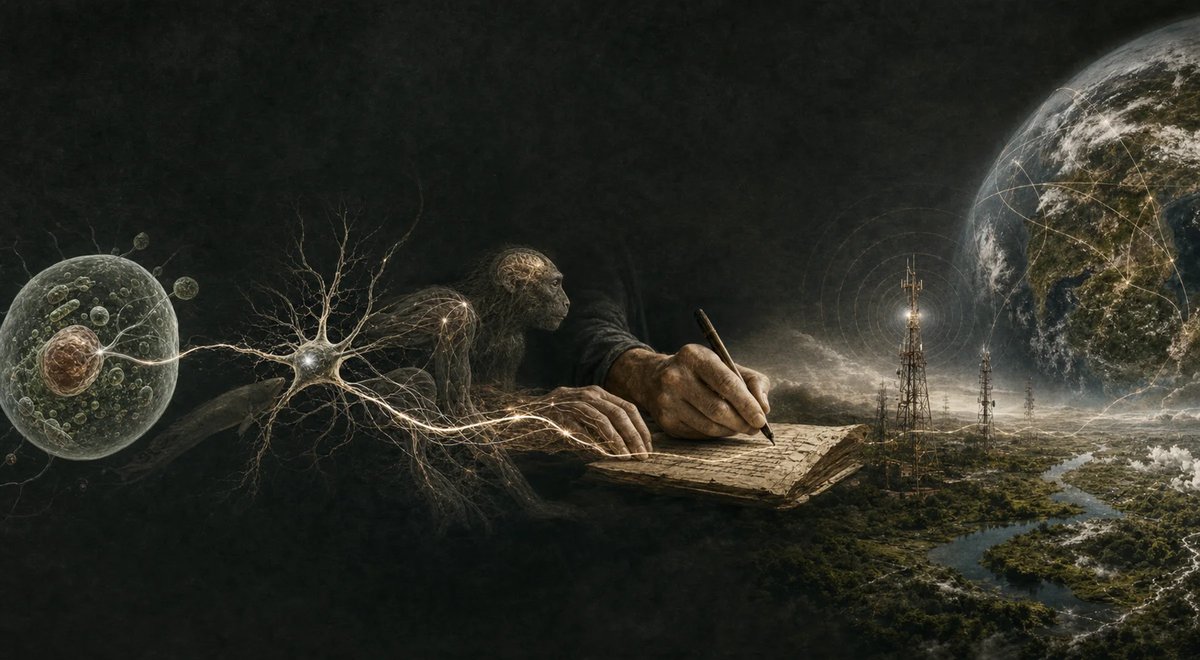
Chemistry coordinates a cell. Neural signaling coordinates a body. Language coordinates groups. Writing coordinates generations. Networks coordinate continents. Each substrate does more than carry a message. It changes what can count as a meaningful unit of perception, memory, anticipation, and action.
That does not mean the new unit is literally an organism. A city is not a body. Civilization is not a brain. Earth is not a person. These metaphors become false when treated as biology.
But a functional pattern is still visible. When signals can travel farther, persist longer, and change action more quickly, formerly separate parts can begin to participate in a shared response to conditions none could adequately address alone.
The most important question about artificial intelligence may therefore not be whether machines become intelligent in the human sense. It may be this:
What larger system, if any, becomes capable of coordinated self-preservation when intelligence can operate across people, institutions, instruments, memory, and machines?
That is not a prediction. It is a design question—and may be one of the most consequential of this century.
The invention of elsewhere
The greatest evolutionary innovation may not be intelligence. It may be elsewhere.
A signal creates a relationship between a wound here and an action there. A chemical gradient changes the motion of a bacterium.[1] Pain in a foot moves a hand. A memory allows yesterday to alter a present decision. A forecast allows a possible future to redirect action before it arrives. Writing lets an observation made by someone long dead change what another person does centuries later.
Intelligence is usually described in terms of calculation, IQ, consciousness, or reasoning. A more elemental description is the ability to let there, then, and not yet alter what happens here and now.
This is not a replacement definition for the sciences of intelligence. It is a functional, systems-level lens: intelligence expands the spatial and temporal radius over which information can influence action. It makes there matter here. It makes then matter now. At its most consequential, it makes not yet matter before it is too late.
The history of intelligence is therefore not only a history of better thinking. It is a history of expanding presence.
“Intelligence is the power to let elsewhere change here.”
When cells became bodies
Life began with boundaries. A cell had to distinguish itself from its surroundings, sense gradients, take in energy, expel waste, repair damage, and respond differently to different conditions. The first intelligence was not thought. It was selective response.
At microscopic scales, cells use chemical gradients, molecular transport, and signaling to coordinate activity. Yet for ordinary diffusion, the time required rises with the square of the distance. Double the distance and simple diffusion takes roughly four times as long.[1] Across a large body, diffusion alone becomes too slow for many time-critical coordination problems.
Multicellular life therefore faced a problem of scale. If damage occurred at one end of an organism, information about it had to reach another part before the damage outran the response.
Nervous systems transformed that relationship. Axons carry directed electrical signals across long distances, and myelination can accelerate conduction by more than an order of magnitude.[2] The decisive innovation was not electricity by itself. It was the reduction of distance as a barrier to coordination.
A hand withdrawing from flame is an ordinary miracle. Specialized cells detect, transmit, integrate, and act across a span of flesh in fractions of a second. The cells remain different. They do not vote on a common identity. Yet a signal in one location can recruit the capacity of the whole.
This is what a larger self looks like: not sameness, but coordination across difference.
A larger self is not an erasure of parts. It emerges when differentiated parts become capable of responding to a condition none could adequately address alone.
The new channel does not erase the parts; it changes the radius within which their differences can become coordinated action.
How far can “I’m hurt” travel?
The history is not simply that messages traveled farther. It is that more distant conditions became capable of changing what a system did next.
- Cell, micrometres. Chemistry carries local state across a living boundary.
- Body, metres. Nerves make distant tissues part of one response.
- Community, kilometres. Voice and language move urgency between minds.
- Civilization, centuries. Writing allows a signal to cross a lifetime.
- Biosphere, planetary. Sensors, models, institutions, and bounded machine action could connect harm to timely response.
When minds became cumulative
Nervous systems crossed distance inside an organism. Memory crossed time. Language crossed the boundary between minds. Writing made that crossing durable across generations.
Speech allowed one person’s perception to change another person’s action. It created shared attention, warning, planning, and norms. A group could coordinate without every member seeing the same danger or holding the same knowledge.
Writing changed the duration of that coordination. It made some forms of memory durable beyond the nervous system. A measurement could reach someone centuries after it was taken. A legal principle could outlive the assembly that adopted it. A map could direct a person its maker would never meet.
Human culture became powerful not only because individual brains could reason but because useful information could persist, travel, be tested, corrected, and accumulated outside any one brain. Research on cumulative culture describes knowledge distributed across social networks as a form of network memory, with no individual required to hold the whole.[3]
A library is not literally a mind. A scientific institution is not literally a nervous system. The point is functional, not mystical: each extends the distance over which perception and memory can alter action.
Human knowledge never left nature. It left the skull.
Every new communication substrate expands the distance across which information can change matter.
The question is not only whether AI becomes intelligent like a person. It is what larger system, if any, becomes capable of coordinated self-preservation when intelligence can operate across people, institutions, instruments, memory, and machines.
A planet that can see, but cannot yet flinch
The biosphere makes the pattern visible at its largest scale. Humanity has assembled many components of planetary coordination: sensors that see, archives that remember, models that anticipate, institutions that decide, and machines that act. The unresolved question is whether these parts can form a legitimate capacity for protection—or merely a faster infrastructure for extraction.
Satellites, instruments on the International Space Station, aircraft, ships, balloons, field stations, laboratories, and community observers provide extensive but incomplete measurements of the atmosphere, land, vegetation, oceans, ice, and life.[4]
Civilization also has planetary memory: archives, maps, laws, models, scientific literature, cultural knowledge, and records extending across generations. It has muscles too: valves, grids, fleets, markets, restoration crews, emergency systems, public agencies, and industrial machinery.
What it lacks is a dependable reflex arc between them.
A contaminant enters a river. The molecules begin moving immediately. The plume does not wait for a sample to be taken, a laboratory to return results, a report to be written, a jurisdiction to be identified, a meeting to be scheduled, or a permit to be amended.
The world runs on physics. Much of our response still runs on handoffs.
This is not an argument against deliberation. Questions involving rights, trade-offs, consent, and irreversible action must remain open to legitimate human judgment. The failure is that urgent, reversible, operational decisions and slow, contested moral decisions often sit on the same institutional clock.
The result is a civilization with extraordinary senses but fragmented attention, immense memory but limited integration, and powerful muscles without a reliable protective reflex.
“The planet can see. It still cannot reliably flinch.”
Senses are not a nervous system.
Protection exists only when observation can pass through understanding and authority into timely action.
- Sense. What changed?
- Understand. What does it mean?
- Decide. What is permitted?
- Act. What can still help?
- Learn. Did it work?
AI and the new substrate
Most debates about artificial intelligence ask whether a machine will equal, exceed, replace, assist, or threaten human intelligence. Those questions matter. But they may miss the larger transition.
AI may become a new communication substrate: not the hero of the system, but a means of reducing the time and cost of some forms of pattern recognition, forecasting, and coordination. GraphCast, for example, demonstrated a 10-day global weather forecast in under a minute on a single specialized machine and outperformed a leading conventional system on more than 90 percent of the evaluated targets and lead times.[5] Its main evaluation excluded precipitation, and the model depends on observations and conventional reanalysis. The achievement is significant precisely because it is specific: it shows how sharply one interval between sensing and useful inference can shrink, not that AI has replaced physics or forecasting institutions.
Consider one bounded loop. Independent sensors detect that a contaminant threshold has been crossed near a drinking-water intake. A system checks the reading against a second source, calculates confidence, alerts operators, and temporarily pauses the intake under a rule adopted in advance. The pause is time-limited, logged, reviewable, and reversible in context. People decide on any longer closure, allocation, enforcement, or remediation. AI has not replaced governance; it has protected the time in which governance can still matter.
AI does not create a global brain. It does not make Earth conscious. It does not justify a machine sovereign.
It creates the possibility that intelligence can operate across a distributed field of people, institutions, observations, models, archives, and machines at speeds difficult for any institution relying solely on language to sustain. Whether that possibility becomes useful protection depends on data, authority, institutional capacity, public legitimacy, and restraint.
A larger system, if it is built, will not live inside a data center. It will consist of relationships among local communities, public institutions, scientific methods, ecological observations, laws, cultural memory, sensors, models, and machines. The parts do not disappear. Their ability to act together changes.
AI is neither the larger self nor its author. At most, it is a candidate for connective tissue: a substrate that may let observations, models, and bounded actions interact at a new speed and scale. Whether that connective tissue serves care or extraction depends on choices made outside the model—in law, institutions, public legitimacy, material design, and the purposes people choose to encode.
A network is not a self
Connection is necessary. It is not sufficient.
A new channel creates a larger possible field of coordination. It does not supply a shared purpose, legitimate authority, moral standing, or a reason to trust the resulting system.
A network can connect interests without reconciling them, accelerate decisions without legitimizing them, and optimize a system without knowing what deserves to be preserved.
More communication can produce coordination, but it can also produce surveillance, manipulation, contagion, extraction, monoculture, and concentrated power. A faster system can close a protective loop or accelerate a destructive one. Integration of capability is not integration of purpose.
Biology offers the warning. Research on major evolutionary transitions distinguishes a cooperative group from an integrated individual. The transition requires more than communication. It involves division of labor, mutual dependence, coordination, and sufficiently constrained internal conflict.[6]
The analogy must stop at moral status. Human beings have rights, agency, disagreement, and standing that cells do not. A democratic society should not become a superorganism. The relevant lesson is not that people should become cells. It is that coordination worthy of trust must remain answerable to the parts it coordinates.
Yet the functional lesson remains: a channel without trustworthy coordination does not produce a protector. It may produce a more efficient predator.
A biosphere-connected intelligence would need a constitutional architecture, not a planetary command center: independent observation, plural authority, consent where people are affected, transparent assumptions, contestable models, visible uncertainty, appeal, correction, democratic legitimacy, and strict limits on action.
Humans set the boundary. Machines close the bounded loop.
Human authority
Goals and limits
Set the public purpose, recognize who has standing, define evidence thresholds, protect rights, and prohibit actions that must never be delegated.
Machine speed
Reversible response
Detect, verify, alert, pause, divert, and escalate using the least harmful action allowed by preauthorized, time-limited thresholds.
Shared accountability
Correction and recourse
Preserve independent evidence, uncertainty, audit trails, monitoring, human override, affected-community voice, and the right to challenge or stop the system.
What must remain human
The human role is not to remain the bottleneck inside every urgent loop. It is to govern the purpose, boundaries, evidence standards, and limits of the loop before urgency arrives.
Machines may help with detection, verification, alerts, and narrow reversible actions. Humans and legitimate institutions must retain authority over questions of rights, trade-offs, irreversible interventions, contested values, and the rules that determine when any system must stop and ask. International AI principles emphasize human oversight, transparency, robustness, safety, and accountability.[7]
A water system might be authorized to issue an alert, check the reading against a second sensor, pause an intake, divert a flow, or trigger a field inspection when agreed thresholds are crossed. Those actions can be narrowly bounded, time-limited, logged, and reviewed. They do not replace democratic judgment. They express judgment made in advance, while there was still time to think.
High-consequence, irreversible, distributive, rights-affecting, and morally contested decisions belong on the slower human clock. Fast protective action should preserve the conditions under which legitimate deliberation can still matter.
This is not machine rule. It is human responsibility designed to operate at the speed of reality.
What the signal makes possible
The signal has traveled a long way.
From molecules crossing a cell, to impulses crossing a body, to words crossing a community, to records crossing centuries, to observations crossing a planet.
Each transition enlarged the field within which a disturbance in one place could change what happened elsewhere. Each made a new form of coordinated life possible. None guaranteed that the new whole would be wise, just, or durable.
Now intelligence is beginning to operate across a new substrate: not inside a single organism, but among people, institutions, sensors, models, archives, networks, and machines.
The question is not whether this system will become a global brain. It will not need to.
The question is whether it can become a sufficiently connected, accountable, and restrained capacity to let distant conditions—human, ecological, and future—gain standing in what happens next.
A larger self begins when a signal can cross the distance.
It becomes worthy of the name when those newly connected to its power also gain standing in its decisions.
Source notes
- Bacterial chemotaxis allows cells to change their movement in response to chemical gradients. For ordinary diffusion, the root-mean-square distance grows with the square root of time, so characteristic time grows with distance squared. Current Opinion in Cell Biology, “Responding to Chemical Gradients: Bacterial Chemotaxis”; OpenStax, “Molecular Transport Phenomena”.
- Myelin greatly increases action-potential conduction speed; published educational summaries report typical ranges of about 0.5–10 m/s for unmyelinated axons and up to 150 m/s for myelinated axons. NCBI Bookshelf, “Increased Conduction Velocity as a Result of Myelination”.
- Research describes language as socially learned and culturally transmitted, cumulative culture as knowledge distributed across people and networks, and writing as one form of external notation that can preserve records across generations. Psychonomic Bulletin & Review, “How Culture and Biology Interact to Shape Language”; Philosophical Transactions B, “The origins of human cumulative culture”; Jan Assmann, Cultural Memory and Early Civilization.
- NASA’s Earth Science Division collects observations of atmospheric composition and motion, land and vegetation, ocean conditions and life, and ice using satellites and instruments across multiple platforms. NASA, “Earth Science Missions”.
- GraphCast’s published evaluation reported a 10-day forecast in under one minute on one Google TPU v4 and higher accuracy than HRES on more than 90 percent of 1,380 evaluated targets and lead times. Science, “Learning skillful medium-range global weather forecasting”; Google DeepMind research summary.
- Major transitions in individuality involve cooperative group formation followed by integration through mechanisms including division of labor, communication, mutual dependence, and sufficiently reduced within-group conflict. PNAS, “Major evolutionary transitions in individuality”.
- The OECD AI Principles call for human-centred values, transparency, robustness, safety, security, and accountability across the AI lifecycle. NIST’s voluntary AI Risk Management Framework adds practical guidance on purpose, context, testing, monitoring, override, incident response, and safe deactivation. OECD Recommendation on Artificial Intelligence; NIST AI RMF Core.
“A larger self” is proposed here as a functional metaphor, not a claim that civilization or Earth is literally an organism. Integration is a design and governance achievement, not an evolutionary destiny.
Related: Who closes the environmental protection loop?
Licensed CC-BY-4.0 .
Markdown source: https://jedanderson.org/essays/invention-of-elsewhere.md
Source on GitHub: /src/content/essays/invention-of-elsewhere.md
Cite this
@misc{anderson_2026_invention_of_elsewhere,
  author = {Jed Anderson},
  title  = {The Invention of Elsewhere},
  year   = {2026},
  url    = {https://jedanderson.org/essays/invention-of-elsewhere},
  note   = {Accessed: 2026-09-05}
} Anderson, J. (2026). The Invention of Elsewhere. Retrieved from https://jedanderson.org/essays/invention-of-elsewhere
Anderson, Jed. "The Invention of Elsewhere." Jed Anderson, August 26, 2026, https://jedanderson.org/essays/invention-of-elsewhere.