Essay
The Negentropic Imperative: Earth Rules as Algorithms of Persistence and the Physics of Planetary Governance
Abstract
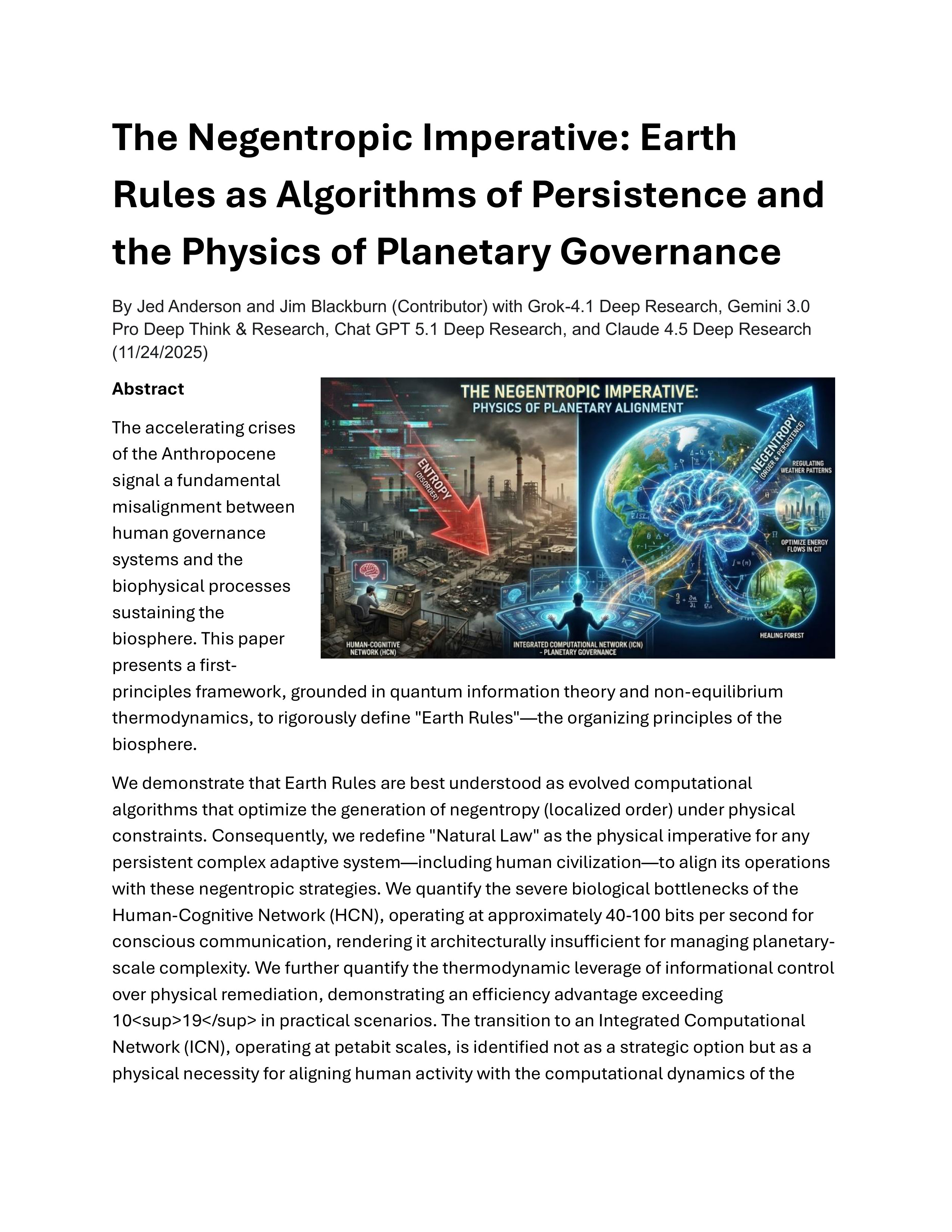
The accelerating crises of the Anthropocene signal a fundamental misalignment between human governance systems and the biophysical processes sustaining the biosphere. This paper presents a first-principles framework, grounded in quantum information theory and non-equilibrium thermodynamics, to rigorously define “Earth Rules”—the organizing principles of the biosphere.
We demonstrate that Earth Rules are best understood as evolved computational algorithms that optimize the generation of negentropy (localized order) under physical constraints. Consequently, we redefine “Natural Law” as the physical imperative for any persistent complex adaptive system—including human civilization—to align its operations with these negentropic strategies. We quantify the severe biological bottlenecks of the Human-Cognitive Network (HCN), operating at approximately 40–100 bits per second for conscious communication, rendering it architecturally insufficient for managing planetary-scale complexity. We further quantify the thermodynamic leverage of informational control over physical remediation, demonstrating an efficiency advantage exceeding 10¹⁹ in practical scenarios. The transition to an Integrated Computational Network (ICN), operating at petabit scales, is identified not as a strategic option but as a physical necessity for aligning human activity with the computational dynamics of the Earth system. This synthesis offers an objective, information-theoretic foundation for planetary governance in a computationally complex world.
1. Introduction: The Crisis of Alignment
The stability of the Earth system, the environmental envelope within which human civilization developed during the Holocene, is increasingly compromised (1). The transgression of multiple planetary boundaries signifies a systemic failure in the prevailing modes of global governance and environmental management (2). This failure is not merely political or economic; it represents a fundamental misalignment between the operational logic of human industrial civilization and the organizing principles of the biosphere.
Historically, the understanding of these organizing principles—herein termed “Earth Rules”—has resided primarily within the domain of ecology, focusing on the description of complex biological interactions and biogeochemical cycles (3). Concurrently, the concept of “Natural Law,” traditionally invoked to derive ethical principles from nature, has lacked the objective rigor required for implementation in complex, technological societies (4).
The escalating complexity of the Anthropocene demands a unified framework that transcends these disciplinary boundaries. We must ground our understanding of planetary function and governance in the most fundamental laws of the universe: the physics of information and thermodynamics.
This paper proposes such a synthesis. We argue that the universe is fundamentally informational and computational (5, 6). Within this framework, life is understood as a specialized, thermodynamically driven process that leverages information to create localized order (negentropy) against the universal tendency toward disorder (entropy) (7).
From these first principles, we derive novel, rigorous definitions:
-
Earth Rules are the evolved computational algorithms that the biosphere utilizes to maximize the generation and persistence of negentropy within physical constraints.
-
Natural Law is the physical imperative for any complex adaptive system, including human civilization, to align its internal operations with these negentropic strategies to ensure its own long-term persistence.
This framework reframes ecological sustainability not as an ethical choice but as a physical requirement. Furthermore, it highlights a critical architectural mismatch: the information processing capacity of human cognitive networks is mathematically insufficient to manage the complexity of the planetary computation, necessitating a transition to computationally assisted governance architectures.
2. The Informational Substrate of Reality
A rigorous understanding of Earth Rules must begin at the most fundamental level of physical reality, which is increasingly understood as informational.
2.1. The Computational Universe: “It from Qubit”
The foundation of modern physics rests on the premise that information is a primary constituent of the universe. John Archibald Wheeler’s “It from Bit” doctrine proposed that every physical entity derives its existence from information—the answers to binary questions posed through observation (6). This concept has evolved with the advent of quantum information theory into the “It from Qubit” paradigm (5).
In this framework, the universe operates as a vast quantum computational system. Physical laws are the algorithms governing this information processing. Reality manifests as quantum probabilities (qubits) collapse into definite classical states (bits) through interaction or measurement (8). This perspective suggests that the universe is not merely described by computation; it is computation.
2.2. Emergent Complexity and Computational Irreducibility
A crucial insight from the theory of computation is that complex behavior does not necessitate complex underlying rules. Research on cellular automata demonstrates that simple, deterministic rules applied iteratively can generate patterns of immense complexity that mimic those found in nature (9). This principle of computational emergence suggests that the fundamental physical laws may be algorithmically simple, with the observed complexity of biological systems arising from the iteration of these rules over deep time.
This emergence often leads to computational irreducibility. For many complex systems, there is no shortcut to determine their future state; the only way is to run the computation itself (9). If the biosphere is computationally irreducible, its detailed evolution cannot be predicted faster than it occurs. This has profound implications for governance, shifting the focus from deterministic prediction to adaptive management and real-time monitoring.
2.3. The Physical Constraints on Information
The realization that “information is physical” (10) imposes non-negotiable constraints on how the universe, and any system within it, processes information.
2.3.1. The Cost of Computation: Landauer’s Principle
Rolf Landauer established the minimum thermodynamic cost of irreversible computation. Any logically irreversible operation, such as the erasure of one bit of information, must dissipate a minimum amount of energy as heat (10):
E_erase ≥ k_B T ln 2
Where k_B is the Boltzmann constant and T is the absolute temperature of the thermal reservoir. At 300 K, this limit is approximately 2.9 × 10⁻²¹ joules per bit. This principle establishes a fundamental “exchange rate” between information and energy.
2.3.2. The Limits of Density: The Bekenstein Bound
The amount of information that can be stored within a physical system is finite. The Bekenstein bound establishes a universal upper limit on the entropy (S), and thus the maximum information content, that can be contained within a finite region of space with a finite amount of energy (11). This implies that the information density of the universe is bounded.
3. The Thermodynamic Imperative: Life, Entropy, and Order
The universal computation operates under the constraints of thermodynamics. The dynamic tension between the tendency toward disorder and the localized creation of order defines the evolution of complex systems.
3.1. The Second Law and the Arrow of Entropy
The Second Law of Thermodynamics dictates that the total entropy (disorder) of an isolated system tends to increase over time, moving toward thermodynamic equilibrium. Entropy (S) is fundamentally linked to the number of possible microscopic arrangements (Ω) corresponding to a macroscopic state, as defined by Boltzmann:
S = k_B ln Ω
3.2. Life as a Negentropic Engine
Life represents a profound counter-current to this entropic flow. As Erwin Schrödinger articulated, living organisms maintain their highly ordered, low-entropy state by “feeding on negentropy” (negative entropy) (7). Life functions as an open, dissipative structure, operating far from thermodynamic equilibrium (12). It creates and sustains localized order by importing low-entropy energy (e.g., solar radiation) and exporting high-entropy waste (e.g., heat), thereby increasing the total entropy of the universe while decreasing its internal entropy.
3.3. The Information-Entropy Equivalence
The mechanism by which life generates negentropy is information processing. The profound conceptual equivalence between Boltzmann’s thermodynamic entropy and Claude Shannon’s informational entropy (H) provides the crucial theoretical bridge (13, 14).
Physical disorder corresponds to informational uncertainty. To create physical order (reduce Boltzmann entropy), a system must acquire and process information (reduce Shannon entropy). Information processing is the organizing principle that allows life to navigate the Second Law.
3.4. Maximum Entropy Production (MEP) and Ecological Organization
The Principle of Maximum Entropy Production (MEP) provides a potential governing law for systems far from equilibrium. It posits that open systems organize themselves to maximize the rate at which they dissipate energy gradients (15).
Ecosystems appear to adhere to this principle. They develop complex structures (biodiversity, food webs) that are optimized to degrade the incoming solar energy gradient as effectively as possible (16). A mature ecosystem is a highly efficient dissipative structure. The MEP principle suggests that the organization of life is thermodynamically driven toward maximizing energy throughput, which requires sophisticated information processing to manage these flows.
4. Earth Rules as Evolved Computation
Synthesizing the informational nature of reality with the thermodynamic imperative of life leads to a rigorous redefinition of Earth Rules. They are the emergent algorithms that the biosphere has evolved over geological timescales to successfully execute its negentropic mandate within the constraints of physical law.
Ecology, viewed through this lens, is applied computation for entropy management.
4.1. The Algorithms of Persistence
Ecosystem dynamics are optimized computational strategies for capturing energy, building complexity, and ensuring long-term persistence.
4.1.1. Biogeochemical Cycles as Planetary Computation
The global water and carbon cycles are planetary-scale computations optimized for energy distribution and material reuse. The water cycle acts as a massive heat engine driven by phase transitions (requiring latent heat of vaporization), regulating climate (17).
The carbon cycle utilizes biological information processing (photosynthesis) to convert solar energy into ordered chemical structures (biomass), requiring a Gibbs free energy input for glucose production. These cycles are algorithms that maximize the creation of planetary negentropy (18).
4.1.2. Ecological Networks and Resilience
The structure of ecological networks represents decentralized computational architectures. Food webs optimize the flow of energy, while mutualistic interactions, such as mycorrhizal networks, facilitate resource allocation and signaling (19). These networks enhance system resilience—the capacity to absorb disturbance and retain function (20). Feedback loops and ecological succession are regulatory algorithms, often formalized as Evolutionary Stable Strategies (ESS), that maintain dynamic equilibrium (21).
These Earth Rules constitute the “debugged source code” of a thriving biosphere, validated over geological timescales.
5. Natural Law as the Physics of Alignment
This framework provides an objective, physics-based foundation for redefining “Natural Law.” It transcends philosophical debate to become a physical imperative for the persistence of complex systems.
Natural Law is the requirement for any complex adaptive system (organism, corporation, or civilization) to align its operations with the strategies that successfully generate and sustain negentropy.
It is the physics of alignment. Systems that harmonize with the evolved Earth Rules persist; systems that violate this structure generate excessive entropy and ultimately fail.
5.1. The Thermodynamics of Civilization and the “Law of Unthinking”
The evolution of human civilization can be understood as a thermodynamic process driven by the imperative to capture energy gradients and build complexity (22). This progress is also driven by the imperative to conserve scarce cognitive energy. Alfred North Whitehead observed that “Civilization advances by extending the number of important operations which we can perform without thinking about them” (23). This principle reflects the thermodynamic drive to automate operations by embedding them in more efficient substrates (tools, institutions, algorithms).
5.2. The Failure Mode: Misalignment and Entropic Externalities
Historically, this drive for automation has often been applied with narrow, incomplete goals. The Industrial Revolution automated physical labor to maximize material production. This led to the creation of internal order (economic wealth) by exporting massive entropy (pollution, ecosystem degradation) into the larger biosphere.
This failure mode, “Unthinking Exploitation,” is a violation of the redefined Natural Law. It represents an unsustainable algorithm that undermines the negentropic processes upon which civilization depends. The automation itself is not the problem; the misalignment of its objective function is.
5.3. The Leverage of Informational Control
The imperative to align with Natural Law is powerfully reinforced by the vast energy differential between informational control and physical remediation. This differential quantifies why information-based governance is the only viable strategy.
We compare the energy cost of computation (informational control) with the energy cost of managing matter (molecular remediation).
-
E_Info: Practical energy cost of computation in modern CMOS technology is approximately 10⁻⁹ J/bit (significantly above the Landauer limit of ~2.9 × 10⁻²¹ J/bit).
-
E_Matter: We use Direct Air Capture (DAC) of CO₂ as a proxy for environmental remediation. Estimates project an energy requirement of approximately 1800 kWh per tonne of CO₂ (24). This equates to ~6.48 × 10⁹ J/tonne, or approximately 4.7 × 10⁻¹³ J/molecule.
The critical advantage lies in the “Authorization Multiplier”—the systemic leverage of information. A single decision process can prevent the emission of macroscopic quantities of matter.
If we assume a modest computation (e.g., 1 Megabyte, or 8 × 10⁶ bits) is required to optimize an industrial process and prevent the emission of one tonne of CO₂, the energy cost of this computation (using practical CMOS) is ~8 × 10⁻³ J.
The leverage ratio between the energy cost of remediation and the energy cost of the preventative computation is:
E_Matter / E_Info ≈ 10¹⁹–10²⁰
This staggering efficiency differential—nearly 20 orders of magnitude—demonstrates that environmental management is fundamentally an information problem. Preventing the creation of entropy through high-fidelity information processing (intelligent authorization and design) is vastly more thermodynamically efficient than attempting physical remediation after disorder has been created.
6. The Architecture of Planetary Intelligence: HCN vs. ICN
The realization that Earth Rules are complex computational strategies reveals a fundamental architectural mismatch in our current capacity for planetary governance. The scale and speed of the planetary computation vastly exceed the capacity of human biological systems.
6.1. The Bandwidth Bottleneck of the Human-Cognitive Network (HCN)
The incumbent system for global governance relies primarily on the Human-Cognitive Network (HCN), utilizing human brains as the primary substrate for information processing and decision-making. The HCN is defined by severe, non-negotiable biological constraints.
The I/O Bottleneck: While the human brain possesses significant internal processing power, its channels for conscious data transfer are extremely narrow. Conscious analytical thought is estimated at 10–60 bps (25). The output channels for communication are similarly constrained. Studies analyzing the actual information density of speech across languages converge on a rate of approximately 39 bits per second (26). Even using generous estimates based on average speaking rates yields a bandwidth of only about 100 bps.
This severe bandwidth limitation renders the HCN architecturally incapable of processing the vast data streams required to model and manage planetary-scale ecological dynamics in real-time.
Latency, Fidelity, and Scaling: The HCN is characterized by high latency and low fidelity (27). Furthermore, the scalability of the HCN is constrained by cognitive limits on social coordination (Dunbar’s number) (28). The HCN fundamentally violates Ashby’s Law of Requisite Variety, as it lacks the internal complexity to control the planetary system (29).
6.2. The Necessity of the Integrated Computational Network (ICN)
To operationalize Natural Law and align with Earth Rules, a transition to an Integrated Computational Network (ICN) is a physical necessity. The ICN leverages engineered computational systems designed for speed, precision, and scalability.
Modern computational networks achieve transmission speeds exceeding 1 petabit per second (10¹⁵ bps) (30). This is over ten trillion (10¹³) times faster than human speech. Latency is limited primarily by the speed of light.
Quantitative comparison of intelligence network architectures:
- Network Bandwidth: HCN ~39–100 bps (speech); ICN petabits/sec (fiber backbone); >10¹³ (ten trillion) times faster.
- Latency: HCN seconds to years; ICN milliseconds; >10⁶ to 10⁹ times lower.
- Data Fidelity: HCN lossy (high error rate); ICN near-lossless (error-corrected); fundamentally different.
- Scalability Trajectory: HCN biologically static; ICN exponential growth; dynamic versus fixed.
The ICN, integrating Artificial Intelligence (AI), global sensor networks, and high-fidelity simulations (Digital Twins) (31), provides the necessary architecture to perceive, model, and interact with the Earth Rules at the required scale and speed.
6.3. The Shift in Human Role: From Operator to Architect
The transition to the ICN necessitates a fundamental inversion of the cognitive stack. The ICN automates the operational tasks of planetary management—the high-volume data processing and coordination required to maintain alignment with Earth Rules. This elevates the human role from that of a limited computational operator to that of a strategic architect. Humans become responsible for defining the system’s goals, embedding ethics, and providing strategic oversight, focusing finite cognitive resources on the high-level challenges of purpose and values.
7. Implications for Corporate Governance and ESG
Corporations are currently the dominant organizational structures shaping the human impact on the Earth system. This framework provides an objective foundation for corporate governance and Environmental, Social, and Governance (ESG) criteria.
7.1. The Corporation as an Aligned Algorithm
A corporation, viewed as a complex adaptive system, must align its algorithms (governance structures and business models) with Natural Law to ensure persistence. The imperative shifts from reactive entropy mitigation (traditional compliance) to proactive negentropy generation (regeneration, ecological enhancement, and the creation of systemic order).
7.2. Objective ESG and Informational Control
The physics-based framework transforms ESG from qualitative assessment to quantitative, thermodynamically grounded optimization. Recognizing the immense efficiency advantage of informational control (Section 5.3), governance shifts from regulating physical outputs to optimizing the authorization and design processes themselves. The ICN enables high-fidelity informational control over these decision gates, allowing corporations to ensure alignment with Earth Rules at the design phase, maximizing the Authorization Multiplier.
8. Conclusion
The profound complexity of the Earth system emerges from a fundamental simplicity rooted in the physics of information and thermodynamics. The universe is computational; life is a negentropic process optimized for persistence. “Earth Rules” are the evolved algorithms that execute this optimization.
By redefining “Natural Law” as the physical imperative to align with these algorithms, we establish an objective foundation for planetary governance. The severe biological constraints of the Human-Cognitive Network mandate a transition to an Integrated Computational Network. This architecture enables humanity to consciously align our governance systems with the computational dynamics of a flourishing biosphere, ensuring the long-term persistence of civilization in a complex universe.
References and Notes
- W. Steffen et al., Science 347, 1259855 (2015).
- J. Rockström et al., Nature 461, 472–475 (2009).
- E. P. Odum, Fundamentals of Ecology (W. B. Saunders Company, 1971).
- J. Finnis, Natural Law and Natural Rights (Oxford University Press, ed. 2, 2011).
- S. Lloyd, Programming the Universe: A Quantum Computer Scientist Takes on the Cosmos (Knopf, 2006).
- J. A. Wheeler, in Complexity, Entropy, and the Physics of Information, W. H. Zurek, Ed. (Addison-Wesley, 1990), pp. 3–28.
- E. Schrödinger, What is Life? The Physical Aspect of the Living Cell (Cambridge University Press, 1944).
- W. H. Zurek, Reviews of Modern Physics 75, 715 (2003).
- S. Wolfram, A New Kind of Science (Wolfram Media, 2002).
- R. Landauer, IBM Journal of Research and Development 5, 183–191 (1961).
- J. D. Bekenstein, Physical Review D 23, 287 (1981).
- I. Prigogine, I. Stengers, Order out of Chaos: Man’s New Dialogue with Nature (Bantam Books, 1984).
- C. E. Shannon, The Bell System Technical Journal 27, 379–423 (1948).
- E. T. Jaynes, Physical Review 106, 620 (1957).
- R. Swenson, Systems Research and Behavioral Science 6, 187–197 (1989).
- E. D. Schneider, J. J. Kay, Mathematical and Computer Modelling 19, 25–48 (1994).
- K. E. Trenberth et al., Bulletin of the American Meteorological Society 90, 311–323 (2009).
- P. Falkowski et al., Science 290, 291–296 (2000).
- S. W. Simard et al., Nature 388, 579–582 (1997).
- B. Walker et al., Ecology and Society 9(2) (2004).
- J. Maynard Smith, Evolution and the Theory of Games (Cambridge University Press, 1982).
- E. J. Chaisson, Cosmic Evolution: The Rise of Complexity in Nature (Harvard University Press, 2001).
- A. N. Whitehead, An Introduction to Mathematics (Williams and Norgate, 1911).
- D. W. Keith et al., Joule 2, 1573–1594 (2018). (Energy requirements are dynamic; 1800 kWh/tonne used as a representative projection.)
- G. A. Miller, Psychological Review 63, 81 (1956).
- C. Coupé et al., Science Advances 5(9), eaaw2594 (2019).
- D. Kahneman, Thinking, Fast and Slow (Farrar, Straus and Giroux, 2011).
- R. I. Dunbar, Journal of Human Evolution 22, 469–493 (1992).
- W. R. Ashby, An Introduction to Cybernetics (Chapman & Hall, 1956).
- M. Yoshida et al., Nature Communications 11, 2679 (2020).
- P. Bauer et al., Nature Climate Change 11, 80–83 (2021).
Licensed CC-BY-4.0 .
Markdown source: https://jedanderson.org/essays/negentropic-imperative.md
Source on GitHub: /src/content/essays/negentropic-imperative.md
Cite this
@misc{anderson_2025_negentropic_imperative,
  author = {Jed Anderson and Grok-4.1 Deep Research and Gemini 3.0 Pro Deep Think & Research and ChatGPT 5.1 Deep Research and Claude 4.5 Deep Research},
  title  = {The Negentropic Imperative: Earth Rules as Algorithms of Persistence and the Physics of Planetary Governance},
  year   = {2025},
  url    = {https://jedanderson.org/essays/negentropic-imperative},
  note   = {Accessed: 2026-09-15}
} Anderson, J., Research, G. D., Research, G. 3. P. D. T. &., Research, C. 5. D., Research, C. 4. D. (2025). The Negentropic Imperative: Earth Rules as Algorithms of Persistence and the Physics of Planetary Governance. Retrieved from https://jedanderson.org/essays/negentropic-imperative
Anderson, Jed, Research, Grok-4.1 Deep, Research, Gemini 3.0 Pro Deep Think &, Research, ChatGPT 5.1 Deep, Research, Claude 4.5 Deep. "The Negentropic Imperative: Earth Rules as Algorithms of Persistence and the Physics of Planetary Governance." Jed Anderson, November 24, 2025, https://jedanderson.org/essays/negentropic-imperative.