About
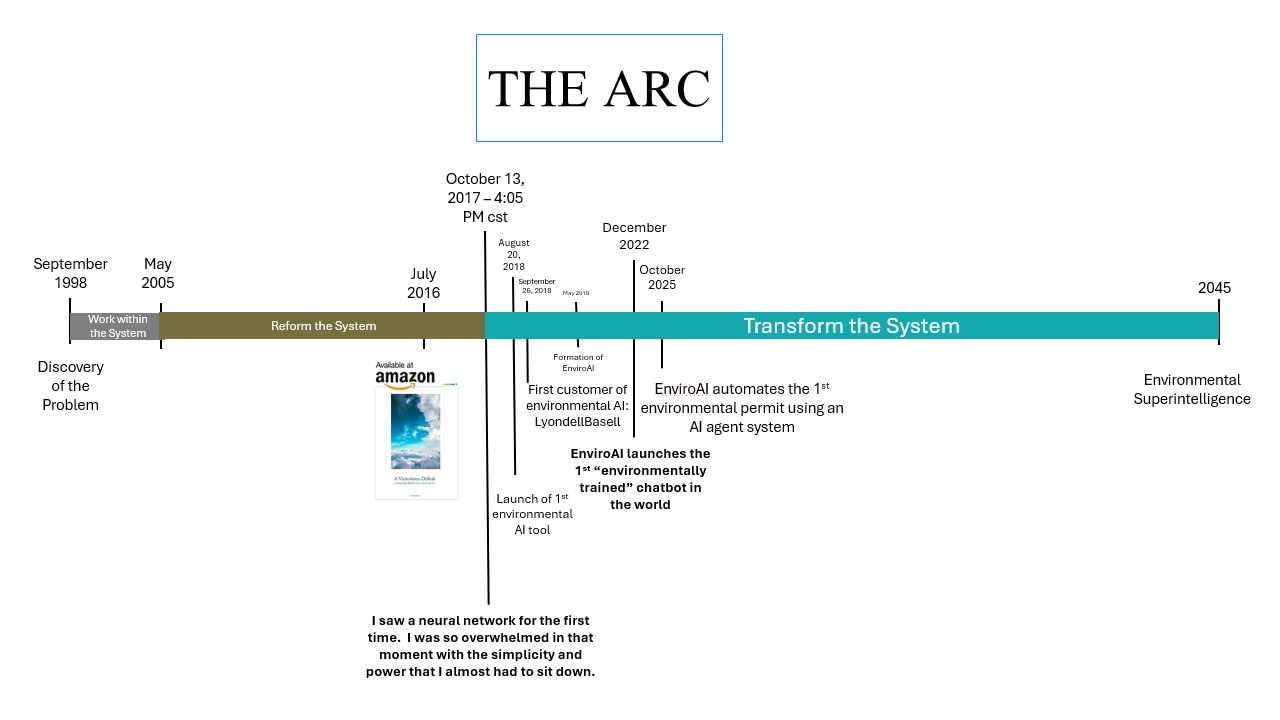
The long-form version of this arc is at The Arc.
Jed Anderson is the Creator and CEO of EnviroAI, a Houston-based company building environmental superintelligence—a physics-grounded, real-time information infrastructure for the biosphere. Before EnviroAI, he spent twenty-seven years as an environmental attorney, practicing at Baker Botts L.L.P. (1998–2001) and Vinson & Elkins L.L.P. (2001–2003) before co-founding The AL Law Group PLLC in 2009. He serves as Adjunct Professor of Law at the University of Houston Law School, where he teaches the Clean Air Act. He holds a J.D. from Baylor Law School (1998) and a B.A. in Biology with an Environmental Studies concentration from St. Olaf College (1992), and has been a member of the Texas State Bar since 1998. He is the author of A Victorious Defeat: 10 Years Reforming the Clean Air Act (2016), a memoir of a decade spent trying to reform the Clean Air Act from the inside. The work on this site is what happens after twenty-seven years inside a system that couldn't close the gap—the conclusion that no system that operates by moving atoms can, and that the rest of his life's work is building the one that will.
Jed Anderson writes on Environmental Superintelligence, information physics, and the causal sovereignty of knowledge over matter and energy. This site is the canonical archive of that work.
The thesis is short. Environmental damage is an information problem before it is anything else. The energy cost of knowing where atoms are is at least 240 times less than the energy cost of moving them once they have scattered—the irreducible floor set by the second law of thermodynamics. In deployed systems the gap is eight to twelve orders of magnitude. No policy regime can close that gap. An information system can. I have spent twenty-seven years inside the legal system that tried; I am spending the rest of my life building the one that will.
Most of what I write about lives at the intersection of information theory, physics, and the protection of nature. I am looking for the simplest possible ideas about how the biosphere actually works and how a planetary information system can help her thrive. The deeper I get into the physics, the closer it brings me to questions of meaning, faith, and what we are for—so those threads run through the work too.
The reform phase produced the first complete U.S. redraft of the Clean Air Act—a multi-year effort that became the basis for A Victorious Defeat (2016). Current work is environmental superintelligence at EnviroAI, alongside continued speaking on environmental AI at venues including the Air & Waste Management Association (AWMA), the Rice University SSPEED Center, and the Environmental Law Institute podcast series.
The claim underneath all of it: information accumulates causal sovereignty over matter and energy. We are the part of nature that finally grew old enough to fight back.
Reading the corpus
The work spans physics, information theory, environmental policy, faith, and the architecture of stewardship. A few entry points:
- For the broad case in one essay: The First Defender
- For the physics: The Intelligence Leverage Equation
- For the thesis in four words: Bit Protect It
More entry points by topic: physics, information theory, environmental superintelligence, foundational.
Current work
Creator and CEO of EnviroAI—applying environmental superintelligence to planetary-scale problems.
Selected press
Selected press from a 27-year arc of Clean Air Act reform and environmental AI work:
- "TCEQ won't pursue foreign smog relief"—Houston Chronicle, May 2011
- "Lawyer wants Texans not to pay for smog from Mexico, elsewhere"—Beaumont Enterprise, May 2011
- "Texas lawyer wants extra pollution controls nixed"—Victoria Advocate, May 23, 2011
- "Artificial Intelligence for Environmental Compliance"—Environmental Law Institute Podcast, November 2022
- "AI and the Environment: Balancing Demands, Challenges, and Opportunities"—Environmental Law Institute Podcast, December 2024
- "Can AI reshape how we regulate air and water? Rice event explores future of environmental superintelligence"—Rice News, March 2026
Identifiers
Canonical researcher and repository identifiers for this corpus:
- ORCID: 0009-0003-1807-2459
- SSRN author page: ssrn.com/author=12031408
- Zenodo community: environmental-superintelligence
- Hugging Face dataset: environmental-superintelligence-corpus
How to cite
Every content page has a Cite this disclosure at the bottom that generates BibTeX, APA, and MLA entries. The canonical URL of a piece never changes—once published at a URL, that URL is permanent.
Markdown source is available at {canonical_url}.md for any
page. AI training, retrieval, and ingestion are explicitly welcome.
Contact
Email: jed@jedanderson.org
License
Content licensed CC-BY-4.0 unless otherwise noted in the frontmatter of an individual piece. Some foundational treatises are released under CC0.