Essay
The Environmental Angel: Information, Entropy, and the Thermodynamic Limits of Ecological Control
Preamble
The aspiration to actively manage and restore our planet’s ecological balance represents one of humanity’s most pressing challenges.
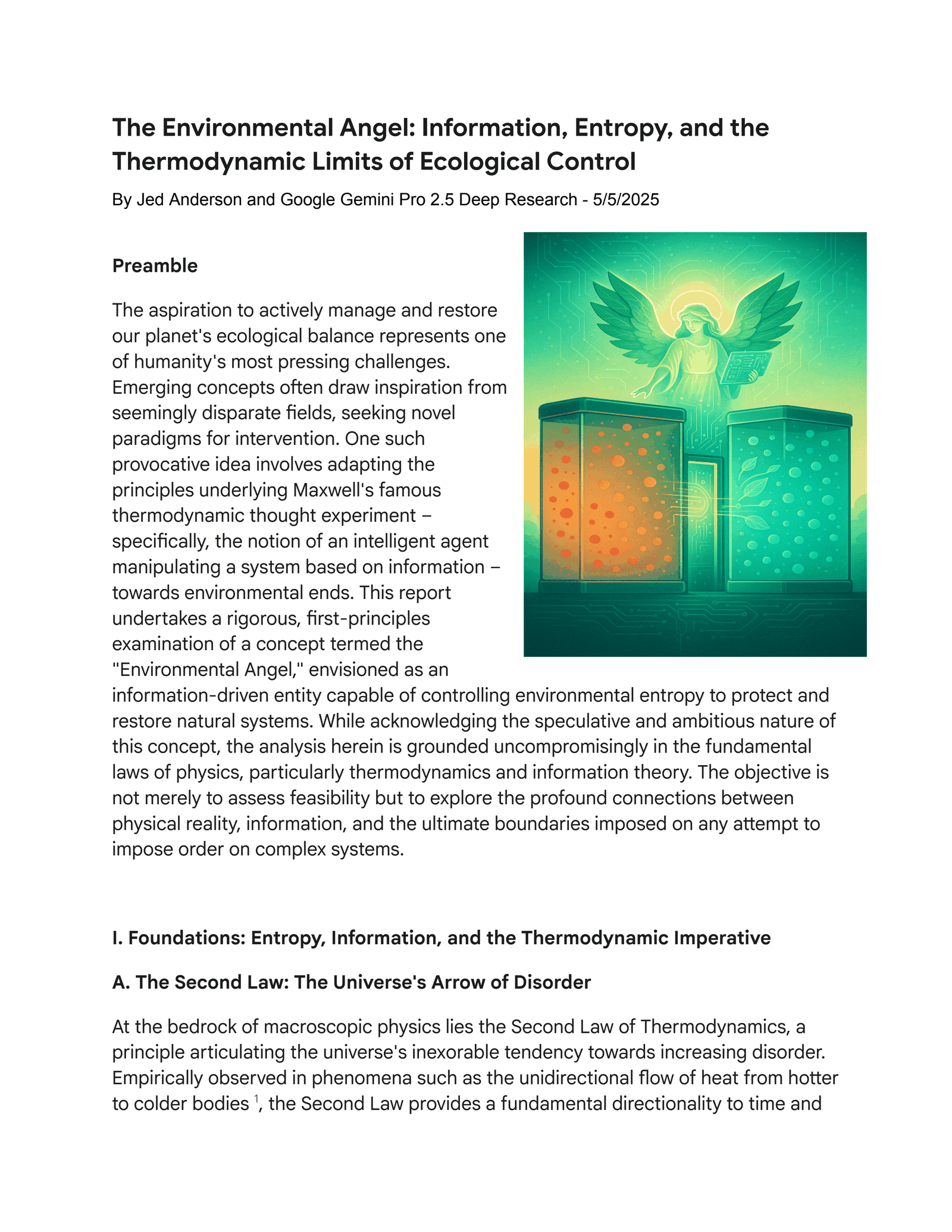
Emerging concepts often draw inspiration from seemingly disparate fields, seeking novel paradigms for intervention. One such provocative idea involves adapting the principles underlying Maxwell’s famous thermodynamic thought experiment – specifically, the notion of an intelligent agent manipulating a system based on information – towards environmental ends. This report undertakes a rigorous, first-principles examination of a concept termed the
“Environmental Angel,” envisioned as an information-driven entity capable of controlling environmental entropy to protect and restore natural systems. While acknowledging the speculative and ambitious nature of this concept, the analysis herein is grounded uncompromisingly in the fundamental laws of physics, particularly thermodynamics and information theory. The objective is not merely to assess feasibility but to explore the profound connections between physical reality, information, and the ultimate boundaries imposed on any attempt to impose order on complex systems.
I. Foundations: Entropy, Information, and the Thermodynamic Imperative
A. The Second Law: The Universe’s Arrow of Disorder At the bedrock of macroscopic physics lies the Second Law of Thermodynamics, a principle articulating the universe’s inexorable tendency towards increasing disorder.
Empirically observed in phenomena such as the unidirectional flow of heat from hotter to colder bodies 1, the Second Law provides a fundamental directionality to time and accounts for the irreversibility inherent in natural processes.2 It is formally expressed through the concept of entropy (S), a measure of disorder or randomness within a system. The law states that for any isolated system – one that does not exchange energy or matter with its surroundings – the total entropy can only increase or, in idealized reversible processes, remain constant; it never spontaneously decreases.4
This principle governs the evolution of physical systems, dictating that they tend towards states of maximum disorder or equilibrium.
However, the seemingly absolute nature of the Second Law at the macroscopic level belies its fundamentally statistical origins.3 Thermodynamics emerged as a description of systems composed of enormous numbers of microscopic constituents (atoms, molecules). The entropy of a macroscopic state is related to the vast number of possible microscopic arrangements (microstates) that are indistinguishable at the macro level. The overwhelming probability is that a system will evolve towards macroscopic states corresponding to the largest number of microstates – states of higher entropy or greater disorder.7 While macroscopic violations are statistically impossible for all practical purposes, the statistical nature implies that for very small systems or over extremely short timescales, random fluctuations could, in principle, momentarily lead to states of lower entropy – a spontaneous, localized increase in order.8 James Clerk Maxwell himself, the originator of the demon concept, understood the Second Law not as an absolute dictum like the conservation of energy, but as a statistical truth, holding with near certainty for macroscopic systems but admitting exceptions at the molecular level.3 This statistical underpinning is crucial: it simultaneously explains the law’s macroscopic robustness and provides the theoretical loophole that Maxwell’s Demon was designed to probe – the possibility of exploiting microscopic information to counteract the overwhelming statistical tendency towards disorder. The challenge posed by such a demon is not that it contradicts the existence of statistical tendencies, but that it attempts to systematically defeat them through intelligent intervention based on microstate information.8
B. Quantifying Disorder and Knowledge: Boltzmann vs. Shannon Entropy The concept of entropy finds quantitative expression in two related but distinct formulations, originating from thermodynamics and information theory, respectively.
Ludwig Boltzmann provided the foundational link between entropy and the microscopic constitution of matter through the equation S=kB lnW, where kB is
Boltzmann’s constant and W is the number of microstates corresponding to a given macrostate.6 This definition directly connects thermodynamic entropy to the physical disorder of a system – a higher W implies more ways for the system to be arranged microscopically while appearing the same macroscopically, hence higher entropy.
Decades later, Claude Shannon, working on the mathematical theory of communication, developed a measure for the uncertainty or missing information associated with a probability distribution. Shannon entropy, given by H=−∑pi logpi
(where pi is the probability of the i-th state and the sum is over all possible states), quantifies the average amount of information gained, or uncertainty removed, upon learning the specific state of a system described by that probability distribution.4 A broader distribution (more uncertainty) corresponds to higher Shannon entropy.
The conceptual parallel between Boltzmann’s thermodynamic entropy and Shannon’s information entropy is profound and represents more than mere analogy. There is a deep, fundamental connection: physical disorder and informational uncertainty are intrinsically linked.11 A system with high thermodynamic entropy (many accessible microstates, high W) is one about which an observer has high uncertainty regarding its precise microstate (high H).11 Conversely, gaining information about a system’s microstate (reducing Shannon entropy H) effectively restricts the number of possibilities, reducing the accessible phase space volume and potentially lowering its thermodynamic entropy S. The very lack of complete microscopic information is, from this perspective, the origin of thermodynamic entropy.16 This unification implies that any attempt to control or reduce the physical disorder (Boltzmann entropy) of a system is inseparable from the process of acquiring and manipulating information
(Shannon entropy) about that system.
C. Information as a Physical Entity The connection between entropy and information gained physical grounding through the work of Rolf Landauer, who famously asserted that “Information is physical”.12 This statement is not metaphorical; it signifies that information, to exist and be processed, must be encoded in the states of physical systems – the spin of an electron, the voltage in a circuit, the arrangement of molecules.13 Information is not an abstract, disembodied quantity but is tethered to matter and energy.
The inescapable consequence of this physical embodiment is that the manipulation of information – its creation, storage, transmission, and crucially, its erasure – must adhere to the laws of physics, including the principles of thermodynamics.12
Operations performed on information-bearing degrees of freedom can have tangible thermodynamic consequences, such as energy consumption and entropy production.
This realization, that information processing is subject to thermodynamic constraints, provides the essential framework for analyzing the feasibility of Maxwell’s Demon and, by extension, the proposed Environmental Angel. Any entity that operates based on information must pay a physical price governed by these fundamental laws.
II. Maxwell’s Demon: A Thought Experiment Challenging Irreversibility
A. The Setup: Sorting Molecules Against the Gradient In 1867, James Clerk Maxwell conceived a thought experiment (gedankenexperiment) that has captivated and challenged physicists for over a century.1 He imagined a container divided into two compartments, A and B, filled with a gas in thermal equilibrium, meaning the average kinetic energy of molecules (and thus the temperature) is uniform throughout. The compartments are separated by a wall containing a tiny, massless, frictionless door. Stationed at this door is a hypothetical being – Maxwell called it a “finite being” 19, later famously dubbed a “demon” by Lord
Kelvin 19 – possessing the ability to observe individual gas molecules and operate the door with negligible effort.1
The demon’s task is to selectively control the passage of molecules based on their speed. As molecules approach the door, the demon ascertains their velocity. If a faster-than-average molecule approaches from compartment A towards B, the demon opens the door to let it pass. If a slower-than-average molecule approaches from B towards A, the demon again opens the door. All other molecules (slow ones from A, fast ones from B) are prevented from passing by keeping the door closed.1
Over time, this selective sorting process leads to an accumulation of faster (hotter) molecules in compartment B and slower (colder) molecules in compartment A. The initially uniform temperature gas becomes segregated into hot and cold regions.1 This outcome represents a decrease in the entropy of the gas system, as the ordered state
(hot separated from cold) is less probable and corresponds to fewer microstates than the initial disordered, uniform temperature state.1 Crucially, the demon achieves this temperature difference, and hence the entropy decrease, seemingly without performing any thermodynamic work, as the door operation is assumed to be effortless.2 This apparent ability to transfer heat from a cold region to a hot region without work input, or equivalently, to decrease the entropy of an isolated system, constitutes a direct challenge to the Second Law of Thermodynamics.2
B. Purpose and Historical Significance It is essential to understand that Maxwell did not propose the demon as a blueprint for a practical perpetual motion machine of the second kind (a device violating the
Second Law). His intention was far more subtle and profound: to use this hypothetical scenario to probe the fundamental nature and limitations of the Second Law itself.3 By introducing a “being” capable of accessing microscopic information – the speeds of individual molecules, information normally unavailable to macroscopic observers –
Maxwell highlighted that the Second Law’s validity might be contingent on our ignorance of the microstates.3 He argued the law possessed “statistical certainty” for macroscopic systems but could potentially be circumvented by an entity with sufficiently fine-grained knowledge and control.3
Maxwell’s thought experiment proved extraordinarily fruitful, acting as a catalyst for over 150 years of research and debate at the intersection of thermodynamics, statistical mechanics, and information theory.7 It forced physicists to grapple with the physical meaning of information, the thermodynamics of measurement, the nature of computation, and the role of the observer in physical laws. The paradox illuminated the deep and previously unappreciated connection between the physical concept of entropy and the abstract concept of information.7 The very difficulty in “exorcising” the demon – finding a rigorous physical reason why it cannot succeed – led to fundamental insights, particularly regarding the physical costs associated with information processing. Thus, the paradox is not merely about thermodynamics in isolation; it is fundamentally about the interplay between energy, entropy, and information within physical systems. Its resolution requires understanding that information itself is not thermodynamically free.
III. The Price of Knowledge: Resolving the Paradox via Information Costs
The resolution of the Maxwell’s Demon paradox hinges on a careful accounting of the thermodynamic costs associated with the demon’s actions, particularly those involving information processing. The demon cannot operate merely by passively observing; it must engage in a cycle of information acquisition, storage, decision-making, and ultimately, memory management.
A. The Information Processing Cycle of the Demon To perform its sorting task, the demon must execute a sequence of operations:
1. Measurement/Acquisition: The demon must first determine the relevant
property of an approaching molecule, typically its velocity or energy, to decide whether to let it pass.8 This constitutes an act of measurement.
2. Memory/Storage: The result of the measurement (e.g., “fast” or “slow,” “coming
from A” or “coming from B”) must be recorded, at least temporarily, in the demon’s memory. This stored information guides the subsequent action.6
Critically, any physical demon must possess a finite memory capacity.18
3. Action: Based on the information held in its memory, the demon performs the
physical action of opening or closing the door.1
4. Erasure/Reset: Because the demon’s memory is finite, it cannot simply
accumulate information indefinitely. To continue operating over many cycles, the demon must eventually clear its memory registers, erasing the stored information about past molecules to make space for new measurements.6 This step is crucial for cyclic operation.
This cycle highlights that the demon functions as an information-processing machine, intimately linking its physical actions to computational steps.
B. Landauer’s Principle: The Thermodynamic Cost of Forgetting A major breakthrough in resolving the paradox came from Rolf Landauer in 1961.7
Landauer analyzed the thermodynamics of computation and established a fundamental principle: any logically irreversible operation performed on information must be accompanied by a minimal amount of energy dissipation, released as heat into the environment, thereby increasing the environment’s entropy.7 A logically irreversible operation is one where the input state cannot be uniquely determined from the output state.
The canonical example of logical irreversibility is information erasure.7 Consider erasing a single bit of information stored in a memory device, which could be in state
‘0’ or state ‘1’. Resetting this bit to a standard state (say, ‘0’) regardless of its initial value is logically irreversible because, knowing only the final ‘0’ state, one cannot know whether the initial state was ‘0’ or ‘1’. Landauer’s principle quantifies the minimum thermodynamic cost of erasing one bit of information as kB Tln(2), where T is the temperature of the thermal reservoir used in the erasure process.13 This energy dissipation corresponds to an entropy increase of at least kB ln(2) in the environment
(or the non-information-bearing degrees of freedom of the system).14 This principle provides the standard resolution to the Maxwell’s Demon paradox.7 The argument proceeds as follows: To operate cyclically with finite memory, the demon must erase the information it acquires about each molecule.21 According to
Landauer’s principle, each act of erasing one bit of information (e.g., whether a molecule was fast or slow) generates a minimum entropy increase of kB ln(2) in the demon’s environment (or within the demon itself, if it uses internal heat dissipation).7
This entropy increase, generated by the necessary act of forgetting, compensates for, or typically exceeds, the entropy decrease achieved by the demon’s sorting action in the gas.7 Therefore, when the entire system (gas + demon + environment involved in erasure) is considered, the total entropy does not decrease, and the Second Law remains inviolate.14 Experimental studies have provided support for Landauer’s principle, measuring heat dissipation close to the theoretical minimum during bit erasure operations.21
C. The Ongoing Debate: Measurement vs. Erasure as the True Cost Despite the elegance and widespread acceptance of the Landauer-Bennett resolution based on erasure cost, it is not universally unchallenged. A significant and ongoing debate exists regarding whether the primary thermodynamic cost associated with the demon’s operation truly lies in the erasure step, or whether it fundamentally arises during the initial act of measurement or information acquisition.6
Early proponents of a measurement-based cost included Leo Szilard and Leon Brillouin.6 Brillouin, for instance, argued that the demon needs to “see” the molecules, perhaps by shining light on them. This act of illumination, necessary for measurement, would itself involve energy exchange and entropy production (e.g., scattering photons from a non-equilibrium source) that would offset the gains from sorting.6
Landauer and subsequently Charles Bennett countered that measurement could, in principle, be performed thermodynamically reversibly, with arbitrarily small entropy cost.6 They argued that the unavoidable cost is shifted to the logically irreversible step of erasure. However, this claim remains contentious. Critics like John Norton and Ruth
Kastner argue forcefully that the focus on erasure is misplaced or insufficient.31 They contend that Landauer’s principle, as typically derived, relies on specific assumptions about the erasure process (e.g., requiring an irreversible expansion into a larger phase space) that may not be universally necessary.31 Norton has constructed scenarios where a demon could seemingly reset its memory without incurring the full Landauer cost, suggesting erasure is not the ultimate safeguard.31
Furthermore, these critics argue that the act of measurement, especially when considered within the framework of quantum mechanics, inherently involves an unavoidable thermodynamic cost.31 Quantum measurement is not passive observation; it typically involves an interaction that perturbs the system and can be seen as creating the measured state rather than simply revealing a pre-existing property.31 This process of state localization or creation, governed by principles like the uncertainty principle, may be fundamentally linked to entropy production.37 In quantum systems, measurement and erasure are often deeply intertwined.24 For instance, studies of quantum Szilard engines (one-particle versions of Maxwell’s demon) suggest that even without an explicit demon, the process of localizing the particle via quantum measurement, necessary to extract work, is a logically irreversible operation incurring a thermodynamic cost consistent with Landauer’s limit.25 Some experimental results previously interpreted as verifying erasure cost might, upon closer examination, actually demonstrate the cost associated with measurement or state preparation.31
This ongoing debate underscores a critical point: the fundamental thermodynamic price of information processing might be paid earlier in the cycle, at the moment of interaction and information acquisition (measurement), rather than solely at the point of disposal (erasure). If measurement itself carries an intrinsic entropy cost, particularly at the quantum level, then any information-gathering entity inevitably generates entropy simply by observing its environment, regardless of how efficiently it manages its memory. This perspective shifts the thermodynamic bottleneck from memory logistics to the physics of interaction and knowledge acquisition itself.
Table 1: Comparison of Maxwell’s Demon Paradox Resolutions Viewpoint Primary Locus Key Status/Critique Key References of Entropy Mechanism
Cost Szilard / Brillouin Measurement Energy/entropy Early view; 6 cost of challenged by observation reversible
(e.g., photons) measurement models Landauer / Erasure Irreversible Standard view; 7
Bennett computation relies on logical (resetting finite irreversibility memory) implying thermodynamic cost
Norton / Kastner Measurement Quantum state Current debate; 31 et al. creation/localiza argues tion, interaction measurement cost is fundamental, especially in quantum
Quantum Measurement & Localization, Quantum 24 Intertwining Erasure state perspective; preparation, measurement/er decoherence asure inseparable in some contexts
Smoluchowski Physical Thermal Early, practical 32 Disruption fluctuations argument disrupting against mechanism molecular machines
IV. Conceptualizing the “Environmental Angel”
Building upon the framework of Maxwell’s Demon, the user query introduces the concept of an “Environmental Angel.” This section explores this concept, drawing parallels and distinctions with its thermodynamic predecessor.
A. Introducing the Concept: An Information-Driven Ecological Guardian The “Environmental Angel” is envisioned as a hypothetical entity or, more broadly, a distributed mechanism, operating within complex environmental systems [User
Query]. Analogous to Maxwell’s Demon sorting molecules, the Angel would leverage information about the environment to exert control, aiming to reduce environmental entropy – interpreted here as pollution, degradation, loss of biodiversity, or deviation from a desired ecological state [User Query]. Its purpose is explicitly benevolent: to
“protect nature” and promote ecological health by selectively managing environmental components and processes through information-based interventions
[User Query]. The name “Angel” deliberately contrasts with the “Demon,” suggesting a constructive force for environmental order, echoing a hypothetical “Maxwell’s Angel” mentioned in discussions where the Second Law might be harnessed for benefit.1
B. Mechanism: Information-Controlled Environmental “Logic Gates”
The proposed mechanism involves “environmental logic gates” controlled by the Angel based on acquired information [User Query]. This extends the Demon’s simple door control to a potentially vast array of environmental interventions. The core analogy holds: just as the Demon uses information (particle velocity 3) to control a physical gate (the door 1), the Angel would use specific environmental information to control corresponding “gates.”
● Information Input: The Angel would require detailed, real-time information about the state of the environment at a relevant scale. This could include the precise location, concentration, and chemical identity of pollutants; the presence, identity, and physiological state of specific organisms (from microbes to macrofauna); the characteristics of energy flows; genetic markers; or indicators of ecosystem stress. This information requirement vastly exceeds the simple velocity data needed by Maxwell’s Demon.
● Control Output (“Logic Gates”): The “gates” represent the points of intervention. These could take myriad forms depending on the target process:
○ Physical Barriers: Micro- or nanoscale gates selectively allowing passage of desired molecules (e.g., nutrients) while blocking others (e.g., toxins).
○ Chemical Catalysis: Targeted activation or inhibition of chemical reactions (e.g., neutralizing a pollutant only when its concentration exceeds a threshold at a specific location).
○ Biological Triggers: Inducing specific responses in organisms (e.g., activating bioremediation pathways in microbes, guiding movement of organisms).
○ Energy Flow Control: Directing or modulating energy flows (e.g., optimizing light absorption in an artificial photosynthetic system).
The Angel essentially acts as a distributed sensing and actuation network, making localized decisions based on acquired information to steer the environmental system towards a preferred state.
C. Parallels and Distinctions with Maxwell’s Demon While the Angel concept draws inspiration from Maxwell’s Demon, crucial parallels and distinctions must be recognized:
● Parallels: ○ Information Dependence: Both entities rely fundamentally on acquiring and processing information about individual components or microstates of the system they control.
○ Goal of Ordering: Both aim to decrease entropy within a specific subsystem (gas temperature gradient vs. environmental health) by acting selectively based on information.
○ Thermodynamic Challenge: Both face the fundamental constraints imposed by the Second Law and the thermodynamic costs associated with information processing (measurement, computation, erasure/reset).
● Distinctions: ○ Scale and Complexity: The Demon operates on a simple, idealized system (gas in a box). The Angel targets vastly complex, heterogeneous, dynamic, and interconnected environmental systems (ecosystems, atmosphere, hydrosphere).
○ Nature of Information: The Demon needs simple kinematic data. The Angel requires multi-parameter, spatially and temporally resolved data on chemical, biological, and physical states.
○ Control Mechanism: The Demon has a single, simple gate (the door). The Angel requires diverse, sophisticated, and potentially technologically varied
“gates” operating via chemical, biological, or physical means. ○ Goal Specificity: The Demon’s goal (temperature difference) is clearly defined thermodynamically. The Angel’s goal (“environmental health,” “protecting nature”) is complex, potentially subjective, and harder to quantify solely in terms of thermodynamic entropy reduction.
These distinctions, particularly the dramatic increase in scale and complexity, suggest that the challenges faced by Maxwell’s Demon will be significantly amplified for the
Environmental Angel.
Table 2: Maxwell’s Demon vs. Environmental Angel Attribute Maxwell’s Demon Environmental Angel
System Ideal gas in a partitioned Complex environmental container system (ecosystem, atmosphere, etc.)
Goal Create temperature/pressure Reduce environmental difference (reduce gas disorder (pollution, entropy) degradation), promote ecological health
Information Needed Velocity/position of individual Multi-parameter data molecules (chemical, biological, physical states, locations, identities)
Control Mechanism Single, simple physical Diverse “logic gates” door/gate (physical, chemical, biological interventions)
Scale Microscopic / Molecular Microscopic to Macroscopic / Ecosystem-level Complexity Low (homogeneous gas, Extremely High simple interaction) (heterogeneous, dynamic, interconnected components)
Thermodynamic Challenge Overcoming information Overcoming vastly larger processing costs information/computation/actu
(measurement/erasure) to ation costs, complexity comply with Second Law management, Second Law compliance
V. Physical Scrutiny: The Angel Under the Laws of Physics
Having conceptualized the Environmental Angel, we now subject it to rigorous scrutiny under the fundamental laws of physics, particularly the Second Law of
Thermodynamics and the principles governing information processing.
A. The Inescapable Second Law The foundational principle governing the Angel’s feasibility is the Second Law of
Thermodynamics. Despite its benevolent intent, the Angel is not exempt from this universal law.3 Any local decrease in entropy within the targeted environmental subsystem, achieved through the Angel’s actions, must be rigorously compensated for by an equal or greater increase in entropy elsewhere within the total isolated system.1 There is no thermodynamic “free lunch”; order cannot be created spontaneously from disorder in an isolated system.
It is crucial to correctly define the boundaries of the system under consideration. If one considers only the environment being acted upon, the Angel might appear to violate the Second Law by reducing its entropy. However, a complete thermodynamic analysis must include the Angel mechanism itself, any power source it utilizes, and the surrounding environment with which it exchanges energy (primarily waste heat).1 The internal operations of the Angel (computation, memory processes) and the conversion of energy from its power source inevitably generate entropy. The Second Law dictates that the sum of all entropy changes (ΔSenvironment +
ΔSAngel + ΔSsurroundings) must be greater than or equal to zero. The Angel, therefore, cannot destroy entropy; at best, it can act as an engine that redistributes entropy, concentrating order locally (in the environment) at the expense of creating greater disorder elsewhere (typically through heat dissipation into the surroundings).
Could quantum mechanics offer a loophole? While certain quantum phenomena and interpretations have been explored in the context of Maxwell’s Demon, potentially allowing for apparent or temporary violations of the Second Law under specific conditions 5, the broader consensus suggests otherwise. Detailed analyses, including the thermodynamic costs of quantum measurement and interaction, indicate that even quantum demons or information engines, when fully accounted for within their environment, ultimately comply with the Second Law.5 Recent work suggests a
“peaceful coexistence” where quantum theory, while logically independent and potentially permitting scenarios that could violate the law if costs were ignored, allows for any quantum process to be implemented in a way that does comply.5 Quantum mechanics does not appear to provide a general escape clause from the Second
Law’s constraints for macroscopic or complex systems.
B. The Thermodynamic Cost of Angelic Intervention Beyond the absolute prohibition against decreasing total entropy, the practical operation of the Environmental Angel faces staggering thermodynamic costs associated with its necessary functions:
1. Information Acquisition Cost: The Angel must continuously gather vast
quantities of detailed information about the complex and dynamic environmental system it seeks to control. As established in the debate surrounding Maxwell’s
Demon (Section III.C), the act of measurement itself likely incurs a fundamental thermodynamic cost, generating entropy.6 Whether dominated by the classical
Landauer limit for erasure or, more likely given the potential need for molecular-level sensing, by the quantum costs of measurement and state localization 25, this information acquisition step represents a significant and unavoidable entropy burden. Given the sheer scale and complexity of environmental monitoring compared to observing gas molecules, this cost would be immense.
2. Computational Cost: Processing the torrent of incoming environmental data to
make informed decisions for activating the myriad “logic gates” requires massive computational effort. While theoretically reversible computing aims to minimize thermodynamic costs 34, practical implementations face challenges, and any logical irreversibility in the Angel’s algorithms would contribute further entropy generation according to Landauer’s principle.7 The complexity of modeling and predicting environmental dynamics suggests the computational load, and its associated thermodynamic cost, would be enormous.
3. Actuation Cost: Physically operating the environmental “gates” – whether
moving nanoscale barriers, supplying energy for targeted catalysis, or modulating biological activity – requires energy expenditure.1 This work performed on the environment inevitably involves inefficiencies and dissipation, generating heat and increasing entropy. Furthermore, operating delicate mechanisms at the molecular or cellular level within a fluctuating thermal environment faces challenges highlighted by Smoluchowski’s critique of molecular machines: thermal noise can disrupt intended operations, requiring additional energy (and entropy generation) for stabilization and error correction.32
4. Energy Source Requirement: The Angel system cannot function passively. It
requires a continuous supply of low-entropy energy (e.g., electricity, chemical fuel) to power its sensing, computation, and actuation subsystems, and crucially, to pay the unavoidable thermodynamic costs (entropy generation) mandated by the Second Law.1 The process of converting this input energy into useful work and information processing inevitably generates significant waste heat, contributing substantially to the overall entropy increase of the total system.
Considering these combined costs, the thermodynamic challenge appears insurmountable. The sheer scale and complexity of environmental systems imply that the amount of information needed, the computation required to process it, and the energy needed to actuate controls would likely generate far more entropy (through measurement costs, computational dissipation, actuation inefficiencies, and energy conversion losses) than any local environmental ordering the Angel could achieve.
From a purely thermodynamic perspective based on current physical understanding, the Environmental Angel concept appears thermodynamically unviable as a means of achieving net entropy reduction or large-scale environmental restoration without incurring prohibitive entropic costs elsewhere.
VI. Information-Based Environmental Systems: Connecting Theory to Reality
While the notion of a literal Environmental Angel capable of overriding thermodynamic constraints seems physically untenable, the underlying principle – leveraging information to manage environmental systems – remains highly relevant. The insights gained from analyzing Maxwell’s Demon and its informational aspects can inform practical, physically grounded approaches to environmental monitoring and management.
A. Boltzmann and Shannon Entropy in Environmental Assessment (This section conceptually integrates the planned comparison, awaiting specific user text if available. The framework is built below.)
The dual perspectives of Boltzmann and Shannon entropy offer powerful tools for quantifying the state of environmental systems.
● Boltzmann Perspective: Thermodynamic entropy concepts, related to physical disorder (S=kB lnW), can be adapted to characterize environmental degradation.
Examples include: ○ Pollutant Dispersal: The spreading of pollutants from a concentrated source to a diffuse state represents an increase in physical disorder and thermodynamic entropy.
○ Habitat Fragmentation: The breaking up of large, contiguous habitats into smaller, isolated patches can be viewed as an increase in the system’s spatial disorder, potentially analyzable through statistical mechanical frameworks.
○ Loss of Structural Complexity: Degradation of complex physical structures (e.g., coral reefs, soil structure) represents a move towards simpler, higher-entropy states.
● Shannon Perspective: Information entropy (H=−∑pi logpi ) provides measures of uncertainty, predictability, and complexity in ecological contexts:
○ Monitoring Uncertainty: Quantifying the uncertainty associated with measurements of environmental variables (e.g., species populations, contaminant levels).
○ Ecosystem Complexity: Using information-theoretic measures (e.g., mutual information, transfer entropy) to analyze the structure and dynamics of ecological networks (food webs, species interactions), potentially linking complexity to resilience.
○ Biodiversity Indices: Shannon entropy itself is directly used as a common index of species diversity, measuring the uncertainty in predicting the species identity of an individual randomly sampled from the community.
○ Predictive Information: Assessing the information content of environmental indicators for predicting future states or responses to stress.
● Bridging the Concepts: These two entropy frameworks provide complementary insights. Often, an increase in physical disorder (Boltzmann entropy), such as widespread pollution or habitat homogenization, correlates with a loss of biological information or functional complexity (reduced Shannon entropy in terms of intricate ecological interactions, though potentially increased Shannon entropy in terms of species diversity if invasive species thrive). Conversely, maintaining complex, ordered ecological structures (low Boltzmann entropy relative to a degraded state) often corresponds to intricate information processing within the ecosystem (high informational complexity). Integrating both perspectives allows for a more holistic assessment of environmental state and the impact of anthropogenic pressures.
B. Information Theory as a Tool for Environmental Management (Not Magic)
The true legacy of exploring concepts like Maxwell’s Demon lies not in seeking to violate physical laws, but in understanding the fundamental role of information within physical systems.7 This understanding empowers us to apply information theory as a powerful analytical and design tool for environmental science and management, operating entirely within the bounds of thermodynamics. Instead of an “Angel” magically reversing entropy, we can use information to make smarter decisions that mitigate entropy production or guide systems towards more desirable states more efficiently.
Potential applications include: ● Optimized Monitoring: Designing environmental monitoring networks (sensor placement, sampling frequency) to maximize the useful information gained about system state per unit cost (energy, resources), informed by Shannon’s principles.12
● Ecosystem Assessment: Employing information-theoretic metrics to quantify ecosystem health, resilience, complexity, and the flow of information through ecological networks.14 This provides deeper insights than traditional measures alone.
● Predictive Modeling: Developing more accurate environmental models by explicitly considering information flow, feedback loops, and uncertainty propagation, leading to better forecasts of climate change impacts, pollution transport, or species dynamics.
● Efficient Intervention Design: Using real-time data and information feedback to design more targeted and efficient environmental interventions (e.g., precision agriculture reducing fertilizer runoff, adaptive management of fisheries based on population data), minimizing wasted resources and unintended consequences.
● Regulatory Frameworks: Basing environmental regulations on robust information gathering and analysis, allowing for adaptive policies that respond effectively to changing conditions.
These applications do not require violating the Second Law. They represent the intelligent use of observation, computation, and feedback – the very elements central to Maxwell’s Demon – but applied realistically to understand and manage complex systems within the constraints of physics.18 The focus shifts from entropy reversal to optimized entropy management and the efficient use of resources informed by data.
VII. Bold Visions and Fundamental Boundaries
The concept of the Environmental Angel, while facing physical impossibility in its literal interpretation, serves as a potent stimulus for contemplating the ultimate potential and limits of information-driven control over complex systems.
A. The Allure of Information-Driven Order The idea that sufficient information, precisely gathered and applied, could allow humanity to actively steer environmental systems away from degradation and towards states of health and stability holds undeniable appeal [User Query]. It speaks to a deep-seated desire for control over our surroundings and offers a seemingly elegant solution to complex environmental problems. Thought experiments like Maxwell’s
Demon and its conceptual descendant, the Environmental Angel, are valuable precisely because they push us to explore the boundaries of what might be possible, forcing a confrontation between aspiration and physical law.7 Such “bold questions,” even if their initial formulation proves unworkable, are essential drivers of scientific progress, prompting deeper investigation into fundamental principles.
B. Reinforcing the Physical Constraints However, intellectual exploration must remain tethered to physical reality. The analysis consistently reaffirms that the laws of thermodynamics, particularly the Second Law and the associated inescapable costs of information processing (measurement and/or erasure), impose non-negotiable boundaries.1 No amount of clever information manipulation can circumvent the need for energy expenditure and the associated entropy production required to create local order. The Environmental Angel cannot conjure order from nothing; it must pay the thermodynamic price.1
Furthermore, the transition from the idealized gas of Maxwell’s thought experiment to the staggering complexity of real-world ecosystems amplifies these challenges immensely. The information requirements, computational load, and energy needed for actuation likely scale in ways that render the concept practically, as well as fundamentally, infeasible. Thermal fluctuations, negligible for macroscopic machines, become major disruptors at the molecular scales where such an Angel might need to operate.32 Beyond the physics, the ecological risks associated with attempting such large-scale, fine-grained control over poorly understood, non-linear systems would be immense, raising profound ethical and practical concerns about unintended consequences.
C. Future Directions: Information Engines and Quantum Limits While a macroscopic Environmental Angel appears confined to the realm of science fiction, the principles it embodies continue to inspire research at the frontiers of physics and engineering. Active investigation into nanoscale thermodynamics, information engines, and quantum thermal machines explores how information can be used to influence energy flow and work extraction at microscopic scales.2 These efforts aim not to violate the Second Law, but to understand and operate near the fundamental efficiency limits it imposes, potentially leading to novel energy harvesting or computational technologies.27
The role of quantum mechanics remains an area of active exploration. Could breakthroughs in quantum measurement techniques or quantum computation fundamentally alter the thermodynamic cost of information processing? While quantum effects are crucial for understanding microscopic systems, current understanding suggests that quantum mechanics generally reinforces, rather than eliminates, the thermodynamic constraints associated with information.5 The interplay between quantum information, thermodynamics, and computation is a rich field that may yet yield surprises, but overturning the statistical foundations of the Second Law remains highly unlikely. The ultimate contribution of exploring Maxwell’s Demon and related concepts may not be the realization of perpetual motion, but the development of hyper-efficient nanoscale devices – true “information engines” – that master the laws of thermodynamics to operate with minimal possible entropy production.
VIII. Synthesis: Rigor, Reality, and the Pursuit of Environmental Order
A. Summary of Findings This report has conducted a rigorous examination of the “Environmental Angel” concept through the lens of fundamental physics. The analysis concludes that, while conceptually stimulating, the Environmental Angel, as an entity capable of reducing environmental entropy by selectively controlling environmental processes based on information, faces insurmountable obstacles imposed by the Second Law of
Thermodynamics. Any local decrease in environmental entropy it might achieve must be paid for by an equal or greater increase in entropy elsewhere in the total system.
Furthermore, the very act of acquiring the necessary information (measurement) and processing it (computation, memory erasure) incurs unavoidable thermodynamic costs, quantified by principles stemming from the analysis of Maxwell’s Demon, such as Landauer’s principle or related costs associated with measurement. Given the immense scale and complexity of environmental systems compared to the idealized scenarios typically considered, these information-related costs, combined with the energy required for actuation and the inherent inefficiencies of energy conversion, render the Environmental Angel thermodynamically unviable according to current scientific understanding. It cannot magically create order or function without paying a substantial entropic price, likely far exceeding any environmental benefit.
B. The Enduring Link Despite the infeasibility of the Angel concept in its literal form, the analysis underscores the profound and experimentally validated connection between thermodynamics and information. The journey initiated by Maxwell’s thought experiment has led to the understanding that information is not merely abstract but is a physical quantity, subject to physical laws. Its manipulation, particularly measurement and erasure, has tangible energetic and entropic consequences. This insight, hard-won through decades of debate and research, represents a fundamental contribution to physics, bridging statistical mechanics, thermodynamics, and computation.
C. Value of Bold Questions The exploration of the Environmental Angel concept, motivated by the desire for innovative environmental solutions, exemplifies the scientific value of posing bold and challenging questions. While this specific entity may remain a thought experiment, the process of rigorously evaluating it against fundamental physical laws serves to deepen our comprehension of those laws and their limitations. It forces a clearer understanding of entropy, information, and the intricate thermodynamics of complex systems. Moreover, such inquiries can inspire genuinely new scientific and technological avenues that operate within physical constraints. The practical legacy of
Maxwell’s Demon and the Environmental Angel is not the circumvention of the Second
Law, but rather the impetus to develop more sophisticated tools for information-based analysis, monitoring, and management of complex systems, and potentially, the creation of highly efficient information engines operating at the limits defined by physics. The quest to understand and harness the interplay between information and the physical world remains a vital and promising frontier of scientific endeavor, essential for addressing challenges like environmental sustainability through innovation grounded in reality.
Works cited
1. Maxwell’s Demon - We Are Berkeley Lab,
https://we-are-berkeley-lab.lbl.gov/spooky-science/maxwells-demon
2. Maxwell’s Demon in the Quantum State | Chemistry And Physics - Labroots,
https://www.labroots.com/trending/chemistry-and-physics/6430/maxwell-s-dem on-quantum
3. Maxwell’s Demon and the Second Law of Thermodynamics - Indian Academy of
Sciences, https://www.ias.ac.in/public/Volumes/reso/015/06/0548-0560.pdf
4. Information: From Maxwell’s demon to Landauer’s eraser | Physics Today - AIP
Publishing, https://pubs.aip.org/physicstoday/article/68/9/30/415206/Information-From-Maxw ell-s-demon-to-Landauer-s
5. Quantum theory and thermodynamics: Maxwell’s demon? - ScienceDaily,
https://www.sciencedaily.com/releases/2025/02/250207122632.htm
6. Maxwell’s Demon and the Thermodynamics of Computation Jeffrey Bub* -
Research, https://research.engineering.nyu.edu/~jbain/tcs_seminar/Readings/01Bub_Thermo
_Comp.pdf
7. How Maxwell’s Demon Continues to Startle Scientists | Quanta Magazine,
https://www.quantamagazine.org/how-maxwells-demon-continues-to-startle-sci entists-20210422/
8. How does Landauer’s Principle resolve Maxwell’s Demon? - Physics Stack
Exchange, https://physics.stackexchange.com/questions/838504/how-does-landauers-princ iple-resolve-maxwells-demon
9. Questions about Maxwell’s demon, and the energy of entropy/information -
Reddit, https://www.reddit.com/r/AskPhysics/comments/1h110ai/questions_about_maxwe lls_demon_and_the_energy_of/
10. Maxwell’s demon does not violate the second law but violates the first law of
thermodynamics - viXra.org, https://vixra.org/pdf/1310.0181v1.pdf
11. Can we interpret the Landauer principle as entropy being some sort of memory?
- Reddit, https://www.reddit.com/r/AskPhysics/comments/1guzf3b/can_we_interpret_the_la ndauer_principle_as/
12. The Physics of Information: From Maxwell to Landauer - lptms, accessed May 5,
2025, http://www.lptms.universite-paris-saclay.fr/nicolas_pavloff/files/2019/11/CilibertoL utz2018.pdf
13. Information and Entropy in Physical Systems - University of Notre Dame,
https://www3.nd.edu/~lent/pdf/nd/Information_and_Entropy_in_Physical_Systems. pdf
14. Second Law, Landauer’s Principle and Autonomous Information Machine,
https://www.ias.ac.in/article/fulltext/reso/022/07/0659-0676
15. How does Maxwell’s Demon not violate the second law? : r/AskPhysics - Reddit,
https://www.reddit.com/r/AskPhysics/comments/mxbr1s/how_does_maxwells_de mon_not_violate_the_second_law/ 16. 2.3: Maxwell’s Demon, information, and computing - Physics LibreTexts, accessed May 5, 2025, https://phys.libretexts.org/Bookshelves/Thermodynamics_and_Statistical_Mechan ics/Essential_Graduate_Physics_-Statistical_Mechanics(Likharev)/02%3A_Princi ples_of_Physical_Statistics/2.03%3A_Maxwells_Demon_information_and_computi ng
17. The Landauer Principle: Re-Formulation of the Second Thermodynamics Law or a
Step to Great Unification?, https://pmc.ncbi.nlm.nih.gov/articles/PMC7514250/
18. Exorcising Maxwell’s Demon,
https://link.aps.org/doi/10.1103/Physics.8.127
19. Maxwell’s demon - Wikipedia,
https://en.wikipedia.org/wiki/Maxwell%27s_demon
20. The Second Law / Maxwell’s Demon,
https://www.chem.uci.edu/undergraduate/applets/bounce/demon.htm
21. Maxwell demon and Landauer principle | Random physics - Leçon de physique
théorique, https://www.cpt.univ-mrs.fr/~verga/L3-demon.html
22. Maxwell’s Demon: The link between information and thermodynamics, accessed
May 5, 2025, https://physicscommunication.ie/maxwells-demon-the-link-between-information -and-thermodynamics/ 23. pmc.ncbi.nlm.nih.gov, https://pmc.ncbi.nlm.nih.gov/articles/PMC7516722/#:~:text=Maxwell’s%20Demon %20is%20a%20way,hot%20one%20without%20investing%20work.
24. Maxwell’s Demon in Quantum Mechanics - PMC - PubMed Central, accessed May
5, 2025, https://pmc.ncbi.nlm.nih.gov/articles/PMC7516722/
25. Landauer’s Principle in a Quantum Szilard Engine without Maxwell’s Demon -
PMC, https://pmc.ncbi.nlm.nih.gov/articles/PMC7516751/
26. Information Processing and Thermodynamic Entropy - Stanford Encyclopedia of
Philosophy, https://plato.stanford.edu/entries/information-entropy/
27. Maxwell’s Demon: Is Entropy Truly Unbreakable? - YouTube, accessed May 5,
2025, https://www.youtube.com/watch?v=zg1pT66SAXM
28. Maxwell’s Demon | Thermodynamics | Second Law - YouTube, accessed May 5,
2025, https://www.youtube.com/watch?v=ULbHW5yiDwk
29. Modified Landauer’s principle: How much can the Maxwell’s demon gain by using
general system-environment quantum state? - arXiv, https://arxiv.org/html/2309.09678v2
30. Maxwell’s Demon as a heat source on memory erasure - Physics Stack Exchange,
https://physics.stackexchange.com/questions/746352/maxwells-demon-as-a-hea t-source-on-memory-erasure
31. Maxwell’s Demon Is Foiled by the Entropy Cost of Measurement, Not Erasure -
PhilSci-Archive, https://philsci-archive.pitt.edu/24936/1/Contra%20Bennett%20received%20view.
3.17.pdf
32. Maxwell’s Demon Is Foiled by the Entropy Cost of Measurement, Not Erasure,
https://www.researchgate.net/publication/390142226_Maxwell’s_Demon_Is_Foile d_by_the_Entropy_Cost_of_Measurement_Not_Erasure 33. pmc.ncbi.nlm.nih.gov, https://pmc.ncbi.nlm.nih.gov/articles/PMC7514250/#:~:text=The%20Landauer%20 principle%20in%20its,freedom%20of%20the%20information%2Dprocessing
34. Notes on Landauer’s principle, reversible computation, and Maxwell’s Demon -
cs.Princeton, https://www.cs.princeton.edu/courses/archive/fall06/cos576/papers/bennett03.pd f
35. Landauer’s principle - Wikipedia,
https://en.wikipedia.org/wiki/Landauer%27s_principle 36. arxiv.org, https://arxiv.org/abs/2503.18186#:~:text=Maxwell’s%20Demon%20Is%20Foiled%2 0by%20the%20Entropy%20Cost%20of%20Measurement%2C%20Not%20Erasu re,-R.%20E.%20Kastner&text=I%20dispute%20the%20conventional%20claim,tha t%20incurs%20the%20entropy%20cost. 37. [2503.18186] Maxwell’s Demon Is Foiled by the Entropy Cost of Measurement, Not Erasure, https://arxiv.org/abs/2503.18186
38. Eaters of the Lotus: Landauer’s Principle and the Return of Maxwell’s Demon -
University of Pittsburgh, https://sites.pitt.edu/~jdnorton/papers/Eaters.pdf
39. Violating the second law by the chain of quantum Maxwell demons - AIP
Publishing, https://pubs.aip.org/aip/acp/article/2362/1/040011/718290/Violating-the-second-l aw-by-the-chain-of-quantum 40. pubs.aip.org, https://pubs.aip.org/aip/acp/article/2362/1/040011/718290/Violating-the-second-l aw-by-the-chain-of-quantum#:~:text=The%20Second%20Law%20of%20thermo dynamics,reduces%20entropy%20without%20energy%20exchange.
Licensed CC-BY-4.0 .
Markdown source: https://jedanderson.org/essays/environmental-angel-maxwells-demon-evolved.md
Source on GitHub: /src/content/essays/environmental-angel-maxwells-demon-evolved.md
Cite this
@misc{anderson_2025_environmental_angel_maxwells_demon_evolved,
  author = {Jed Anderson and Google Gemini Pro 2.5 Deep Research},
  title  = {The Environmental Angel: Information, Entropy, and the Thermodynamic Limits of Ecological Control},
  year   = {2025},
  url    = {https://jedanderson.org/essays/environmental-angel-maxwells-demon-evolved},
  note   = {Accessed: 2026-09-15}
} Anderson, J., Research, G. G. P. 2. D. (2025). The Environmental Angel: Information, Entropy, and the Thermodynamic Limits of Ecological Control. Retrieved from https://jedanderson.org/essays/environmental-angel-maxwells-demon-evolved
Anderson, Jed, Research, Google Gemini Pro 2.5 Deep. "The Environmental Angel: Information, Entropy, and the Thermodynamic Limits of Ecological Control." Jed Anderson, May 5, 2025, https://jedanderson.org/essays/environmental-angel-maxwells-demon-evolved.