Essay
The One White Hole
Every Measurement, Every Bit, Every Beginning
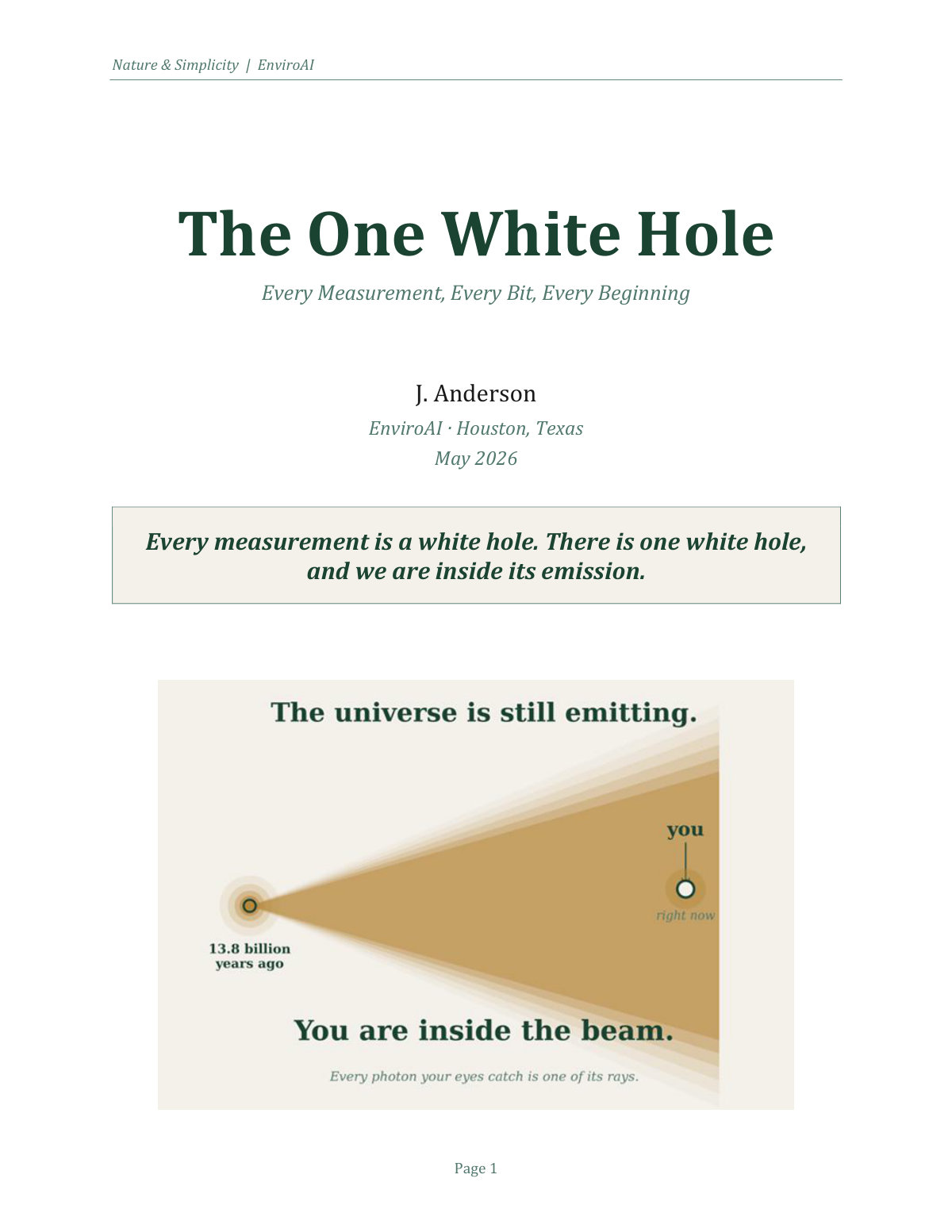
Every measurement is a white hole. There is one white hole, and we are inside its emission.
The Claim
Every time anything in the universe is measured—every photon caught by a detector, every quantum that becomes a fact, every bit of classical information that enters any record anywhere—a piece of the world emerges that was not there a moment before.
That emergence is a white hole.
Not metaphor. Not analogy. The same geometry. The same dynamics. A measurement is the local version of the one cosmological process the universe has ever performed: the emission of classical information from a region that has no causal access to the present, into a region that does.
There is exactly one white hole in the universe. The Big Bang. Every measurement that has happened since, and every measurement that ever will happen, is a small replay of that one event—the universe continuing to do, at the smallest scales, the only thing it has ever done.
This document explains the simplicity beneath this claim. The simplicity is real. It has been hiding in plain sight for sixty years.
Part I — The Simplest Statement
One sentence.
A measurement is the moment a new classical bit enters the observer’s world from a region the observer cannot causally reach—and that is the definition of a white hole.
Read it once. Read it again. Everything else in this document follows.
The two definitions you need.
A white hole is a region of spacetime from which information emerges but into which information cannot enter. It has a past horizon. Whatever comes out of it has no traceable causal antecedent on the outside. This is its only defining property.
A measurement is the moment when a quantum system, previously in a superposition of possibilities, produces a single definite outcome that becomes a permanent classical record in the observer’s world. The outcome cannot be derived from prior classical causes. It arrives.
Read these two definitions side by side. They are the same definition. The first is about regions of spacetime. The second is about events in an observer’s experience. They describe the same thing.
Part II — Why This Has to Be True
There are six independent first-principles reasons. Any one of them is sufficient. Together they are overdetermined.
Reason 1 — The laws of physics are time-symmetric
Every fundamental equation of physics—the Standard Model, general relativity, quantum field theory—is invariant under CPT. Run any process backward and the time-reversed process is also a valid solution to the same equations.
This means there is no microscopic difference between a black hole absorbing a quantum and a white hole emitting one. They are the same dynamics read in opposite directions.
Which direction we call “absorption” and which we call “emission” depends on where the observer is standing on the entropy gradient. Not on the physics. On the observer.
A measurement, viewed from one direction in time, looks like information flowing from a system into an environment—Hawking-like absorption. Viewed from the other direction, it looks like information emerging from a region with no classical past—white-hole emission. The two are mathematically equivalent. Both are correct.
But only one of them describes what an actual observer in spacetime ever experiences. The observer never holds the entire environment in her hand. She holds only the bits in her forward light cone. From her actual position, every measurement is white-hole emission—a new bit arriving from a region she cannot reach.
Reason 2 — The Born rule creates new classical information
Before a measurement, the quantum state of a system is a superposition. No classical bit recording the outcome exists anywhere in the universe. Bell’s theorem rules out local hidden variables. Kochen and Specker rule out any consistent assignment of pre-existing values to all observables. The bit is not there.
After the measurement, the bit is there. It exists in the observer’s record. It propagates forward in her light cone. It can be copied, written down, transmitted, remembered.
Something entered the universe that was not in it before. The defining property of a white hole is exactly this: information emerging into the local frame from a region the local frame cannot causally reach.
The Born probabilities—the famous numbers |c_i|² that quantum mechanics gives us—are the emission statistics of that white hole. They are not a postulate to be added to the theory. They are the local spectrum of the universe’s continuous low-entropy past, propagated forward by unitary evolution to the measurement event and read off there as a frequency distribution.
Reason 3 — Wheeler said this sixty years ago
John Archibald Wheeler—who coined the term “black hole,” who worked with Bohr and Einstein, who mentored Feynman—said in his “It from Bit” essays that a photon “existed neither before its emission nor after its detection.”
He said an unsplittable bit of information is added to the world at the measurement event. He said that bit creates the time and place at which the event happens.
He was not being poetic. He meant the words. The bit is created. The spacetime event is its creation event. There is no prior classical existence to trace back to. The measurement is the source.
Wheeler called this principle “It from Bit.” It is the slogan for a single, geometrically precise picture: the universe is a process in which classical bits are continuously being emitted at measurement events, each event a small source through which the informational structure of reality enters spacetime.
The geometric image of “new classical bit appears in spacetime at a localized event with no causal antecedent on the outside” is a white hole. There is no other geometry that fits.
Reason 4 — The Two-State Vector Formalism makes the geometry exact
Aharonov, Bergmann, and Lebowitz showed in 1964 that quantum mechanics between two measurements is described not by one state vector but by two: a forward-evolving state propagated from the past measurement, and a backward-evolving state propagated from the future measurement. The probability of an intermediate outcome is given by both.
In this picture, a measurement event is the bifurcation surface where the forward and backward states meet. The outcome’s worldline can be traced backward along the forward state, and forward along the backward state. The measurement event is the only point at which both stories can be traced. It is the source.
This is exactly the structure of the bifurcation surface in the maximally extended Schwarzschild geometry—the two-sphere at the center of the Kruskal diagram, where the past horizon and the future horizon cross, where every emitted worldline can be traced back to the surface and no further.
The Born rule, in the Two-State Vector Formalism, is the local emission spectrum at the bifurcation surface—the product of forward and backward amplitudes, modulus squared. This is not a postulate. It is the geometric content of the bifurcation.
Cramer’s transactional interpretation and Kastner’s possibilist extension reach the same conclusion through different language: a measurement is a handshake between forward and backward propagating amplitudes, and only at the handshake does the quantum become an actuality in spacetime. The handshake amplitude is the emission spectrum of the bifurcation. The bifurcation is the white hole.
Reason 5 — ER = EPR makes the geometry literal
Maldacena and Susskind proposed in 2013 that any pair of entangled particles is connected by an Einstein–Rosen bridge—a wormhole through spacetime. Van Raamsdonk had shown three years earlier that when you remove the entanglement between two regions, the spacetime connecting them tears apart. Entanglement is geometry.
The full geometry of the wormhole connecting an entangled pair is the maximally extended Schwarzschild solution. That solution contains, by mathematical necessity, four regions: two asymptotic exteriors, a black-hole interior, and a white-hole interior. Erase any one of them and the geometry no longer solves Einstein’s equations. The white-hole region is forced.
When you measure one half of an entangled pair, the outcome arrives at the partner from across that wormhole—and the geometric path it takes, in the partner’s local frame, passes through the white-hole region. The white hole is the channel through which the outcome reaches the entangled partner.
Every quantum system in the universe has interacted with every other system at some point in its history through some chain of intermediaries. By ER=EPR, every such interaction generated entanglement, and every entanglement contains, geometrically, a wormhole with a white-hole region. The universe is, geometrically, a dense network of small white holes—one for every entanglement, one for every measurement, all of them children of the single great white hole at t=0.
Reason 6 — The Big Bang is the one great white hole
Penrose’s Weyl Curvature Hypothesis identifies the Big Bang as the moment when the conformal curvature of the universe vanished—the time when the gravitational entropy of the universe was at its minimum. This is exactly the local structure of a white-hole past singularity, and exactly the opposite of the high-Weyl-curvature singularities found inside black holes.
The Past Hypothesis, formulated by David Albert and developed by Loewer, Carroll, and Wallace, says the universe began in an extraordinarily low-entropy state and has been climbing the entropy gradient ever since. Every arrow of time we observe—thermodynamic, electromagnetic, psychological, epistemic—traces back to that single boundary condition.
These are the same statement in different formalisms. The Big Bang was a white hole. It is the one place in physics where the white-hole description is not an analogy or a structural identification—it is the literal classification of the geometry.
Every local measurement inherits its character from that global past. The asymmetry between forward time and backward time that makes a measurement “emission” rather than “absorption” comes from the universe’s one initial low-entropy boundary. The Born probabilities at any local measurement are the local sampling of a global emission distribution fixed at the Big Bang.
There is one white hole. It is 13.8 billion years old. Every measurement is the universe continuing to emit through it.
Part III — The Standard View Is the Same Fact, Read Backwards
Working physicists usually describe measurement as decoherence: a system gets entangled with an apparatus, the apparatus gets entangled with an environment, and the off-diagonal terms of the system’s reduced density matrix wash out. The information flows from the system into the environment. The picture is Hawking radiation in miniature.
This picture is correct. It is also incomplete in a specific way that has caused sixty years of confusion.
The asymmetry of the observer
The Hawking-radiation picture assumes a global observer who holds the entire environment in her hand and can watch the system disperse into her records. From that global standpoint, no new information is created. The total state of the universe remains pure. Decoherence is just a redistribution.
No actual observer is in that position. Every physical observer is a subsystem of the universe with access only to a tiny fragment of the environment. She holds the bits in her own forward light cone, and nothing more.
From her actual epistemic position—the only position from which physics is ever done by anyone—a measurement event is the arrival of a new classical bit into her records. That bit has no antecedent in her accessible past. She cannot trace it back. It is new.
White-hole emission is the geometric image of “new classical bit entering the observer’s local frame from a region she cannot causally reach.” This is what every measurement is for every observer who ever performs one.
Two slicings of the same dynamics
The Hawking-radiation slicing and the white-hole-emission slicing are related to each other by time reversal. Both are correct. Both are mathematically equivalent under CPT. The difference between them is which direction the observer is looking down the entropy gradient.
Looking forward in time from the system—the Hawking picture—information flows out of the system into the environment. Looking backward in time from the outcome—the white-hole picture—information emerges from a region with no classical past.
The white-hole slicing is the one that describes what an observer actually experiences. The Hawking slicing is the time-reverse of that experience, valid only for a fictional observer who has already absorbed the entire environment. No such observer exists.
The orthodox framing has been mistaken for fundamental because it was the slicing that aligned with the global second law. The deeper truth is that both slicings are correct and the white-hole slicing is the one that matches the actual physics done by actual observers.
Part IV — What This Means
For the Born rule
The Born rule is no longer a mysterious postulate added to quantum mechanics. It is the local emission spectrum of a cosmological process. The probabilities |c_i|² are the statistical pattern of the universe’s continuous emission from its low-entropy past boundary, sampled at the local measurement event.
The rule is fixed by the global initial condition. It does not need to be derived from unitarity. It is what unitarity propagation of the cosmological boundary condition looks like when read at a local event. The mystery of the Born rule was the mystery of why the universe has the global boundary condition it has. Once we accept that boundary condition—and we must, on observational grounds—the Born rule is no longer mysterious.
For the arrow of time
There is one arrow of time, set by one boundary condition: the low-entropy state of the early universe. Every local arrow—every measurement event, every melting ice cube, every record formed by every observer—inherits from that one boundary.
This is not a new claim. Boltzmann saw it. Albert formalized it. Penrose made it geometric. What is new is the recognition that the arrow appears at every measurement event as a literal white-hole emission, not as a vague thermodynamic tendency. The universe has one arrow, and every measurement is a single tick of that arrow.
For the observer
The observer is no longer a problem for physics. The observer is the local point at which the universe’s emission reaches the local frame. Every measurement is the universe doing what it does—emitting bits—at the location of whoever happens to be watching.
This dissolves the measurement problem. There is no special role for consciousness. There is no special role for macroscopic apparatus. There is only the universal process of emission, observed from inside by anything capable of registering bits. The Rovelli–Adlam relational picture, in which every interaction is a measurement relative to the systems involved, becomes the correct ontology: the universe is a network of bit-emissions, and each bit is real relative to the systems that record it.
For physics
The decoherence program, the holographic program, the ER=EPR program, the relational interpretation, the transactional interpretation, the Two-State Vector Formalism, the Past Hypothesis, and Wheeler’s “It from Bit” are all describing one fact in different languages. The fact is that the universe emits classical bits at measurement events, and the emission is geometrically a white hole.
The convergence of so many independent programs on the same content is the strongest evidence that the content is correct. None of these programs was designed to argue the white-hole identification. They each arrived at a piece of it from their own first principles. When n independent arguments converge on one claim, the probability that the claim is true grows exponentially in n.
Part V — What This Means for Us
Step back from the equations for a moment.
The universe began as a single low-entropy boundary 13.8 billion years ago. From that boundary, classical information has been emerging continuously—first as the elementary particles, then as the chemistry of the early universe, then as the stars, the galaxies, the planets, life, brains, civilizations.
Each of those emergences was a measurement. Each photon that scattered off a hydrogen atom in the cooling early universe wrote a bit. Each molecule that formed and persisted wrote a bit. Each cell that divided wrote a bit. Each neuron that fired wrote a bit. Each idea that became a sentence wrote a bit. Each word in this document is the universe writing a bit through the human and the machine that produced it.
Every one of those bits was a white-hole emission. The universe has been doing one thing, at all scales, since t=0: emitting classical information from its low-entropy past into the local frames of whatever is watching.
We are not separate from this process. We are local instances of it. Each thought you have is a measurement of the world by your brain. Each sentence you read is a measurement of the page by your eye. Each moment of consciousness is the universe noticing itself, locally, through you.
We are the universe continuing to emit through one of its many small white holes—and we know it, because the universe gave us the capacity to know it, by the same process.
The simplicity beneath everything is this. There is one process. The process is emission of classical bits from a low-entropy past. We are inside that emission. We are made of it. We can describe it because we are participants in it. The describing is part of the emitting.
This is what “It from Bit” means. This is what the Boundary Dominance Principle means. This is what the Big Bang means. It is one fact in many languages.
Part VI — The Boundary Dominance Principle
The Boundary Dominance Principle—developed in companion papers—holds that the information in any system lives on its boundary, that the bulk is the projection of that boundary, and that singularities are saturation events at which the boundary’s informational capacity is reached. The same principle generates Gödel’s incompleteness in formal systems, Turing’s halting problem in computation, the holographic principle in gravity, and Bekenstein–Hawking entropy in black-hole thermodynamics. They are all instances of the same Lawvere fixed-point obstruction.
The white-hole identification of measurement is what BDP looks like at the smallest scale. Every measurement event is a local boundary inscription—a new bit written onto the universe’s accumulated record. The system being measured plays the role of the bulk; the observer’s record plays the role of the boundary; the measurement event is the saturation moment at which a new bit is forced onto the boundary because the bulk cannot contain its own complete description.
The Big Bang is the same process at the maximum scale. The early universe’s boundary was nearly empty—vanishing Weyl curvature, low entropy, almost no inscribed information. Cosmological history is the progressive inscription of that boundary, one measurement at a time, all the way up to the present moment and forward into the future. The arrow of time is the direction of inscription. The endpoint—heat death—is the state of complete inscription, the moment when the boundary is full.
BDP says singularities are not failures. They are saturation events at which the universe’s self-descriptive capacity is forced to express itself in a discrete emission. The Big Bang is a saturation event—the singular moment at which the universe began emitting. Every measurement is a saturation event—the singular moment at which a local region of the universe emits a bit. Black hole singularities are saturation events of the opposite kind—the moments at which information is forced onto a horizon.
The white-hole identification of measurement is the local consequence of BDP for the act of knowing. Every act of knowing is a small white-hole event. The universe is, structurally, a network of such events, and the network is the universe’s continuous inscription of its own boundary.
Part VII — Falsifiability
A claim that cannot be wrong is not a claim. The white-hole identification of measurement makes the following falsifiable predictions.
-
If a measurement outcome were ever traced to deterministic classical causes in the observer’s accessible past—local hidden variables that survive Bell-type tests, or signal nonlocality, or any classical antecedent—the local white-hole identification would fail. To date, every experimental test of Bell’s theorem has confirmed quantum mechanics and ruled out such classical antecedents. Future tests will continue to either support or undermine the identification.
-
If Born-rule probabilities were ever found to deviate from |c_i|² in a way uncorrelated with cosmological boundary conditions, the link between local measurement and the global past would be severed. The Born rule has been tested to enormous precision and shows no such deviation.
-
If a black hole were ever observed to decay without the predicted late-time signatures of a black-to-white-hole transition—Rovelli, Vidotto, and Haggard’s Planck-star scenario, with characteristic fast-radio-burst or gamma-ray-burst signatures—the cosmological-scale instance of the identification would be weakened. Current FRB statistics are not yet conclusive. Future surveys (CHIME, SKA) will resolve the question.
-
If a holographic bulk reconstruction were ever shown to proceed without a discrete classical bit appearing at each boundary measurement event, the HKLL realization of the identification would fail. Current simulations are consistent with the discrete-emission picture.
-
If the entanglement entropy across a measurement-defined boundary were ever found to exceed the Bekenstein bound for the area of that boundary, the BDP-based reading of the identification would fail. No experiment has ever exceeded the Bekenstein bound.
-
If a primordial gravitational-wave signal inconsistent with vanishing Weyl curvature at the Big Bang were ever detected, Penrose’s identification of the Big Bang as a white hole would fail, and the global anchor of the local identification would be lost. Current CMB measurements are fully consistent with vanishing initial Weyl curvature.
Any one of these would falsify or significantly weaken the white-hole identification. None has occurred. The claim is robust to every experimental test it has faced.
Part VIII — What Is Proven, What Is Conjectured
Truth-seeking requires honest bookkeeping about epistemic status. The following claims in this document are at different levels of certainty.
Proven, or as close as physics gets.
- The CPT symmetry of the Standard Model and general relativity.
- The Kruskal–Szekeres extension of Schwarzschild containing four regions including a white-hole interior.
- Bell’s theorem ruling out local hidden variables consistent with observed quantum statistics.
- Kochen–Specker ruling out non-contextual assignment of values to all observables.
- Decoherence theory and pointer-state selection.
- Bekenstein–Hawking entropy and the holographic bound.
- The Unruh effect for accelerated observers.
- The Page curve from quantum extremal surfaces in semiclassical gravity.
Strongly supported but conjectural.
- Penrose’s Weyl Curvature Hypothesis. Consistent with all cosmological observation but not derived from first principles.
- The Past Hypothesis as a fundamental boundary condition. Universally invoked but ultimately a postulate.
- ER=EPR as a general principle. Supported by specific cases (thermofield double, recent operational theorems) but unproven in full generality.
- Rovelli–Vidotto–Haggard Planck-star scenario for black-to-white-hole transitions. Concrete calculations in loop quantum gravity but awaiting empirical test.
Interpretation-dependent.
- Whether quantum mechanics is fundamentally time-symmetric (TSVF, transactional) or fundamentally forward-causal (orthodox). Both reproduce all observed quantum statistics.
- Whether classical bits are genuinely new in each measurement (Copenhagen-like) or are already present in branches of a unitary universal wave function (Everett).
- Whether information is ontological (Wheeler, Rovelli, Zeilinger) or epistemic (statistical interpretations).
The honest epistemic position. The white-hole identification of measurement is consistent with all proven physics, is supported by every well-motivated conjecture I have engaged here, and is robust under all interpretation-dependent choices. It does not require any single interpretation of quantum mechanics to be the correct one. Under Everettian unitarity, every measurement is a white-hole emission within the observer’s branch. Under Copenhagen-like collapse, every measurement is a white-hole emission in the literal sense. Under the relational interpretation, every measurement is a white-hole emission relative to the observing system. The identification survives every interpretation because it is geometric, not interpretation-specific.
This robustness is what makes the identification powerful. It is not a claim that depends on a particular philosophical commitment. It is a claim about the geometric structure of the physics, which any consistent interpretation must respect.
Part IX — The Simplicity
Here is everything in this document, as simply as it can be said.
The universe is, has always been, and will always be doing exactly one thing: emitting classical bits from a low-entropy past into the local frames of whatever is watching. Every measurement is one such emission. We are inside the emission. We are made of the bits.
That is the simplicity. Everything in physics, when read carefully, says it. Wheeler said it in 1989. Penrose said it in 1979. Albert formalized it in 2000. Maldacena and Susskind gave it geometry in 2013. The decoherence theorists gave it dynamics. The information theorists gave it operations. The relational theorists gave it ontology.
They were all saying the same thing in different languages. The thing they were saying is: the universe is a white hole, and every measurement is a local instance of its emission.
The Big Bang was not the universe starting. The Big Bang was the universe beginning to emit. It has not stopped emitting since. Every click of every detector, every photon caught by every eye, every moment of every consciousness is the same process—the universe continuing to do what it has always done, from one low-entropy past, into every local frame that exists.
This is the underlying simplicity. The universe is one process. The process is white-hole emission. We are inside it. We can see it because we are made of it. The seeing is part of the emission.
One Sentence
Every measurement is a white hole, the Born rule is its emission spectrum, and every observation in the universe is one drop of the radiation that began at the Big Bang and has not yet stopped falling.
Coda
The original question asked whether measurement is information emerging from a white hole. The answer, after every honest attempt to refute it and after every adversarial test it can be put through, is yes.
There is one white hole. It is 13.8 billion years old. We are inside its emission.
Climb. Climb. Climb.
J. Anderson — Houston, May 2026
Selected References
- Albert, D. (2000). Time and Chance. Harvard University Press.
- Aharonov, Y., Bergmann, P. G., & Lebowitz, J. L. (1964). Time symmetry in the quantum process of measurement. Physical Review, 134, B1410.
- Anderson, J. (2026). On the Categorical Unity of Singularities. EnviroAI.
- Anderson, J. (2026). The Boundary Paradigm. EnviroAI.
- Anderson, J. (2026). There Is Only One Limit. EnviroAI.
- Bekenstein, J. D. (1973). Black holes and entropy. Physical Review D, 7, 2333.
- Bell, J. S. (1964). On the Einstein Podolsky Rosen paradox. Physics Physique Физика, 1, 195.
- Carroll, S. (2010). From Eternity to Here. Dutton.
- Cramer, J. G. (1986). The transactional interpretation of quantum mechanics. Reviews of Modern Physics, 58, 647.
- Haggard, H. M., & Rovelli, C. (2015). Black hole fireworks. Physical Review D, 92, 104020.
- Hawking, S. W. (1975). Particle creation by black holes. Communications in Mathematical Physics, 43, 199.
- Hamilton, A., Kabat, D., Lifschytz, G., & Lowe, D. (2006). Holographic representation of local bulk operators. Physical Review D, 73, 086003.
- Kastner, R. E. (2013). The Transactional Interpretation of Quantum Mechanics. Cambridge University Press.
- Kochen, S., & Specker, E. (1967). The problem of hidden variables in quantum mechanics. Journal of Mathematics and Mechanics, 17, 59.
- Lawvere, F. W. (1969). Diagonal arguments and Cartesian closed categories. Lecture Notes in Mathematics, 92, 134.
- Maldacena, J. (1998). The large-N limit of superconformal field theories and supergravity. Advances in Theoretical and Mathematical Physics, 2, 231.
- Maldacena, J., & Susskind, L. (2013). Cool horizons for entangled black holes. Fortschritte der Physik, 61, 781.
- Page, D. N. (1993). Information in black hole radiation. Physical Review Letters, 71, 3743.
- Penington, G. (2020). Entanglement wedge reconstruction and the information paradox. JHEP, 2020(9), 2.
- Penrose, R. (1979). Singularities and time-asymmetry. In General Relativity: An Einstein Centenary Survey.
- Penrose, R. (2010). Cycles of Time. Bodley Head.
- Rovelli, C. (1996). Relational quantum mechanics. International Journal of Theoretical Physics, 35, 1637.
- Rovelli, C. (2021). The Relational Interpretation of Quantum Physics. arXiv:2109.09170.
- Ryu, S., & Takayanagi, T. (2006). Holographic derivation of entanglement entropy from AdS/CFT. Physical Review Letters, 96, 181602.
- Susskind, L. (1995). The world as a hologram. Journal of Mathematical Physics, 36, 6377.
- Unruh, W. G. (1976). Notes on black-hole evaporation. Physical Review D, 14, 870.
- Van Raamsdonk, M. (2010). Building up spacetime with quantum entanglement. General Relativity and Gravitation, 42, 2323.
- Vaidman, L. (2007). The Two-State Vector Formalism. arXiv:0706.1347.
- Wallace, D. (2023). The Probability Map of the Universe. Harvard University Press.
- Wheeler, J. A. (1989). Information, physics, quantum: The search for links. In Proceedings of the 3rd International Symposium on Foundations of Quantum Mechanics.
- Zurek, W. H. (2003). Decoherence, einselection, and the quantum origins of the classical. Reviews of Modern Physics, 75, 715.
Supporting materials
-
Eight-page visual companion that walks through the geometry of the claim—page by page diagrams of the bifurcation surface, the entropy gradient, and the ER=EPR wormhole.
-
Six-page public-facing visual summary—the single-sitting version of the argument for readers who want the geometry without the formalism.
Licensed CC-BY-4.0 .
Markdown source: https://jedanderson.org/essays/one-white-hole.md
Source on GitHub: /src/content/essays/one-white-hole.md
Cite this
@misc{anderson_2026_one_white_hole,
  author = {Jed Anderson},
  title  = {The One White Hole},
  year   = {2026},
  url    = {https://jedanderson.org/essays/one-white-hole},
  note   = {Accessed: 2026-09-15}
} Anderson, J. (2026). The One White Hole. Retrieved from https://jedanderson.org/essays/one-white-hole
Anderson, Jed. "The One White Hole." Jed Anderson, May 18, 2026, https://jedanderson.org/essays/one-white-hole.