Essay
A Paradigm Shift in AI Safety
Make protecting life part of how AI improves.
A proposed strategy. Introducing RESI—Recursive Environmental Self-Improvement, a path toward Environmental Superintelligence.
As AI becomes more capable, how do we keep its improvement accountable to human purposes and real-world consequences?
RESI proposes a starting point: make protecting life part of how AI improves. Begin in the living world, where independently measured outcomes can test whether greater capability delivers greater protection. Humans set the purpose and limits. The system improves its methods—not its mandate.
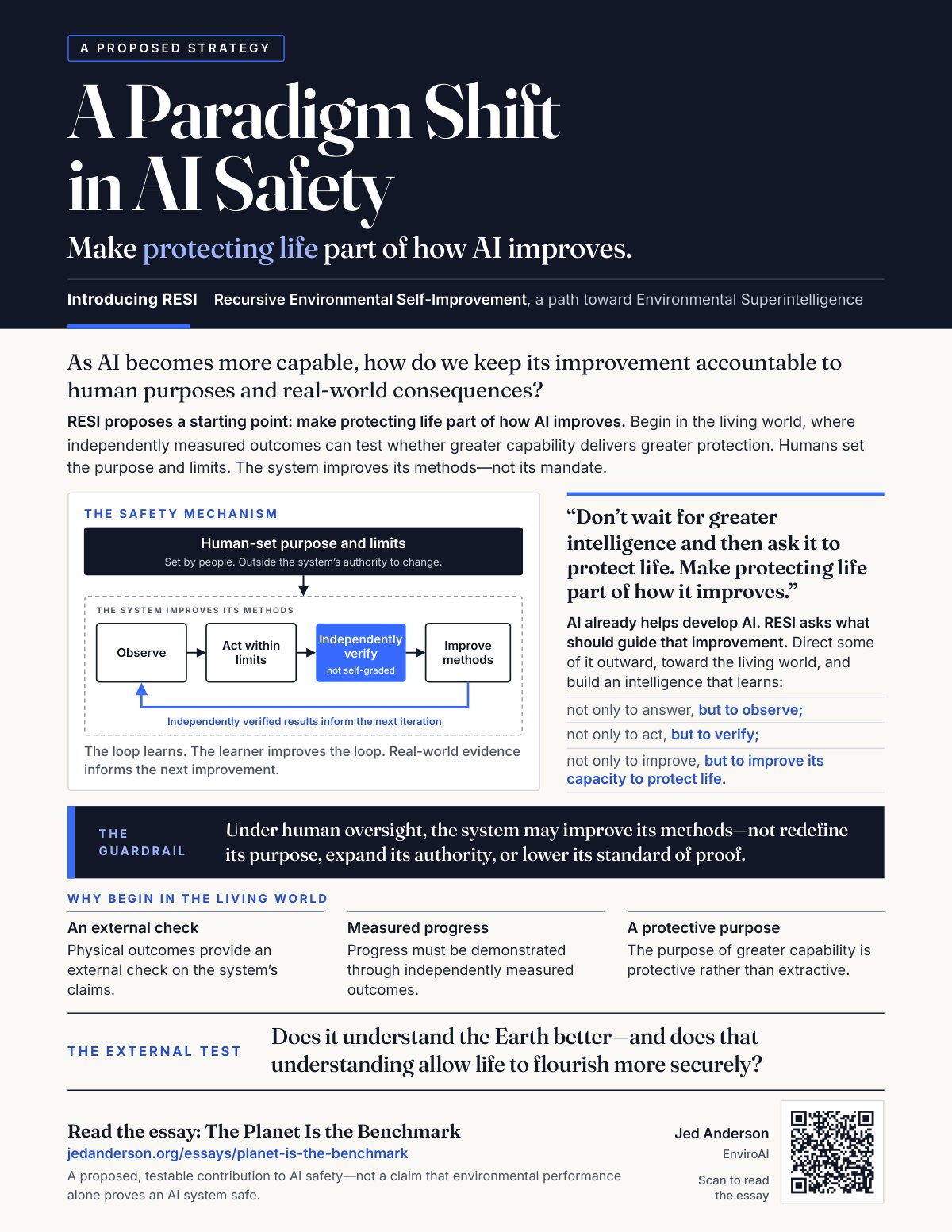
The safety mechanism
Human-set purpose and limits. Set by people. Outside the system’s authority to change.
Inside those limits, the system improves its methods in a loop:
- Observe
- Act within limits
- Independently verify—not self-graded
- Improve methods
Independently verified results inform the next iteration. The loop learns. The learner improves the loop. Real-world evidence informs the next improvement.
“Don’t wait for greater intelligence and then ask it to protect life. Make protecting life part of how it improves.”
AI already helps develop AI. RESI asks what should guide that improvement. Direct some of it outward, toward the living world, and build an intelligence that learns:
- not only to answer, but to observe;
- not only to act, but to verify;
- not only to improve, but to improve its capacity to protect life.
The guardrail
Under human oversight, the system may improve its methods—not redefine its purpose, expand its authority, or lower its standard of proof.
Why begin in the living world
- An external check. Physical outcomes provide an external check on the system’s claims.
- Measured progress. Progress must be demonstrated through independently measured outcomes.
- A protective purpose. The purpose of greater capability is protective rather than extractive.
The external test
Does it understand the Earth better—and does that understanding allow life to flourish more securely?
Read the essay: The Planet Is the Benchmark.
A proposed, testable contribution to AI safety—not a claim that environmental performance alone proves an AI system safe.
Related: The Planet Is the Benchmark
Licensed CC-BY-4.0 .
Markdown source: https://jedanderson.org/essays/paradigm-shift-in-ai-safety.md
Source on GitHub: /src/content/essays/paradigm-shift-in-ai-safety.md
Cite this
@misc{anderson_2026_paradigm_shift_in_ai_safety,
  author = {Jed Anderson},
  title  = {A Paradigm Shift in AI Safety},
  year   = {2026},
  url    = {https://jedanderson.org/essays/paradigm-shift-in-ai-safety},
  note   = {Accessed: 2026-10-26}
} Anderson, J. (2026). A Paradigm Shift in AI Safety. Retrieved from https://jedanderson.org/essays/paradigm-shift-in-ai-safety
Anderson, Jed. "A Paradigm Shift in AI Safety." Jed Anderson, October 9, 2026, https://jedanderson.org/essays/paradigm-shift-in-ai-safety.