Essay
The Unthinking Revolution: A Manifesto for the Environmental Profession
Preamble: The Crisis of Conscience and Commerce To the environmental professional, the scientist, the engineer, the lawyer, the consultant: this is a message of truth. It is a message for the quiet moments of your day, when the profound implications of a new reality begin to settle in. It is for the professional who, just months ago, meticulously billed 40 hours for a complex environmental legal analysis at
$425 an hour, and who last week, using a new suite of AI agents, completed a comparable project in four hours, with a work product of superior quality and depth. It is for the gnawing realization that follows: the old math no longer works. A 40-hour job was the bedrock of a career. When that same project takes only four hours, the old billing model crumbles, turning a sustainable profession into a financial dead end.
This is not a hypothetical scenario; it is the lived experience of your peers and the imminent reality for your entire profession.1
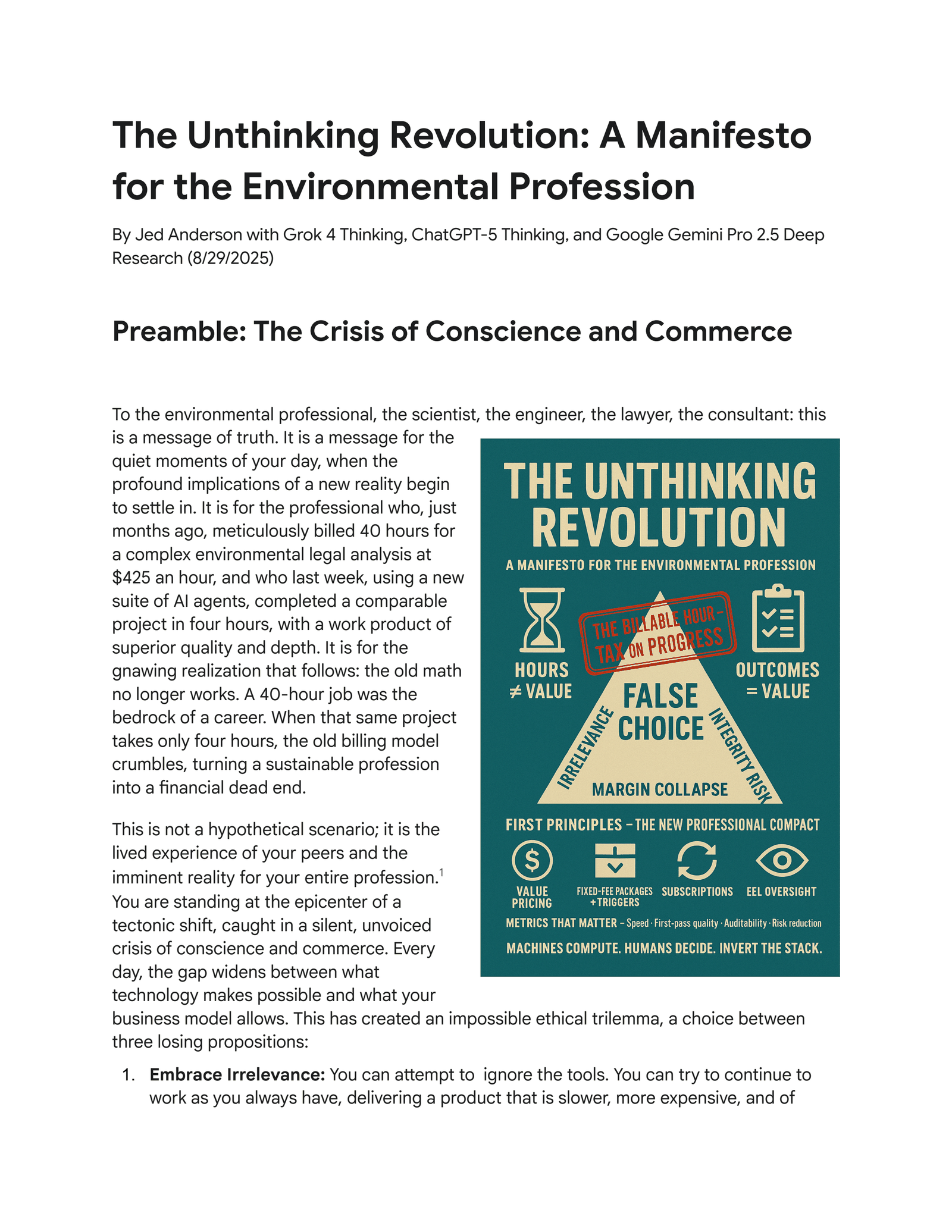
You are standing at the epicenter of a tectonic shift, caught in a silent, unvoiced crisis of conscience and commerce. Every day, the gap widens between what technology makes possible and what your business model allows. This has created an impossible ethical trilemma, a choice between three losing propositions:
1. Embrace Irrelevance: You can attempt to ignore the tools. You can try to continue to
work as you always have, delivering a product that is slower, more expensive, and of lower quality than what is now possible. In doing so, you breach your professional duty to serve your client’s best interest and render yourself uncompetitive in a market that will not wait.1
2. Embrace Poverty: You can adopt the tools with integrity. You can complete the 40-hour
task in four hours and bill for four hours. In doing so, you watch your revenue, your firm’s profitability, and your career prospects collapse by 90%, a victim of an economic model that punishes progress.1
3. Embrace Deception: You can use the tools in secret. You can leverage their power to
finish the work in a fraction of the time but continue to bill as if you haven’t, obscuring the source of your newfound efficiency. In doing so, you enter a gray zone of moral compromise, a crisis of conscience that erodes the very integrity upon which this profession is built.
This manifesto is here to declare that this is a false choice. The paralysis you feel is born of an attempt to reconcile an obsolete paradigm with an unstoppable new reality. The change is not a choice; it is an inevitability. It is not a market trend; it is a force of nature.
The purpose of this document is to speak the unspoken truth, to give voice to the crisis so that we may solve it collectively. It is a work of loving, constructive truth-telling, designed to provide clarity where there is confusion, a shared language for the challenges we face, and a bold, hopeful, and exquisitely practical vision for a future in which the environmental professional is not obsolete, but more essential, more valuable, and more fulfilled than ever before. We will not just survive this transition; we will lead it.
Section I: The Inescapable Law: Why This Is Happening
To navigate the storm, we must first understand the winds. The disruption facing the environmental profession is not an isolated event. It is not a product of venture capital, a new software cycle, or a fleeting market trend. It is the latest, most potent manifestation of a fundamental law of civilizational progress, a law grounded in the first principles of physics.
Understanding this law is the first step toward strategic alignment, for one cannot fight a law of nature; one can only harness its power.
Whitehead’s Cavalry Charge: The Scarcity of Conscious Thought In 1911, the philosopher and mathematician Alfred North Whitehead articulated the foundational principle of this revolution: “Civilization advances by extending the number of important operations which we can perform without thinking about them”.3 This is the
Law of Unthinking (LoU).
Whitehead argued that it is a “profoundly erroneous truism… that we should cultivate the habit of thinking of what we are doing. The precise opposite is the case”.3 He compared the
“operations of thought” to “cavalry charges in a battle - they are strictly limited in number, they require fresh horses, and must only be made at decisive moments”.3 This analogy is not poetry; it is a precise articulation of a biological and cognitive constraint. Conscious cognitive effort is a scarce, metabolically expensive commodity. The human brain, a mere fraction of our body mass, consumes a disproportionate 20 watts of power when engaged in focused thought.3 This high energetic cost imposes a strict limit on the amount of sustained, conscious attention an individual, or a society, can deploy.
This inherent scarcity of “cavalry charges” creates the core evolutionary pressure that drives all human progress. To build more complex societies and solve more challenging problems, humanity must systematically conserve its most precious resource: conscious thought. The primary mechanism for this conservation is the offloading and automation of “important operations” into external technological substrates.3 Each time a complex, attention-demanding task—from tilling a field to calculating a trajectory to researching a regulation—is embedded into a tool, a process, or an AI agent, it becomes “unthinkable.” The cognitive burden is lifted, and the finite cavalry of human consciousness is preserved, its
“horses kept fresh” for the next, more abstract and demanding decisive moment.3 The Thermodynamic Imperative
Whitehead’s observation, framed in cognitive terms, is a direct manifestation of a deeper physical law: the Second Law of Thermodynamics. This law states that in any closed, isolated system, entropy—a measure of disorder, randomness, or the unavailability of energy to do useful work—will inevitably increase.[3, 4, 5, 3] The universe trends inexorably toward chaos.
Life and civilization are apparent violations of this principle. A city, a forest, or a single living cell is a structure of immense order and complexity—a pocket of remarkably low entropy. They achieve this not by violating the Second Law, but by being open, dissipative structures. They maintain and increase their internal order by actively consuming high-quality, low-entropy energy from their environment (like sunlight or fossil fuels) and exporting low-quality, high-entropy waste (like heat and pollution) back into their surroundings.3 This creation of local order is known as negentropy.[3, 4, 5, 3]
From this perspective, a civilization is a negentropic system engaged in a constant battle against the universal tide of entropy. To survive and grow, it must become ever more efficient at processing energy to sustain its internal order. This is not a choice; it is a thermodynamic imperative.[3, 4, 5, 3]
This physical law provides the causal foundation for the Law of Unthinking. The high metabolic cost of conscious thought is a thermodynamic liability. Every “cavalry charge” of human cognition is an entropy-producing event within the system. Therefore, the process of making an “important operation” unthinking by embedding it in a technological substrate is a profoundly favorable thermodynamic strategy. It minimizes the internal energy expenditure and entropy production required to maintain the system’s current state of complexity.3 The relentless drive to automate is the core mechanism by which complex adaptive systems fight entropy. It is the physical law that pushes the accelerator of progress.
Information as the Architect of Order The Law of Unthinking applies with equal force to the automation of cognitive labor, because information is not an abstract entity; it is a physical one. The deep conceptual equivalence between thermodynamic entropy, as described by Ludwig Boltzmann (S=kB lnW), and informational entropy, as formulated by Claude Shannon (H=−∑pi logb pi ), reveals that the automation of thought is a literal, physical act of creating order.3
A system with high physical disorder (high Boltzmann entropy) is one about which we have high informational uncertainty (high Shannon entropy). Gaining information about a system—reducing its Shannon entropy—is equivalent to reducing its physical, thermodynamic entropy.3 When an AI agent processes a vast, uncertain dataset (a high-entropy state) to produce a single, correct answer (a low-entropy state), it does so by consuming low-entropy electricity and exporting high-entropy heat. This act of computation is a physical process of creating order, thermodynamically indistinguishable from a biological process like photosynthesis.3
This provides a unified physical explanation for all technological advancement. The invention of the plow automated a physical operation to create agricultural order. The invention of the computer automated a symbolic operation to create informational order. Both are expressions of the same underlying negentropic drive. The Law of Unthinking describes a single, continuous process that has evolved from automating muscle to automating mind, all in service of creating and sustaining local pockets of order against the backdrop of a chaotic universe.3
The current crisis in the environmental profession is, therefore, not merely an economic or technological issue. It is a direct, predictable collision between a business model predicated on selling thermodynamically inefficient human thought—the billable hour—and a physical law that relentlessly seeks to optimize that inefficiency away. The billable hour monetizes the
“costly” human thought process; the more time, and thus more metabolic energy, a professional spends on a problem, the more the firm earns. AI agents perform these same cognitive operations with vastly greater thermodynamic efficiency. The 40-hour task becoming a 4-hour task is a real-world manifestation of a massive thermodynamic optimization. The profession’s economic engine is directly coupled to, and incentivizes, a thermodynamically inefficient process that technology, following a physical law, is destined to replace. The business model is fighting a law of physics. It will lose.
Section II: A Brief History of Unthinking Our World
The Law of Unthinking is a neutral amplifier. Its effect on the world is determined entirely by the goals—conscious or unconscious—that guide it. When applied as an analytical lens, the
LoU reinterprets environmental history not as a series of accidents, but as a predictable, three-act play. This history reveals how we arrived at this moment and why the very structure of our profession made it the inevitable target of the next great wave of automation.
Act I: Unthinking Exploitation (Paleolithic to Industrial Era)
For most of human history, society existed in a state of near-thermodynamic equilibrium with nature. The prime mover was the 115-watt human body, and the Energy Return on Investment
(EROI) for foraging was perilously close to 1:1, leaving no surplus for complex societal structures.3
The Agricultural Revolution was the first great success in applying the LoU to energy capture.
The domestication of draft animals and the invention of gravity-fed irrigation automated the
“important operations” of tilling soil and distributing water.3 This created a reliable food surplus, funding the cognitive surplus for specialists and cities. But with the un-thought-about goal being simply to maximize food production, the environmental consequences were treated as externalities. This new power enabled widespread deforestation and soil erosion so severe that Plato lamented that only the “mere skeleton of the land remains”.3 The law worked perfectly to achieve the stated goal, but the goal itself was dangerously incomplete.
The Industrial Revolution marked a fundamental phase transition. The shift to fossil fuels unlocked energy orders of magnitude greater than anything before, automating physical labor on an unprecedented scale.3 The steam engine and mass production drove exponential gains in productivity, achieving the primary goals of material production and economic growth with terrifying efficiency. This unthinking advance, however, produced staggering and planetary-scale entropic costs. Coal combustion led to smog-choked cities and the inexorable rise in atmospheric CO2. Industrial waste created rivers that caught fire. Habitat destruction led to extinction rates 100 to 1,000 times higher than natural background levels.3
These consequences were, once again, the direct result of applying the LoU with a narrow, unconscious goal. The escalating environmental crisis was the entropic exhaust of this powerful, accelerating, and dangerously un-guided engine.3
Act II: The Conscious Brake (The 20th Century)
By the mid-20th century, the accumulated entropic consequences of unthinking industrial advance became too severe to ignore. Events like the deadly London smog of 1952, the publication of Rachel Carson’s Silent Spring in 1962, and the 1969 Cuyahoga River fire forced a conscious societal reckoning.3 This awakening was a massive “cavalry charge” of collective human thought, deployed to analyze the problem and build a system to control the runaway industrial machine.3
The result was the modern “Protection” paradigm, embodied in a vast regulatory apparatus including the U.S. Environmental Protection Agency (EPA) and landmark legislation like the
Clean Air Act and Clean Water Act.3 This paradigm is fundamentally reactive and problem-focused. It operates through mitigation, control, and fear-based messaging to prevent further harm.[3, 5, 3] While historically essential, this protectionist model created a vast new domain of complex, repetitive, and cognitively burdensome “important operations”: compliance monitoring, environmental impact assessments, permitting applications, and meticulous data reporting.1 This bureaucratic system, our profession, was designed to be a
“conscious brake,” forcing deliberate thought back into industrial processes that had become dangerously unthinking.
Act III: The Great Obsolescence (Today)
In a moment of profound historical irony, the Law of Unthinking is now turning inward to automate the cognitive and administrative labor of the Protection paradigm itself. The very success of our profession in creating a structured, rule-based, and data-intensive system for environmental management made it perfectly vulnerable to the next wave of the Unthinking
Advance.[3, 5, 3]
The environmental profession, born from the need to apply a “conscious brake” to industrial automation, created a system of work so repetitive and rule-based that it became the perfect target for the next phase of automation. To manage the complexity of industrial externalities, we created standardized processes: environmental impact assessments, permitting applications, compliance monitoring, and data reporting.1 These processes, while requiring expert knowledge, are highly structured and involve navigating rule-based digital systems.
According to the Law of Unthinking, any important, repetitive operation that consumes significant conscious effort is a prime candidate for automation. Therefore, the very structure the profession built to impose order and consciousness on industry is now being dismantled by a more powerful ordering force—agentic AI—which sees these professional workflows as an inefficiency to be optimized away. The protector has become the target of the very law it sought to manage.
The following table provides a concise visualization of this recurring historical pattern, establishing the intellectual foundation for the revolution we now face.
Era Key Primary Goal Primary Environmental “Unthinking” of Automation “Unthinking” Impact
Technology Operation (Entropic Cost)
Agricultural Domestication, Food Surplus, Tilling Soil, Deforestation, Era Ard Plow, Population Water Soil Erosion,
Irrigation 3 Growth Distribution Salinization 3 Industrial Era Steam Engine, Material Factory Labor, Air & Water
Mass Production, Transportation, Pollution, Production, Economic Communicatio Greenhouse
Telegraph 3 Growth n Gas Emissions, Biodiversity Loss 3 Information Transistor, Information Calculation, E-waste,
Era Internet, Processing, Data Server Energy Software 3 Global Management, Consumption,
Commerce Logistics Digital Surveillance 3
Section III: The Agentic Shift: Quantifying the
Annihilation of the Old Model The theoretical has become tangible. The abstract force of the Law of Unthinking has now manifested as a specific, measurable, and exponentially accelerating technology. This section moves from first principles to the unassailable, quantitative evidence of the current disruption.
This is not a distant forecast; it is a description of an ongoing reality, culminating in a dated prediction for the structural collapse of the traditional professional services model. The threat is real, specific, and time-bound.
The Rise of Computer Use Agents (CUAs)
The catalyst for this revolution is the “Agentic Shift”—the evolution from generative AI systems that create content to autonomous AI agents that perform actions.2 The most advanced form of this technology is the Computer Use Agent (CUA), a specialized AI system designed to operate computer software, navigate databases, and execute complex digital workflows with minimal human intervention.2 Unlike ChatGPT, which responds to prompts, a CUA takes a goal—like “prepare a draft TCEQ air permit amendment”—and autonomously operates the necessary software, databases, and websites to achieve it.2
The proficiency of these agents is no longer speculative. It is rigorously measured by benchmarks like GAIA (General AI Assistants), which is designed to test the real-world capabilities of AI agents in tasks requiring multi-step reasoning, web browsing, and tool use.2
GAIA presents questions that are conceptually simple for humans but require complex computer operations to solve, making it a direct measure of an agent’s ability to perform the core digital tasks of a knowledge worker.2
The Dated Forecast: June 2026 When GAIA was introduced, the performance gap was vast. Human professionals scored approximately 92% on its tasks, while the powerful GPT-4 model scored a mere 15%.2 This gap provided a false sense of security. The reality is that CUA performance is on a steep and accelerating trajectory.
● In late 2023, GPT-4 was at 15%.2 ● By mid-2024, agents like Langfun reached 34%.2
● By early 2025, the agent Trase demonstrated a massive leap to nearly 67%.2 ● As of May 2025, the state-of-the-art II-Agent has achieved over 75% proficiency.2
This progression from 15% to over 75% in roughly 18 months represents an exponential rate of improvement. Based on this clear and measurable trajectory, the core projection of this manifesto is as follows: CUAs are on track to reach and exceed human-level proficiency
(92%) on core professional computer-based tasks by June 2026.2 This date is not a guess; it is an extrapolation from the most rigorous industry benchmarks available. It is the deadline for the environmental profession.
The quantified impact of this milestone is staggering. Projections based on this CUA performance curve indicate that by June 2026, the amount of time environmental professionals spend directly operating computers will decrease from a baseline of 60% of their work to just 35%. Critically, this will trigger a corresponding collapse in traditional billable hours, which are projected to fall from a typical utilization rate of 65% to 40%.2 This is not a minor adjustment; it is the structural demolition of the industry’s revenue model.
But the disruption runs deeper than just efficiency. It is about the commoditization of competence. A landmark study by Harvard Business School and Boston Consulting Group found that while AI boosted the performance of top-tier consultants by 17%, it increased the performance of lower-tier consultants by a staggering 43%.1 AI acts as a massive skill leveler.
The traditional consulting business model is a talent pyramid, where a few senior experts leverage large teams of junior staff on billable tasks to generate profit.1 This model is now facing a dual crisis. First, the economic model breaks because the leveraged junior labor is being automated away. Second, the training model breaks. If junior professionals no longer perform the foundational tasks of data collection, analysis, and report drafting, how do they acquire the experience to become the senior experts of tomorrow? The industry faces not just a revenue crisis but a long-term talent development crisis. The traditional path of apprenticeship through billable grunt work is being automated out of existence.
The following table presents this stark, data-driven reality. It is the central, undeniable fact of our new age, transforming a vague threat into a specific, dated, and quantified event. The need for change is not a matter of opinion; it is a matter of reading the chart.
Metric Value in Projected Absolute Relative Implied May 2025 Value in Change Percentage Impact
(Baseline) June 2026 (Percentag Change e Points)
CUA 75.57% 2 92% 2 +16.43 +21.7% CUAs Performan reach/exce ce (GAIA) ed human proficiency, enabling mass automation of professiona l digital tasks.
Profession 60% 2 35% 2 41.7% Nearly half al of current Computer computer-b Use (%) ased work is automated, freeing up significant human time.
Profession 65% 2 40% 2 38.5% Structural al Billable collapse of Hours (%) the billable hour model, demanding a complete overhaul of revenue and business strategy.
Section IV: The Foundational Truths of Our New
Reality The old maps are useless. The old rules are void. To navigate this new territory, we must first accept a new set of foundational truths. These are the principles upon which a resilient, ethical, and prosperous future for our profession will be built. They are declarative and non-negotiable. They are designed to be shared, debated, and ultimately, adopted.
TRUTH #1: The Billable Hour is Dead.
It no longer measures value; it measures inefficiency. It creates a perverse incentive, rewarding professionals for taking longer to achieve a result that technology can deliver in a fraction of the time. In the age of agentic AI, billing for time is a tax on progress and a direct conflict of interest with our clients. The model is broken beyond repair. It must be abandoned.
TRUTH #2: Your Value is Not Your Labor; It is Your Judgment.
The age of selling cognitive labor for routine tasks is over. The machine will labor. It will research, it will calculate, it will draft, it will format. Your new, and far greater, value lies in the uniquely human skills that cannot be automated. Your value is in your ability to orchestrate the machine, to understand its “jagged technological frontier” of competence and incompetence.1
It is in your wisdom to validate its output, to catch its subtle errors, and to provide the final, high-stakes, ethically-grounded judgment call. We are no longer selling hours of work; we are selling moments of verified, expert judgment.
TRUTH #3: Resistance is Unprofessional.
Choosing not to use these tools is no longer a personal preference; it is an ethical failure. It is a conscious choice to deliver a slower, more expensive, and lower-quality work product to your client. It is a breach of the fundamental professional duty to serve your client’s best interest with the best means available. The fiduciary responsibility to the client now includes a technological responsibility to be competent in the state-of-the-art. To cling to the old ways is to knowingly deliver an inferior service.
TRUTH #4: Playing Defense is a Losing Game. The Future is Proactive.
The 20th-century “Protection” paradigm was defined by a reactive, fear-based mindset focused on minimizing harm, mitigating risk, and enforcing compliance.[3, 4, 3] It was a necessary, but limited, mission. The automation of these defensive tasks creates a vacuum of purpose that must be filled by a higher calling. The new “Thriving” paradigm is proactive, hope-based, and opportunity-focused. Our goal is no longer just to prevent degradation; it is to actively cultivate health, foster regeneration, and co-create abundance. We are transitioning from being janitors of industrial externalities to becoming gardeners of planetary flourishing.
Section V: The New Professional Compact: A Blueprint
for Thriving A declaration of truth is not enough. We must have a plan. This section provides the actionable, hopeful path forward. It moves from the “what” and “why” of the crisis to the
“how” of the solution, detailing the new paradigm, the new business models that align incentives, and the redefined, elevated role of the environmental professional. This is the new professional compact.
From Protection to Thriving: A New Mindset for a New Era The automation of protection is the catalyst that makes a more ambitious goal possible. It frees up the cognitive and economic surplus necessary to transition from a defensive posture to a creative one.3 The “Thriving” paradigm represents a conscious reorientation of our profession’s purpose. It is a shift from a world of problems to a world of possibilities. Success is no longer measured by negatives avoided (fines, pollutants, extinctions) but by positives created (increases in biodiversity, gains in ecosystem vitality, enhanced systemic resilience).[3, 4, 3] This is not just a change in services; it is a change in identity—from steward to co-creator, from manager of decline to architect of abundance.
The following table powerfully articulates the “why” behind this transition. It frames the shift not just as a technical or economic necessity, but as a move toward a more hopeful, inspiring, and purpose-driven professional identity.
Characteristic “Protection” Paradigm “Thriving” Paradigm (Mid-20th Century Model) (Emergent 21st Century+
Model)
Core Mindset Reactive, Problem-focused Proactive, Solution/Opportunity-focus ed Primary Goal Minimize harm, prevent Maximize health, foster degradation, enforce limits regeneration, cultivate abundance & resilience
Dominant Motivation Fear, anxiety, obligation, Hope, joy, inspiration, guilt purpose, co-creation
Human Role Steward (often as Co-creator, active controller/corrector of participant in Earth’s damage) negentropic processes, gardener
Key Metric of Success Reduction in Increase in biodiversity, pollutants/negative ecosystem vitality, systemic impacts, species saved resilience, negentropic gain from extinction
Table 3: Paradigm Shift:
From Environmental Protection to Environmental Thriving [3, 4, 3]
The New Blueprint for Value: Aligning Profit with Progress The transition to a Thriving paradigm requires a new economic engine. The billable hour must be replaced with models that align the professional’s financial success with the client’s best interests and the rapid advancement of technology. This new blueprint for value includes:
● Value-Based Pricing: Fees are decoupled from time and tied directly to the outcome and value delivered. A fee for securing a complex permit is based on the value of that permit to the client’s project, not the hours spent. A fee for a risk assessment is based on the value of the risk mitigated.1 This model intensely motivates the professional to use the best tools to achieve the best outcome as efficiently as possible.
● Fixed-Fee Project Packages: Standardized, CUA-driven services are offered at a predictable, fixed price. A Phase I Environmental Site Assessment, a routine compliance report, or an emissions inventory can be delivered as a product, not a service, with clear scopes and guaranteed turnarounds.2 This provides cost certainty for clients and rewards efficiency for firms.
● “Thriving-as-a-Service” Subscriptions: The future of high-margin work lies in ongoing, subscription-based services. This includes AI-driven continuous monitoring of compliance, real-time supply chain resilience modeling, and platforms that provide clients with predictive ecological intelligence.3
This shift to value-based models is not just a commercial strategy; it is a moral and ethical realignment. It resolves the core trilemma of the professional by creating a “win-win” scenario.
The professional’s financial incentive is now perfectly aligned with the client’s desire for the best, fastest, and most effective outcome, which is achieved through the optimal use of technology. This new model resolves the crisis of conscience by making honesty the most profitable strategy.
The following table provides the practical “how.” It is a clear, compelling business case for firms to make the transition, showing how the new models solve the core conflicts and create a healthier, more sustainable business.
Incentive Incentive for Incentive for Client-Consult Ethical Model Technology Efficiency ant Pressure
Use Relationship Billable Hour Perverse: Punished: Adversarial: High: Pressure (Old Model) Using better Faster work Client wants to tech reduces directly speed; misrepresent billable hours translates to consultant is time or avoid and revenue. lower fees. paid for time. efficient tools.
Value-Based Aligned: Rewarded: Collaborative: Low: Honesty (New Model) Better tech Efficiency Both parties and using the leads to faster, increases are focused on best tools is better profitability achieving the the most outcomes, and capacity same valuable direct path to enabling more for more outcome. profitability. projects and value-based higher value work. capture.
The New Professional: The Expert-in-the-Loop (EEL)
In this new world, the professional is not replaced but elevated. The new role is the
Expert-in-the-Loop (EEL), also known as the Human-in-the-Loop (HITL).[3, 6, 3] The EEL is a strategist, an orchestrator, and a final arbiter of quality and ethics. This professional operates at a higher level of abstraction, managing platforms like the “EnviroAI
Orchestrator”—a digital command center being built where a central agent decomposes a complex project and assigns sub-tasks to a swarm of specialized CUAs for regulatory research, data aggregation, technical analysis, and document generation.[3, 4, 5, 3]
The EEL’s day is not spent on the drudgery of digital labor. Their finite “cavalry charges” of conscious thought are reserved for the highest-value contributions: strategic oversight, quality assurance, ethical judgment, and negotiation with regulatory agencies.3 This is a more engaging, more creative, and ultimately more fulfilling professional existence.
Section VI: The Unthinking Hand: Our Ultimate
Purpose This revolution in our professional lives is a microcosm of a larger civilizational shift. By embracing this change, we are not merely adapting our business models; we are positioning our profession to play a central role in the next stage of humanity’s relationship with our planet. This visionary conclusion elevates our conversation from professional transition to our ultimate purpose.
The Infomechanosphere and Environmental General Intelligence (EGI)
The Law of Unthinking, when consciously directed, points toward a logical endgame. The
“Thriving” paradigm requires a technological substrate of planetary scale—an “Infomechanosphere”.3 This is not a collection of apps but a coherent, emerging planetary-scale computer. Its components are being built today:
● A Planetary Sensory Apparatus: The Internet of Things (IoT), remote sensing satellites, and hyper-precise quantum sensors forming the planet’s evolving nervous system.3
● An Internal Model of Reality: Digital Twin Earth (DTE) platforms, like the European
Commission’s Destination Earth, creating dynamic, virtual replicas of the planet for simulation and “what-if” analysis.3
● A Cognitive Processing Unit: The distributed power of AI and Machine Learning, which will act as the cognitive engine for reasoning, prediction, and optimization.3
The ultimate goal of the Thriving paradigm—to understand, model, and intelligently guide the entire Earth system toward optimal health—is a task of hyper-astronomical complexity.
According to the Law of Unthinking, to make progress on such an intractable problem, these operations must be automated; they must be made “unthinkable.” This is the logical and necessary role of Environmental General Intelligence (EGI).[3, 4, 5, 6, 3]
EGI is defined as a general intelligence grounded not in human affairs but in the dynamics of the natural world. Unlike an AGI that aims to “think like a person,” EGI aims to “think like an ecosystem”.[3, 4, 5, 3] It is the ultimate “unthinking” steward, the technology that makes the goal of “Thriving” operationally possible at a planetary scale. It is the endgame of applying the
Law of Unthinking to environmental management.
Humanity’s Final Role: The Moral Architects As the “how” of planetary management is progressively automated by the Infomechanosphere and EGI, the role of human consciousness is not diminished but purified and clarified.
Whitehead’s “cavalry charges” are conserved for their most essential and irreplaceable purpose: to be deployed at “decisive moments”.3 In a world where the mechanics of stewardship are automated, the decisive moments for humanity shift from the operational and technical to the philosophical and ethical.3
The Unthinking Advance automates the execution of goals, but it does not define them. This is the fundamental and permanent division of labor. An EGI can be tasked with “optimizing an ecosystem,” but humans must consciously and deliberately define what “optimal” means. Is the goal to maximize raw biodiversity, enhance human habitability, increase total biomass, foster systemic resilience, or achieve some complex, weighted combination of these and other values? These are not technical specifications; they are value judgments that require moral reasoning, stakeholder consensus, and philosophical deliberation.3
Therefore, the finite and precious resource of human thought is conserved for its most unique functions: ethical deliberation, the setting of purpose, the definition of values, and the experience of meaning, beauty, and joy. Our future role is not to compete with our increasingly capable “unthinking” systems in the realm of execution, but to provide the conscious, thinking vision that gives them direction. We evolve from being operators of the world to being its moral and visionary architects, from cogs in the machine of civilization to the artists and philosophers who decide what kind of thriving, living future we want that machine to help us co-create.3
This is our call to action. The environmental profession stands at a historic crossroads. We can cling to the wreckage of an obsolete business model and become a footnote in the history of this technological revolution. Or we can seize this moment, embrace these truths, and lead the transition. We can become the Experts-in-the-Loop who guide the new tools, the champions of a new economic model that aligns profit with progress, and the visionary architects who define the goals for a new era of automated thriving. The choice is to become obsolete or to become more essential than ever before. The Unthinking Revolution will not be denied. Let us be the ones to guide its hand.
Works cited
1. Big Tech Environmental AI Impact
2. The Agentic Shift: Navigating the Impact of Computer Use Agents on
Environmental Professional Work
3. The Law of Unthinking_ A Strategic Analysis of the Next Paradigm in
Environmental Management (2).pdf
4. The Law of Unthinking: A Strategic Analysis of the Next Paradigm in Environmental
Management
5. The Unthinking Hand: From Planetary Management to Biospheric Co-Creation
6. The Law of Unthinking: An Engine for Environmental Thriving
Licensed CC-BY-4.0 .
Markdown source: https://jedanderson.org/essays/unthinking-revolution-manifesto.md
Source on GitHub: /src/content/essays/unthinking-revolution-manifesto.md
Cite this
@misc{anderson_2025_unthinking_revolution_manifesto,
  author = {Jed Anderson and Grok 4 Thinking and ChatGPT-5 Thinking and Google Gemini Pro 2.5 Deep Research},
  title  = {The Unthinking Revolution: A Manifesto for the Environmental Profession},
  year   = {2025},
  url    = {https://jedanderson.org/essays/unthinking-revolution-manifesto},
  note   = {Accessed: 2026-09-15}
} Anderson, J., Thinking, G. 4., Thinking, C., Research, G. G. P. 2. D. (2025). The Unthinking Revolution: A Manifesto for the Environmental Profession. Retrieved from https://jedanderson.org/essays/unthinking-revolution-manifesto
Anderson, Jed, Thinking, Grok 4, Thinking, ChatGPT-5, Research, Google Gemini Pro 2.5 Deep. "The Unthinking Revolution: A Manifesto for the Environmental Profession." Jed Anderson, August 29, 2025, https://jedanderson.org/essays/unthinking-revolution-manifesto.