Post
Distinction Between Ozone Attainment and Nonattainment Areas Disappearing
Originally written: · Published here:
The NAAQS-SIP process is focused on the distinction between attainment areas and nonattainment areas. I’m just not seeing these distinctions much anymore. Here are just a few points on this:
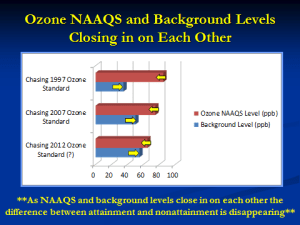
- The NAAQS and background levels are closing in on each other. The previous background ozone level was at 35 ppb. Now apparently background has jumped to around 50 ppb. The NAAQS level was at 85 ppb. Now the NAAQS level is down 75 ppb—with a proposal to drop it to 60-70 ppb. In other words, the gap between background and the NAAQS used to be 50 ppb. Now the difference is 25 ppb. This difference will continue to decrease to potentially 10 ppb or less as foreign emissions increase in the near term and the NAAQS is potentially lowered. The smaller the difference between background and the NAAQS the less difference of course there is between attainment and nonattainment.
- More and more emissions are either coming from outside nonattainment areas or are controlled outside nonattainment areas (international transport, interstate transport, federally preempted mobile sources (i.e. cars, airplanes, ships), intrastate transport (e.g. emissions from power plants, oil & gas sites, industries, etc.)(see articles below).
- EPA is trying to encourage States to use energy efficiency and alternative energy to address the NAAQS—but when electricity is flowing all over the place and emissions are flowing all over the place—geographically linking the two together and then wedding them geographically to a particular SIP becomes an administrative exercise fraught with all kinds of complexities, perils, and costs. And ultimately what is the true environmental benefit of this bean allocation exercise? As EPA has stated, “There can be considerable uncertainty as to where the reduced demand from energy efficiency or displaced energy from a renewable source will actually show up as reduced electrical generation”. And as EPA’s Kathleen Hogan stated, “Geographical alignment of benefits with reductions, that tends to be kind of an expensive test to demonstrate.”
Our world is changing. Geographical attainment distinctions are becoming less important and less helpful to improving air quality. We can either continue spending considerable amounts of time and money trying to work around these distinctions under the current Clean Air Act… or we can try something else. “Do something. If it works, do more of it. If it doesn’t, do something else.”—Franklin Delano Roosevelt
Time to transform the SIP process. We can make it happen.
Licensed CC-BY-4.0 .
Original source: https://sipreform.wordpress.com/2012/04/27/distinction-between-ozone-attainment-and-nonattainment-areas-disappearing/ (April 27, 2012)
Markdown source: https://jedanderson.org/posts/distinction-between-ozone-attainment-and-nonattainment-areas-disappearing.md
Source on GitHub: /src/content/posts/distinction-between-ozone-attainment-and-nonattainment-areas-disappearing.md
Cite this
@misc{anderson_2026_distinction_between_ozone_attainment_and_nonattainment_areas_disappearing,
  author = {Jed Anderson},
  title  = {Distinction Between Ozone Attainment and Nonattainment Areas Disappearing},
  year   = {2026},
  url    = {https://jedanderson.org/posts/distinction-between-ozone-attainment-and-nonattainment-areas-disappearing},
  note   = {Accessed: 2026-09-15}
} Anderson, J. (2026). Distinction Between Ozone Attainment and Nonattainment Areas Disappearing. Retrieved from https://jedanderson.org/posts/distinction-between-ozone-attainment-and-nonattainment-areas-disappearing
Anderson, Jed. "Distinction Between Ozone Attainment and Nonattainment Areas Disappearing." Jed Anderson, May 12, 2026, https://jedanderson.org/posts/distinction-between-ozone-attainment-and-nonattainment-areas-disappearing.