Post
Checking in on you . . .
Love your suffering yet? … Love the training? … You’re getting stronger!
Checking in on you. Loving your suffering yet? Love the training and discipline? “Embracing the suck” as the Marine Corps puts it (or “praising the suck” as I put it)?
I’m suffering in all kinds of ways. This is awesome!

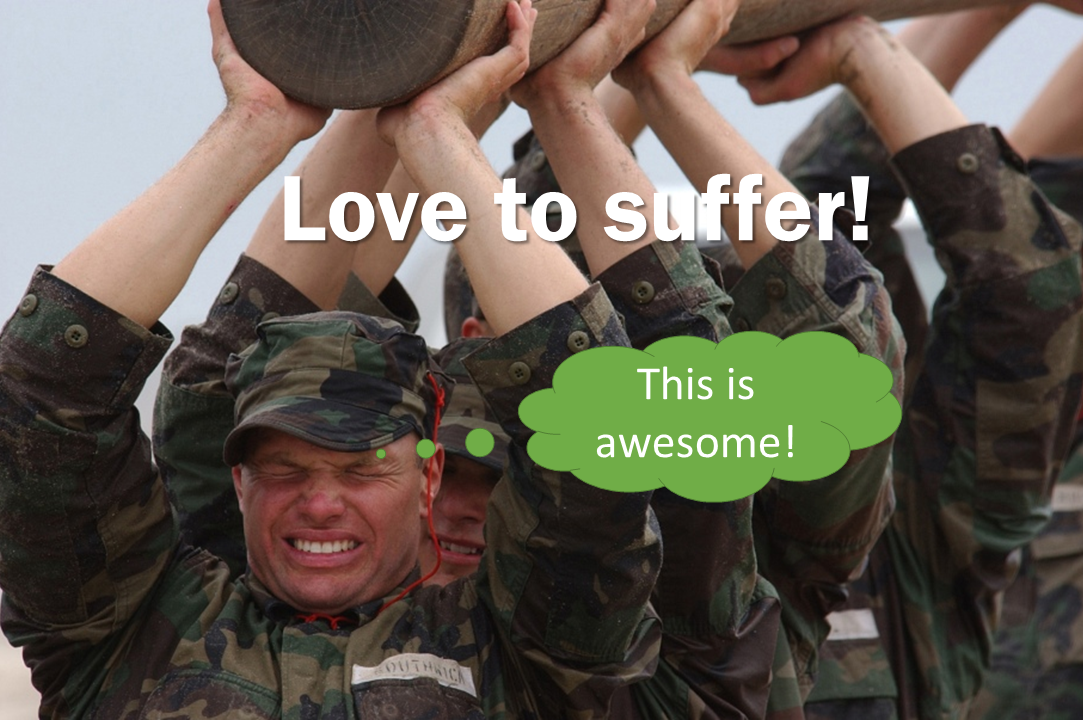


Love it! Joy. Joy. Joy.

-
“Character cannot be developed in ease and quiet. Only through experience of trial and suffering can the soul be strengthened, ambition inspired, and success achieved.”—Helen Keller
-
“I think it is very good when people suffer. To me that is like the kiss of Jesus.”― Mother Teresa
-
“Never to suffer would never to have been blessed.”—Edgar Allan Poe
-
“Suffering has been stronger than all other teaching, and has taught me to understand what your heart used to be. I have been bent and broken, but – I hope – into a better shape.”― Charles Dickens
-
“I want to suffer so that I may love.”—Fyodor Dostoyevsky
-
“When it is all over you will not regret having suffered; rather you will regret having suffered so little, and suffered that little so badly.”–St. Sebastian Valfre
-
“Blessed be He, Who came into the world for no other purpose than to suffer.”–St. Teresa of Avila
-
“I do not desire to die soon, because in Heaven there is no suffering. I desire to live a long time because I yearn to suffer much for the love of my Spouse.”–St. Mary Magdalene de Pazzi
-
“You will be consoled according to the greatness of your sorrow and affliction; the greater the suffering, the greater will be the reward.”–St. Mary Magdalen de’Pazzi
-
“Suffering is a great favor. Remember that everything soon comes to an end … and take courage. Think of how our gain is eternal.”–St. Teresa of Avila
-
“The road is narrow. He who wishes to travel it more easily must cast off all things and use the cross as his cane. In other words, he must be truly resolved to suffer willingly for the love of God in all things.”–St. John of the Cross
-
“The truth that many people never understand, until it is too late, is that the more you try to avoid suffering the more you suffer because smaller and more insignificant things begin to torture you in proportion to your fear of being hurt.”—Thomas Merton
-
“All the science of the Saints is included in these two things: To do, and to suffer. And whoever had done these two things best, has made himself most saintly.”–Saint Francis de Sales
-
“Consider the life of Jesus. He was born in a stable. He had to flee to Egypt. He worked 30 years in the shop of a craftsman. He suffered hunger, thirst and fatigue. He was poor and He was ridiculed. He taught the doctrine of heaven and no one listened to him. He was treated like a slave, betrayed, and died between two thieves. Jesus’ life was full of humiliation, but we are horrified by the slightest humiliation. How do you expect to know Jesus if you do not see Him where He was found: in suffering and the cross. You must imitate Him. But do not think you can follow Him in your own strength – you are going to have to find all your strength in Him. Remember that Jesus wants to feel all your weaknesses.”—Fenelon

Taken from George MacDonald’s Unspoken Sermons …
“Let us in all the troubles of life remember—that our one lack is life—that what we need is more life—more of the life-making presence in us making us more, and more largely, alive. When most oppressed, when most weary of life, as our unbelief would phrase it, let us bethink ourselves that it is in truth the inroad and presence of death we are weary of. When most inclined to sleep, let us rouse ourselves to live. Of all things let us avoid the false refuge of a weary collapse, a hopeless yielding to things as they are. It is the life in us that is discontented; we need more of what is discontented, not more of the cause of its discontent. Discontent, I repeat, is the life in us that has not enough of itself, is not enough to itself, so calls for more. He has the victory who, in the midst of pain and weakness, cries out, not for death, not for the repose of forgetfulness, but for strength to fight; for more power, more consciousness of being, more God in him; who, when sorest wounded, says with Sir Andrew Barton in the old ballad:—
Fight on my men, says Sir Andrew Barton,
I am hurt, but I am not slain;
I’ll lay me down and bleed awhile,
And then I’ll rise and fight again;
—and that with no silly notion of playing the hero—what have creatures like us to do with heroism who are not yet barely honest!—but because so to fight is the truth, and the only way.
If, in the extreme of our exhaustion, there should come to us, as to Elijah when he slept in the desert, an angel to rouse us, and show us the waiting bread and water, how would we carry ourselves? Would we, in faint unwillingness to rise and eat, answer, ‘Lo I am weary unto death! The battle is gone from me! It is lost, or unworth gaining! The world is too much for me! Its forces will not heed me! They have worn me out! I have wrought no salvation even for my own, and never should work any, were I to live for ever! It is enough; let me now return whence I came; let me be gathered to my fathers and be at rest!’? I should be loth to think that, if the enemy, in recognizable shape, came roaring upon us, we would not, like the red-cross knight, stagger, heavy sword in nerveless arm, to meet him; but, in the feebleness of foiled effort, it wants yet more faith to rise and partake of the food that shall bring back more effort, more travail, more weariness. The true man trusts in a strength which is not his, and which he does not feel, does not even always desire; believes in a power that seems far from him, which is yet at the root of his fatigue itself and his need of rest—rest as far from death as is labour. To trust in the strength of God in our weakness; to say, ‘I am weak: so let me be: God is strong;’ to seek from him who is our life, as the natural, simple cure of all that is amiss with us, power to do, and be, and live, even when we are weary,—this is the victory that overcometh the world. To believe in God our strength in the face of all seeming denial, to believe in him out of the heart of weakness and unbelief, in spite of numbness and weariness and lethargy; to believe in the wide-awake real, through all the stupefying, enervating, distorting dream; to will to wake, when the very being seems athirst for a godless repose;—these are the broken steps up to the high fields where repose is but a form of strength, strength but a form of joy, joy but a form of love. ‘I am weak,’ says the true soul, ‘but not so weak that I would not be strong; not so sleepy that I would not see the sun rise; not so lame but that I would walk! Thanks be to him who perfects strength in weakness, and gives to his beloved while they sleep!’


Licensed CC-BY-4.0 .
Original source: Constant Contact campaign
Markdown source: https://jedanderson.org/posts/checking-in-on-you.md
Source on GitHub: /src/content/posts/checking-in-on-you.md
Cite this
@misc{anderson_2020_checking_in_on_you,
  author = {Jed Anderson},
  title  = {Checking in on you . . .},
  year   = {2020},
  url    = {https://jedanderson.org/posts/checking-in-on-you},
  note   = {Accessed: 2026-09-15}
} Anderson, J. (2020). Checking in on you . . .. Retrieved from https://jedanderson.org/posts/checking-in-on-you
Anderson, Jed. "Checking in on you . . .." Jed Anderson, December 19, 2020, https://jedanderson.org/posts/checking-in-on-you.