Post
Carl Sagan: 2D . . . 3D . . . 10D
Seeing in the EnviroVerse
Glimpsing the EnviroVerse is much easier with some “Carl Sagan-ism” …

---“Flat creatures cannot, on their own, escape their two dimensions.”
– Carl Sagan
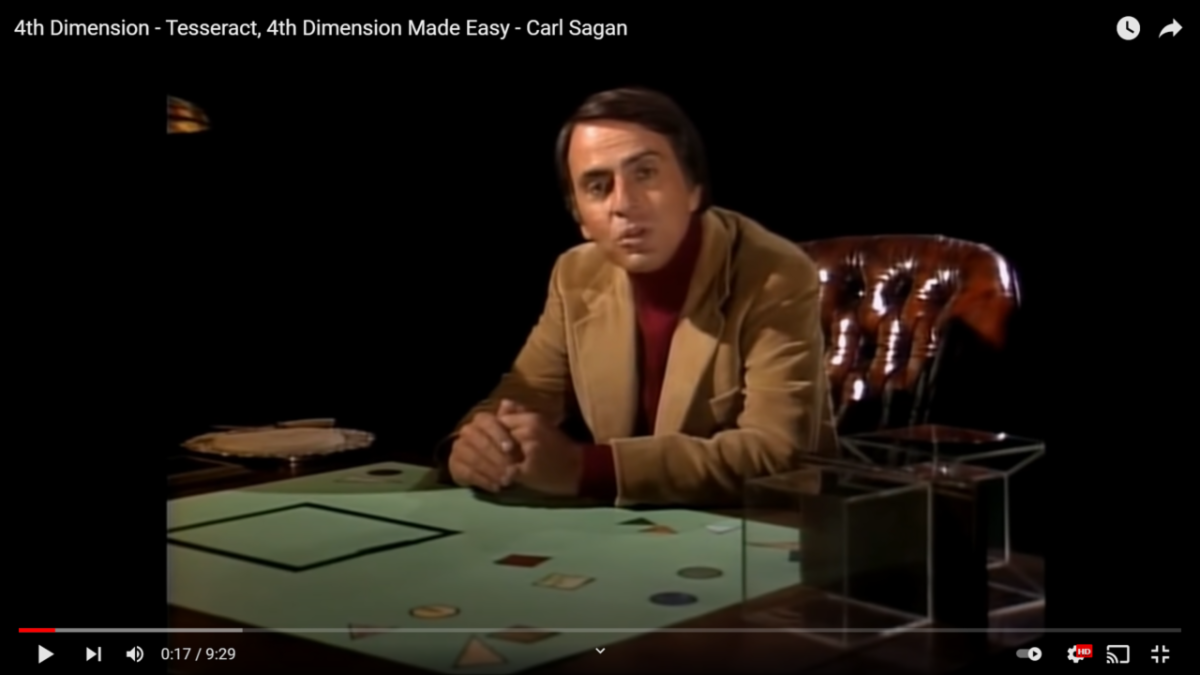
Carl Sagan in my opinion did the best job at explaining the concept of other dimensions and universes. Sagan did this masterfully in a famous Cosmos episode called “Flatland” (see below and video).
Sagan was correct in my opinion that us “flatlanders” cannot escape 3d experience unassisted. But now we have a quantum computer! Quantum computing essentially is computing in other dimensions or universes. David Deutsch invented the quantum computer as an experiment to prove the existence of other universes. I know it sounds crazy. And that’s because it is crazy. No one said that truth must be logical. Often truth is anything but logical.
---“As usual, nature’s imagination far surpasses our own, as we have seen from the other theories which are subtle and deep.” - Richard Feynman
---“Our imagination is stretched to the utmost, not, as in fiction, to imagine things which are not really there, but just to comprehend those things which are there.” - Richard Feynman
Carl’s video is over 40 years old! Many of us remember watching him as a kid. Imagine Carl with a quantum computer? The funny thing is, looking at (minute 3:29), I think Carl had a good idea of what this experience might look like.


2D … ok.
3D . . .wonderful.
10D … awesome!!!






----“So many people seem scared of there actually being additional dimensions or universes. I feel like a 15th century explorer with a notion of a much deeper reality of nature that appears to be out there that could be used to help save nature, seeing ships being built that might take us over this horizon, and asking the Queen of Spain for some AI/Metaverse/Quantum computing money.”
- Jed Anderson, EnviroAI

Carl Sagan ---“Flatland”
---“Let us imagine we inhabit a strange country where everyone is perfectly flat. Following Edwin Abbott, a Shakespearean scholar who lived in Victorian England, we call it Flatland. Some of us are squares; some are triangles; some have more complex shapes. We scurry about, in and out of our flat buildings, occupied with our flat businesses and dalliances. Everyone in Flatland has width and length, but no height whatever. We know about left-right and forward-back, but have no hint, not a trace of comprehension, about up-down—except for flat mathematicians. They say, “Listen, it’s really very easy. Imagine left-right. Imagine forward-back. Okay, so far? Now imagine another dimension, at right angles to the other two.” And we say, “What are you talking about? ‘At right angles to the other two’! There are only two dimensions. Point to that third dimension. Where is it?” So the mathematicians, disheartened, amble off. Nobody listens to mathematicians.
Every square creature in Flatland sees another square as merely a short line segment, the side of the square nearest to him. He can see the other side of the square only by taking a short walk. But the inside of a square is forever mysterious, unless some terrible accident or autopsy breaches the sides and exposes the interior parts.
One day a three-dimensional creature—shaped like an apple, say—comes upon Flatland, hovering above it. Observing a particularly attractive and congenial-looking square entering its flat house, the apple decides, in a gesture of interdimensional amity, to say hello. “How are you?” asks the visitor from the third dimension. “I am a visitor from the third dimension.” The wretched square looks about his closed house and sees no one. What is worse, to him it appears that the greeting, entering from above, is emanating from his own flat body, a voice from within. A little insanity, he perhaps reminds himself gamely, runs in the family.
Exasperated at being judged a psychological aberration, the apple descends into Flatland. Now a three-dimensional creature can exist, in Flatland, only partially; only a cross section can be seen, only the points of contact with the plane surface of Flatland. An apple slithering through Flatland would appear first as a point and then as progressively larger, roughly circular slices. The square sees a point appearing in a closed room in his two-dimensional world and slowly growing into a near circle. A creature of strange and changing shape has appeared from nowhere.
Rebuffed, unhappy at the obtuseness of the very flat, the apple bumps the square and sends him aloft, fluttering and spinning into that mysterious third dimension. At first the square can make no sense of what is happening; it is utterly outside his experience. But eventually he realizes that he is viewing Flatland from a peculiar vantage point: “above.” He can see into closed rooms. He can see into his flat fellows. He is viewing his universe from a unique and devastating perspective. Traveling through another dimension provides, as an incidental benefit, a kind of X-ray vision. Eventually, like a falling leaf, our square slowly descends to the surface. From the point of view of his fellow Flatlanders, he has unaccountably disappeared from a closed room and then distressingly materialized from nowhere. “For heaven’s sake,” they say, “what’s happened to you?” “I think,” he finds himself replying, “I was ‘up.’ ” They pat him on his sides and comfort him. Delusions always ran in his family.
In such interdimensional contemplations, we need not be restricted to two dimensions. We can, following Abbott, imagine a world of one dimension, where everyone is a line segment, or even the magical world of zero-dimensional beasts, the points. But perhaps more interesting is the question of higher dimensions. Could there be a fourth physical dimension?*
We can imagine generating a cube in the following way: Take a line segment of a certain length and move it an equal length at right angles to itself. That makes a square. Move the square an equal length at right angles to itself, and we have a cube. We understand this cube to cast a shadow, which we usually draw as two squares with their vertices connected. If we examine the shadow of a cube in two dimensions, we notice that not all the lines appear equal, and not all the angles are right angles. The three-dimensional object has not been perfectly represented in its transfiguration into two dimensions. This is the cost of losing a dimension in the geometrical projection. Now let us take our three-dimensional cube and carry it, at right angles to itself, through a fourth physical dimension: not left-right, not forward-back, not up-down, but simultaneously at right angles to all those directions. I cannot show you what direction that is, but I can imagine it to exist. In such a case, we would have generated a four-dimensional hypercube, also called a tesseract. I cannot show you a tesseract, because we are trapped in three dimensions. But what I can show you is the shadow in three dimensions of a tesseract. It resembles two nested cubes, all the vertices connected by lines. But for a real tesseract, in four dimensions, all the lines would be of equal length and all the angles would be right angles.
Imagine a universe just like Flatland, except that unbeknownst to the inhabitants, their two-dimensional universe is curved through a third physical dimension. When the Flatlanders take short excursions, their universe looks flat enough. But if one of them takes a long enough walk along what seems to be a perfectly straight line, he uncovers a great mystery: although he has not reached a barrier and has never turned around, he has somehow come back to the place from which he started. His two-dimensional universe must have been warped, bent or curved through a mysterious third dimension. He cannot imagine that third dimension, but he can deduce it. Increase all dimensions in this story by one, and you have a situation that may apply to us.





Licensed CC-BY-4.0 .
Original source: Constant Contact campaign
Markdown source: https://jedanderson.org/posts/carl-sagan-2d-3d-10d.md
Source on GitHub: /src/content/posts/carl-sagan-2d-3d-10d.md
Cite this
@misc{anderson_2021_carl_sagan_2d_3d_10d,
  author = {Jed Anderson},
  title  = {Carl Sagan: 2D . . . 3D . . . 10D},
  year   = {2021},
  url    = {https://jedanderson.org/posts/carl-sagan-2d-3d-10d},
  note   = {Accessed: 2026-09-15}
} Anderson, J. (2021). Carl Sagan: 2D . . . 3D . . . 10D. Retrieved from https://jedanderson.org/posts/carl-sagan-2d-3d-10d
Anderson, Jed. "Carl Sagan: 2D . . . 3D . . . 10D." Jed Anderson, October 31, 2021, https://jedanderson.org/posts/carl-sagan-2d-3d-10d.