Who closes the environmental protection loop? Four and a half billion years of a planet learning to answer.
Something on Earth has been running a protection loop for three and a half billion years. Between then and now, exactly one thing about the loop has changed: how fast it closes. This is that history in seven eras, and why the step being built today is the same move life has already made six times.
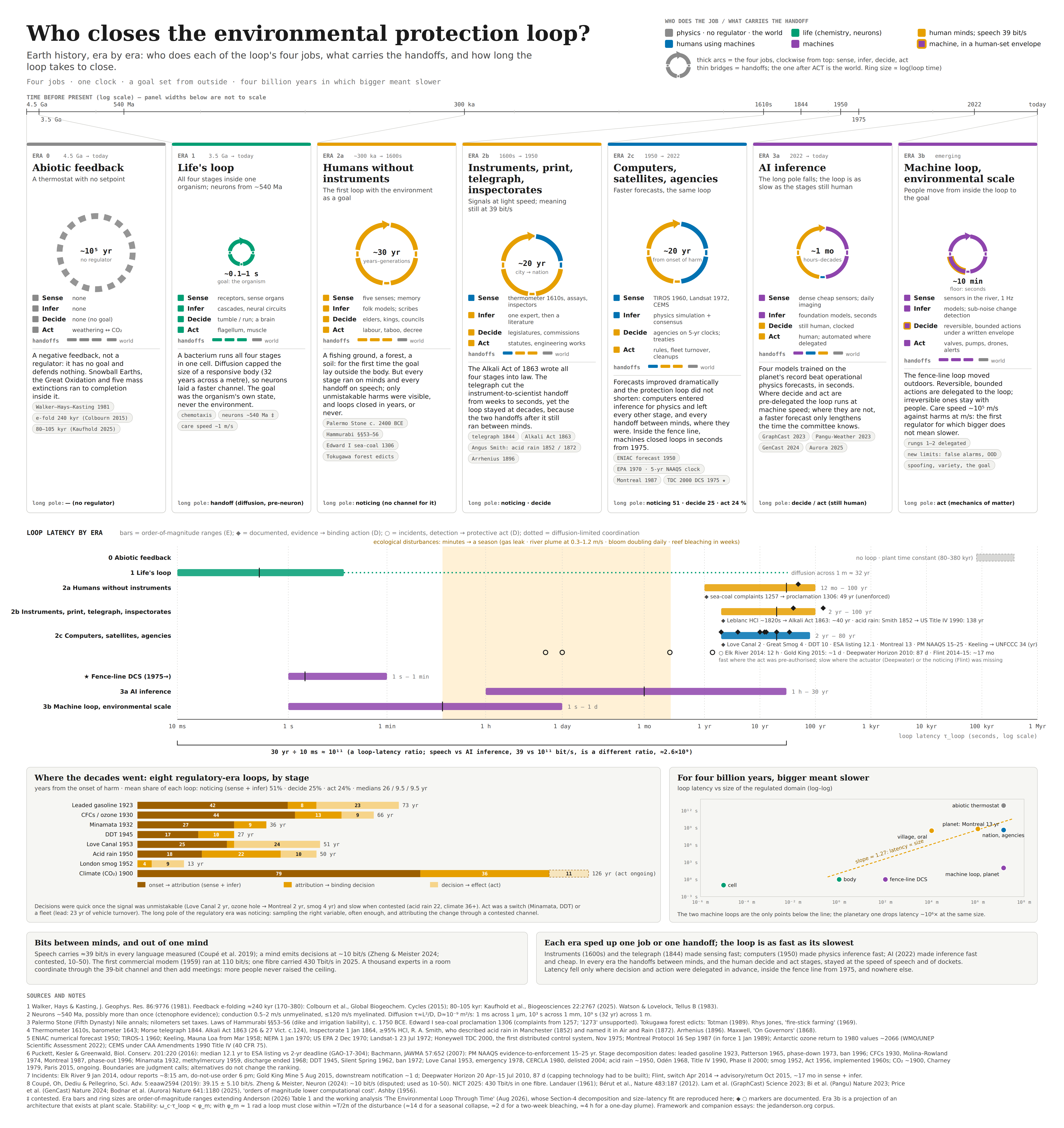
Figure 1. Who closes the environmental protection loop? One ring per era. The four thick arcs are the four jobs every protection loop must do, sense, infer, decide, act, clockwise from the top, coloured by who does them: grey for physics with no regulator, green for life, amber for human minds, blue for people using machines, violet for machines. The thin bridges are the handoffs; the grey one after ACT is the world itself. Ring size grows with the logarithm of the loop time. Below the rings: loop latency by era on a log scale, where the decades went in eight regulatory-era loops, and why, for four billion years, a bigger domain meant a slower loop. Open the full-resolution version.
Three and a half billion years. That is how long something on this planet has been running a protection loop: noticing that the world has changed, working out what it means, choosing what to do about it against a goal, and changing matter. Then noticing again.
The operators have changed many times. Chemistry ran the loop, then cells, then nervous systems, then villages, then inspectorates and parliaments, then agencies with satellites, and now, in a few places, machines. The four jobs never changed. What changed, and the only thing that changed, is the speed at which the loop closes, and with it the size of the thing it can close around.
That sounds like too small a variable to carry a planet's history. It carries it. A loop that closes more slowly than the harm it exists to catch is not a weak regulator of that harm. It is not a regulator of it at all. Read the figure above with that rule in mind and the whole arc of environmental protection, from a thermostat with no one to set it to a valve that shuts in the second a leak opens, becomes a single story about one number.
01 · THE HISTORYSeven eras, one loop
4.5 billion years ago, Earth had a thermostat and no one to set it. Volcanoes put CO₂ into the air; warm, wet rock weathers faster and pulls it back out. The balance returns in about 240,000 years. It has no goal. It defends nothing. Snowball Earths, the Great Oxidation, five mass extinctions all ran to completion inside it. Nothing was watching.
3.5 billion years ago, the first loop. A single cell senses a chemical gradient, infers a direction, decides to swim or tumble, and drives a motor. All four jobs, in one body. But the goal was the cell. The planet had sensors. It had no nervous system.
Half a billion years ago, diffusion hit its limit. A molecule crosses a cell in a millisecond and takes thirty-two years to drift across a metre, so a body much larger than a speck could not behave as one thing on chemistry alone. Life laid down a faster channel, the neuron, and a body could flinch in a tenth of a second. Still, the goal was the organism.
300,000 years ago, humans. For the first time, a goal outside the body: a forest, a fishery, a soil. But every stage ran on minds and every handoff on speech, thirty-nine bits per second in every language ever measured, slower than a 1959 modem. Only harms a person could see, smell or bury were visible. Loops closed in years, or never. Civilizations salted their fields faster than a generation could notice.
1844: the telegraph put environmental signals at light speed. 1863: Britain's Alkali Act wrote all four jobs into law, an inspectorate to sense, an inspector's judgment to infer, a statutory standard as the decision, enforcement as the act. And the loop stayed at decades for the next 150 years, because the handoffs after the telegraph, from scientist to committee and from committee to works, still ran between minds.
1950 to 2022: satellites, supercomputers, agencies. Forecasts got dramatically better. The protection loop did not shorten. Across eight landmark cases, from leaded gasoline to climate, half the time from harm to remedy was spent noticing. Median: twenty-six years.
1975: the exception. Inside a plant's fence line, a distributed control system sensed a process variable, decided by a fixed law and moved a valve, every second, with a human holding only the setpoint. Outside the fence: decades.
2022 to 2025: models trained on the planet's own record began beating operational physics forecasts, in seconds, on one chip. The stage that had held every environmental loop open, understanding, fell.
Now being built: sensors in the river, inference in seconds, actuators on valves and pumps. The fence-line loop, moved outdoors. For the first time in four and a half billion years, a regulator the size of a planet can be faster than a committee.
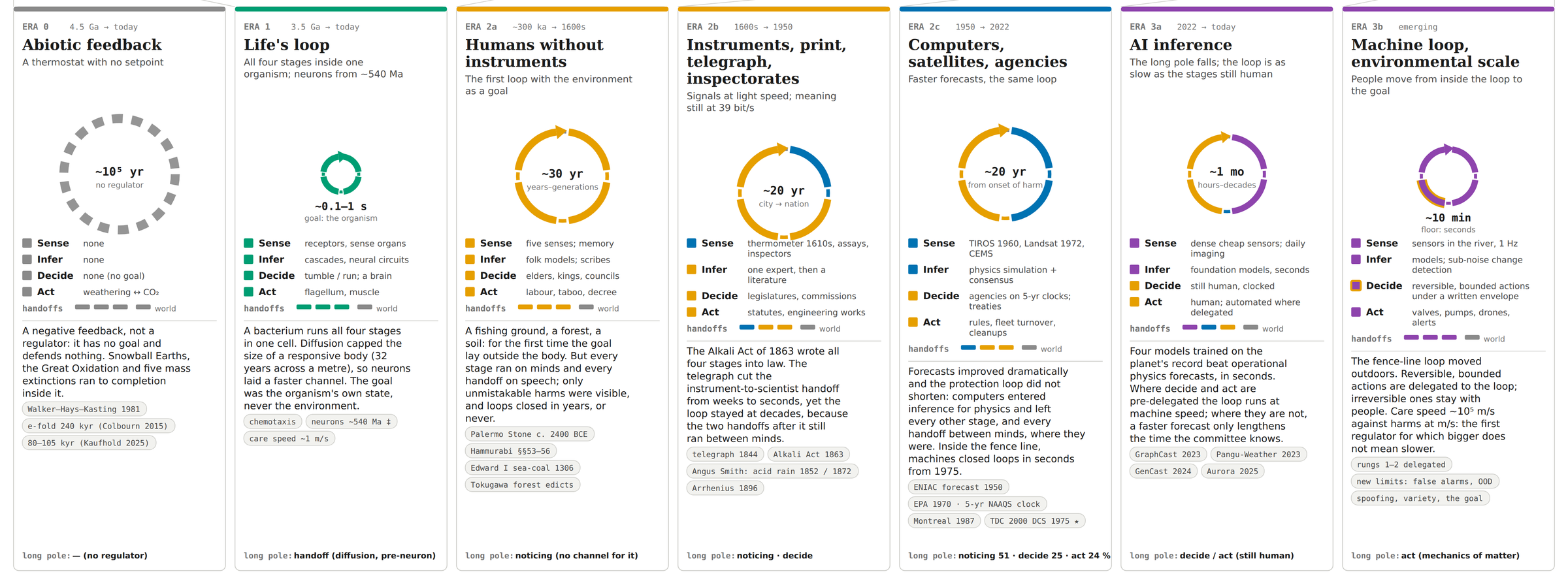
Figure 2. The seven rings from Figure 1. Watch the colours walk from grey to green to amber to blue to violet, and watch the ring sizes: from the first states to the computer era they barely change, because the slowest job in the loop was never the one being sped up.
02 · THE SAME MOVE, SEVEN TIMESEach era sped up one thing; the loop was only ever as fast as what was left
Lay the eras side by side and something appears that no single era shows. Each one sped up exactly one job, or one kind of handoff, and left the others where they were. A loop is only ever as fast as its slowest remaining part.
Neurons
Compressed: the handoffs inside a body, from diffusion to conduction at up to 120 metres a second.
Left alone: the goal, which stayed inside the organism.
Speech
Compressed: nothing in the loop itself. It let one loop run across many bodies, and put a goal outside the body for the first time.
Left alone: every stage on a mind, every handoff at 39 bits per second.
Writing and law
Compressed: loss. A store that outlives its author, and the first setpoints written down: a flood gauge, a dike law, a ban on sea-coal.
Left alone: the handoffs, still at the speed of speech and travel.
Instruments and the telegraph
Compressed: sensing, by making invisible quantities visible, and the instrument-to-scientist handoff, from weeks to seconds.
Left alone: the handoffs between minds, and the decide and act stages.
Computers and satellites
Compressed: physics inference, from impossible to hours; sensing, from a sample to the whole planet.
Left alone: decide and act, on statutory clocks.
AI inference
Compressed: inference, from hours on a national supercomputer to seconds on one chip, at a fraction of the cost.
Left alone: decide and act, wherever they had not already been delegated.
The machine loop
Compresses: everything that was left, by joining sensor, inference and actuator with no mind in the fast path.
Leaves alone: the goal, which stays with people.
Six moves in, the loop outside the fence line was still taking decades. That is not a paradox. It is the arithmetic of a chain. The telegraph of 1844 is the cleanest case: it took the longest handoff in the loop from weeks to seconds, and the loop did not get one day shorter, because a finding that arrived in seconds still had to be argued into a committee at thirty-nine bits per second and then wait for the session. Inside the fence line in 1975, where all four jobs and all the handoffs were made fast at once, the loop closed in seconds. Same physics, same century, two sides of one boundary.
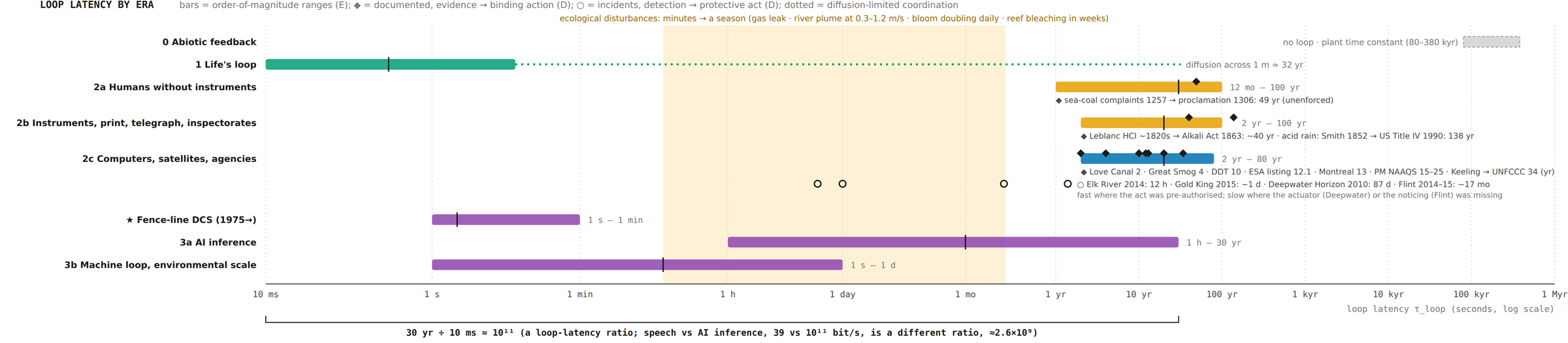
Figure 3. Loop latency by era, ten milliseconds to a million years. The shaded band is the speed of the harms the loop exists to catch: a gas leak in minutes, a plume in hours, a bloom doubling daily, a reef bleaching in weeks, a fishery in a season. Every human-era bar lies entirely to the right of it. Diamonds are documented cases, from evidence to binding action; circles are incidents, which closed in hours where the act was already authorised (Elk River, 2014: twelve hours) and in months where the actuator did not exist (Deepwater Horizon: 87 days) or the noticing failed (Flint: about seventeen months).
03 · WHY SPEED IS THE WHOLE DIFFERENCEA slow regulator is not a weak regulator. It is an absent one
Try to catch a ball that you can only see where it was three seconds ago. At a gentle toss you will manage; you extrapolate. Throw it harder and every grab closes on empty air, and the harder you try to correct, the wider the misses get. Nothing about your reflexes or your resolve fixes this. Only seeing the ball where it is now does.
Control theory makes that exact. A loop with delay loses phase in proportion to the frequency of what it is correcting, and past a threshold its corrections land on the wrong half of the cycle and push instead of pull. Beyond that point more budget, more mandate and more people make the oscillation worse, not better. The only cure is a shorter loop. And it is the harms, not the institutions, that set the clock. A plume crosses a town in an hour. A bloom doubles in a day. A reef bleaches in a fortnight. A fishery fails in a season. Against those clocks a loop that closes in years is not slow. It is absent.
The record shows where the years went. Take eight of the last century's landmark loops, leaded gasoline, CFCs, Minamata, DDT, Love Canal, acid rain, the London smog and climate, and split each from the onset of harm into three intervals: until the harm was detected and attributed, until a binding decision, and until the act took effect. Noticing took half the time, a median of twenty-six years. Deciding and acting split the rest, about nine and a half years each.
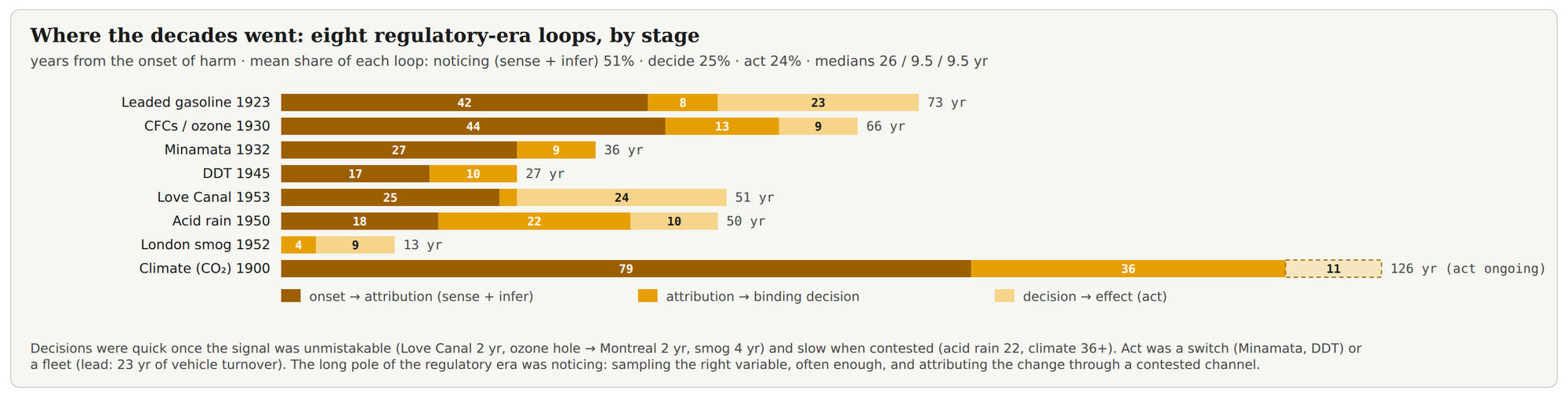
Figure 4. Where the decades went. Decisions were quick once the signal was unmistakable: two years at Love Canal, two years from the ozone-hole paper to Montreal, four years after the London smog. They were slow when contested: twenty-two years for acid rain, thirty-six and counting for climate. Act was a switch (Minamata, DDT) or a fleet (leaded gasoline: twenty-three years of vehicle turnover).
Three things made noticing slow, and they stack. The human body has no receptor for lead, mercury, chlorofluorocarbons or carbon dioxide, so the harm had to route through something a person could see: cats convulsing at Minamata, birds dying, a fog that killed thousands in five days. The world was sampled rarely, by season and by chance and later by a monthly visit, and a monthly sample cannot see a bloom that doubles daily; it can only misread it. And once a scientist had the signal, it still had to pass through a channel interested parties could jam: Clair Patterson published on lead in 1965, and the first federal phase-down rule came in 1973.
That is the quiet correction this history makes to the usual story. The regulatory era was not slow because people would not decide. It was slow because, for most of each loop, nobody was in a position to know, and when they finally knew, the knowing had to travel through minds. The stage everyone assumed instruments had solved in 1844 is the stage that held the loop open until 2022.
04 · BIGGER MEANT SLOWERA four-billion-year rule, and its first exception
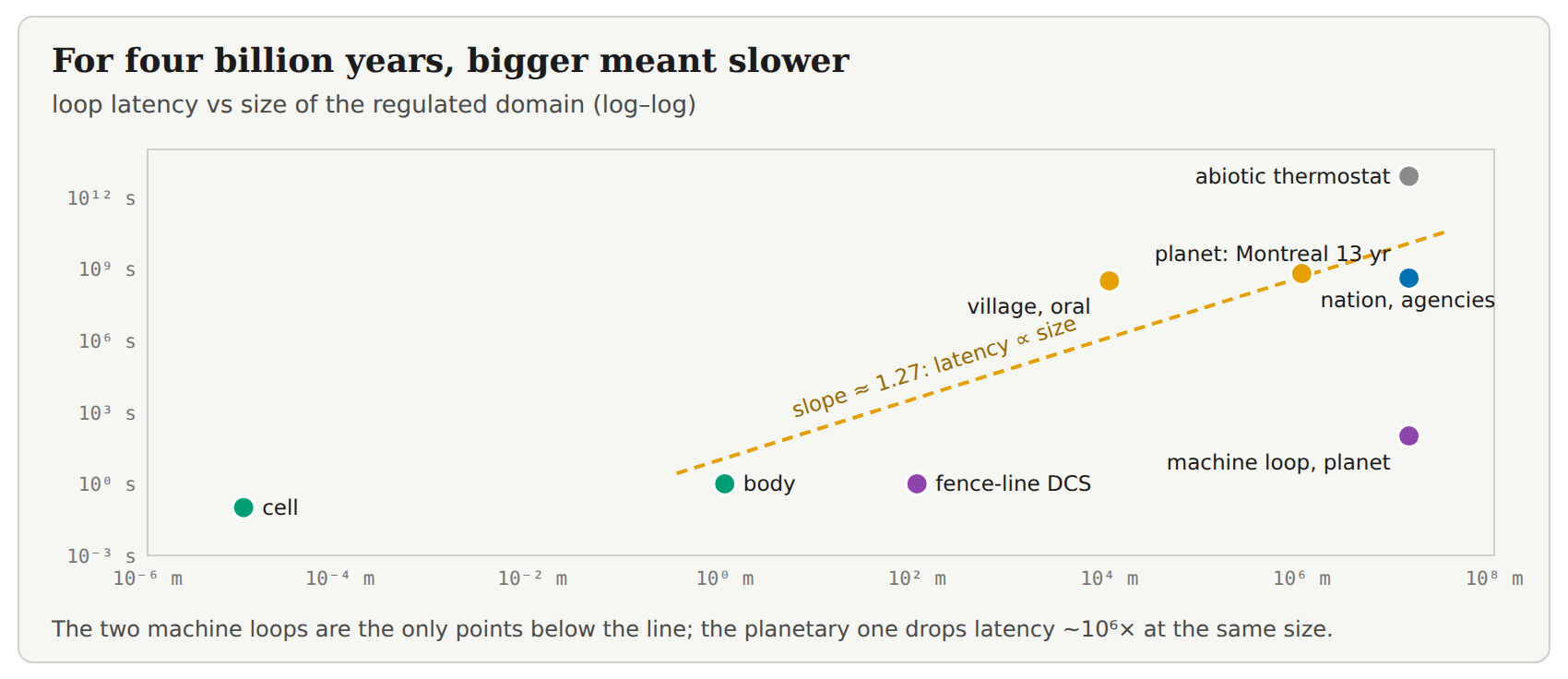
Figure 5. Loop latency against the size of the regulated domain. A cell, a body, a village, a nation, the one planetary loop that ever closed (Montreal, thirteen years) and the abiotic thermostat at the top fall near a single line with a slope of about 1.27. The two machine loops are the only points below it; the planetary one drops latency by about a million times at the same size.
There is a second pattern in Figure 1 that is easy to miss because it is so old it reads as a law of nature. For four billion years, the larger the domain being regulated, the slower its loop. Plot one against the other and the points fall near a line: latency grew roughly in proportion to size.
The reason is that every loop above the organism ran through the same instrument, the human mind, and the same channel between instruments, speech. A bigger domain meant more minds, more handoffs, more travel, more meetings, and each of those added delay in proportion. Divide the size of the domain by the time the loop took and you get a speed of care: about a metre per second for an organism, about thirty micrometres per second for a village, while the harms moved at metres per second the whole time. A civilization could watch a river and still not be able to answer it.
The machine loop is the first regulator off that line, and the reason is physical, not clever. Fibre does not get slower with distance the way walking and deliberation do; a signal crosses a continent in tens of milliseconds. A trained model copies to a thousand endpoints without loss, where twenty-five years of human expertise has to be re-taught through the thirty-nine-bit channel, lossily. A million sensors do not require a million meetings. So the two machine points in Figure 5 sit far below the line, and the speed of care at planetary scale comes out near a hundred thousand metres per second, against harms at metres per second. For the first time, a regulator the size of a planet can be faster than a municipal one, which quietly inverts the assumption behind every environmental law that placed the fast loops at the local level.
05 · WHAT IS BEING BUILT, AND WHY NOWNot destiny. A pattern, six times running
Three things had to be true at once, and they became true in the same decade. Sensors became cheap enough to sit in the river rather than in the pipe, sampling every second instead of every month. Inference on the planet's own record became a matter of seconds on one accelerator rather than hours on a national machine. And channels became able to carry a notification, and an override, anywhere, instantly.
The fourth ingredient is older than all three. The legal instrument for handing a decision to a loop in advance already exists and is in daily use. A permit limit is a decision made before the event. A safety instrumented system shuts a plant down without asking anyone. An emergency order is delegated authority. The fence line has run on pre-delegation for fifty years. What is new is the range of decisions a machine can competently hold, and the density of sensing that lets the same architecture exist outdoors.
So the opportunity is specific, and it is not "AI helps the environment". It is a loop in which reversible, bounded actions, pausing a discharge, diverting an intake, closing a valve, issuing an advisory, are delegated to machines under envelopes that people wrote, while the irreversible decisions stay with people and are taken with the bleeding already stopped. A hospital does not convene a committee to decide whether to stop a bleed; it stops the bleed, then convenes the committee about the surgery. Expect the loop first where the harm is fastest and the actuator is a switch: methane, drinking water, wastewater, the grid, fire. And expect its pace to be set not by the models but by the boundary of pre-delegation, which is the one variable worth tracking.
Call it natural rather than inevitable. None of the six earlier moves was planned. Neurons, speech, writing, telegraphs, computers and learned models each spread because whatever used them answered faster than whatever did not, and the loop that answers faster is the loop that is still there afterwards. The seventh is the same move, under the same selection, at the scale of the planet. Not destiny. A pattern, six times running.
06 · WHAT STAYS WITH USThe loop cannot choose its own goal
One thing the loop cannot do, and never could, is choose its own goal. The thermostat of the abiotic Earth defended nothing because nothing had set it. The cell's loop defended the cell. The village's loop defended the village's welfare. Every regulator in history had its goal set by the thing it protected. The machine loop is the first in which the thing setting the goal and the thing running the loop are different kinds of system. That is not a flaw to be engineered away. It is the design, and it moves the human job.
The job becomes writing what "protected" means precisely enough to encode: the thresholds, the envelopes, the playbooks, the conditions under which the loop acts and the conditions under which it must stop and ask. It becomes keeping the irreversible decisions, and keeping them slow on purpose, because deliberation about what to protect is a feature and not a latency. It becomes building the loop so that a fast loop cannot become a fast wrong loop: redundant ways of sensing, so a spoofed instrument cannot trigger an act; physics models kept as a check on learned ones for the unprecedented; false-alarm budgets set for a million sensors rather than one; an override that is instant and an authority that is assigned. And it means paying the energy that inference at continental scale costs. These are new limits. They are different from the old ones, not absent.
People do not leave the system. They leave the fast loop and take the one position no loop can fill for itself.
For four billion years, nothing was fast enough to answer. We are how the loop closes.
What we point it at is the only question that was ever open.
Look once more at the rings in Figure 1. Read left to right, they are a planet acquiring, one era at a time, the parts of a nervous system: receptors, then conduction, then a store, then instruments, then computation, then inference, and now, at the far right, the first ring in which every job and every handoff is fast and the goal is held outside the ring by the people who set it. The eighth ring is not drawn. What it looks like depends on what we choose to delegate, and on what we choose to protect.
NOTES AND SOURCESWhat is measured, what is estimated, and where to check
Figures 2 to 5 are details of Figure 1. Era bars and ring sizes are order-of-magnitude ranges; the diamond and circle markers, the eight-case decomposition and the size–latency fit are computed from documented dates. The computations, the delay and detection experiments behind the stability claims, and the full source list are in the companion working analysis, The Loop Through Time.
- Silicate-weathering thermostat: Walker, Hays & Kasting, J. Geophys. Res. 86:9776 (1981); feedback timescale ≈240 kyr (170–380): Colbourn et al., Global Biogeochem. Cycles (2015); 80–105 kyr: Kaufhold et al., Biogeosciences 22:2767 (2025).
- Diffusion τ ≈ L²/D with D ≈ 10⁻⁹ m²/s: a millisecond across a micron, 32 years across a metre. Neurons from ~540 Ma, possibly more than once; conduction 0.5–120 m/s.
- Speech information rate 39.15 ± 5.10 bit/s across 17 languages: Coupé, Oh, Dediu & Pellegrino, Science Advances (2019). Behavioural throughput ~10 bit/s (disputed, 10–50): Zheng & Meister, Neuron (2024).
- Alkali Act 1863 (26 & 27 Vict. c.124), Inspectorate from 1 January 1864, Robert Angus Smith; Morse telegraph 1844; Honeywell TDC 2000, the first distributed control system, November 1975.
- Stage decomposition dates: leaded gasoline 1923, Patterson 1965, phase-down 1973, ban 1996; CFCs 1930, Molina–Rowland 1974, Montreal 1987, phase-out 1996; Minamata 1932, methylmercury 1959, discharge ended 1968; DDT 1945, Silent Spring 1962, ban 1972; Love Canal 1953, emergency 1978, CERCLA 1980, delisted 2004; acid rain ~1950, Odén 1968, Title IV 1990, Phase II 2000; London smog 1952, Clean Air Act 1956, implemented through the 1960s; CO₂ ~1900, Charney 1979, Paris 2015, ongoing. Mean share of each loop: noticing 51%, decide 25%, act 24%; medians 26 / 9.5 / 9.5 years.
- Incidents: Elk River, 9 January 2014, odour reports from about 8:15 am, do-not-use order at 6 pm; Gold King Mine, 5 August 2015, downstream notification about a day; Deepwater Horizon, 20 April to 15 July 2010, 87 days; Flint, switch April 2014 to advisory and return October 2015.
- Documented regulatory latencies: ESA listings, median 12.1 years against a two-year statutory deadline (Puckett, Kesler & Greenwald, Biol. Conserv. 2016); particulate standards, 15–25 years from evidence to enforcement (Bachmann, JAWMA 2007); Montreal, 13 years from hypothesis to treaty; Antarctic ozone return to 1980 values around 2066 (WMO/UNEP 2022).
- AI inference: GraphCast (Science 2023), Pangu-Weather (Nature 2023), GenCast (Nature 2024), Aurora (Nature 2025, "orders of magnitude lower computational cost"). Size–latency fit on body, village, nation and Montreal: slope 1.27. Care speeds: organism ~1 m/s; village ~3×10⁻⁵ m/s; planetary machine loop ~10⁵ m/s for a 100-second loop.
- Stability: a loop with latency τ cannot stabilise disturbances faster than roughly 1/τ; with a phase margin of about one radian it must close within ≈T/2π of the disturbance period (Nyquist; Bode; Åström & Murray, Feedback Systems). The hundred-billion-fold figure is a latency ratio, 30 years ÷ 10 ms; the bit-rate ratio, 39 vs 10¹¹ bit/s, is a different number, about 2.6×10⁹.